
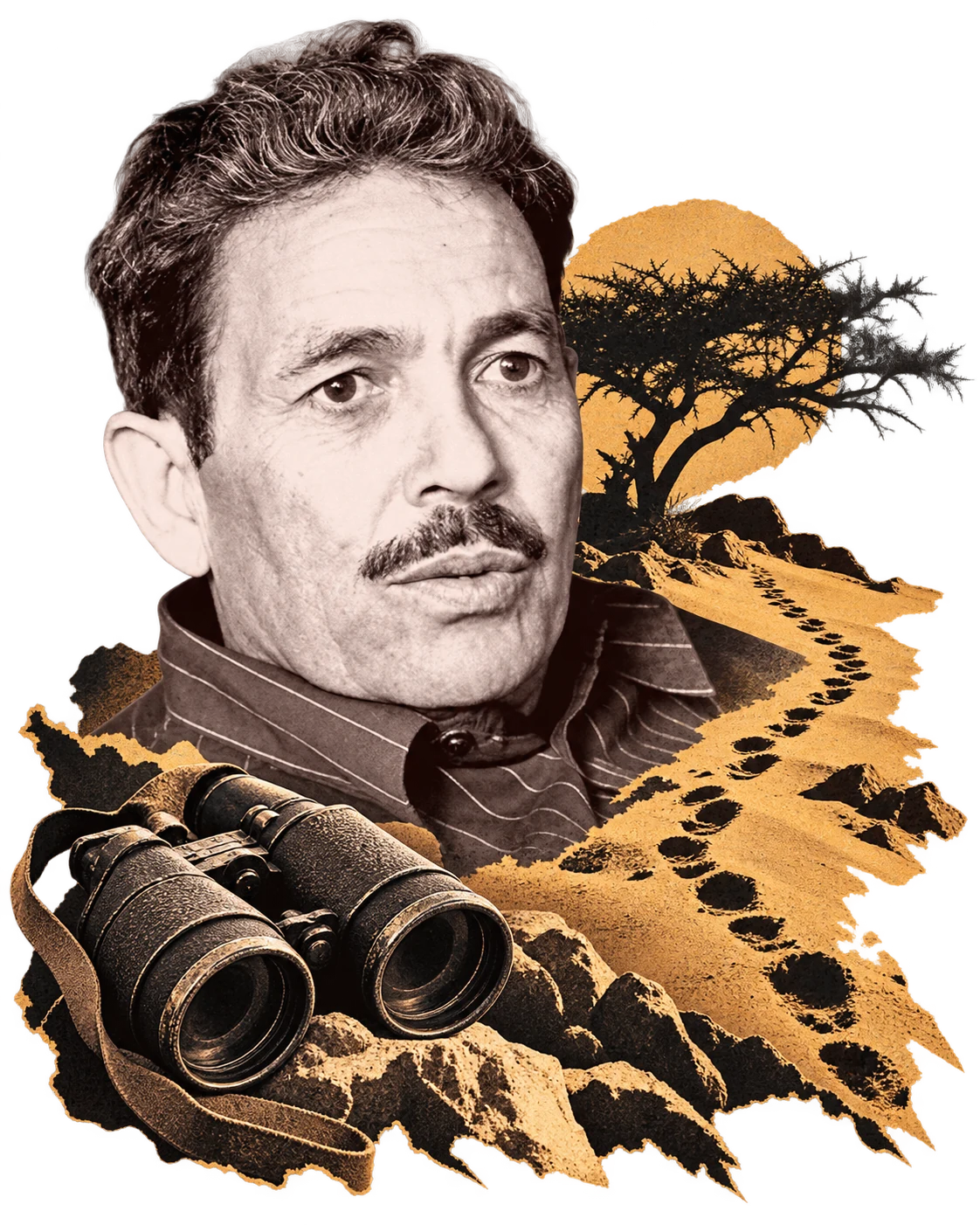
The incredible story of a Bedouin soldier who was recruited as a cook, rose through the ranks, and commanded one of the IDF's most important reconnaissance units. He was the father of the "Doctrine of Avoidance," and received the Medal of Distinguished Service and three citations for bravery.
Abd al-Majid Khader al-Mazarib - Amos Yarkoni
From Na'ura to the IDF
Abd al-Majid Khader al-Mazarib, of the al-Mazarib tribe, was born in June 1920 in the village of Na'ura, near Afula, when the country was under British Mandate rule. At the age of 19, during the Arab Revolt in 1939, he joined Arab gangs that sabotaged the Iraq-Haifa oil pipeline, but they accused him of helping Jews and of treason. He later recounted this period: "They chained me together with two of my friends in a pit. I was supposed to appear before an old judge, who usually sentenced defendants to death. I climbed onto my friends' shoulders, got out of the pit, and helped them out. We went to our tribe's encampment, at the foot of Mount Moreh. On the way, we were dying of thirst. We traveled through a wadi. I said, 'There is water in this wadi.' We walked along it and found water, because I smelled it in the cold air."
After he escaped, the members of his tribe feared revenge from the gangs and moved with their herds to the area near the newly established moshav of Shimron, near Nahalal. In Shimron, Abd al-Majid met Moshe Dayan, a young Haganah commander who set aside an adjacent area for them, provided them with water and food, and even protected them. This help made a profound impression on Abd al-Majid Khader, who felt indebted to the Jewish community. Two weeks later, the tribe reconciled with the gangs and returned to its original encampment near Afula.
In November 1947, when the War of Independence began, 27-year-old Abd al-Majid Khader was at the Haifa oil refinery. The day after the Partition Plan was announced, Irgun fighters threw an explosive device at a group of Arabs at the refinery entrance. Six Arabs were killed in the explosion, and in response an enraged Arab mob stormed the refinery compound and killed 39 Jewish workers with sticks and iron bars. When Abd al-Majid heard what had happened, he ran to the electricians' hut, warned them, and saved six electricians from certain lynching. As he recalled that day, it was a defining moment: "After seeing Arabs slaughter Jews, a red light went on in my head. I decided to help the Jews." That same month, he enlisted in the IDF's newly established Minorities Unit, Unit 300. At the time, he was the only Bedouin in the IDF.
At the very start of his military service, he changed his name to Amos Yarkoni. Amos because it began with the Hebrew letter ayin, like his former name, and Yarkoni was derived from a translation of his family name, Khader. From then on, he was known as Amos Yarkoni.
Amos's contribution was most notable between the Sinai Campaign in 1956 and the Six-Day War in 1967. During this period, Egyptian intelligence worked to gather information about IDF bases near the border. To obtain it, Egyptian military intelligence trained commando units under the command of Colonel Mustafa Hafez. The commando soldiers, considered the elite of the Egyptian army, were tasked with crossing the border in small groups at night, scouting the bases in the Ashkelon area, gathering information, and hiding by day until nightfall, when they would return to Egyptian territory under cover of darkness. During this period, traveling at night south of the Ashkelon-Kiryat Gat road was frightening and dangerous.
Amos Yarkoni was put in charge of the scouts in Unit 300, and his tracking skills and knowledge of the desert came into play as he found lost travelers and drove out Bedouins who had crossed into the Negev from Sinai. Later, he commanded the camel-riding unit that protected the Negev. In 1953, he was accepted to officer training and recalled: "The course was hard for me only because of the Hebrew language and the theoretical subjects, which I wasn't familiar with. But when they took me into the field, I was a wolf." After completing officer training, he returned to the Minorities Unit and was given command of a platoon.
In 1955, his platoon was stationed opposite Khan Yunis and assigned to locate a group of Egyptian intelligence operatives in the Hamama swamps near Ashkelon. The mission was successful and led to the establishment of Unit 424, the Shaked Reconnaissance Unit. Its first commander was Zvika Ofer, and Amos Yarkoni was his deputy. In April 1961, Yarkoni was appointed commander of the unit. He was admired for his professionalism, which allowed him to dispense with the formality and distance usually associated with rank.
Shaked, the Injury and the Pursuits
During a pursuit in December 1959, he lost his hand. In the morning, tracks were discovered leading to the Hamama swamps (Nitzanim). A small team under Amos's command began the pursuit: "I went step by step in their direction. I left lookouts in case they tried to get out and escape. They were hiding in the Hamama swamp, and there, in the water, there were no tracks. I moved forward through the reeds. I walked, and the guys followed me. Suddenly I fell. My right hand was left hanging. I felt no pain. I fired the entire magazine into the reeds. I told Saleh to run, while I lay there and said to myself: This is the end!" Amos recounted later. Yarkoni's close aide, Nissim Alfandari, was also wounded in the chest. It was unclear whether Amos would return to Shaked after his injury. "If Moshe Dayan can make it with one eye, Yarkoni will make it with one hand," Amos declared, and he returned. A month later, he was already commanding a pursuit near Hatzerim, and with a prosthetic hand he killed three infiltrators.
Amos's tracking abilities became legendary during his lifetime. Major General Rehavam Ze'evi recounted: "During one of the pursuits on the Egyptian border, Amos told me he knew the infiltrators were aware we were after them. That seemed like too much to me. I couldn't believe you could tell from the tracks that they knew anything about us. Amos explained: 'Notice that after roughly every ten steps, the tracks veer slightly. That's because every so often the infiltrators look back at us.'"
Amos was also a legend among Bedouin trackers: "If a man were to cross the desert, pick up a small stone, spit beneath it, and put it back in place, al-Majid would notice the change even 100 years later. He would bend down, discover the spit, and start following the spitter's tracks. He would reach the man's grave, since the man would have died by then, knock on the headstone, and ask, 'Why did you spit on the stone, you scoundrel?'"
On the Jewish holiday of Shavuot in 1964, tracks were found near Kibbutz Erez. From examining them, Amos Yarkoni concluded that they belonged to an Egyptian intelligence team consisting of a scout, a courier, and a guard. He believed that, while crossing the border, the scout had carried the courier on his back to confuse Amos and his soldiers. The scout and the guard returned to the Gaza Strip, while the courier continued deeper into the Negev to meet Israeli Arabs and pay them for the intelligence they had gathered for the Egyptians. The "Red Diamond" procedure was immediately activated, meaning that suspects were to be searched for at all Egged bus stations, on the assumption that the courier would try to board a bus or hitch a ride. Indeed, the courier was caught at the bus station at Kibbutz Bror Hayil. Money and photographs of the Arabs he was supposed to meet were found on him. During questioning, he said that in two weeks a team was due to pick him up near Kibbutz Erez. Amos and several of the fighters prepared an ambush. At 9:00 p.m. on the appointed day, two figures appeared on the road, and a firefight began. Amos described what happened: "As soon as the shooting started, I jumped up and told the men to run forward. I was afraid the Egyptian would escape, and indeed, they moved backward. One of them was wounded and fell. I shouted to the men to charge, and then I was hit in the leg. The wounded Egyptian fired. I told the guys, 'Leave him, run after the other one.'" The team was eventually eliminated.
Amos spent three months in the hospital, but his leg never regained its strength. With a prosthetic hand and a dragging leg, he went to the Southern Command chief at the time, Zvi Zamir, and said: "I don't have enough strength. I'm not old, but the soldiers are wolves. Give them a young commander they can run after."
Zamir did not accept his request to retire, and Amos continued commanding the unit for another three years after being wounded, achieving many successes. After the Six-Day War, Amos Yarkoni, an Arab Muslim, was replaced by a Jewish officer named Fouad (Binyamin Ben-Eliezer), and Amos was appointed governor of the Sinai Peninsula, where he worked mainly with the Bedouin tribes, whose language and religion were familiar to him from home.
Recognition, Disappointment and Farewell
In 1953, with the establishment of Unit 101 by Arik Sharon, the idea of decisive action took root: take the initiative, enter enemy territory, and decide the battle - a clear and aggressive victory.
In the Shaked Reconnaissance Unit, Amos Yarkoni developed the idea of avoidance. The unit's operations focused on stopping the process of escalation toward war at its very outset and defusing its violent potential, thereby preventing wars. Amos drew this idea from Bedouin culture, where it had existed for generations. While Amos and a small group of soldiers kept the peace on the southern border, the IDF developed its air combat capabilities, which enabled a swift victory in the first days of the Six-Day War. This methodology is also used today by the international community.
This is what the Southern Command chief at the time, Yeshayahu Gavish, wrote: "My dear Amos, I know how much your methods of operation, combat techniques, and your unit's level of performance served as an example for the entire IDF. You personally gave the best of your health for the State of Israel. Only a few know of your exploits, but the IDF and the State of Israel will not forget what you did. Many are alive thanks to you."
Despite his contribution to the IDF, Amos Yarkoni was not satisfied with the treatment he received from the country he loved so much. When his son Yossi applied to serve in an elite unit but was turned down, Amos claimed that the rejection was because he was Bedouin. He made the same claim when his daughter applied for a job with a health fund in Jerusalem but was assigned to a clinic in the eastern part of the city.
Yarkoni died on February 7, 1991, after battling a serious illness. Six brigadier generals carried his coffin, which was draped in the Israeli flag. He was laid to rest in the non-Jewish section of the military cemetery at Kiryat Shaul. Rehavam Ze'evi eulogized him, saying: "You were the father of the IDF's trackers and tracking. So many owe you their security and their lives without even knowing it. You were a proud Arab and a loyal Israeli, decorated with citations for bravery for covert operations, who believed that Jews and Arabs could live together. To all of us, you were the greatest of the great."
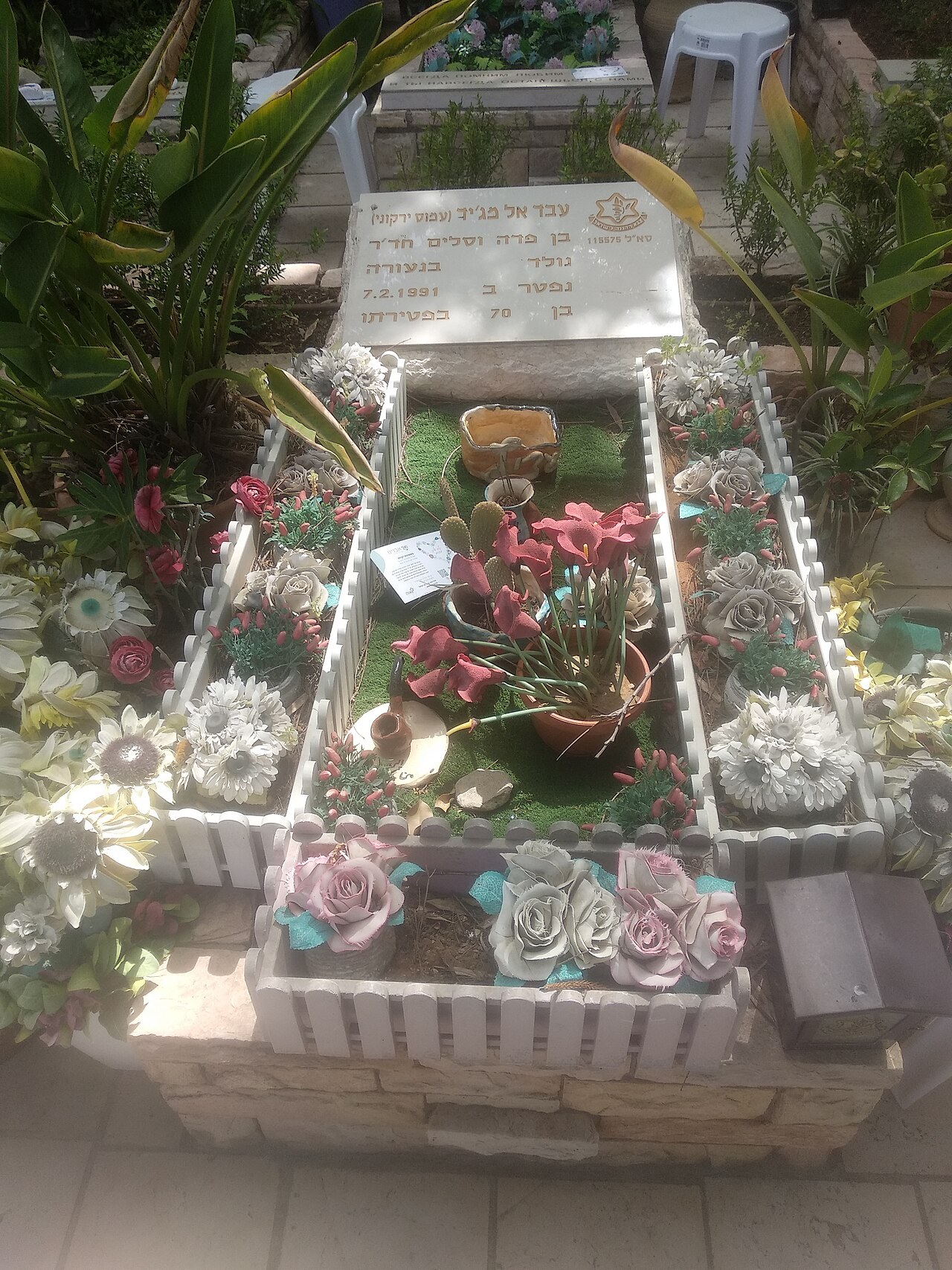
The Mishmar HaNegev base, used by the "Knights of the South" Transport Battalion, and the Givati Brigade's Reconnaissance Battalion were named after him. The Beersheba Municipality named a street after him in Neighborhood V of the city.
תגובות
עדיין אין תגובות.