
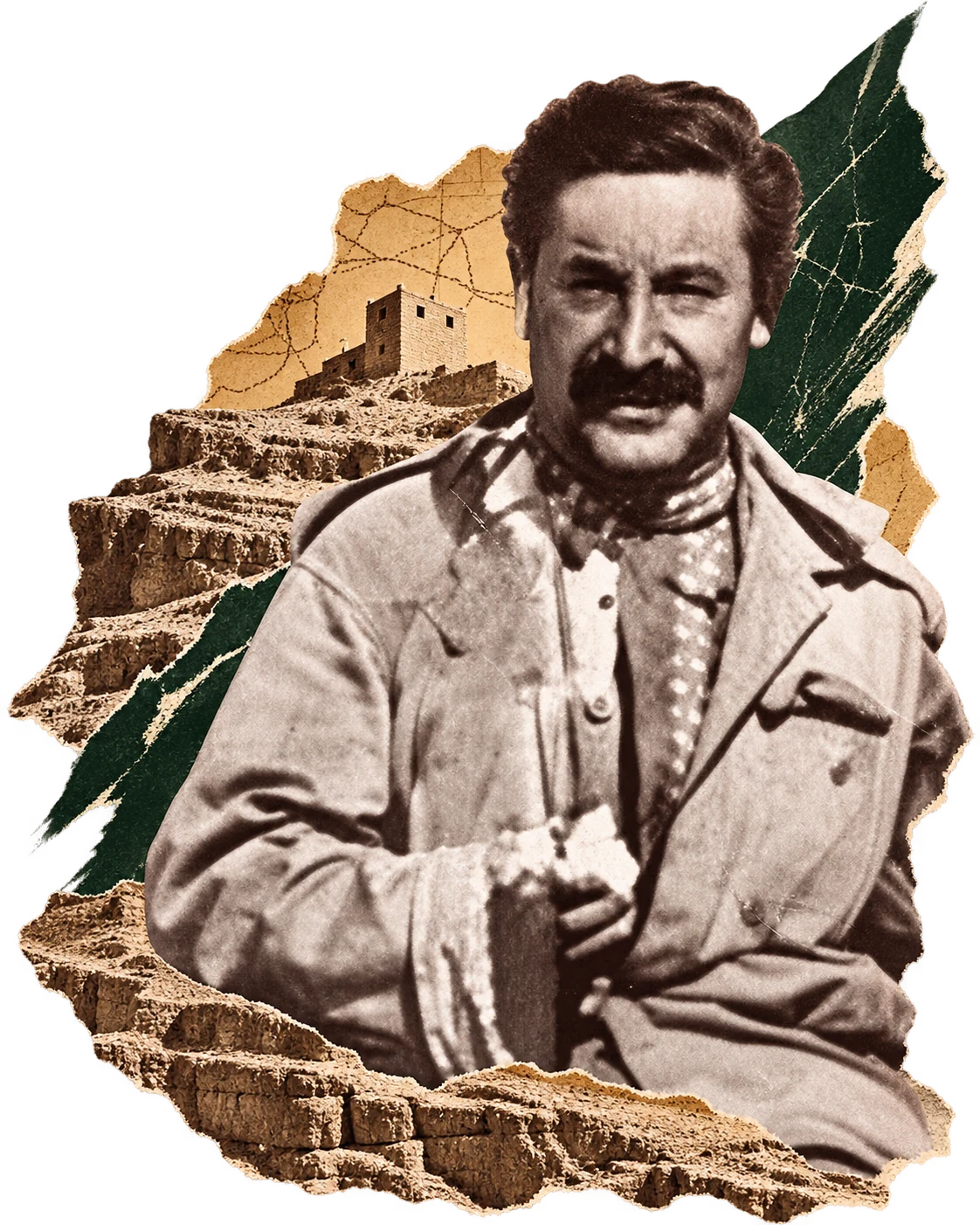
Dov didn’t like the month of December. Both times he was wounded, it was in December. His life story could have been made into a gripping thriller, packed with heroic exploits.
The Last Battle at Auja al-Hafir
When the IDF was established, many Lehi fighters joined the army, most of them enlisting in Battalions 82 and 89 of the 8th Brigade, the IDF’s first armored brigade. It was under the command of Yitzhak Sadeh ("the Old Man" - hence its nickname, "the Old Man’s Brigade"). At the end of December, the brigade was ordered to capture Auja al-Hafir (today Nitzana). This was the last of the major battles of the War of Independence. Since surprise was essential, the forces were moved at night, with their lights off, across the Halutza sands. Because the journey took longer than expected, the element of surprise was lost. It was not until midday on December 26, the first day of Hanukkah, that the forces reached Auja al-Hafir, and Battalion 82 stormed the fortress. Since most of the vehicles had become stuck in the sand, it was decided to send in an armored infantry company. The mission was assigned to Battalion 89, which included Dov’s company, which was supposed to strike the enemy from behind.
"I was in Battalion 82," Nehemia Ben-Tor recalled. "We were ordered to enter Auja al-Hafir with six armored vehicles, and we faced a very heavy response from anti-tank weapons. We didn’t have enough strength. We were ordered to stop and pulled out. At that point Dov’s company went in. We were standing by the side of the road when an armored vehicle suddenly stopped beside me, and I saw him standing in the turret. Exposed, proud, one meter away from me. I said, 'Hello,' and asked him to be careful. They started moving, and that was the last time I saw him. He was shot in the neck fifteen minutes later." Dov was 25 when he died and was buried in Halutza. About six months later, on July 20, 1949, he was laid to rest in Nahalat Yitzhak Cemetery.
"The Blond Dov" was one of the most senior fighters and field commanders in the Lehi underground. He was one of Lehi’s boldest and bravest commanders, and became a legend and a symbol of heroism in his own lifetime. He was Lehi’s operations officer and the underground’s field leader during the period when the underground groups united to form the Hebrew Resistance Movement (1945-1946). Dov was its most prominent operations commander.
From Lodz to Lehi
Yaakov Granek was born in Lodz, Poland, in 1923, to a well-to-do family that had made most of its fortune in the textile industry. At the age of 15, he joined Betar. "There were six Jews in the school and about fifty non-Jews," his brother Gershon recalled. "Every time, he’d come home with a mark or a bruise. We’d ask, 'What happened?' He’d answer, 'I wasn’t going to keep quiet.' Our father always said, 'If you’re strong, fight back. If you’re weak, get out of the way.' That was how we were brought up, and it was also his nature."
During World War II, when Germany invaded Poland, the teenage Dov was determined to fight the invaders and told his parents he was going to defend the capital, Warsaw. Dov joined the Polish commandos, fought the Nazis, and wreaked havoc among them as a machine gunner. The Poles, impressed by the boy and his daring, considered awarding him a commendation, but had no time to do so: Poland surrendered, and Dov was taken prisoner. He was put on a prisoner transport, but managed to escape. He made his way alone to Lithuania, and several years later traveled to Moscow and from there, via Turkey and Syria, arrived in Palestine in 1940 as part of the Youth Aliyah, settling in Rosh Pina. His brother Gershon recalled: "He sent a telegram to the ghetto through the Red Cross, saying he’d settled in Rosh Pina. I didn’t know what that was; I thought it was a city. After the war, I wrote to the mayor of Rosh Pina and said I was looking for my brother. A few months later, I got a letter from Dov. I guess they did manage to find him after all."
Around that time, the Irgun split. David Raziel called for a halt to operations against the British so as not to hinder their war against the Nazis. Abraham Stern, by contrast, argued that the fight against the British must continue with all force until they were driven out. He therefore broke away and founded Lehi. Dov decided to join those who advocated fighting with all force. In Lehi he was given the name "Dov," and his comrades called him "the Blond." Some time later, he went to serve as an auxiliary policeman at Kibbutz Kfar HaHoresh, where he met Leah, a high school student who had come to help with the harvest. "A blond fellow sat down beside me and said, 'You’re going to be my wife,'" Leah recalled years later. "He didn’t say hello or tell me his name. I didn’t know him." Leah was Dov’s kindred spirit, a tough, daring Lehi fighter. Dov developed a score to settle with the British after his beloved Leah was caught by them while putting up posters, as Dov watched, unable to help her.
Combat Operations Against the British
One of the operations Dov commanded that hit the British hardest was an attack on three British military airfields in the country: Lydda, Kastina (Hatzor), and Sirkin. On the night of February 28, 1946, Dov and 30 fighters arrived at Sirkin in a covered truck. As Dov broke through the barrier, the sappers cut the fence, approached the planes, and attached explosives to them. Minutes after they had withdrawn, explosions rang out. Five Anson aircraft and three Spitfires went up in flames. The base’s approximately 300 soldiers opened fire, but fortunately all the fighters returned to their base safe and sound. In addition to suffering damage of about 39 million pounds sterling, the British suffered a huge blow to their prestige. General Bernard Paget, commander in chief of the British Army in the East, ordered all the bombers in the country to be transferred to Egypt. After that, the interception of immigrant ships bound for the country came to a halt.
The car carrying the British High Commissioner, Lord MacMichael, was on its way to a farewell party being held for him in Jaffa. The Lord was pro-Arab; during his rule, Lehi commander Abraham Stern was executed. On 08.08.1944, Yehoshua Cohen (later Ben-Gurion’s bodyguard at Sde Boker) and ten other fighters, including Dov, tried to assassinate him. They set an ambush on the road out of Jerusalem, and when the convoy arrived, they threw a Molotov cocktail at it. When a wall of fire formed, they opened fire on the convoy with machine guns. The High Commissioner’s driver managed to get the car away, and the High Commissioner survived.
In December 1946, Dov tried to rob the Polish Bank in Tel Aviv to help fund the organization’s activities. He was wounded during the operation and, after surgery, was smuggled out of the hospital. The next robbery took place in September 1947 and is considered the boldest robbery before the establishment of the state. Dov and three teams attacked a British armored car operating on behalf of Barclays Bank at 103 Allenby Street in Tel Aviv. The next day, the newspaper Haaretz reported: "One of the attackers began taking the money bags out of the car. The first bag was stained with the policemen’s blood. A tall, handsome young man, whom passersby said they could have sworn was English, climbed into the car and expertly removed a Bren machine gun from the turret. Four young men were then seen carrying the two bags in pairs. The man who had taken the machine gun, apparently the operation’s commander, followed them with the captured weapon." In April 1948, Dov returned to the same bank and stole 200,000 Palestine pounds - Lehi’s biggest robbery.
The operation at the British Criminal Investigation Department offices made Dov a terror to the British. The offices were located in the Russian Compound in Jerusalem. Uri Milstein wrote about Dov’s break-in at the fortified building: "Dov advanced quickly, firing bursts from his Tommy gun with his right hand and throwing grenades at the windows with his left. As he went up the stairs, he saw a British officer armed with a huge pistol. They stood facing each other, the freedom fighter and the representative of the dying empire. Dov was faster. A burst from the Tommy gun felled the Briton on the CID stairs." Nehemia Ben-Tor recounted the same operation: "At the main entrance gate, Dov put in more explosives than were needed... The blast burned his trousers, and his legs were quite badly burned. There was no choice; he took off what was left and fought in his underwear. The problem was that his trousers had an identity card in them, probably a forged one, but at least the British now had a picture." The Blond’s picture appeared on wanted lists at every police station.
The British had only one chance to capture Lehi leader Israel Eldad (father of MK Professor Aryeh Eldad): when he broke his back while escaping. He fell from the fourth floor, was injured, and could not get away. On 07.07.1946, under heavy guard, Israel was taken for treatment to the orthopedic surgeon Dr. Yosef Troy, on HaNevi’im Street in Jerusalem. Disguised as medical orderlies, Dov and a group of fighters overpowered the guards and escaped with Israel Eldad.
From the Underground to the IDF and Remembrance
At 4:00 p.m. on 14.05.1948, the People’s Council convened at the Dizengoff Museum in Tel Aviv. David Ben-Gurion read the Declaration of Independence of the State of Israel. At the same time, the British flag was lowered at Haifa port, and the High Commissioner left the country. Lehi had achieved its goal. Lehi fighters met at Sheikh Munis (today the Palmach Museum) and declared: "We were an underground movement that fought with weapons solely against the foreign enemy, the foreign government... We recognize and accept the authority of Hebrew independence. We did not recognize or accept the authority of various organizations that sheltered under British rule. We recognize and accept the authority of a genuine Hebrew government. We did not recognize the Agency; we will recognize the government. We did not recognize the Haganah; we will recognize the army. But a Hebrew government, any Hebrew government, good or bad, left-wing or right-wing, any Hebrew government that rules democratically, has the right to establish its authority, and it will also achieve it." After Lehi disbanded, Dov and his comrades joined the 8th Brigade, founded by Yitzhak Sadeh and Moshe Dayan. The idea was to develop combined-arms warfare in the IDF, integrating armor, infantry, and artillery. Dov commanded the company in the commando battalion that took part in Operation Dani to capture Lydda, Ramla, and the surrounding area. In July 1948, during the Ten Days of fighting, he led his men in an assault on the Iraq Suwaydan police fort (Negba), and in October of that year he led his soldiers in Operation Yoav to liberate the Negev.
The Altalena affair put Dov’s loyalty to the IDF to the test. Altalena was a ship purchased by the Irgun, which arrived in the country in June 1948 carrying immigrants and weapons. The ship arrived about five weeks after the state was established and three weeks after Irgun members had agreed to disarm and join the IDF. When it arrived, Menachem Begin, then the Irgun leader, demanded that some of the weapons be handed over to the Irgun. Government representatives insisted that the weapons first be transferred to the IDF, after which they would decide what to do with them. Begin firmly opposed this, and tensions were immense. When Dov was asked to defect from the IDF with his soldiers, he refused, saying that he had sworn allegiance to the IDF and the state, and that, as far as he was concerned, the era of the underground movements was over.
Dov loved writing poems. He always carried a black notebook and filled it in during his spare time. When he asked to publish his work in Lehi’s in-house bulletin, someone told him he’d be better off sticking to what he was good at.
After the fall of the Blond Dov, one of the senior IDF commanders said, "He was twenty years ahead of the thinking and development in the IDF. Today, the response is to charge at the sources of fire. Dov did it instinctively; he was the first, and perhaps the only one, to act that way." The poet Uri Zvi Greenberg wrote of him: "A lament for the Sicarius, Captain Dov in the Israeli Army. He was a tree trunk of fire that all the waters of his enemies could not extinguish."
Streets named after the late Yaakov Granek can be found in the Ramat Chen neighborhood of Ramat Gan (Captain Dov Street) and in Beersheba (Captain Dov Street), near 8th Brigade Street, in whose ranks he fought.
A memorial plaque in his memory stands near his home in Ramat Gan.
תגובות
עדיין אין תגובות.