
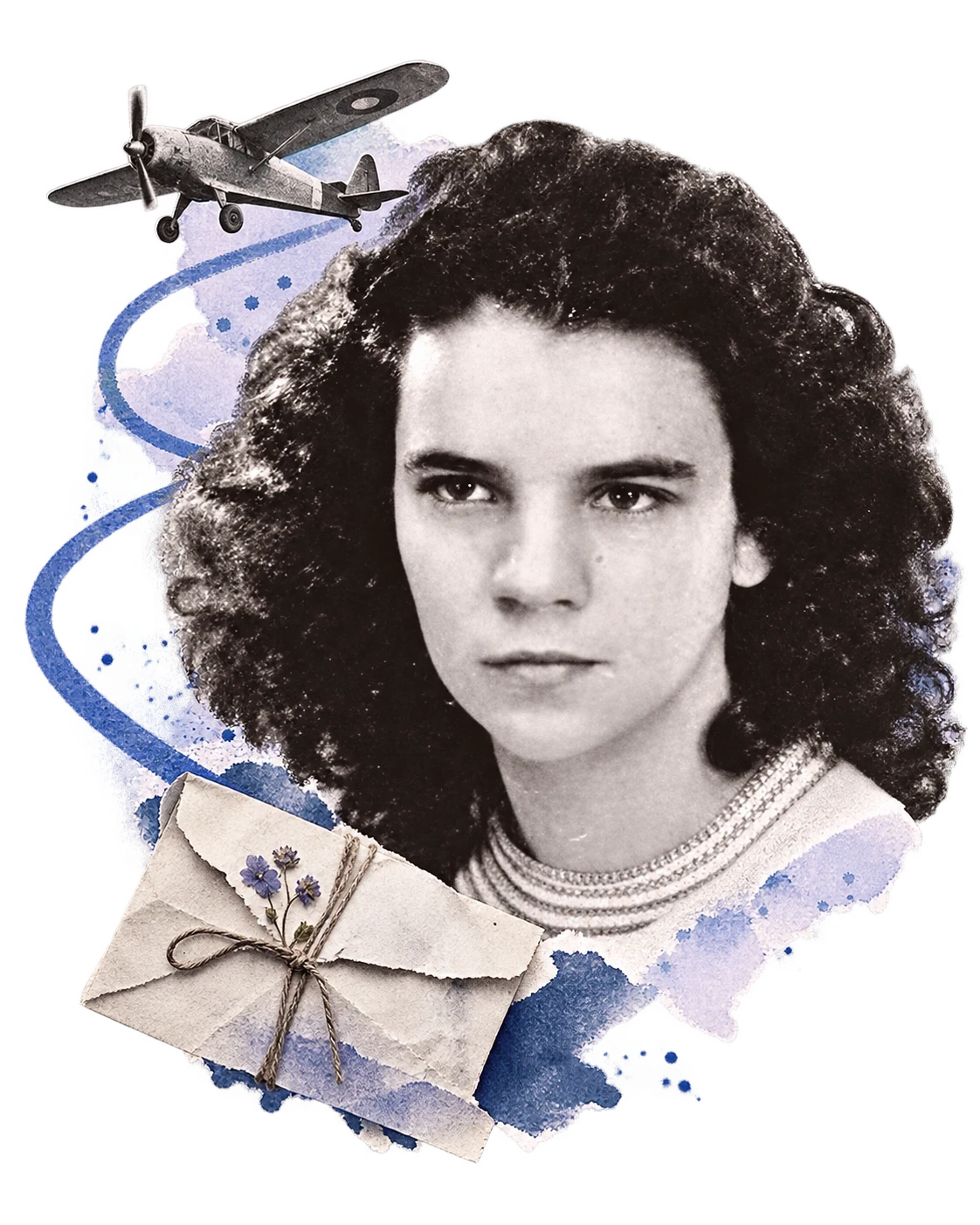
A moving love story that opens a window onto the lives of young fighters in the final years of the British Mandate in Palestine. A couple in love, dreaming of marrying and building a home in the newly born Land of Israel.
The Plane Crash in Jerusalem
On the morning of August 3, 1948, the sisters Ruth and Rauma were sitting in the living room of their parents' home in Rehavia, passing the time in light conversation. They had arrived in Jerusalem not long before, since Ruth's husband, Moshe Dayan, had been appointed commander of Jerusalem (Rauma married Ezer Weizman, later president of Israel). Ruth gathered up the cups and later recalled: "I was standing at the sink, facing the kitchen window, washing dishes. In front of me was Jerusalem's makeshift airstrip, which began at the edge of the Valley of the Cross and ended at the stone wall of the monastery. Suddenly I began to hear a kind of putt-putt-putt, like an engine struggling to start but failing. I looked up from the sink and saw a Primus taking off slowly. Then, before it had gained much height, only a few meters, its engine suddenly died and it fell like a stone, its nose striking the ground. I immediately called Rauma, and together we boiled water for sterilization, took sheets from the house to use as bandages, and went downstairs to the commander's car."
Ruth took Moshe Dayan's private car: "We got into the car and started driving over rocks and stones to where the broken plane lay on the ground. Soldiers stopped us on the way, but I told them it was the commander's car and they let me through. We reached the plane, and what I saw I will never forget. It was terrible. The two bodies were completely intact, lying beside the broken plane. Zehara was so beautiful... and there she lay, completely whole, but silent."
She was 'Shmulik's Zehara' - that was how people knew her even long after Shmulik was no longer alive, and that was how she described herself in a written pledge the two of them made toward the end of their service in the Palmach: "Of my own clear and free will, and with great love, I hereby declare my full consent - and, beyond that, my unconditional commitment - to marry Shmulik as soon as circumstances allow us both to be released from active service in the brigade. In witness whereof, we have signed - Zehara Levitov"
Family Background and Meeting in the Palmach
Zehara Levitov was born in Tel Aviv on October 20, 1927. Her parents, Zita and Yehuda, decided to immigrate to the Land of Israel after meeting Joseph Trumpeldor, and arrived aboard the legendary ship Ruslan, which ushered in the Third Aliyah. They were among the founders of Kibbutz Kiryat Anavim in the Jerusalem hills. Her father was one of the leaders of Hever HaKvutzot, the kibbutz movement affiliated with Mapai, and a leading figure in the Histadrut's Workers' Economy. When she was born, her parents named her Zehara because she "brought radiance into our lives." After losing their baby daughter Hadassah and a newborn son, who did not survive the harsh living conditions in the kibbutz, her parents decided to move to Tel Aviv. Soon after Zehara was born, the family returned to the kibbutz, later moved to Jerusalem, and then returned to Tel Aviv, where Zehara studied at Tichon Hadash. After graduating in 1946, she enlisted in the Palmach. At first she was at Kibbutz Tel Yosef, where she shared a tent with Leah Schlossberg (later Leah Rabin), and later she moved to another Palmach unit at Kibbutz Ein Harod and became commander of the women's squad.
Zehara drew attention wherever she went. She was witty, strong-minded, beautiful, and possessed both leadership qualities and physical strength. It was the young squad commander Shmuel Kaufman who found the courage to start writing to her, asking her to call him Shmulik. Zehara replied to his letters without excessive sentimentality, but made a point of calling him Shmuel.
Shmuel Asher Kaufman was born on July 2, 1927, to Fruma and Yehuda Kaufman. His father, Yehuda, immigrated to Palestine in 1926 from Ukraine at the invitation of his close friend Hayim Nahman Bialik, who asked him to compile a dictionary. The learned Yehuda had studied law, linguistics, history, and philosophy, and was the first editor-in-chief of the Hebrew Encyclopedia. When Shmuel was born, his father Yehuda adopted the name Even Shmuel. To mark Shmulik's birth, Bialik wrote him a poem: I give this gift / to the child Shmuel Asher / so that he may be / a whole and worthy Jew.
His mother, Fruma, died when he was 15, and in 1944, at the age of 17, he enlisted in the Palmach. As a commander, he arrived at Ein Harod, where he met Zehara. Shmuel was gifted and blessed with a rare talent for writing. He spent a great deal of time with Hayim Nahman Bialik, Yitzhak Ben-Zvi, Berl Katznelson, and the writer Haim Hazaz, who were friends of his father, then head of the Culture Department at the National Council. This is what he wrote to Zehara: "Your appearance on the horizon of my life melted the terrible mask, melted it forever... and how good that feels... But why are you so far from me now? Why aren't you here? Who has the right to send you away and take you from me? Do you, too, feel the pain of our 'heart-string'? You have gone far from here, and the string is stretched, hurting unbearably."
Love, Parting and Grief
The Night of the Bridges on July 16, 1946, set their love alight. Zehara took part in the operation to blow up the Gesher HaZiv bridge, and was wounded in the eye during it. In the same operation, Zehara lost Amichai Kleibner of Rehovot, her first love from her high school days. After she was wounded, she went to her parents' home and wrote to Shmuel: "Well, I got home, and my name had gone ahead of me. It turned out that they had told the story at home, but I denied it emphatically." Shmuel came to visit her, and their friendship turned into a passionate love. From then on, Zehara addressed Shmuel as "my Shmulik."
Zehara recovered, and Shmulik was supposed to be discharged, but the events of Black Saturday led him to decide to extend his service in the Palmach. When they returned to Ein Harod as a couple, they moved into the same tent. Their love shone brightly and moved everyone who saw them. A member of Kibbutz Ein Harod described them this way: "Those two were a wonderful sight, spreading so much light and warmth around them."
On the days when they had to part to carry out their respective assignments, they exchanged letters. He wrote to her: "No distance will change the fact that we are Shmulik of Zehara and Zehara of Shmulik" (December 5, 1946). She wrote: "I can't fall asleep without wishing you good night" (December 18, 1946). He wrote to her: "This is one evening, the only one, when you, my dearest love, are not here with me" (December 20, 1966). She replied: "Even the pen misses you. I can feel it in the way it writes" (January 2, 1947).
When Shmulik decided to leave the Palmach, his commanders pressured him to stay. After a personal meeting with Yigal Allon, the Palmach commander, Allon realized that Shmulik was determined and discharged him. Zehara asked him to stay until Saturday night, when their friends would hold a farewell party. On Friday, May 2, 1947, Shmulik was asked to help his friends practice with a live grenade at the shooting range at Kibbutz Geva, near Ein Harod. The grenade exploded, killing Shmulik and two of his trainees. Shmulik was laid to rest on the Mount of Olives in Jerusalem in a funeral procession attended by thousands. Before the funeral, Yitzhak Ben-Zvi eulogized him: "Many of us knew and cherished Shmuel Kaufman, who did not live to reach the age of twenty. In his few short years, he was an example in his studies, in his talents, and in his devotion to his people and his homeland. Shmuel fell at the foot of Mount Gilboa, in soil consecrated by sweat and blood."
Zehara collapsed. "My Shmulik, my child," she wrote in the many letters she continued to address to him: "Are you there beneath the heavy stones, wanting to get out, with no one to open them? Come back to me, my child. You disappeared from the horizon of my life like the sun that has set and will never rise again."
A month after his death, she wrote to him: "My Shmulik! Today is your birthday - your twentieth birthday. Do you remember what we decided for your birthday? We decided to give you a present, and it was a wedding. And now the day has come, and I am here, and you... you didn't come. My Shmulik, it is so terrible to think that you are neither here nor far, far away. There is nowhere I can find you, anywhere in this vast or tiny world. You are not coming. Only your letters are with me, your belongings, your image, and your love. Those are what I have left, but what am I to do with them without you?"
New York, Flight and Remembrance
Shmulik's sister Bruria worked as an assistant to Professor Albert Einstein and managed to obtain admission to an American university for Zehara. Zehara decided to continue with their shared plan and enrolled in medical school at Columbia University in New York. When she arrived in New York, she received another terrible piece of news: all the soldiers of the Lamed-Heh Platoon, some of whom she knew personally, had been killed on their way to aid the besieged Gush Etzion. "Soon there won't be a single young man among my friends left in the country... I am the only one who has survived," she wrote to her family. To Shmulik she wrote: "Shmulik, the country is burning. Dozens of people perish every day. They all go one after another: Sali, Rafi, Dani Mas, and more and more. Have you met them? Don't think I've started believing in strange things, but sometimes an image comes to mind of all the guys who left us gathering somewhere, renewing the old days beside a campfire and a finjan. Strange, isn't it? But don't judge me harshly, Shmulik. So many strange thoughts have attacked me during this long time since you left me."
In New York, Zehara met Teddy Kollek (later mayor of Jerusalem), who persuaded her to join a flight-training course taught by Eleanor Rudnick, daughter of Oscar Rudnick, one of the wealthiest Jews in the United States in the 1940s. Eleanor owned a private airfield in Bakersfield, California, and hoped to join and contribute to the work of Al Schwimmer (an American-Israeli Jewish flight engineer and pilot, founder of Israel Aerospace Industries, and recipient of the 2006 Israel Prize for Lifetime Achievement and Contribution to Society), who was acquiring aircraft, spare parts, and weapons for the Jewish community in the Land of Israel. Eleanor contacted Teddy Kollek, who was engaged in procurement at the time, and together they began acquiring aircraft. Eleanor came up with the idea of training Palmach commanders who were in the United States to fly, and thirteen candidates were recruited for the operation.
The four-month course began on March 1, 1948. Among the trainees were two women: Sarah Guberman and Zehara Levitov. When Zehara was asked at the start of the flight course why she had chosen a dangerous profession like aviation, she replied: "I knew all along that I would die young anyway." During the flight course, Zehara and Amnon Berman (from a family of Jerusalem bakers) fell in love. At the end of the course, the trainees arrived in the country and were assigned to Squadron A at Sde Dov. They took part in the battles of the War of Independence, and Zehara completed the mission her friends in the Lamed-Heh had begun, delivering supplies to the besieged residents of Gush Etzion and the Negev. Zehara experienced the loss of a beloved for the third time when Amnon's plane was shot down over Lod on July 7, 1948.
Shmulik's Zehara began helping her father and Shmulik's father edit a book in Shmulik's memory. She died in a plane crash while on her way to meet Shmulik's father.
Amos, Zehara's only brother, named his daughter after his sister. The girl developed cancer and died during Sukkot in 1968, a few months after the liberation of the Mount of Olives, at the age of six. At the request of Shmuel Kaufman's father, little Zehara was buried beside Shmulik, and in this way their pledge of fidelity was fulfilled, at least symbolically.
Several books have been written about this love story, including To Love Until Death by Devorah Omer and Like the Radiance of the Sky by Ofer Regev. The play Zehara’s Shmulik was also produced and staged in October 1981.
In 1957, the Jerusalem Municipality decided to name a street in her honor in the Rehavia neighborhood - Netiv Zehara. The nearby street, HaTayasim Street, was named in memory of all the pilots who flew to besieged Jerusalem.

תגובות
עדיין אין תגובות.