
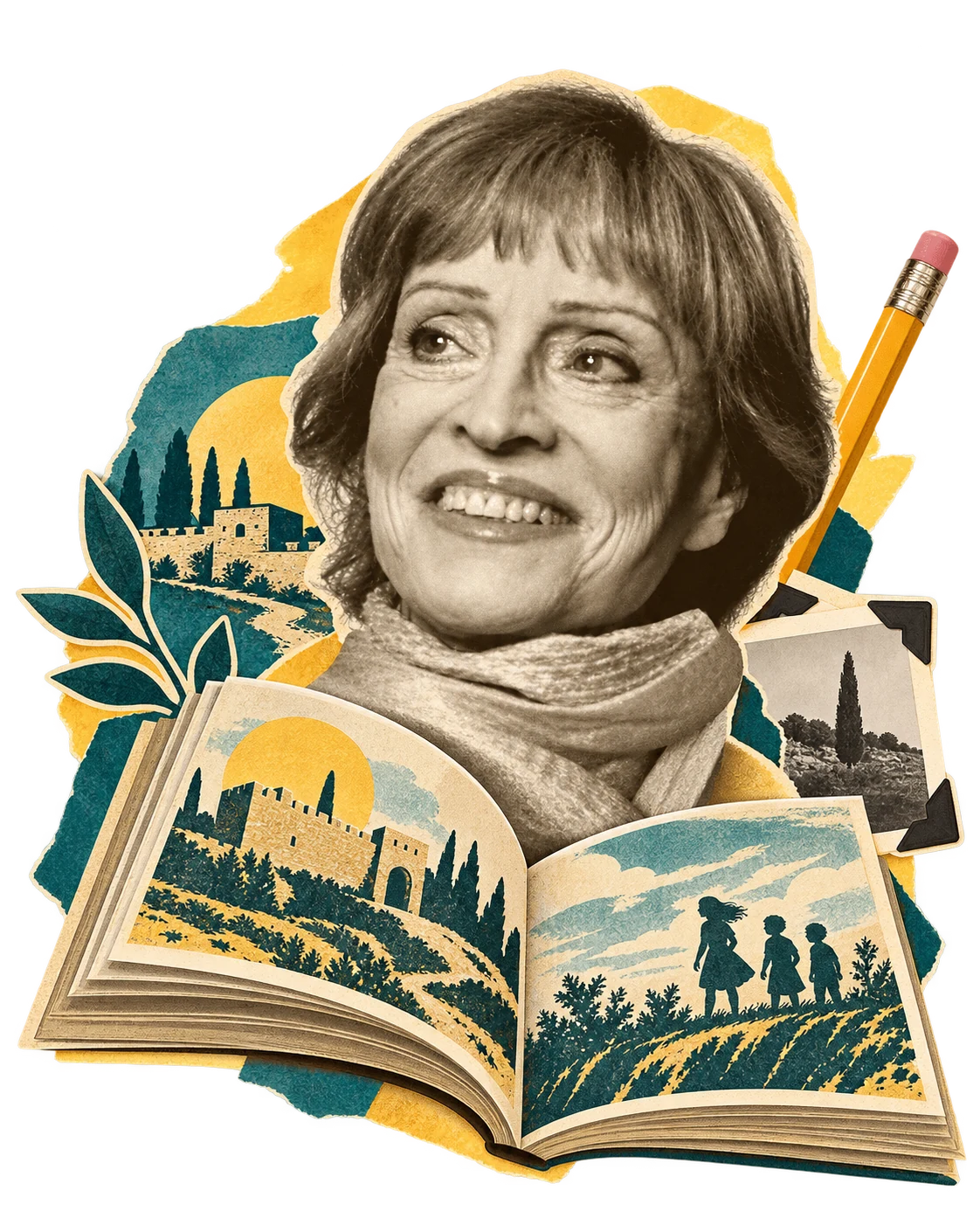
Itamar Ben-Avi, Sarah Aaronsohn, Benjamin Ze'ev Herzl, David Ben-Gurion, Yitzhak Rabin, Tzivia Lubetkin, Tuvia Kushnir, Zohara Levitov, Yaakov Meridor, and Mania Shochat - she wrote a book about every one of them.
Deborah Omer
A Childhood of Loss and Imagination
She was only a year old when her parents divorced. "Dad would come to visit me, and at the end of every visit I cried," Deborah said. "I wanted him to stay, but he always left. Once he told me to open my palm and placed his empty hand on it, as if it held something, and said, 'Here, I'm giving you a dwarf as a present. His name is Krashindo, he's invisible, and he's yours alone. You can sail with him in your imagination wherever you want.' Then he left to fight in the most just war, World War II." And so Deborah began to dream. Her father, Moshe, was sent to Europe with the Jewish Brigade of the British Army, and Deborah was left in Kibbutz Ma'oz Haim without a father. She grew up with two women: her mother, Leah Lifshitz-Shereshevsky, and Galya, the caregiver at the children's house. On January 17, 1944, when Deborah was 11, the sound of a loud gunshot rang out in the kibbutz. "Mom killed herself," they told her. That same day, Galya also left the kibbutz, and Deborah was left alone.
Only a month later did a letter from her father reach her: "My dearest Deborah'le. The terrible news has reached me. I wanted to come to you, but it is quite impossible. How can we console ourselves, my daughter? It is so hard for me to write this letter to you. If only I could be with you now, but it is fate. We will bear the pain together, Dvora. What happened cannot be changed. All you need to remember, Dvora, is that Mom's dream was always to see you grow and flourish, cheerful and diligent. Before me now is Mom's last letter to me, and the whole letter is about you. If we want to fulfill Mom's wish, you must overcome the pain and sorrow, study hard, and be a diligent and good girl. We will keep Mom's memory in our hearts. How good she was, how devoted and how wise. Please write to me, my daughter, and I too will write often. I hold you to my heart, Dvora, from far away, and share your pain. Dad."
No one explained to the girl why her mother had killed herself. At the funeral she was told, "Don't cry. We don't cry at funerals here." Her sister said: "She was sure that now that Mom was dead, Dad would come back... But Dad didn't come back. He only returned two and a half to three years later. She really grew up alone." Years later, Deborah's daughter said, "My mother got stuck at the age of 11." Deborah used that ability to get stuck at 11 to write 89 books, most of them for young people. She wrote from a girl's perspective, as President Shimon Peres put it in a letter to her family after her death: "Deborah, may she rest in peace, is considered a great children's author... She wrote with a wise pen and loving ink... Her writing was like the sky over Israel, almost without clouds. This allowed rays of real light to penetrate our hearts... She wrote history, she wrote pedagogy, but without letting those lofty titles keep her from speaking to readers at eye level. She loved us. We readers of all ages loved her... She allowed us, the adults, to be children. She allowed children to be more grown-up... She left behind a legacy that will continue to flow strongly even after she has left us..."
Her timeless books continue to sell hundreds of thousands of copies, even years after they were written. Among them is Sarah, Heroine of NILI, which has sold about five thousand copies a year for decades. According to book translator Atara Ofek, "Deborah was sensitive to people who were different. In the books for young people that she wrote about unconventional characters, she knew how to capture them on paper for generations to come. She had an immense understanding of a child's soul."
Childhood and Writing in the Kibbutz
Deborah was born in 1932 and was the first girl born in Kibbutz Ma'oz Haim. Her mother, Leah Lifshitz-Shereshevsky, was one of the kibbutz's founders, and her father was the writer Moshe Musinzon, brother of Yigal Musinzon, creator of the Hasamba series. "Ink flows through your veins, not blood," Yigal aptly put it, and indeed, from an early age, writing served as an escape for her.
Deborah began writing as a teenager, inspired by her father. Her first stories were published in Bama'aleh, the newspaper of the Working Youth movement, which her father edited. "He promised me that he published the stories because of their quality, and not because I was his daughter... But I preferred to sign them with just my first name," she said.
When she finished her military service, the kibbutz members' assembly decided to send her to study teaching. "I never thought of becoming a teacher, and I wasn't a good student at school, but they apparently saw something in me that I hadn't yet seen in myself," she said. She studied teaching at Oranim Teachers' Seminary and, on returning to the kibbutz, taught sixth grade. Inspired by her students, she began writing the column Tamar's Pages for the weekly newspaper Davar for Children. Published in weekly installments, the stories were something like Tamar's personal diary. Tamar was a girl from Kibbutz Rimon in the Valley who grew up in a very close-knit family with her parents and two brothers. Deborah was the first author to write books aimed at girls.
It was Uriel Ofek who encouraged her to turn the pages into a book, and later they became a series that he edited, with every book becoming a bestseller. After her success, Deborah called Uriel Ofek "my lucky horseshoe" and would give him every book she wrote to edit. "I kept diaries from the age of 7 to 17, but I never thought I'd become a writer. I grew up in a kibbutz and saw my future in the kibbutz enterprise. I thought maybe I'd be a tractor driver," Deborah said of those days.
Turning History into Story
She married Shmuel Varnik in the kibbutz, and after their marriage they changed their surname to Omer. From then on she was known as the writer Deborah Omer. Her books were successful, and they left the kibbutz. In 1960 they moved to Winnipeg, Canada, on behalf of the Jewish Agency, and for four years Deborah taught at a Jewish school in the city as one of the first emissaries there. Her son Gil was also born there; he later became CEO of the Habima Theatre. When they returned to Israel, she met Ehud Ben-Yehuda, son of the man who revived the Hebrew language, at one of the Friday night gatherings organized by Dan Ben-Amotz at the Hamam club in Jaffa. Their conversation led to lengthy research, which culminated in the 1967 publication of The Firstborn of the House of Avi.
"What interests me is the history of this land. Rebecca Alper's The Settlers on the Mountain is my green lantern. The book made an enormous impression on me. That's what I want to do. It's a fantastic example of what can be written. Every time I pass by Motza on the way to Jerusalem, my heart skips a beat. I'd like to tell the story of the settlement at Ein Ganim. My children don't know, for instance, that my grandmother died of yellow fever. My daughter Tali has no idea what yellow fever is." (The Settlers on the Mountain is a heroic tale of the HaCohen family and their hardships as they settled in Motza.)
After reading The Firstborn of the House of Avi, the writer Uriel Ofek suggested that Deborah write a similar book about the NILI underground, which operated during the Ottoman period. She adopted the idea and decided to place Sarah Aaronsohn at the center of the book. Once again, after extensive research, Sarah, Heroine of NILI was published and was also a great success. The two books were followed by more biographies adapted for young readers, about figures from the history of Zionism and the Jewish community in Palestine. They included To Love unto Death (about Zohara Levitov); A Voice Called in the Dark (about Herzl and his family); Tears of Fire (about Tzivia Lubetkin); To the Top of the Mountain (about David Ben-Gurion); At a Gallop (about Mania Shochat); and I Swore Allegiance (about Yitzhak Rabin).
The Family Secret
Despite the success of her books, her mother's suicide remained a mystery: "How could she leave a girl and two babies like that? I hoped she hadn't killed herself, but I didn't dare ask. I was afraid of the answer." Only many years later, when Deborah was already a mother herself, did Shlomo Ben-Elkana come to see her. A former police officer and expert in locating missing persons, he had found the remains of Avshalom Feinberg in Sinai. Ben-Elkana asked Deborah to write a book about him and boasted that he could obtain any information she needed. Deborah challenged him and asked him to find out what had happened to her mother.
One rainy winter night, Ben-Elkana brought Deborah together with Galya, the beloved caregiver from her childhood in the kibbutz. Galya revealed to Deborah that her mother had not killed herself, but had been killed by an accidental gunshot during one of the Haganah's training exercises. The story of suicide had been invented to hide the underground training exercises from the British. And that was not all: Galya told Deborah that she herself had accidentally fired the shot that killed her mother. This shattering revelation gave rise to the book Direct Hit, which Deborah wrote after uncovering the secret, 30 years after her mother's death.
Of the figures she wrote about, Deborah said: "It matters a great deal to me how these people will be remembered, and that's one of the things that drives my writing... There are so many graves of men and women who did so much for Zionism, and no one remembers them. It pains me, and I want to do something about it."
Awards and Legacy
Deborah Omer received many awards, including the Yatziv Prize for Children's Literature (1959); the Prime Minister's Prize for Hebrew Writers for Tamar's Pages (1979); the Hans Christian Andersen Honorary Award from the International Organization of Children's Writers, an award presented by the Queen of Denmark and considered the Nobel Prize for children's writers (1986); the Korczak Medal from the Polish Writers' Association (1987); the Minister of Culture's Prize in the children's and young adult category (2005); and the Israel Prize for her contribution to Israeli culture (2006).
In her final years, Deborah Omer suffered from dementia and declined. In May 2013, at the age of 81, she passed away. She lived in Moshav Kfar Ma'as, where she was also buried.
תגובות
עדיין אין תגובות.