
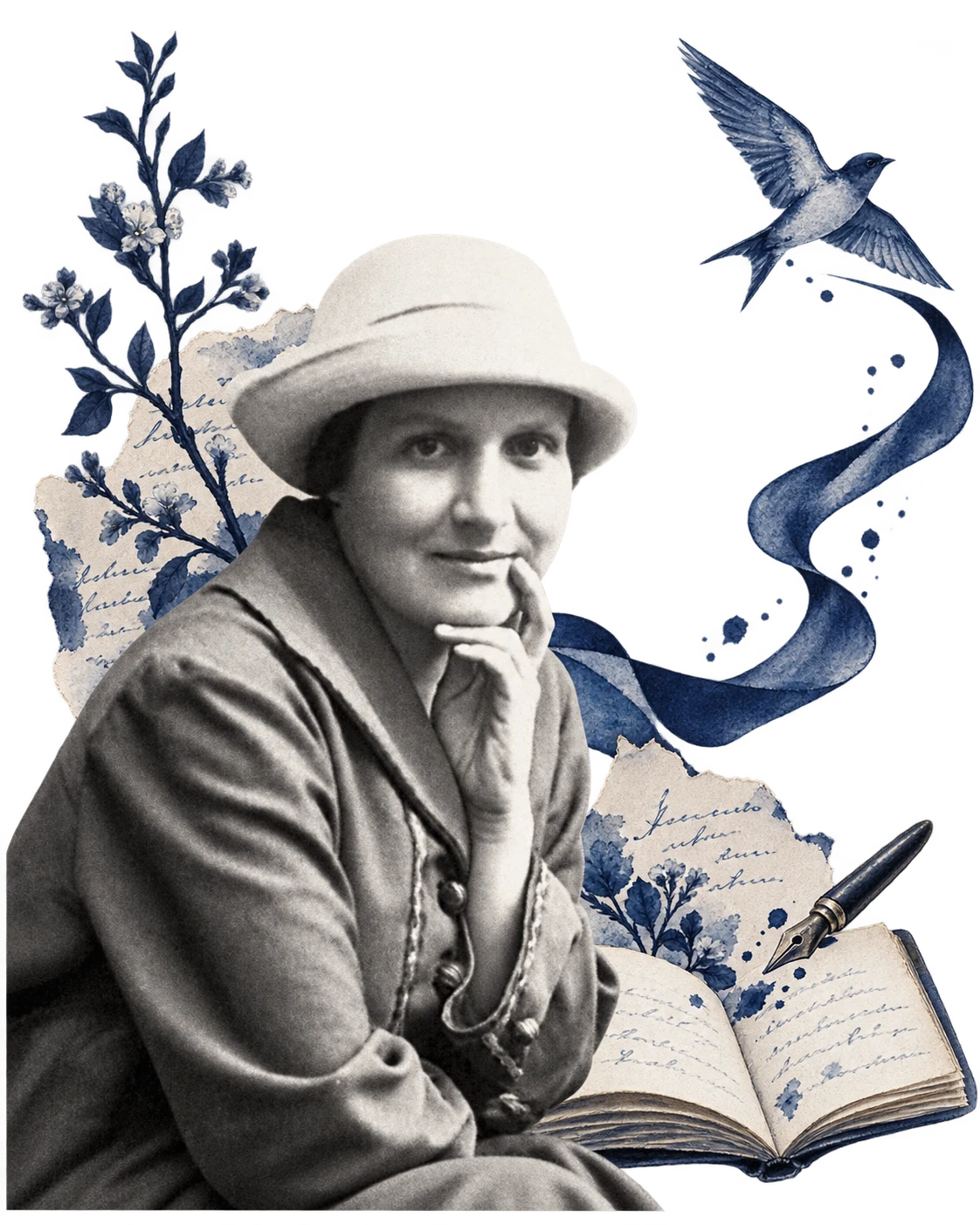
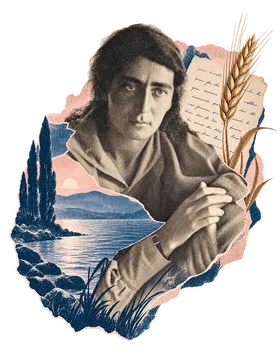
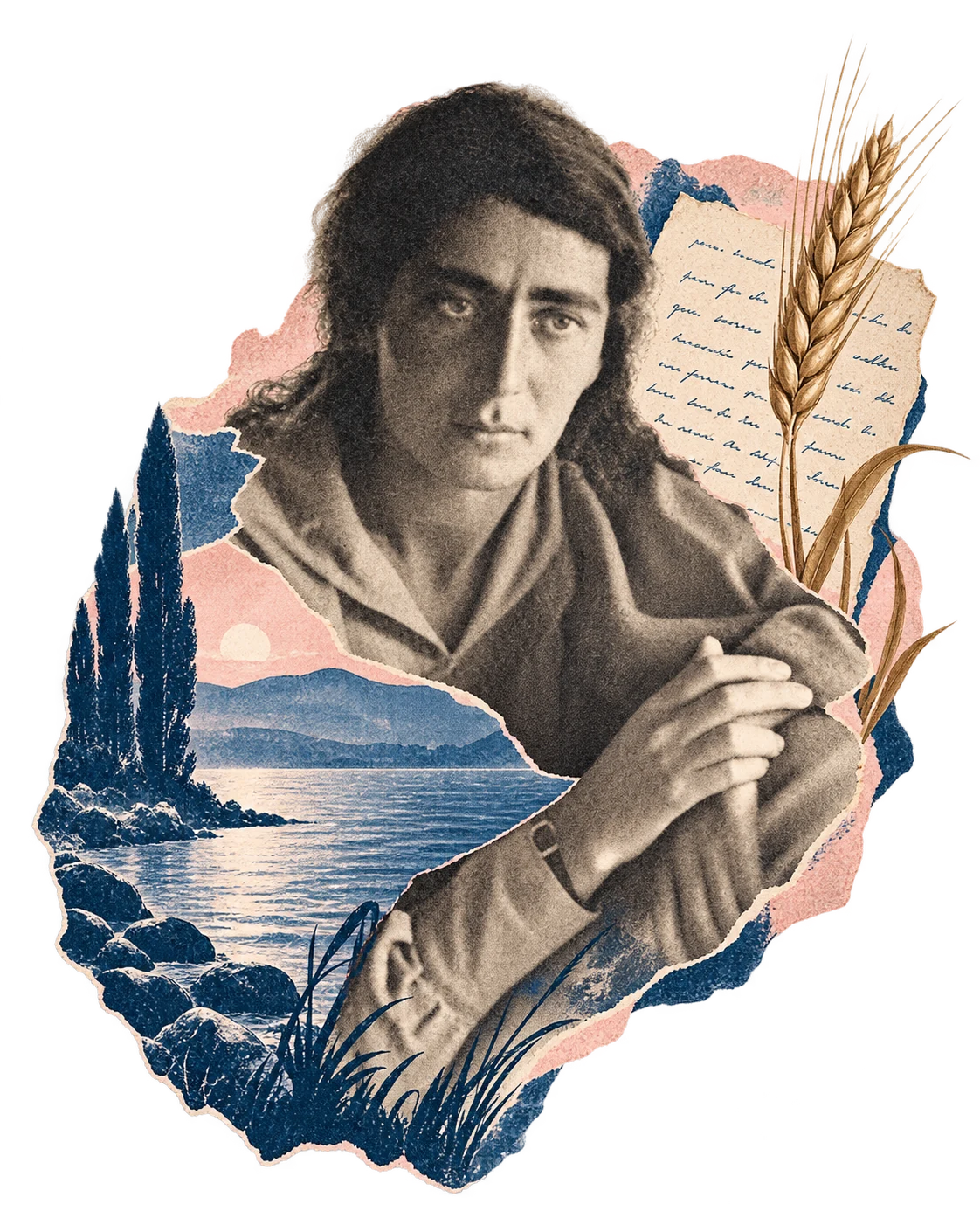
Buried near the grave of the poet Rachel is a non-Jewish woman of whom Rachel once said, "There is only one who equals me in Hebrew poetry." In the early 1920s, Elisheva was considered the most prominent among the women poets who founded modern Hebrew women's poetry.
Buried near the grave of the poet Rachel is a non-Jewish woman of whom Rachel once said, "There is only one who equals me in Hebrew poetry." In the early 1920s, Elisheva was considered the most prominent among the women poets who founded modern Hebrew women's poetry.
Between Two Languages
Elisheva was born in 1888 in Ryazan, some 200 kilometers from the capital, Moscow. Her birth name was Yelizaveta Zhirkova. Her father, Ivan Zhirkov, belonged to the Eastern Orthodox faith, and her mother came from an Irish Catholic family. Her father worked as a teacher and eventually became a publisher of textbooks. When Elisheva was three, her mother died, and she went to live with her aunt in Moscow, where she was raised in the English language and culture.
1907 was a pivotal year for her. As a high school student, her future was shaped by two things: she began writing poetry, and that same year she befriended a Jewish girl who sat beside her in class and awakened her interest in Jewish culture and the Hebrew language. Elisheva began learning Yiddish, which she found easy because she knew German.
Elisheva wrote about two hundred poems in Russian, and in 1919 a selection of them was published in two collections: "Moments" and "Hidden Songs." These poems explored her ties to Jewish culture. After discovering the Hebrew language and Jewish culture, Elisheva devoted some 13 years to learning Hebrew. In 1920, she wrote her first poem in Hebrew, and after that she no longer wrote in Russian.
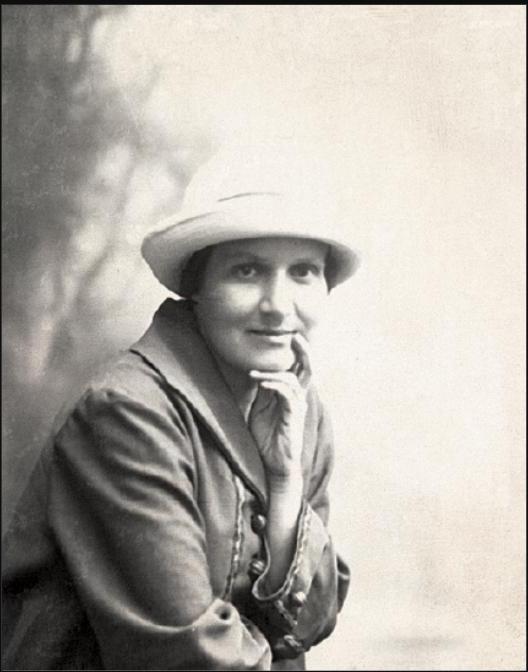
She had signed her Russian poems with her Russian name, "Yelizaveta." From then on, she began signing her Hebrew poems "Elisheva."
Her first Hebrew teacher, and future husband, Shimon Bihovsky, influenced her and helped her master this foreign and ancient language. She adopted Hebrew as the sole language of her creative work.
During her studies, Shimon was impressed by Elisheva's diligence and gentle spirit. She, in turn, was impressed by his patience and dedication to the task. They fell in love, and the relationship between teacher and student led to their marriage in 1920.
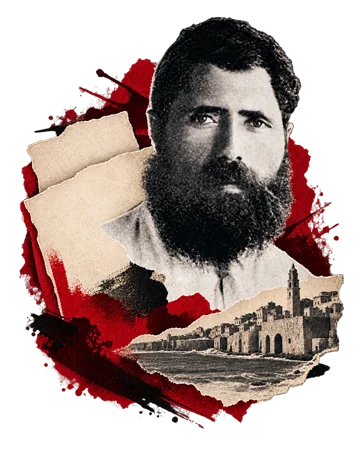
Shimon Bihovsky was an active Zionist and the secretary of Dr. Yehi'el Tschlenow. Bihovsky was also a teacher, literary critic, and publisher. He was a close friend of J. H. Brenner and Uri Nissan Gnessin, and also helped them publish their work.
A New Home in Tel Aviv
In the winter of 1925, the Bihovskys realized their dream. They left the Soviet Union and immigrated to the Land of Israel with Miriam, their one-year-old daughter, settling in the small city of Tel Aviv, not far from the Herzliya Gymnasium. Their dream became reality, but in time it became clear that this was not quite the dream they had hoped for.
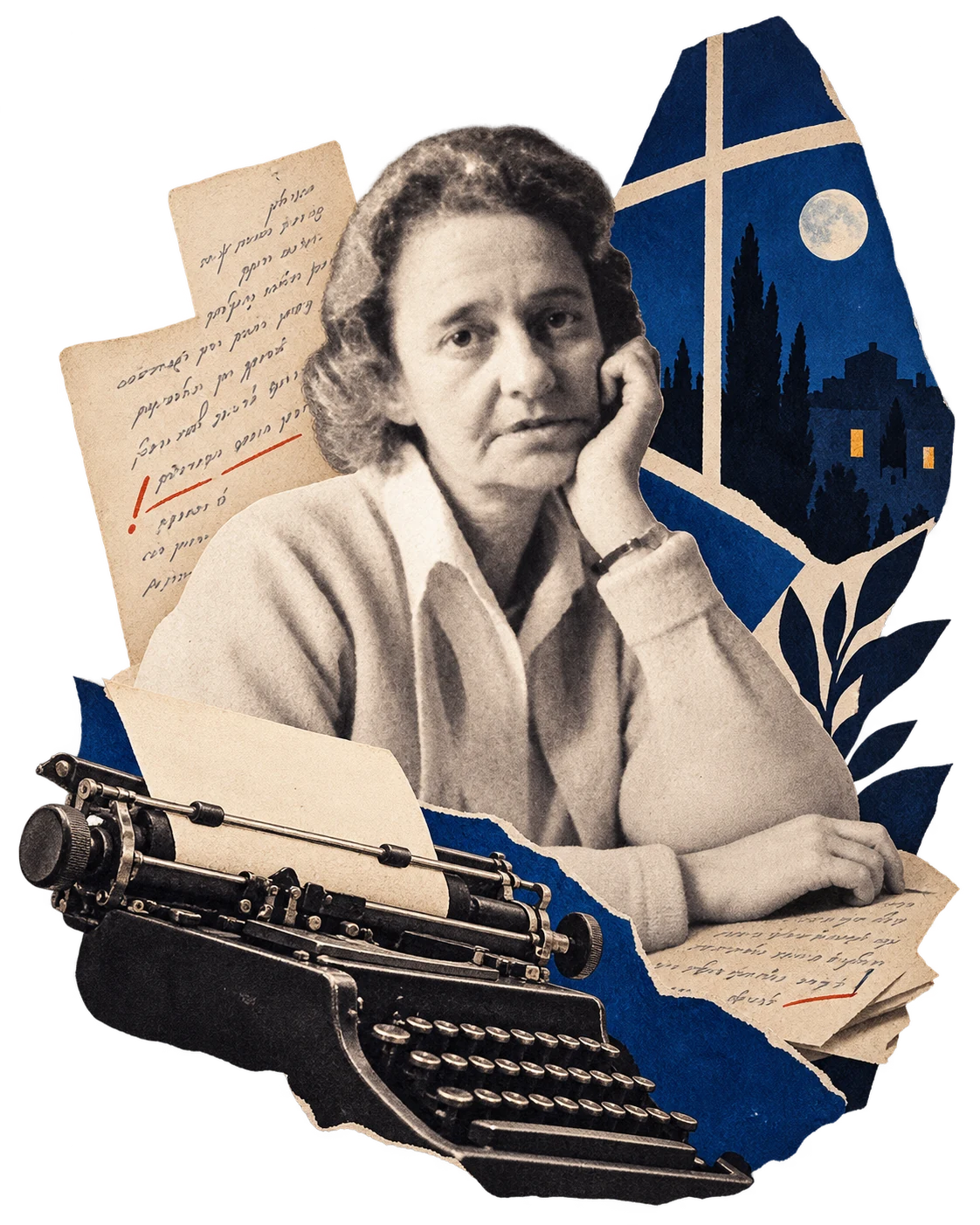
In Tel Aviv, the Bihovskys established a private publishing house, Tomer, devoted exclusively to publishing Elisheva's work. In 1926, her first collection of poems, "A Small Cup," appeared. It was, as one critic wrote, "a little book of poetry, as small as a man's palm and as thin as a strand of hair." In other words, the book was published in a tiny format, a miniature volume, an innovation in the history of Hebrew poetry (books at the time were published in enormous formats), and contained just 27 poems. Despite its tiny size, or perhaps because of it, the book was a success that, given the circumstances of the time and the limitations of Hebrew literature then, could be considered spectacular. Three editions appeared within two years, and all sold out. A small luxury edition of 200 numbered copies, printed on fine paper, also sold out. No collection of poems by another poet of that generation achieved such wide circulation.
The appearance of Elisheva, a non-Jewish poet who had left her people and language to join the Jewish people in their renewed homeland, thrilled and moved the Jewish public in the Land of Israel, who saw her as a kind of new Ruth, even though she had not converted to Judaism.
Elisheva knew how the public viewed her, and she centered all the poems in her second collection around Ruth, which was also titled "Ruth" (1916). Through the figure of a woman uprooted from her homeland, she developed a sense of alienation and loneliness. In her Russian poems, Elisheva quoted the Book of Ruth and used the biblical figure to describe the spiritual state she herself inhabited: she had grown distant from those close to her, yet remained a stranger among those far away, whom she had tried to grow closer to.
The literary community also welcomed her warmly, holding poetry readings in her honor and publishing her work wherever possible. Her popularity became so great that it enraged the younger poets (the Ktuvim group, led by Avraham Shlonsky), who made her a target in their struggle against the older poets (the Moznayim group, led by H. N. Bialik, to which Elisheva belonged). This period lasted seven years (1925-1932), and it was precisely during these years that Elisheva wrote most of her Hebrew work.
During those years, Elisheva left behind an impressive and varied literary legacy: Hebrew poetry collections - "A Small Cup" (1926), "Rhymes" (1928), and "Collected Poems" (1970); stories - "A Turning Wheel" (1923), "Lights at Night" (1925), and "An Incidental Case" (1929); five short stories collected in the volume "Stories" (1928); translations and essays. Above all, she made her mark with the novel "Alleys" (1929), the first Hebrew novel written by a woman in the Land of Israel.
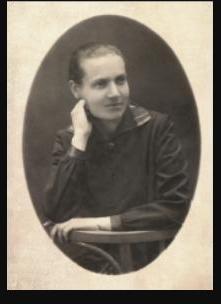
Nevertheless, the couple's financial situation was difficult, and, much against her wishes, Elisheva was often forced to leave her husband and daughter and travel among Jewish communities in Eastern and Western Europe, where she gave readings of her poems and stories.
The Legacy and the Final Years
In the summer of 1932, while Elisheva was traveling in Kishinev, her husband died suddenly. It was the first domino to fall. Elisheva returned to Tel Aviv, and her world collapsed around her. Along with her husband's death, everyone began turning their backs on her. Her efforts to find work, including as a librarian at the Sha'ar Zion Library, came to nothing. She moved into a dilapidated shack on the outskirts of Tel Aviv and raised her daughter in extreme poverty. Bialik was the only reason she was spared starvation: through his intervention, she received a small allowance. Bitter and hurt, Elisheva cut herself off from the literary community in the country.
At the beginning of 1949, Elisheva was supposed to travel to England to visit her daughter Miriam and her three granddaughters. But when she began to feel unwell, her friends from Davar HaPo'elet helped her go for a time to the Tiberias hot springs, where she died of a malignant illness in March of that year.
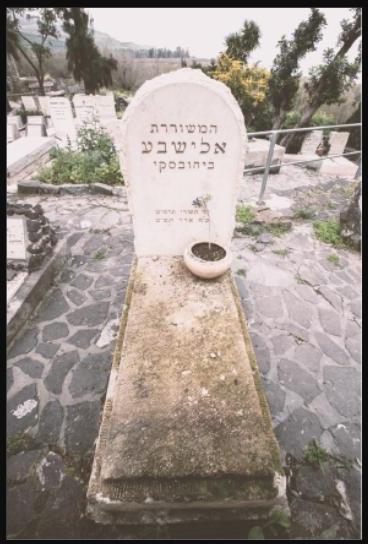
Elisheva never converted to Judaism and always took care to point this out, so there were difficulties in burying her in a Jewish cemetery. Eventually, it was agreed that she would be buried in the cemetery of Kvutzat Kinneret, beside the grave of the poet Rachel.
There, in the cemetery on the shore of the Sea of Galilee, the words of her poetry came true:
"Here I shall sit between sea and sky and earth, for the end has come, too. For my soul has found its homeland."
תגובות
עדיין אין תגובות.