
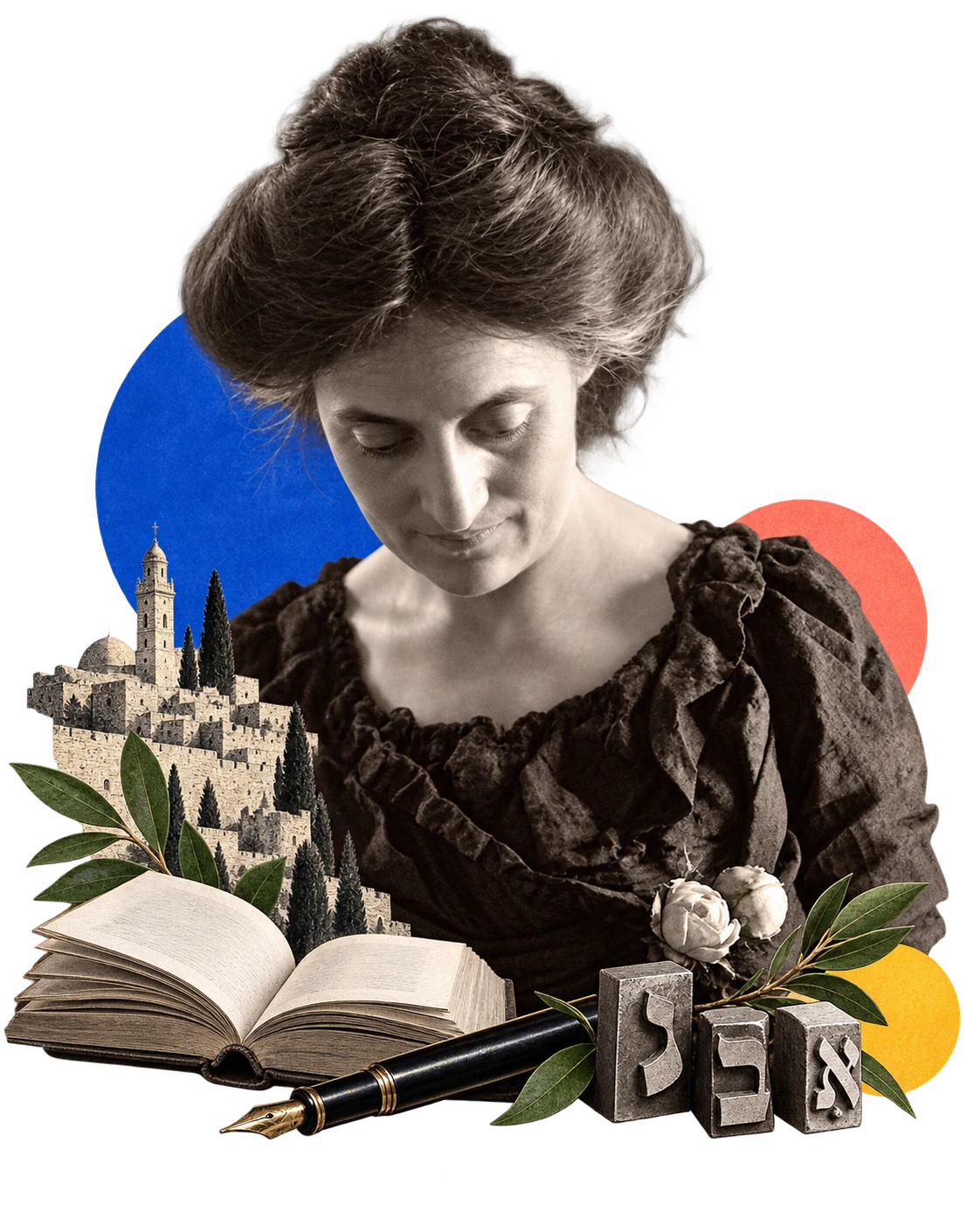
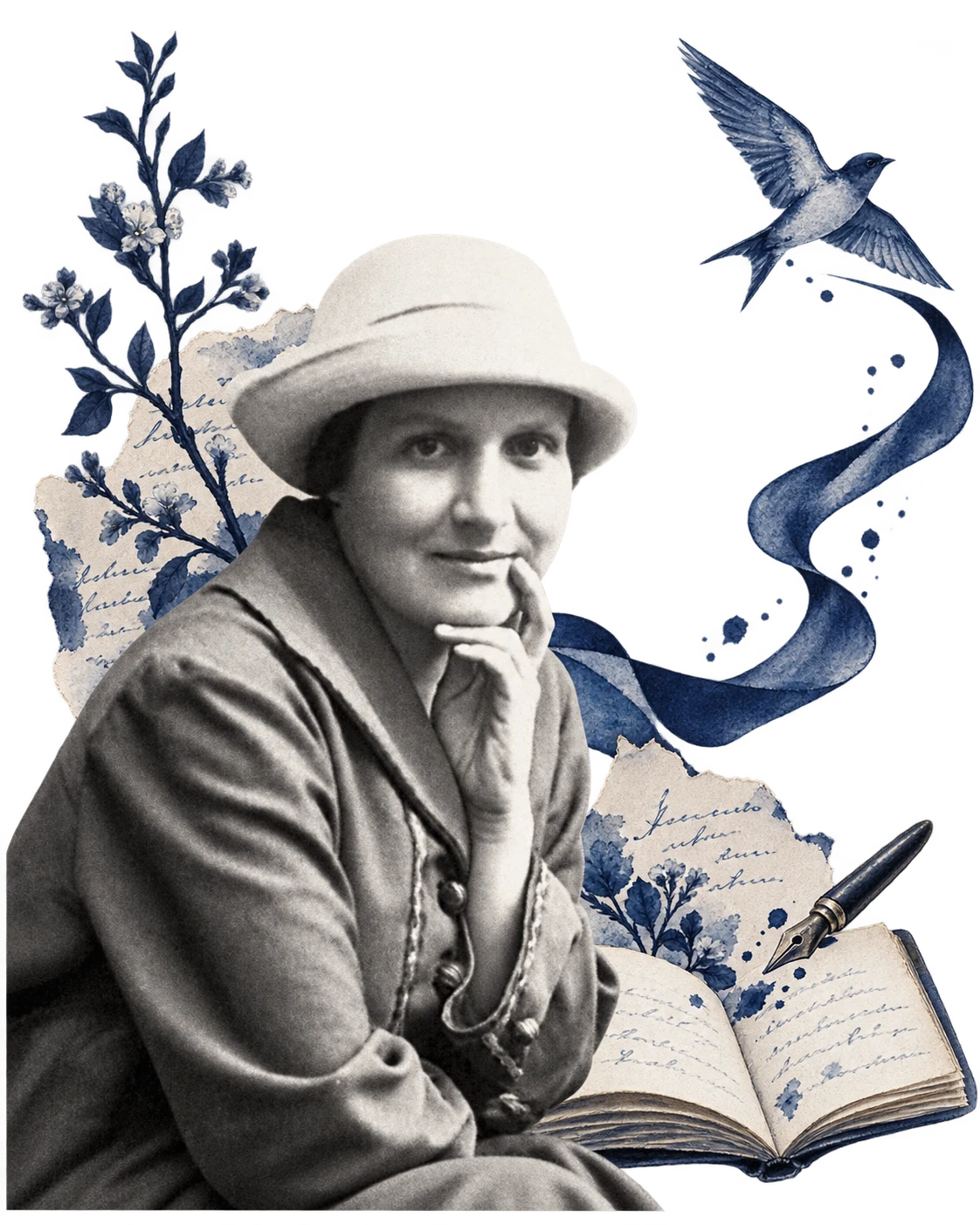
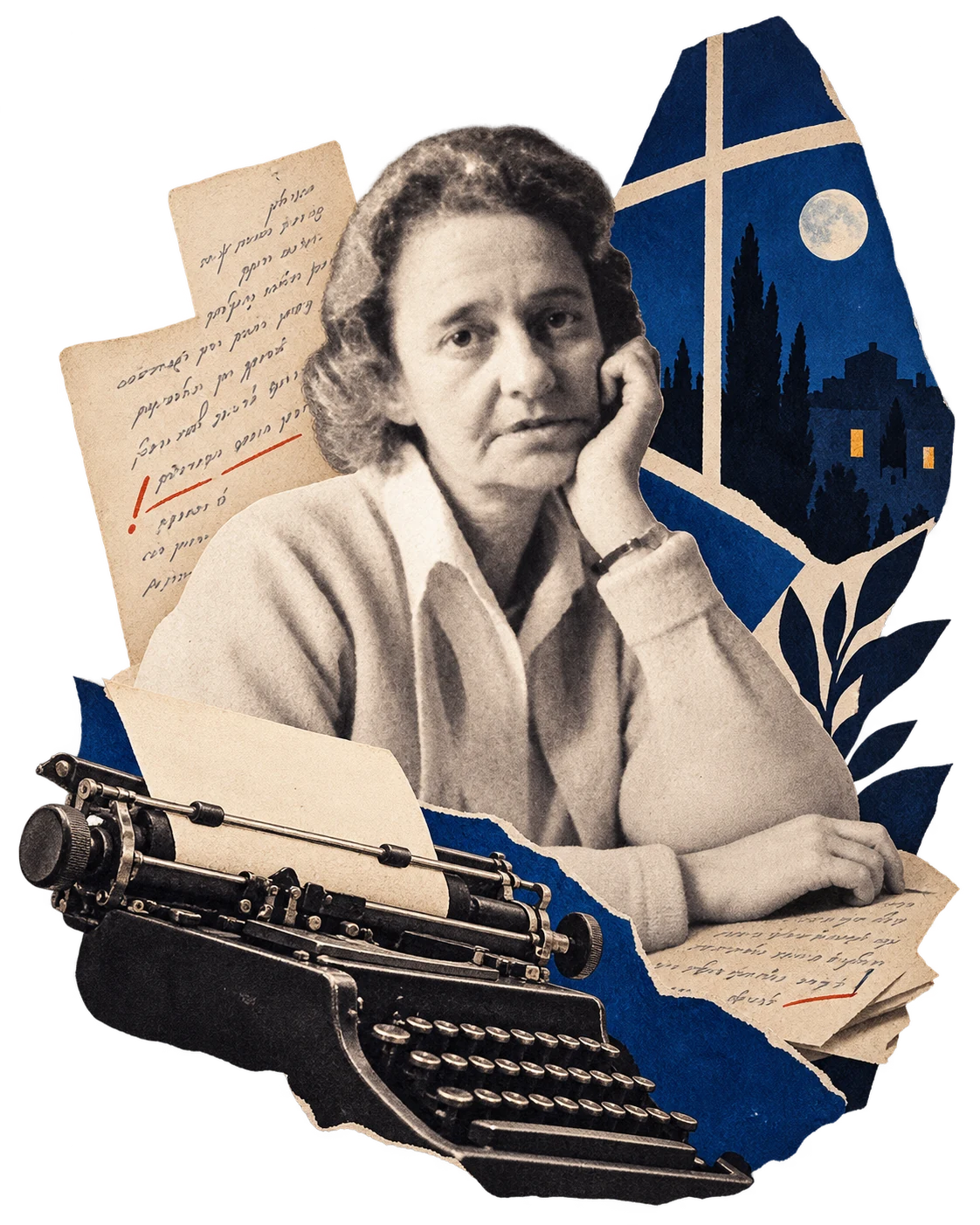
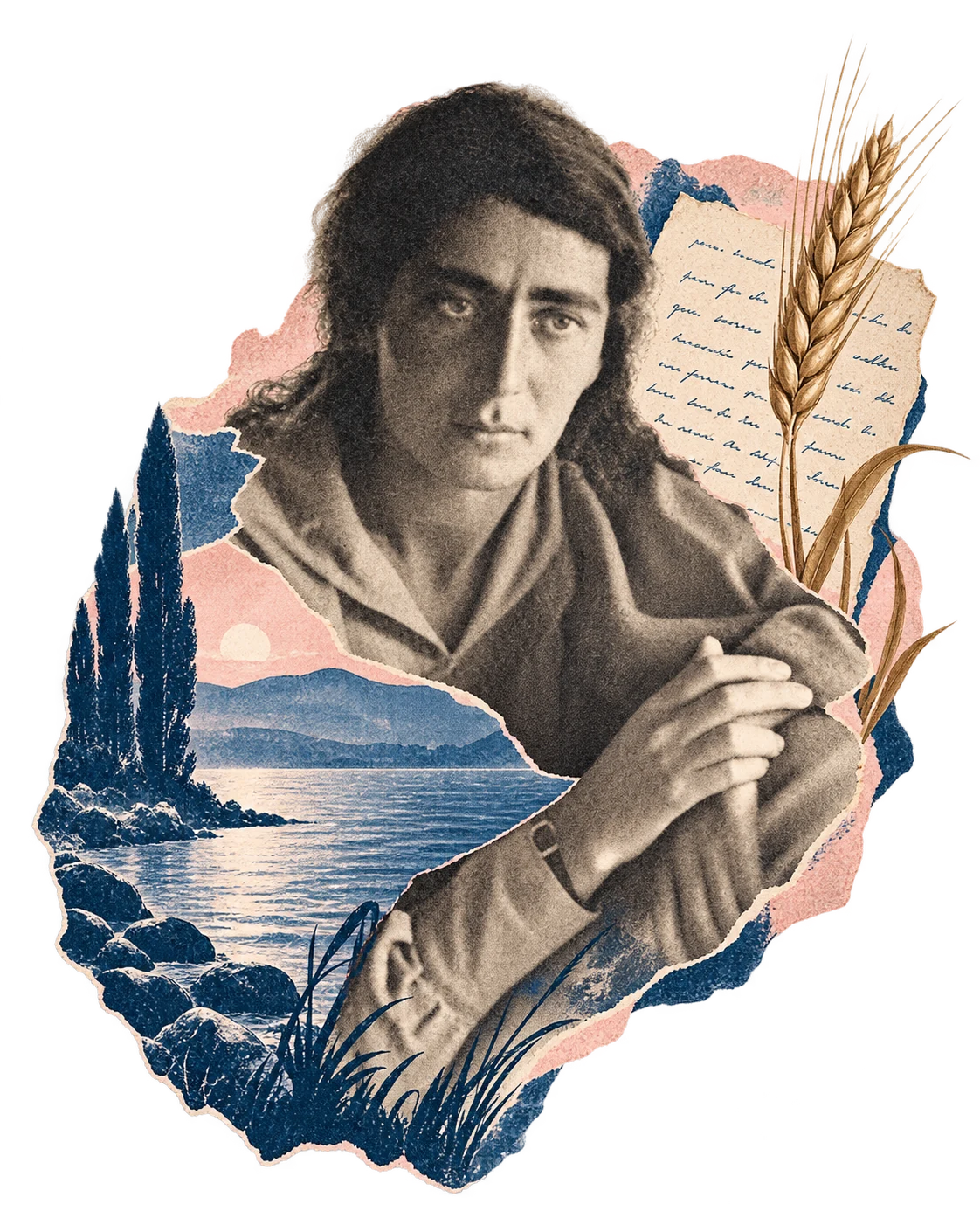
The wife of Eliezer Ben-Yehuda. A perceptive and determined writer, she made a major contribution to the Hebrew language and was the first journalist to cover fashion.
Like Ruth and Naomi
The two women walking along the road that stretched across Moab's wind-swept plains were on their way to Bethlehem. A generation separated them, and each carried her grief. Naomi had been widowed many years earlier and had recently lost both her sons, Chilion and Mahlon. Her daughter-in-law Ruth was Mahlon's widow. Here we encounter one of the Bible's great love stories: Ruth's love for Naomi. After she was widowed, Ruth the Moabite was given her mother-in-law's permission to return to her home and the religion of her birth: "But Ruth said, Do not urge me to leave you, or to turn back from following you. For wherever you go, I will go; and wherever you lodge, I will lodge. Your people shall be my people, and your God my God. Where you die, I will die, and there will I be buried. May the Lord do so to me, and more also, if anything but death parts me from you." (Ruth 1:16).
More than 2,000 years later, Hemda Ben-Yehuda saw herself as a latter-day Ruth, and her husband, Eliezer Ben-Yehuda, the reviver of the Hebrew language, as Naomi. After their marriage, she wrote in her diary: "A young woman, twenty years old, who did not know a single word of Hebrew, not even the letters of the holy alphabet. Ben-Yehuda entrusted me, without a word or explanation, with the fate of his newspaper and dictionary, with rebuilding the ruins of his Hebrew home, the battleground for the revival of the language, and above all, with the education of the first Hebrew child [...] And so I said to him: Your God is my God, your land is my land, and your language is my language." Eliezer Ben-Yehuda, too, had lost his wife Devorah, Hemda's older sister, who died of tuberculosis in 1891. On her deathbed, she asked Eliezer to marry her sister. That same year, three of his five children died one after another in a diphtheria epidemic. A year after this terrible tragedy, his sister-in-law Beila-Pola, née Jonas, arrived in the country to marry him. After their wedding, Eliezer Hebraized Beila-Pola's name to Hemda, inspired by Désirée, Napoleon's beloved. "He Hebraized Désirée (desire, DBA) as Hemda, from the Hebrew word for desire." The couple had six children, and Hemda raised both her own children and Eliezer's children with Devorah "in great hardship," as she later wrote. Eliezer valued her help and often made it clear that "if not for her (Hemda), the dictionary would never have been published." Hemda was exceptionally talented and went on to become a journalist and writer in her own right.
From the Jonas Home to the Ben-Yehuda Home
Hemda Ben-Yehuda was born in 1873 as Beila Jonas, into a prosperous family in Russia. Her father, Shlomo Naftali Herz Jonas, was a follower of the Lubavitcher Rebbe, a successful merchant, an intellectual, a poet, and one of the first members of Hovevei Zion. Although her father was a Zionist and her older sister Devorah married Eliezer Ben-Yehuda, a Hovevei Zion member who would go on to revive the Hebrew language in the Land of Israel, as a young woman Hemda was far removed from both Judaism and Zionism. She received a general education, and after graduating from a gymnasium in Moscow, studied chemistry at the Women's Higher Courses in Natural Sciences. The great turning point in her life came with the death of her sister Devorah. At eighteen, Hemda left everything behind to travel to a distant, undeveloped land and marry her brother-in-law Eliezer, who was fifteen years older than she was and was then suffering from tuberculosis, in an effort to rebuild the family that had been plunged into an abyss of grief by its devastating losses. Hemda and Eliezer married in Constantinople, and from their very first meeting he began teaching her Hebrew. When she tried to open her suitcase, Ben-Yehuda took hold of the key and said, "This is a key." Hemda found great symbolism in learning this particular word first, noting that it was not only a key to learning a new language, but also a key to her life with Ben-Yehuda and to her new life in the Land of Israel. Later, Hemda confessed her love for him: "When I was still a little girl, back there, in the places you had passed through, I loved in you not only your beauty and your body, but also your pure soul, your mighty intellect, your clear mind, your knowledge and thoughts, and your courage. I loved everything about you, and I loved you like a madwoman."
As he wrote in 1882, Eliezer Ben-Yehuda saw the revival of the Hebrew language as a means of establishing a people, not as an end in itself: "Never, since the people of Israel left its land, has there been a time when unity was as necessary to it as it is today... But this unity will come to the people of Israel only if it speaks one language, and no language other than the language of its ancestors can give it this unity... Only through the Hebrew language will Israel live in its land..."
When Hemda married Eliezer, she decided to relieve him of all the daily burdens so that he could devote himself to compiling the dictionary. She raised the children, took care of the household, managed the finances, wrote, chiefly about the figure of the new woman in the country that was to be established, and, like her husband, threw herself into promoting the Hebrew language. Through her writing, she served as a mouthpiece for Eliezer's views and helped spread his linguistic innovations. She also wrote his diary.
Hemda and Eliezer's relationship began during his visit to the Jonas family home in 1886, when she was only fifteen, and their love was intense and passionate. In 1893, shortly before Hanukkah, an article appeared in HaTzvi, the newspaper founded by Eliezer Ben-Yehuda, under the headline "Mitzvot Require Intention." The article praised the bravery of Judah Maccabee and searched for someone like him who would know how to "gather an army and move forward." Eliezer Ben-Yehuda's ultra-Orthodox opponents informed on him to the Turks, claiming that the article was nothing less than a call for rebellion against the authorities. Eliezer was arrested and sentenced to a year in prison. On the eve of his trial, he wrote Hemda a moving love letter from his cell:
"My Hemda, my wife, the life of my soul and spirit, tomorrow is judgment day. My heart tells me, and my hope is strong, that the judges will see for themselves that my enemies have made a false accusation against me, and will set me free. I feel that this is my last night in prison; by this time tomorrow, we will be together at home. How I will embrace you, my dear daughter, how I will kiss you, my sweet wife! How pleasant the prison seems to me tonight; how dear my cell is to me, in the hope that tomorrow I will be with you! But, my dear Hemda, my precious wife, no one knows what tomorrow will bring. The slightest mishap could cause some confusion, some small delay, and that would be enough to send me back to my cell for a few days... This awareness is enough for us to bear and endure everything with courage and strength of spirit. And so, my dear wife, be strong and courageous, and know that I will find peace in your peace. Knowing that you will overcome all the sorrow that has come upon us and remain well will give me the strength to endure, so that afterward we can be together again and return to our great work for the good of progress, as before. I embrace you, my sweet daughter, and kiss you. Eliezer Ben-Yehuda"
Ben-Yehuda enlisted the help of several rabbis, and to the great joy of Eliezer and Hemda, the judges decided to release him. He returned to his family. This was his Hanukkah miracle.
In another letter, toward the end of 1909, when Hemda was aboard a ship in Egypt, she wrote to him:
"My beloved Eliezer, only three or four days separate us, and they too will pass. I am thinking that perhaps this letter will reach you before I do. I am writing these lines because our ship will stay in Alexandria for two days and in Port Said for a day and a half. The ship will reach the port of Jaffa on Saturday. It will be very hard for me to stay there until Sunday. Will you come on Saturday? Or perhaps you could come to Jaffa to meet me, if you can, and we can return together on Sunday? I can't believe such sweet words. Is this really the last letter? Until we meet. If you can't come to Jaffa, perhaps you could telegraph K. to say whether I should come on Saturday or stay until Sunday, and he can deliver the telegram to me when I get there. Kisses and greetings to you, yours, Hemda"
Eliezer's son Itamar Ben-Avi also published passionate love letters to Leah Abushdid in the newspaper and even threatened to kill himself if she would not accept him (link to the story of Itamar Ben-Avi's love).
A Life for the Language
Hemda was highly intelligent, determined, and bold. From the moment she crossed the threshold of her new home, she was already speaking Hebrew: "After three months, I told Ben-Yehuda that he could speak to me only in Hebrew, and I would answer him in Hebrew or Russian, as best I could. This mixed conversation in the two languages continued for about two or three months, until I began speaking only Hebrew."
Ben-Yehuda's dictionary, The Dictionary of the Old and New Hebrew Language, was published in 17 volumes, and its creation spanned more than fifty years (1908-1959). Ben-Yehuda lived to see only the first five volumes; the rest were published after his death. Hemda secured both the funding and a publisher for the dictionary.
In the preface to the dictionary, Eliezer Ben-Yehuda wrote: "Here is the place for me to express my deep gratitude, from the bottom of my heart, to everyone who helped me in this undertaking, whether spiritually, morally, or materially. And first and foremost to my wife and friend, Hemda, who stood with me in the struggle for the dictionary from the very first moment she came to me... Besides her help with the work itself, as I have already mentioned, she always supported me and encouraged me, and never let me despair, even in the most difficult and darkest hours, when it seemed to me that there was no hope that we would ever obtain the material resources needed for the work and its publication. Later, she freed me entirely from material worries, so that I could devote my mind solely to the scholarly work. She took it upon herself to see the matter through, and through her strength of spirit overcame every obstacle. She succeeded in establishing special committees to work on obtaining the necessary resources. Without her, the dictionary would never have been published."
Eliezer also tried writing children's stories, but quickly realized that Hemda was the one with the talent: "The need of the hour is for women to enter Hebrew literature, and only women can bring feeling, tenderness, flexibility, and subtle, shifting shades of meaning into the dead Hebrew language [...] Simplicity and precision in place of exaggerated rhetoric." In those years, Hemda Ben-Yehuda was one of the first three Hebrew women writers, along with Nehama Pukhachevsky and Devorah Baron. She was the first woman journalist to be paid for her work. She helped edit the family newspapers HaHashkafa, HaTzvi, and HaOr, in which she published her stories. She conceived, edited, and wrote the first fashion column in Hebrew. Hemda coined the word "ofna" (fashion), replacing the word "moda." She derived "ofna" from the way one dresses.
A Pioneer of Hebrew Fashion
Her granddaughter Eliezera Ben-Yehuda spoke of her grandmother, the first Hebrew fashion icon: "She was ahead of her time in many ways. She had exquisite taste; I never saw her in a robe or pajamas. She was one of the first women to dye her hair, and she walked around the streets of conservative Jerusalem with blue hair. When she visited me in New York in 1949, about two years before her death, she was so unhappy because the hip surgery she had undergone forced her to give up the fashionable high heels she loved so much and wear comfortable shoes. She wanted to die right then. That's how much she loved fashion."
In 1904, a new column, the first of its kind, appeared in HaHashkafa, signed "White Rose," Hemda Ben-Yehuda's pen name. She began her first column this way: "For the first time in its history, fashion is entering the pages of the Hebrew press. I write these lines with fear and trepidation. Who will not mock me, who will not laugh at me, who will not condemn me, and who knows whether I will not be boycotted?" She spoke out against the custom of wearing feathers: "For two years now, a war against feathers has been raging throughout the world. People have begun to cry out like cranes that adorning oneself with feathers is savage, that it is unbecoming to the fair sex of our age, and that it is cruel. After all, feathers are stolen from birds and fowl, their wings and tails are taken, and they are constantly plucked while still alive, causing the poor creatures terrible pain and suffering..."
In spring, she recommended switching to light-colored, lightweight clothes: "Spring, spring! What great joy you bring with you. You will dress not only nature in cheerful colors, but also us, the rulers, or rather the women rulers, inviting us to pack winter away in our trunks and wardrobes and welcome spring in lightweight dresses and hats in the lightest colors." She spoke out against the custom of dressing children in finery and then punishing them for getting it dirty: "A child, or more precisely, a little girl, cannot understand the torment of dressing up. You can put her in the prettiest dress, sewn with great care, and tell her that day to look after her beautiful dress. She will promise, but just let her go outside and join her friends, and as soon as that moment of pride has passed, she will forget all her promises and run to a puddle or sit on the ground... She will fall down and dirty or tear her precious dress, and all the money and effort will have been for nothing. So the best advice for mothers is to dress their children as simply as possible, not to torment them every moment with shouting, and sometimes even with blows, for their mischief."
Preserving the Legacy
Eliezer Ben-Yehuda died in December 1922, leaving Hemda alone: "The grave has closed over him; the reviver of our language is no longer with us, and will no longer provide us with all that we need in our daily Hebrew lives. We have left our father's table, and each of us feels a sacred duty to carry on Hebrew life in all its splendor." Hemda took it upon herself to continue Ben-Yehuda's life's work. She established a fund in his memory, the "Eliezer Ben-Yehuda Memorial Trust," under the patronage of the High Commissioner, with Chaim Weizmann, president of the Zionist Organization, as its president, and Commander Kisch (Yoav Kisch's grandfather) as its head. Completing the dictionary took many years and was marked by ups and downs. After a decade, the fund was dissolved, and Hemda continued alone: "I alone bear all the responsibility for the scholarly quality and physical appearance of this volume." At that point, only the ninth volume had been completed. After a campaign of persuasion, she succeeded in enlisting prominent figures in the effort and established the "Society for the Completion of Eliezer Ben-Yehuda's Dictionary of the Hebrew Language." The society was headed by Professor Naftali Herz Tur-Sinai, a Hebrew linguist and scholar of the Bible and Semitic languages. He undertook to bring the dictionary's publication to completion, and the remaining volumes were published under his editorship. After Hemda's death, the final three volumes were published. Volume 14, the first to appear after her death, opened with a note from its editor, Naftali Herz Tur-Sinai: "On August 26, 1951, while we were working on this volume of The Dictionary of the Old and New Hebrew Language by Eliezer Ben-Yehuda, Mrs. Hemda Ben-Yehuda was taken from us. She was the great woman who stood by her great husband and gave of her spirit and energy to this life's work, which was sacred to her above all else. We hoped to complete the undertaking during her lifetime and place the finished dictionary before her, but our hope was not fulfilled, and we stand in mourning at her grave. Yet her memory is with us in this sacred work, and it will not be forgotten by us or by her son Ehud, may he live long, who stood by her in her old age and to whom she passed on the right and duty to complete the work begun by his great parents."
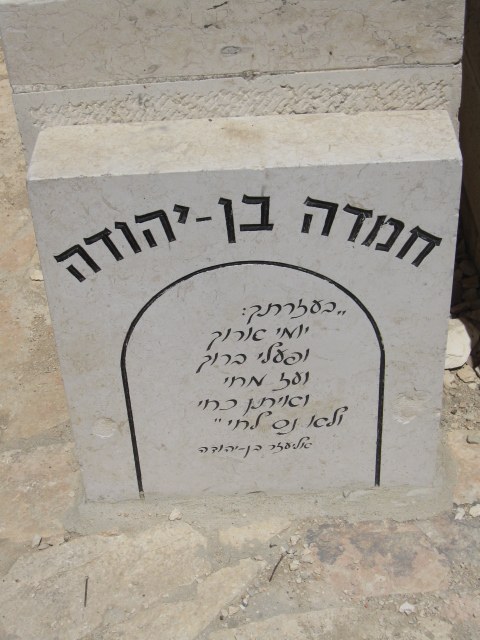
Hemda spent her final days at her home at 28 Ein-Gedi Street in Talpiot, Jerusalem, a house later known as "Ben-Yehuda House." She died in the summer of 1951, aged 78, and was buried in the Sanhedria Cemetery. After the Six-Day War, she was reinterred beside her husband on the Mount of Olives in Jerusalem. His words are engraved on her tombstone: "With your help: my day is long, my work blessed; my vigor is strong and steadfast, and my vitality has not waned."
תגובות
עדיין אין תגובות.