
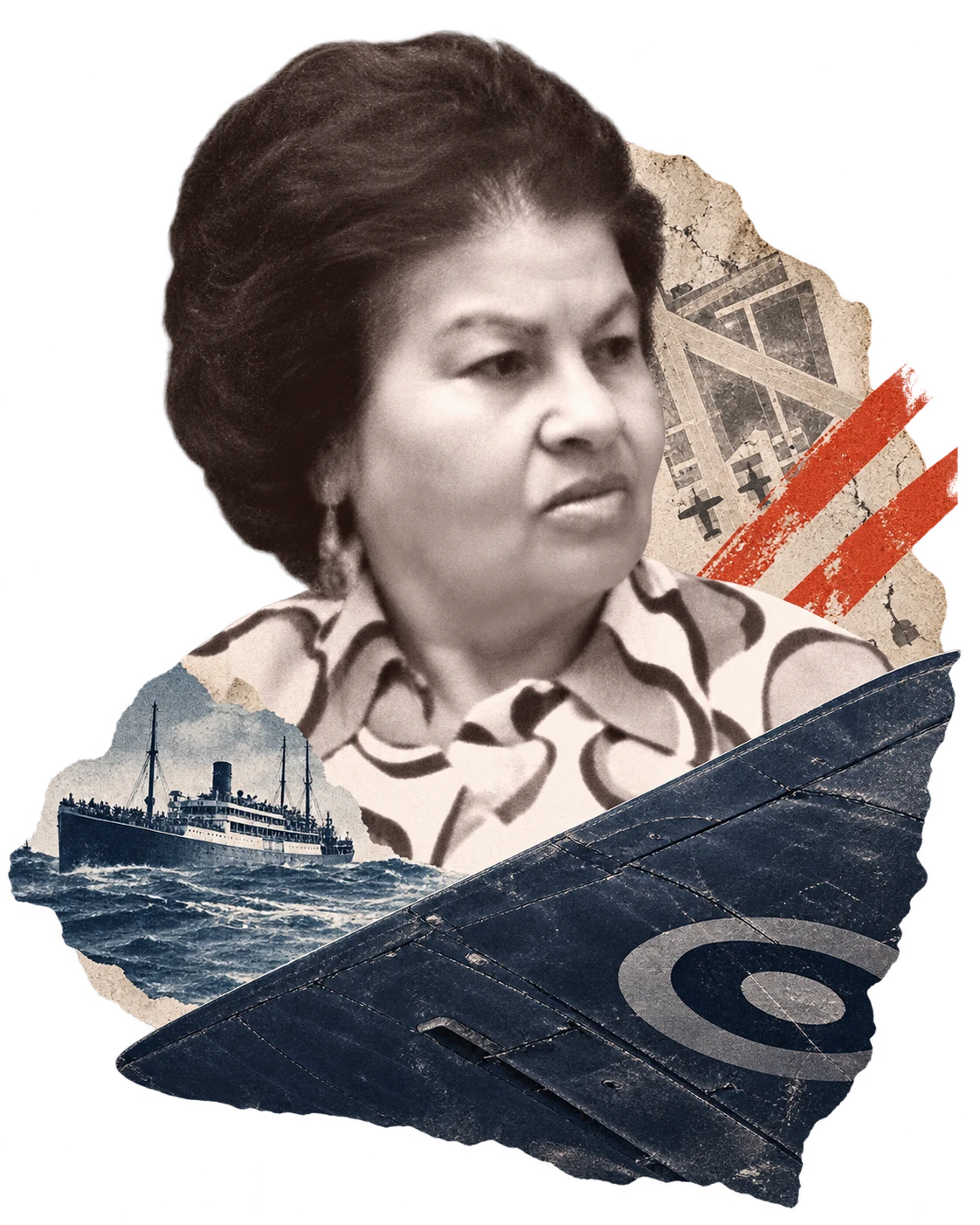
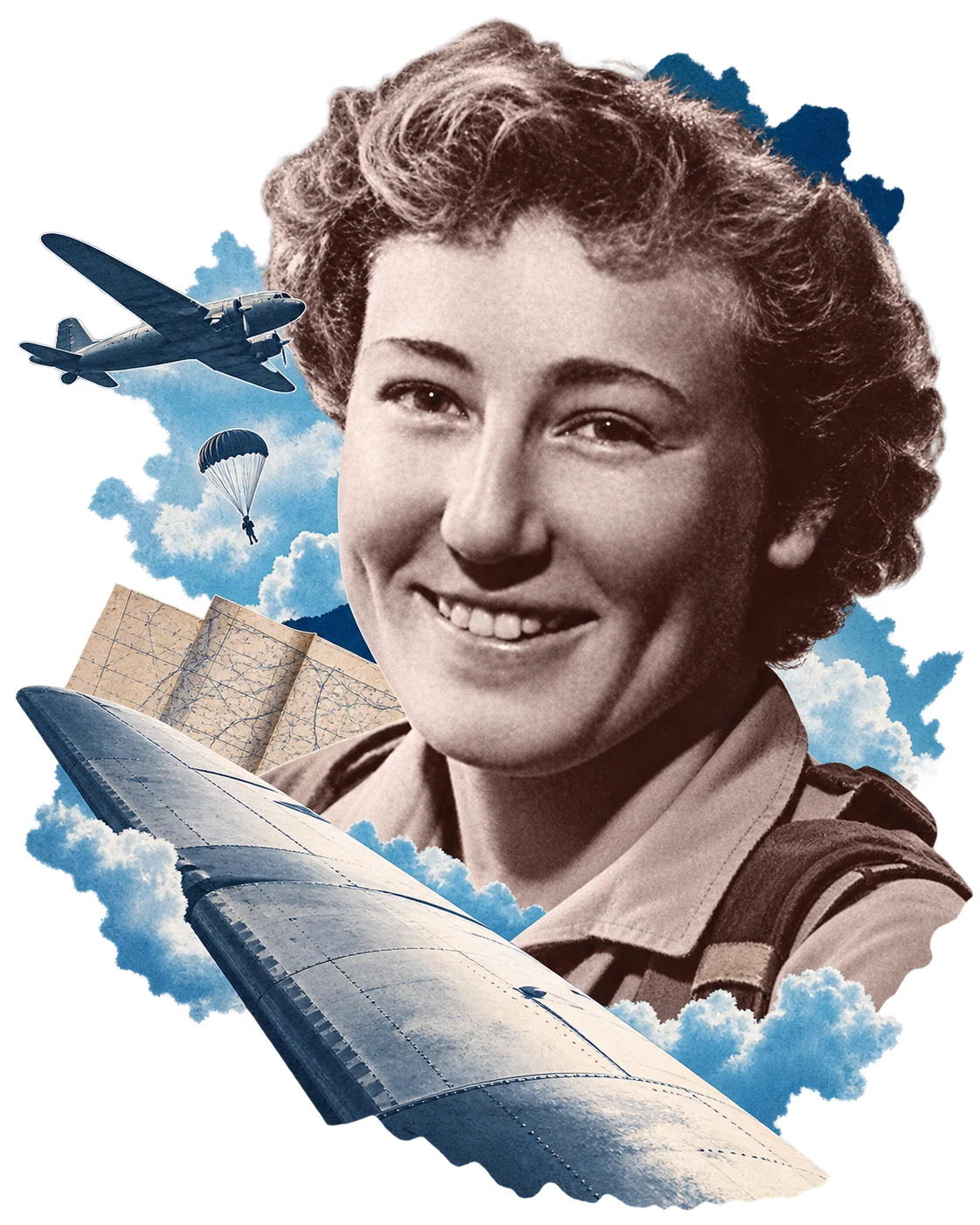
She fought the British with determination and courage, blew up planes involved in spotting illegal immigrant ships, and earned the title "the Irgun's number one female fighter."
The Court-Martial Speech
The three defendants at the British military court denied the court's right to try them. They ignored the charges against them and knew that severe sentences awaited them. They also knew that the eyes of the entire press, both in the country and abroad, were upon them, so they turned the courtroom into a platform for delivering their political messages. And so Dvora Kalfus, the last of the defendants, declared at the opening of the trial, held on June 25, 1946: "Gentlemen, after you sentenced the two young Hebrews, Ashbel and Simchon, to death, they both rose to their feet, stood at attention, and sang our national anthem, 'Hatikvah,' with fervor... Gentlemen: you British do not recognize either our anthem or our flag, and since there can be no nation without an anthem and a flag, your position means that you do not recognize the Hebrew nation. In other words, in this respect you identify with Adolf Hitler... In your stupidity, you assumed that we would accept this and cherish the fleeting lives of condemned slaves rather than fight... If, after two thousand years of exile, the people of Israel still live and endure, then our hope is not lost... If, after a generation of persecution and slaughter, humiliation and degradation, we have been privileged to serve as Hebrew soldiers and to see Hebrew soldiers fighting, weapons in hand, for the liberation of their homeland, then our hope is not lost... Our hope is not lost. Do your rulers, hard-hearted and empty-headed, know what this song means to us and to millions of our brothers? Do they know who sang this song, and where? When the vile Nazi murderers herded our parents, our brothers, and our sisters into the death trains, our martyrs sang 'Hatikvah.' Therefore, know this, gentlemen: we, the Children of Israel, will fight you until the hope of the millions who were slaughtered is fulfilled, because you, together with your partner Hitler, did not recognize their anthem or their flag, and because you stole their homeland. In this war of liberation, our nation has been reborn, and it will force you to recognize it, its right to a homeland, and the symbols of its independence recognized throughout the civilized world. You will recognize the Hebrew nation, whether you want to or not, but you will recognize it..."
Two days later, the verdict was handed down, and twenty-one-year-old Dvora Kalfus was sentenced to fifteen years in prison. At the end of the reading of the verdict, she told them: "In fifteen years, you won't be here to see me in prison." After the verdict was read, all the defendants stood and sang "Hatikvah," joined by the Jewish audience in the courtroom.
Dvora's speech was published and printed in the displaced persons camps. Dov Shilansky, former Speaker of the Knesset, said: "It was as if a biblical heroine were speaking to those who had survived the fire, who so needed to hold their heads high as Jews after the Holocaust."
The Operations That Led to the Trial
Dvora found herself in the courtroom following the attack on the railway facilities. On the night of April 2, 1946, after lengthy planning, the Irgun carried out its plan to paralyze railway traffic and blow up several bridges. That same night, Lehi members also blew up the Na'aman Bridge, south of Acre. It was the Irgun's largest field operation, involving about 100 fighters. The force was divided into three groups: one unit blew up two bridges near Yavne, while the other two operated in the Gan Yavne-Ashdod area.
After completing their mission, the forces operating in the Yavne area began retreating north through the sand dunes. Walking through the dunes was difficult and slowed the column. At dawn, a British plane spotted the last group near Bat Yam and summoned a large force to the area. On the morning of that day, when the fighters set out on the operation, Dvora Kalfus was in Tel Aviv. She decided to head toward the returning forces to meet her younger brother, Yoel, and was captured along with the group. "Bullets flew over my head, but I owe my life to the British sergeant who told his comrades, 'Do not kill the girl.' When the trial was held before the military court, the sergeant was called to testify, and the first thing he said was, 'Where is the girl?'" Dvora recounted.
Thirty-one fighters were captured in this operation, among them the organization's finest commanders. It was a severe blow to the Irgun's combat force (Hak). Dvora was taken to the detention center in Jaffa, and three days later transferred to the women's prison in Bethlehem. Lehi member Geulah Cohen, later a member of the Knesset, was in the same cell as Dvora and wrote of her that she "left her mark on the prison uniform and defeated the prison, its guards, and their sentence." These were just some of Dvora's deeds that earned her the title "the Irgun's number one female fighter."
Dvora Kalfus was born in 1925 in Tel Aviv to a traditional, nationally minded family. When she was ten, the family moved to Ramat Gan. Her parents were active Revisionists, and their support for the Irgun passed on to their children: Nathan, the eldest, was active in illegal immigration, and Dvora's two older sisters were members of Betar before later joining the Irgun. It was clear that Dvora would continue the tradition, and indeed, in 1939 she too joined the Irgun. Three years later, Dvora completed a youth-instructors' course, and a year after that she took a squad-commanders' course at Shuni, near Binyamina. On completing it in 1944, she returned to Ramat Gan to command a girls' squad.
Yaakov Chelibonov, known to his friends as Jaco, was born in Bulgaria in 1925. From a young age, Yaakov was a member of the Maccabi Hatzair movement and witnessed the Nazi invasion of Bulgaria. At the age of nineteen, he read Jabotinsky's writings in Bulgarian and became an ardent Zionist. He decided to leave his family and immigrate to the Land of Israel. He crossed the border alone and made his way to Turkey, where he met Akiva Levinsky, who introduced him to Eri, Jabotinsky's son. Levinsky and Jabotinsky told him about the horrors of Auschwitz and the extermination camps. When Yaakov asked, "Why didn't the Jews flee to the Land of Israel?" the two replied that the British had closed the country's gates. When they told him about the harsh restrictions of the White Paper and he asked, "And why aren't they fighting the British?" Eri Jabotinsky told him that the Irgun had been established in the country, with the fight against the British inscribed on its banner. The two gave Yaakov money, and he continued by train to Beirut. In 1944, he arrived in Haifa.
The attack on the railway facilities in April 1946 was not Dvora's first operation. Her first operation was in October 1944, when she "confiscated" textiles from British government warehouses, intending to sell them and fund Irgun operations. Dvora's task was to persuade the truck drivers who had been hired to transport the textiles to abandon their trucks. Mordechai Tzipori, a former deputy defense minister who took part in the successful operation, said that one of the drivers, despite his anxiety, could not stop marveling at the daring girl with the long braid.
Six months later, Dvora joined four fighters whose mission was to blow up the oil pipeline from Iraq to the Haifa refineries. The timing mechanisms were made from bottles containing sulfuric acid. On the way to Haifa, the bottles were in Dvora's bag, but unfortunately acid spilled from one of them and burned her leg. Despite the pain, Dvora kept walking with the fighters. When the mission was over, she returned to Tel Aviv by bus and was not treated until the following day. The next operation she took part in was in December 1945, when Dvora was among the fighters who attacked British army facilities at the site where the Tel Aviv Expo Center now stands.
When Dvora was not taking part in operations, she worked for the National Workers' Organization in Ramat Gan, finding work for unemployed Irgun members.
When Yaakov Chelibonov joined the Irgun, he changed his name to Yaakov Nehushtan, because of his hair color. In his first mission, he took part in the bombing of the Bat Galim police station. He received his next assignment from Shimon Shechter, who instructed him to take another comrade and travel to Kfar Ata, where they would be given a sack of explosives. After the two collected the sack, they were on their way to the bus stop when they were caught by Gaffirs, Jewish policemen serving the British, and transferred to Acre Prison. Yaakov later discovered that members of the Haganah had turned him in.
The most impressive and important operation Dvora Kalfus took part in was the attack on the military airfield at Lydda. This operation against the British planes involved in spotting immigrant ships was coordinated with Lehi and formed part of an attack on three airfields. Dvora recounted: "The operation at Lydda was so interesting and so nourishing to the soul... I was a unit commander responsible for first aid... The walk was very difficult because there was deep mud everywhere. You put your foot in the mud and can't pull it out. In the end I took off my shoes, tied them around my neck, and walked barefoot. The boys saw this, and some of them did the same..."
Eleven military aircraft were destroyed in this operation. That same night, two other military airfields were attacked: at Kastina (Tel Nof), Irgun fighters destroyed twenty planes, and a Lehi unit attacked the military airfield near Kfar Sirkin and destroyed eight more planes.
Life After Release
From Acre Prison, Yaakov Nehushtan was transferred to Eritrea. Members of the underground movements were imprisoned in Africa for four and a half years, among them many who would later lead the country: Meir Shamgar, Yitzhak Shamir, Eliyahu Meridor, and Mordechai (Motke) Tzipori. Fifty-four Irgun and Lehi members tried to escape through a tunnel they had dug, but were caught and returned to prison. When the State of Israel was declared, the prisoners returned to the country by ship. Their families and friends were waiting on the shore, including Dvora Kalfus, who had come to welcome her brother. No one was waiting for Yaakov Nehushtan, but he met Dvora. He recalled: "I was impressed by her, and afterward I kept looking for her to get closer to her, and then we fell in love." Yaakov Nehushtan and Dvora Kalfus married and had two sons.
Dvora helped establish the Tagar Institute for National Education, was one of the initiators of the exhibition on the women imprisoned in Bethlehem at the Underground Prisoners Museum in Jerusalem, chaired the government committee for Prisoners of Zion, and received the Yakir Yerushalayim (Worthy Citizen of Jerusalem) award. Yaakov Nehushtan became a lawyer, a member of the Knesset, a political envoy in Washington, and Israel's ambassador to the Netherlands.
The son of Yaakov and Dvora is Ido Nehushtan, former commander of the Israeli Air Force (2008-2012). In 1997, Ido Nehushtan commanded Hatzor Airbase, one of the bases his mother had tried to blow up.
תגובות
עדיין אין תגובות.