
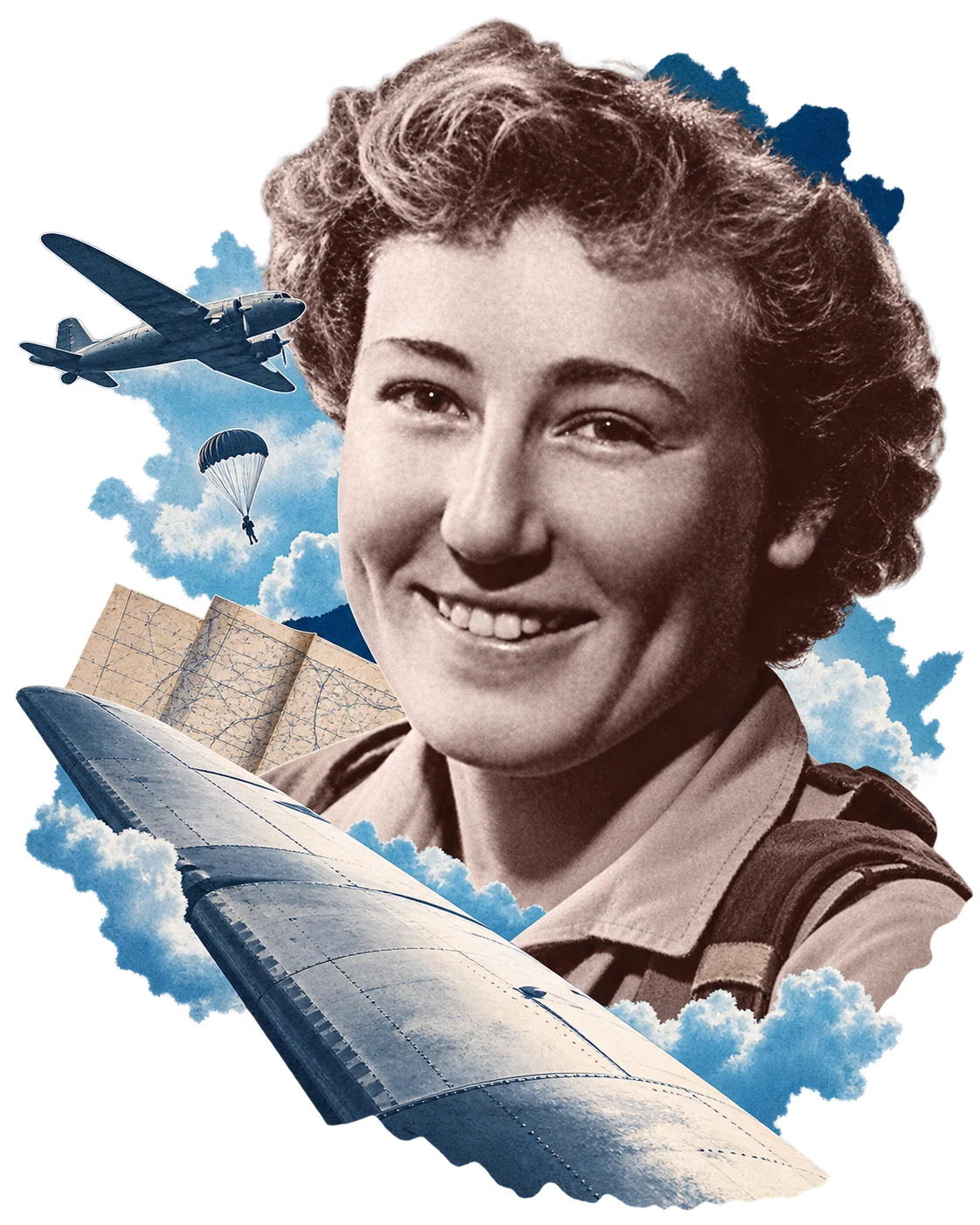
This is the story of the first woman to complete the Air Force flight course, and of a few of the operations she took part in. The story of
The Drop into the Mitla Pass
The tension in the air was immense. Sixteen Dakota aircraft stood ready on the runway. The aircrews moved among the troops boarding the planes. At exactly 3:00 p.m., the aircraft took off, formed a 4X4 formation, and flew east from Tel Nof toward Beersheba and the Dead Sea - maintaining radio silence and flying low...
The previous evening, the 890th Battalion had gathered in the canteen hall to hear from its commander, Rafael Eitan (Raful). The entire battalion sat silently on the floor. Raful stood before them and, as was his way, said just a few words: "We are about to carry out the first parachute operation by a Jewish army in history... Everyone who gets out of the plane and has his parachute open should look down, find a road junction, and head for it... As day approaches, in the morning, we will begin to come under sniper fire and bombardment. Anyone who doesn't dig in is finished... What we have with us is all we have. Every sip of water you drink is one less for you later. There are no wells there - it's a desert... This is the first time the unit is parachuting into battle, not into exercises on the sand... Discipline, willpower, and endurance, and we'll carry this out without a hitch. Any questions?"
The formation continued on its way to Sodom and Hatzeva. From there it headed toward the Ramon Crater and Nahal Paran, and at 4:30 p.m. the planes crossed the border into Egypt, westward, parallel to the Kuntilla-Mitla road. As the aircraft approached their target, each group of four climbed to parachuting altitude. The lead navigator, Eyal Achikar, was on plane No. 1, with squadron commander Yaakov Avisar and co-pilot Yael Rom (Finkelstein). As soon as Yael Rom's call rang out over the radio - "Green, green, green" - the first parachute canopies began to open. This was the beginning of the Battle of Mitla, which earned those who took part in it a parachute wings pin with a red background.
Yes. It was Yael Rom who, with her call of "Green, green, green," supposedly gave the signal to begin the battle.
The Air Force's First Woman Pilot
Yael Rom was the first woman to complete the flight course in the Israeli Air Force. Yael's story inspired many women to apply for the flight course, and some of them completed it. Batya Orani, who made history in her own right as the Air Force's first woman navigator, said, "I met Yael at Sirkin Base during the preparatory stage of the navigator course." Orani was also on the flight that carried the paratroopers into the Battle of Mitla: "Yael and I waited for special permission from the IDF chief of staff to take part in the operation, while the paratroopers sat in rows along the sides of the planes and we were already wearing our flight suits and had all our equipment on. At the last moment, permission came through, and we took off in a formation of four. We flew for four nights during the operation and evacuated the many wounded."
Yael Rom was a graduate of the fifth flight course of the Israeli Air Force. She completed the course in 1951. About 100 cadets began the course, but only 18 earned their wings. Yael Rom spoke of those days: "We had no idea which of us was, or would become, a good pilot, because most of the instructors thought they had to be tough and 'squeeze the life out of us.' To their credit, they succeeded: with determination, persistence, and extreme rigor in matters of academic and military discipline, they laid the foundations for the flight schools of generations to come." In the Air Force journal, Yael described the course: "The course wasn't easy for us. For a whole year we worked hard and lived in constant fear of being dismissed for not measuring up. Every time we were summoned to fly with the school commander or one of the examiners, we were terrified, and every day we watched our ranks grow thinner... But we all knew who the star of the course was, because his instructor never missed an opportunity to sing his praises. How did we survive and even succeed in such a tough system? I think we drew our strength from our love of flying, which grew stronger as we progressed through the course. I had a close-knit trio of friends: Mordy, Lasi, and Yankele Agassi, who took me under their wing at the beginning of my basic course and stayed with me until they graduated, in August 1951. They deserve my thanks. We spent all our free time together until lights-out, sat together in the dining hall, read a chapter of the Bible together every evening followed by a story by Damon Runyon, and went on trips around the country whenever we could. A dear friendship." Yael Rom was born in Tel Aviv in 1932. She enlisted in Gadna, the pre-military youth corps, and while waiting to be assigned to a company commanders' course in Gadna, two flight instructors suggested that she take the screening tests. Rom took them and passed. She went on to the basic course, and at its conclusion ranked second among the graduates and was assigned to a course for twin-engine aircraft. Rom later returned to instruct in Gadna Air, the aviation branch of the pre-military youth corps, and in 1953 her efforts to return to the Air Force as a transport pilot succeeded. She thus became the first woman pilot in the Israeli Air Force. Yael Rom was the first woman in the Western world to complete a full military flight course and qualify as a captain in the first half of the 20th century. She qualified to fly seven types of aircraft and was the first woman pilot to fly an operational mission beyond enemy lines, as well as the first to fly aircraft for a civilian airline, Arkia. She served in the Air Force for ten years, first in compulsory service and later in career service and the reserves, in transport and parachute-drop roles. At 24, as a lieutenant in the reserves, Rom was one of the two pilots in the Dakota that carried the paratroopers under Rafael (Raful) Eitan's command to Mitla in Sinai. In the same operation, Rom also flew the paratroopers under Mota Gur's command on a mission to At-Tur and served as co-pilot of the first plane to land in Sharm el-Sheikh.
In 1962, after becoming a mother, she was forced to leave reserve service. Throughout her life, Rom worked to advance the status of women in Israel and women's sports. She served as the prime minister's adviser on women's affairs and, in the late 1980s, ran for mayor of Haifa on behalf of Likud. She devoted her later years to advancing women and also initiated the Na'aleh project, which encouraged girls to study engineering.
Yael Rom was married to Yosef Rom, a professor of aeronautical engineering who served as a Likud member of the Knesset. They had three children: their daughter Vered Rom-Kedar is a professor of mathematics who headed the Department of Computer Science and Applied Mathematics at the Weizmann Institute of Science from 2014 to 2016; their second daughter, Dalit Rom-Shiloni, is a professor of biblical studies at Tel Aviv University; and their son, Rami Rom, holds a doctorate in chemistry and is a patent attorney.
On May 24, 2006, Yael Rom died of cancer at the age of 74.

תגובות
עדיין אין תגובות.