
One of the most glorious and best-known battles fought by the IDF during the Six-Day War was the battle for Ammunition Hill. 15 commendations, one song, and a sentence that became a legend.
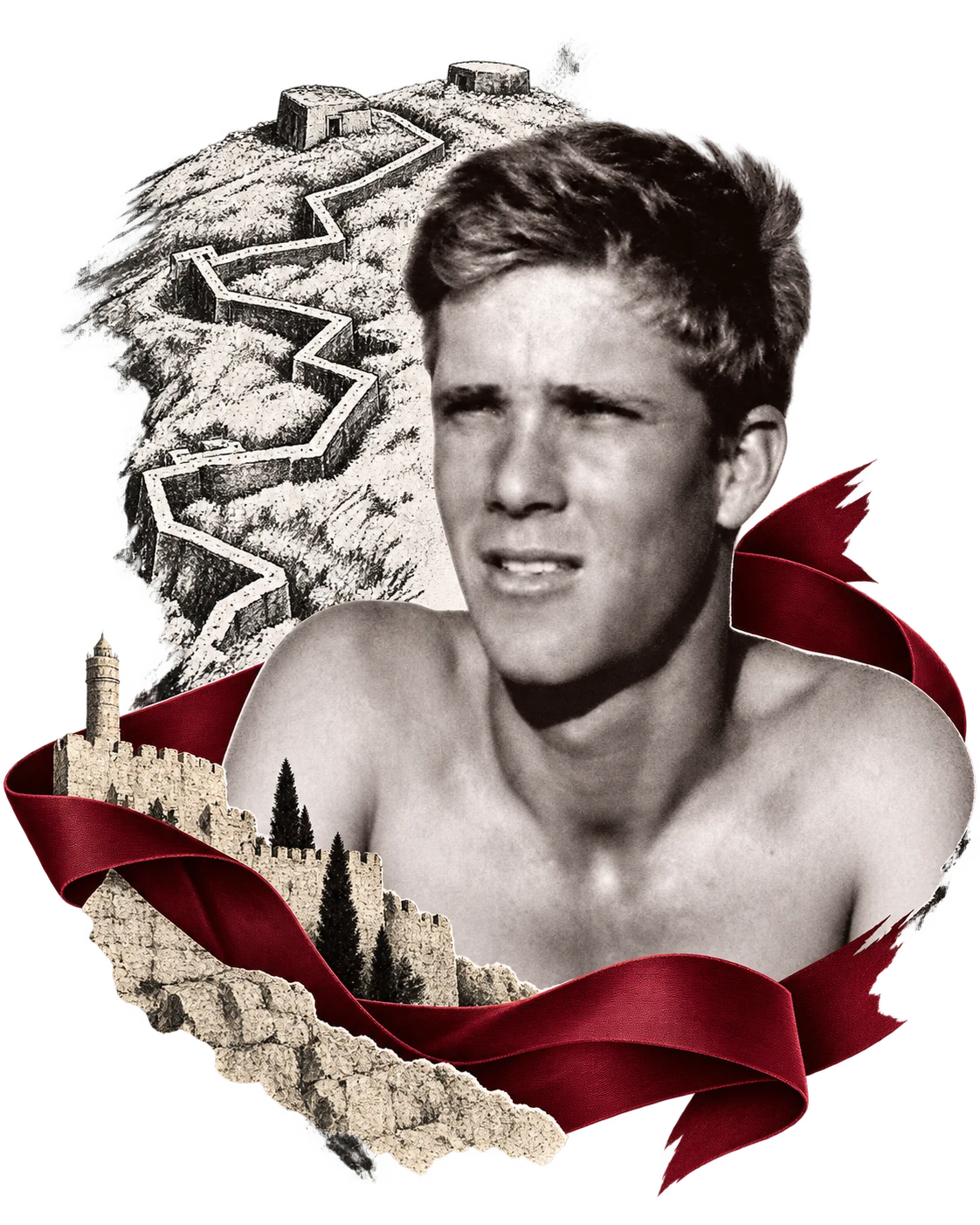
Eitan Naveh
Background to Ammunition Hill
The Ammunition Hill compound was built by the British in the early 1930s. It was a bunker for storing ammunition for the adjacent police academy. When the British left, Irgun forces took over the compound. In May 1948, the Jordanian Legion captured it from the Irgun. The capture of the hill severed Mount Scopus from the Jewish community, and for about 19 years the mountain remained an Israeli enclave.
Ammunition Hill was part of the city's fortification system. The Ramat Eshkol and Ma'alot Dafna neighborhoods were built on the slopes of the hill, and government offices and the national headquarters of the Israel Police were established not far away.
After capturing Ammunition Hill, the Jordanians fortified it relentlessly. It was a formidable outpost with three lengthwise trenches: western, central, and eastern, all leading to the top of the hill. Cross-trenches connected the lengthwise ones, and between them were forty well-fortified, carefully camouflaged positions, each covering the others. The hill was surrounded by four barbed-wire fences, with mines laid between them. The Givat Hamivtar outpost to its north commanded the entire hill, allowing Jordanian soldiers to hit anyone who entered it.
The assessment was that Jordan would not enter the war, and the General Staff had not prepared any offensive forces. The 55th Paratroopers Brigade, commanded by Mordechai (Motta) Gur, was supposed to parachute behind the Egyptian lines in the al-Arish area. But the Air Force's strike in the opening hours of the war made the brigade's mission unnecessary, and it was decided to attach it to Central Command for the battle for Jerusalem. The campaign for Jerusalem involved Air Force units and soldiers from three reserve brigades: the Jerusalem Infantry Brigade, the Harel Armored Brigade, and the 55th Brigade.
Eitan Naveh on His Way to the Paratroopers
Eitan Naveh was born in June 1944 to Walter and Clara Hanau, who had met at a training program in Germany and immigrated before Hitler had gained power. They first lived in Petah Tikva, then moved to Kibbutz Givat Hashlosha. Eventually, they settled in the moshav of Moledet and took up farming. There, too, they changed their surname to Naveh. Eitan was a child who loved exploring the outdoors, and school was not his favorite place. At just 10 years old, he began working on tractors and showed a talent for mechanics and technology. His brother would bring him engine parts, and Eitan would build go-karts from them. He grew into a very strong man. People said that when he thrust a pitchfork into a bale of hay, he could fling it over all the other bales on the wagon.
When the time came for him to enlist, it was clear that the strong, blond young man would join the paratroopers. He was a highly motivated fighter. Seven months after enlisting, Eitan was wounded and transferred to Chorazim (Almagor), where he met Shalva, a Yemenite soldier from Rishon LeZion. Shalva recalled: "We were the attraction in Chorazim. A Yemenite woman walking around with a blond man - it certainly turned heads." Eitan and Shalva married in 1964, and their friends joked, "Eitan caught Shalva - and found his peace." A year before the wedding, during the hot month of August, a fire broke out in the Almagor area, and Eitan received a commendation from the brigade commander for his part in putting it out. After his service, they returned to Moledet, where their son Doron was born.
Uzi Narkiss, the commanding general, presented the 55th Brigade with its new mission: to break through the urban line and create a continuous territorial link to the enclave on Mount Scopus. The main objective was the police academy and the adjacent Ammunition Hill outpost. On the eve of the war, the Jordanians reinforced the outpost, bringing its strength to 150 soldiers.
Eitan Naveh was called up for reserve duty three times a year. His friend Amnon Neubach said that Eitan was "the sort of man who would take a canteen off his webbing to make room for another magazine." While others fell asleep at night and collapsed into their sleeping bags, he cleaned his machine gun. He kept pestering his commanders to get him a kit bag and cleaning rods. "Otherwise the machine gun won't work," he warned them again and again. Eitan came home to celebrate his birthday. Five days later, he took part in the battle for Ammunition Hill.
The Assault on the Compound
Yaki Haimovich (Hetz), who was then a private in Platoon 2 of Company C, 66th Battalion, Paratroopers Brigade, recalled the preparations to capture Ammunition Hill: "At ten at night, we arrived for an initial briefing from the platoon commander, and it turned out there was no intelligence. They simply knew nothing."
As Yoram Taharlev wrote in his song, the battle began at two-thirty. The 66th Battalion of the 55th Brigade launched an assault on the police academy and Ammunition Hill. Company D broke into the police academy, while Company A passed them and moved east. Company B turned north and entered a trench, and the soldiers of Company C followed them to continue the fighting in the dark. Heavy Jordanian fire poured from the bunkers and cross-trenches, creating an area that would later be called the "Triangle of Fire." Soldiers from Company D entered the central and eastern trenches. One squad charged toward the sources of the fire, and all its fighters were hit. Company B, called in again to help clear the trenches, came under fire, and only nine fighters remained.
Later, the force commander, Captain Nir Nitzan, recalled: "We stopped in the trench to regroup when suddenly a grenade was thrown at us from outside. It exploded right beside us, and by a miracle none of us was hurt. I was gripped by the fear that the Jordanians running around outside would start pelting our trench with grenades and turn us into pieces of human flesh. We had to stop them, and to do that one of us had to jump out of the trench and see what was happening in the area. When I sent Eitan, deep down I knew I was sending him on a hopeless mission, but I still hoped he would come back alive. There was no time then to ask who was willing to volunteer and go on the mission. Eitan was known as the man to turn to for any rescue or serious problem that arose in the field. When he heard the order, he didn't hesitate for a moment. Armed with his light machine gun, he sprang to the edge of the trench and began running forward along it, drawing the enemy's fire and unleashing a hail of fire that kept anyone with a grenade launcher at bay. The volume of fire Eitan produced was truly insane. So was the speed at which he changed magazines. He fired at the openings of the bunkers inside the trench and didn't stop until he was hit by a bullet in the head and killed. Only later did Eitan's comrades count more than thirty bodies of Jordanian soldiers, and then we realized how much bloodshed he had prevented among our men."
Eitan Naveh probably had a feeling that this time he would not return from the battle. In his last letter to his parents, he wrote: "We are about to set out. We - the paratroopers - hope to return home safely. We are ready for any order we are given and waiting for the decisive moment. We won't let the team down. There is plenty of courage. Best wishes to the whole family, and see you again, from your son, who loves you and hopes to return home safely. Yours, Eitan." To his wife and son, he wrote: "Shalva and Doron, hello. I feel fine and there are no problems. If there are any, we'll deal with them. There is simply no choice; you have to go where you don't want to. Shalva, I would want Doron to have a father. So if I don't come back, act accordingly. I simply don't know where this will end. I hope it will end well, as we all would like."
One of the fighters' biggest problems was the long weapons, which made it impossible to fight in the narrow trenches. The commanders who ran forward were the first to be killed, and the privates took their places, just as the song describes:
And no one asked where they were headed / The first man to go fell there / You needed a lot of luck / On Ammunition Hill. Those who fell were dragged behind / So they wouldn't block the way / Until the next one fell in line / On Ammunition Hill.
Many of the commanders fell, and one of the battle's nicknames was "the Battle of the Privates."
The fighters continued advancing through the trenches and outside them. The soldiers fought courageously in the central trench until they reached the central bunker and captured it. At sunrise, the soldiers of Company B returned, accompanied by two tanks. They spread out among the trenches and entered the western trench. The fighting was fierce, but they continued advancing until they overcame the Jordanian force, which had also fought with great courage. At 06:15, the battle ended, and the way to Mount Scopus was open.
The Battle Immortalized in Song
At the end of 1967, as Independence Day approached, Yoram Taharlev was approached by Danny Litani, then director of the Central Command entertainment troupe, and asked to write a song about the paratroopers. Around that time, the poet came across an issue of the newspaper Bamachaneh containing accounts of the battle by those who had received decorations. Yoram Taharlev decided to write a song interwoven with quotations from the fighters' words. He used the soldiers' words without changing them, apart from a few small cuts, and incorporated them into the song he wrote. "The aim was to describe the battle as the fighters saw it. Almost none of the songwriters had been in the battle, and they tried to describe things that were more about feelings or an image of the battle. I wanted to describe the battle so it would remain as a document," Yoram Taharlev explained.
The part of the song describing Eitan's heroism comes from the account of his commander, who sent him to cover the force. "Eitan was one of the stories that struck me as very dramatic. It was a very chilling story, and that's why I put it in the song. It contains authentic testimony, written by soldiers and not poets, and I think that's the song's strength," he explained.
Yoram Taharlev brought the song to his regular composer, Yair Rosenblum, who wrote a melody for it that made it one of a kind. There had never been a song like it, certainly not among military entertainment troupes. It was 5 minutes and 45 seconds long. The Central Command entertainment troupe performed it. Kobi was given the honor of reading the battle accounts. One of the passages ends with a sentence that became a saying: "I don't know why I received a commendation. All I wanted was to get home safely." The sentence is attributed either to Shalom David or to Yaki Haimovich (Hetz), mentioned here.
Thirty-six paratroopers fell in the battle for Ammunition Hill, and 15 of the soldiers who took part in it received decorations for acts of courage and heroism. The Jordanians lost 71 fighters.
Eitan Naveh was 23 when he fell. A few months later, the IDF Chief of Staff awarded him a commendation for his part in the battle, recognizing his "act of bravery and daring in battle." The commendation later became the Medal of Valor. When Eitan fell, he left behind a wife and a nine-month-old baby. His commander, Captain Nir Nitzan, received the Medal of Distinguished Service.
תגובות
עדיין אין תגובות.