
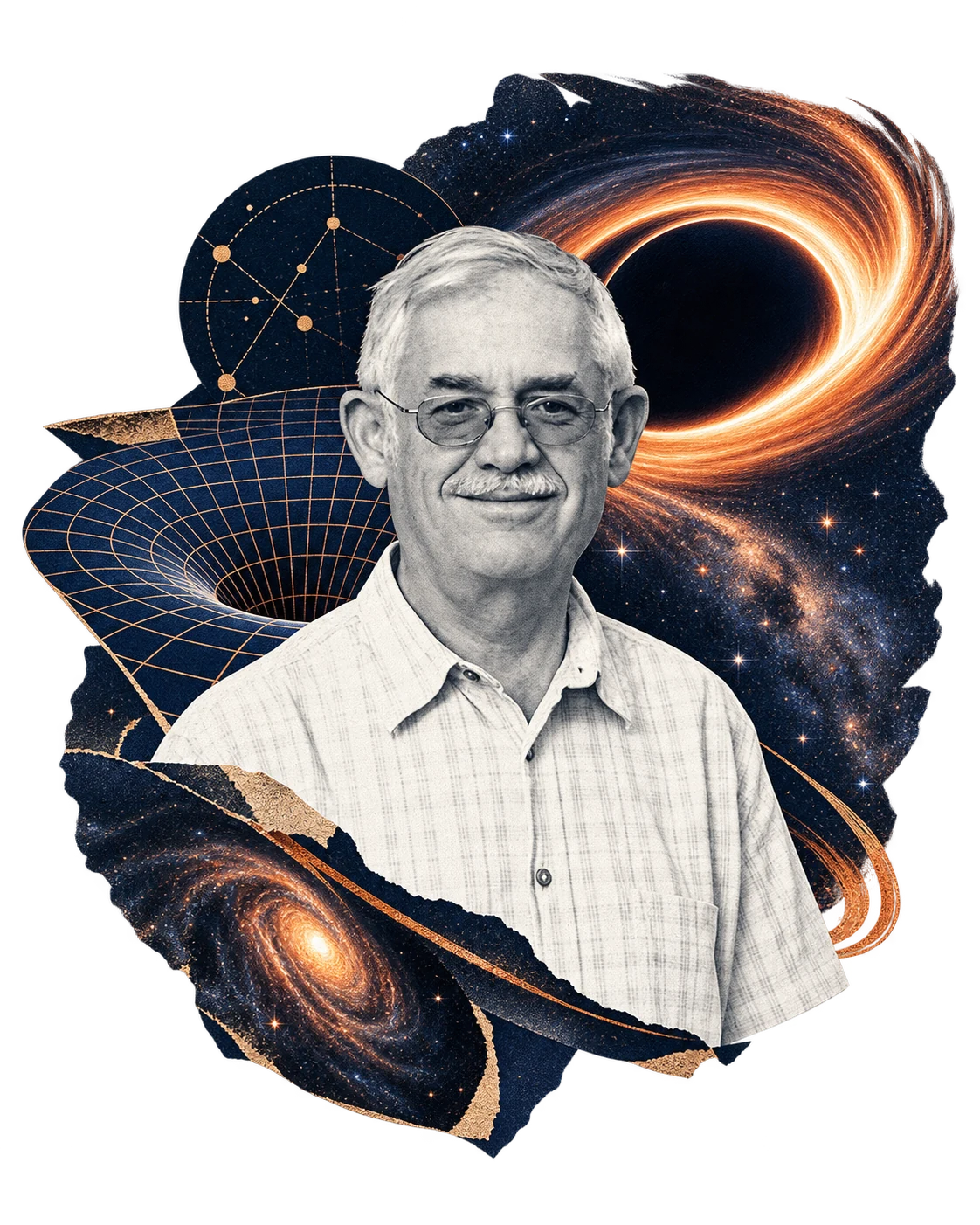
A brilliant, observant Jewish Israeli physicist who stood firm against those who opposed his ideas, foremost among them the astrophysicist Professor Stephen Hawking, and proved that his theory of black holes was correct and well-founded.
Entropy, Time and the Expanding Universe
In a series of pioneering papers, Jacob David Bekenstein proposed a direct, profound, and unexpected connection between the geometry of a black hole's event horizon and the concepts of thermodynamic entropy and information theory. If at this point you're asking for a translation into plain English or looking for an escape hatch, you belong to 99.9% of the world's population. My challenge is to make these obscure lines clear by the time you finish reading this article, at the level of "Aha..."
Let's start with the concept that will accompany us throughout: 'entropy,' or, in simple terms, 'natural messiness.' Nature has an unwritten rule: things always tend toward maximum messiness. Think about your room: if you don't actively tidy it, it will become a complete mess. In physics, this mess is called entropy. When the room is completely messy and cannot get any messier, it has reached 'peak messiness.' Scientists call this state 'thermodynamic equilibrium.'
According to the Big Bang theory, the universe began in a dense, hot state, with all its matter mixing immediately and reaching peak messiness in the very first second of the Big Bang. This is where the problem, or paradox, arose: if the universe began already at peak messiness, how did it continue to develop? After all, according to the laws of nature, time moves forward only as messiness increases. If we reached the peak at the very beginning, time should have 'stopped,' and no order should have formed: no stars, no galaxies, and no humans.
The answer to the paradox proposed by Jacob Bekenstein was that the universe is expanding. That same messy room, now transformed into a gigantic hall, is no longer at 'peak messiness,' because space has been created that allows matter to rearrange itself and form stars and entire systems. From this, it follows that as the universe continues to grow, the potential for messiness grows too. This is what allows the universe to keep developing, and what creates the 'arrow of time.' We have a clear sense that there is a past, when the universe was smaller and more concentrated, and a future, in which it continues to expand. Naturally, it seems to us that time moves from the past toward the future; we remember the past and worry about the future. But this is not how things are for the strange group known as physicists. From their point of view, the direction of time can be reversed, and there is no difference between past and future. One could say that Jacob Bekenstein's solution even allows physicists to worry about the passage of time.
The Event Horizon and Black Holes
Jacob also worked in another field with a clear timeline: black holes. A black hole is a place in space where the force of gravity is so strong that nothing can escape it, not even light. Imagine a boat sailing down a river toward a huge waterfall. The closer it gets, the stronger the current becomes. There is a certain point beyond which, even if the boat's engine were running at full power, the current would be too strong and the boat would be swept over. A black hole has a similar 'point of no return.' Since even light, the fastest thing in the universe, is not fast enough to escape from there,
that point of no return is called the 'event horizon' (Event Horizon). It is like an invisible line at sea, beyond which we cannot see because the Earth is round - that is the horizon. Events are anything that happens, such as a light turning on, a spacecraft moving, or simply matter falling. The event horizon is the boundary where the universe accessible to us simply ends. This place appears completely dark to us - a black hole. These holes form when a giant star, much larger than our Sun, reaches the end of its life and collapses in on itself. All the star's enormous mass is compressed and crushed into a tiny point, creating this tremendous gravitational pull. In effect, it is the most powerful vacuum cleaner in the universe, surrounded by absolute darkness because it does not allow even light to escape and tell us what is inside. In the early 1970s, the scientific community regarded black holes as simple, completely cold objects, and even called them 'Frozen Stars.' The prevailing assumption was that entropy, or disorder, was irrelevant to these gravitational objects, since just three observable geometrical parameters were enough to fully characterize them.
At first, Bekenstein encountered staunch opposition from the giants of his generation, foremost among them the rock star of physics, Stephen Hawking. But he proved that black holes define an arrow of time, since their future lies in the direction in which they grow larger.
Bekenstein's Academic Career
Jacob David Bekenstein was born in May 1947 in Mexico City. His parents, Joseph and Esther (née Wladislawotsky), were Polish Jewish refugees who fled war-torn Europe on the eve of World War II and found refuge in Latin America. In the early 1960s, the family moved to the United States. Their first stop was Texas, after which they moved to New York, where Bekenstein received a rigorous education in the exact sciences. Bekenstein began his undergraduate studies at the Polytechnic Institute of Brooklyn and received a Master of Science (M.Sc.) degree in physics in 1969. He pursued his doctorate at Princeton University under the guidance of the renowned physicist John Archibald Wheeler, who was known for his unconventional way of thinking and for coining scientific terms that became part of the established vocabulary, including 'black hole.' Wheeler immediately recognized the young student's talent and directed him toward research into the theoretical foundations of extreme gravitational physics. In 1972, Bekenstein completed his doctorate on black hole entropy and presented the world with his three most influential papers, written during this period.
After receiving his doctorate, Bekenstein moved to the University of Texas at Austin, where he was a postdoctoral fellow at the Center for Relativity from 1972 to 1974. During these years, he deepened his investigations into gravitational physics and examined the interplay between quantum fields and curved spacetime. In 1974, driven by a sense of national belonging and deep Zionist convictions, Bekenstein decided to fulfill his dream and immigrate to Israel. He joined the faculty of the Department of Physics at Ben-Gurion University of the Negev in Beersheba. His immigration and work in the Negev contributed greatly to establishing research in general relativity and astrophysics in Israel, at a time when these fields were still in their infancy in the country. In 1978, at just 31 years old, he was promoted to full professor. In 1983, he was appointed head of the university's Department of Astrophysics, while holding the prestigious Robert and Jean Arnow Chair in Astrophysics until 1990.
In 1990, Bekenstein moved to the Hebrew University of Jerusalem, where he joined the Racah Institute of Physics as a full professor and became a prominent academic leader. In 1993, he was appointed head of the university's Department of Theoretical Physics, and later held the Michael Polak Chair in Theoretical Physics. During his years working in Jerusalem, Bekenstein devoted enormous effort to teaching and became an object of admiration for his ability to simplify any complex subject and make it accessible to his students. During 2010-2009, he was a visiting scholar at the Institute for Advanced Study (IAS) in Princeton, where he again collaborated with leading theoretical physicists from around the world.
Professor Bekenstein, much like Professor Yeshayahu Leibowitz, knew how to combine science and religion and saw no contradiction between his scientific worldview and his belief in God. He was often quoted as saying: "I look at the world as the product of the work of the Holy One, blessed be He. He established very specific laws, and we take great pleasure in discovering them through scientific work and seeing how everything fits together." Jacob married Bilhah, and they had three children: Yehonadav, Uriah, and Rebecca, all of whom followed in their father's footsteps and pursued scientific careers. His son, Yehonadav Bekenstein, later joined the Faculty of Materials Science and Engineering at the Technion in Haifa as a faculty member.
In the summer of 2015, during an academic visit to Helsinki, Professor Bekenstein unexpectedly died of a heart attack. His death left an immense void in the international and Israeli scientific communities.

תגובות
עדיין אין תגובות.