
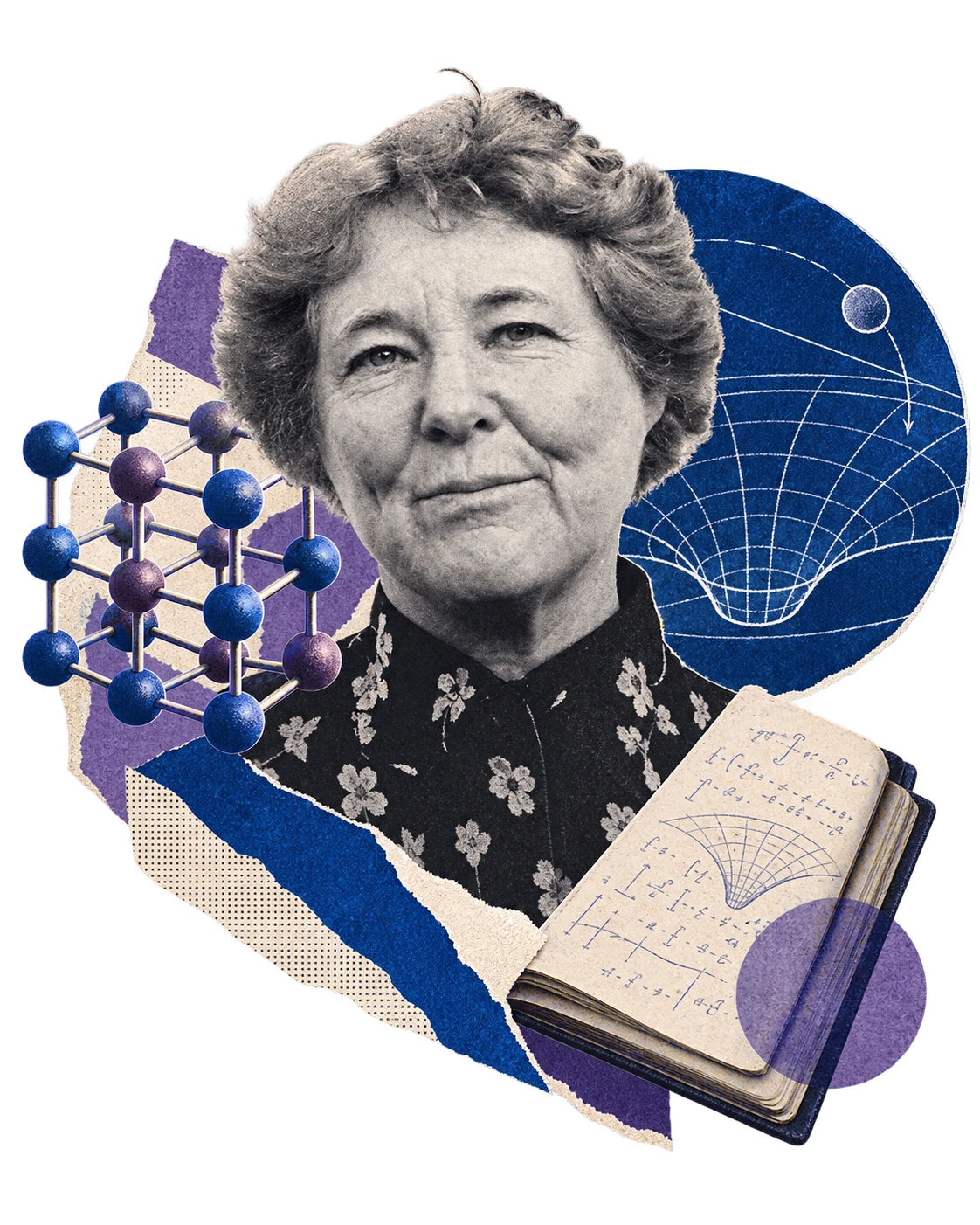
The Israeli mathematician and physicist who became Albert Einstein's last research assistant, Lars Onsager's partner in solving one of the most complex problems in statistical physics, and a key figure in building the scientific infrastructure of the young State of Israel.
Einstein's Miracle Year
The year 1905 was extraordinarily exciting for the physics community, so much so that it bestowed on it the honorary title of the "miracle year" (Annus Mirabilis). At the time, Albert Einstein, just 26 years old, was working as a junior clerk at the patent office in Switzerland. Despite his modest position, that year he published four scientific papers that completely changed the face of modern physics. One of the most groundbreaking papers concerned the "special theory of relativity" and appeared in June 1905.
Until that moment, the world was seen as a rather boring place from a physical standpoint: time flowed at a constant pace and along a single axis, while gravity seemed like a kind of large, flat magnet pulling objects toward it. Then Einstein came along and proved that none of this was true. He discovered that the faster you move, the more slowly your own time passes relative to someone standing still. He also established that there is an absolute limit in nature that no one can exceed - the speed of light. At the same time, he laid the groundwork for the world's most famous equation: E=mc². The equation teaches us that energy and matter are actually two sides of the same coin. Even a tiny amount of matter contains an enormous, unimaginable quantity of energy.
General Relativity
Ten years later, Einstein expanded his theory to include gravity. In November 1915, he presented the final equations of the "general theory of relativity" to the Prussian Academy of Sciences. In his groundbreaking treatment of space and time, he revealed that gravity is not a magnet, but that the universe works like a stretched rubber sheet.
He explained this with a simple image: If you place a heavy ball, like the sun, on the sheet, it will create a dip. If you roll a smaller ball, like Earth, nearby, it will "fall" into the dip and begin to orbit the heavy ball. This description shows that gravity is not a mysterious, invisible "pull," but simply the result of heavy objects physically bending the space around them.
If you've managed to make it through the scientific explanations so far, you're probably wondering how this affects our lives. You might be surprised to learn that relativity didn't just change what physicists scribble on the blackboard - it physically changed the world we live in, from the technology in our pockets to our deeper understanding of where we came from and where the universe is headed.
The most obvious example we encounter every day is our ability to navigate using GPS. Satellites in space travel at very high speeds and are in a region where gravity is weaker than on Earth. According to Einstein's calculations, these satellites' clocks run 38 microseconds faster each day than clocks on the ground. That may not sound like much, but without the precise mathematical correction based on Einstein's theory, your GPS would be off by no less than 10 kilometers every single day!
The next example may be the most dramatic - and controversial - of all: the formula that revealed that a tremendous amount of energy is hidden in a small amount of matter. Our ability to generate electricity in nuclear reactors is based directly on converting mass into energy. At the same time, the development of the atomic bomb was also a direct and tragic application, from Einstein's perspective, of that profound insight.
In addition, the general theory of relativity gave us the tools to understand the universe on a large scale: The Big Bang - the prediction that the universe is expanding, which leads to the conclusion that it had a beginning, follows directly from his equations. Black holes - Einstein predicted the existence of objects so dense that they bend space infinitely, a concept that went from science fiction to proven reality. Gravitational waves - only recently have we managed to measure "ripples" in the fabric of spacetime, opening up an entirely new way to study the universe.
All of this made Einstein a cultural icon: the scientist who, through the power of thought alone, managed to change the rules of the universe, becoming synonymous with extraordinary genius.
The Dream of Unifying the Forces
After these achievements, Einstein began working on one of science's "holy grails." It sounds like science fiction, but it is in fact the greatest aspiration of modern physics - a unified field theory.
Imagine walking into a huge kitchen and seeing lots of electrical appliances: the mixer works one way, the oven follows another logic, and the refrigerator speaks an entirely different language. A little frustrating, right? You'd want one rational control panel that explains how everything works together in sync. That's exactly what Einstein was trying to do with our universe.
There are four fundamental forces in nature through which everything happens: gravity, which keeps us on the ground and Earth in its orbit; the electromagnetic force, responsible for electricity, magnets, light, and the fact that your phone works; the strong nuclear force, the "glue" that keeps atoms from falling apart; and the weak nuclear force, responsible for radioactive phenomena.
To explain these forces, we currently have two completely different systems of laws: for large things, like stars and galaxies, we have Einstein's theory of relativity. For small things, like atoms and particles, we have quantum mechanics. The problem is that they simply don't fit together. When we try to combine them mathematically, we get nonsensical results. A unified field theory is the theory that researchers are still searching for - one that will unite all these forces under a single roof and prove that the forces that seem different to us are actually different aspects of one single, unified force.
Einstein devoted the last 30 years of his life to trying to find this formula, but he did not succeed. Even today, physicists working on string theory or quantum gravity are still trying to solve this puzzle.
One of the most remarkable women stood beside him: the heroine of our story, Bruria Kaufman. Her contribution was crucial to developing the nonsymmetric field equations and writing the complex mathematical appendices. Had Einstein and Kaufman succeeded in their mission, their achievement would have brought the forces of gravity and electromagnetism together under a single geometric structure.
And so the question arises again: How does this affect us? If we ever find this theory, we will be able to understand more deeply how the universe began - the Big Bang - what really happens inside black holes, and perhaps even learn how to control gravity or travel through space in ways that now seem impossible. Imagine traveling to Mars in a few minutes or getting to Eilat in fractions of a second. Yes, it sounds completely imaginary right now - but that is exactly how the world looked before Einstein's revolutionary discoveries.
Bruria Kaufman at Princeton
In 1947, Bruria Kaufman arrived at the Institute for Advanced Study in Princeton (IAS). At first she worked as an assistant to John von Neumann, but before long she began working closely with Albert Einstein - a fruitful collaboration that lasted until his death in 1955. Her role at his side was not merely technical; she was a true intellectual partner who provided the complex mathematical framework for his thinking.
On one occasion, Einstein spent many weeks wrestling with a complicated formula that failed to produce the expected result. Kaufman went over the calculations and quickly discovered that Einstein had forgotten a "factor of 2," a simple algebraic error that had held up the entire research project. When she cautiously approached one of his former assistants, he reassured her and explained that Einstein did indeed tend to make this kind of computational error. This discovery established her as someone capable of challenging and even correcting the greatest physicist of the century.
Kaufman coauthored two scientific papers with Einstein, a rare and extraordinary achievement, and also contributed a detailed mathematical appendix to the fourth and fifth editions of his classic book The Meaning of Relativity. This work placed her at the forefront of physics research at the time and made a significant contribution to its development.
Family, Studies and a Breakthrough
Bruria Kaufman was born and raised in an environment steeped in profound scholarship, rich culture, and deep-rooted Zionism. She was born in New York on August 21, 1918, to a Jewish family that had emigrated from Ukraine. Her parents were Yehuda Kaufman (Even Shmuel) and Sarah Fruma, née Kruger. Her father, who was born in Balta, was a polymath who studied at yeshivas and universities in Europe, where he acquired an impressive breadth of knowledge in philosophy and linguistics. After emigrating to Canada in 1913, he developed his famous Hebrew-English dictionary (the "Kaufman Dictionary") and edited Hebrew newspapers.
In 1926, the family immigrated to the Land of Israel at the invitation of her father's close friend, the national poet Hayim Nahman Bialik, who had asked him to edit a dictionary. Yehuda, a multifaceted intellectual who had studied law, linguistics, history, and philosophy, later became the first editor-in-chief of the Encyclopedia Hebraica. A year after the family's immigration, Bruria's brother Shmuel was born, and Yehuda officially adopted the name Even Shmuel. To mark Shmuelik's birth, Bialik wrote him a dedicatory poem: "I give this gift / To the boy Shmuel Asher / So that he may be a Jew / Upright and worthy." In the Land of Israel, Yehuda became best known for his exemplary translation of The Kuzari and his monumental commentary on Maimonides' Guide for the Perplexed.
The unique combination of rigorous logical thinking, characteristic of Maimonides, and a passionate love of language and science was passed from father to daughter. Yehuda, who also served as director of the National Committee's Department of Culture, was close to key figures such as Berl Katznelson and Bialik. It was Bialik who shared family moments and smiles with the eldest daughter, and affectionately rhymed this line for her: "Bruria, Bruria, what a scandal!"
Bruria studied at the Workers' Children's School in Tel Aviv and went on to Herzliya Hebrew Gymnasium. Even as a child, she showed extraordinary talent, not only in science but also in playing the piano. Music remained an integral part of her life, and she even studied composition with the composer Stefan Wolpe. When the family moved to Jerusalem, Bialik dedicated another poem to her for her bat mitzvah, describing her as "utterly innocent and pure, with no end to the kindness of her youth."
Letters her brother Shmuelik wrote to her in those years offer a fascinating record of the spirit of the times. During the 1936-1939 Arab Revolt, he wrote to her excitedly: "A miraculous day - not a single Jew was killed!" In 1938, Bruria completed her bachelor's degree in mathematics at the Hebrew University in its early days on Mount Scopus.
Three years later, in 1941, Bruria Kaufman returned to New York to pursue doctoral studies at Columbia University. At the end of that year, she married the linguist Zellig Harris, a world-renowned scholar at the University of Pennsylvania and Noam Chomsky's teacher (whom Chomsky later disavowed). The couple shared a deep socialist-Zionist ideology. Harris was a key figure in the Avuka movement, which advocated a vision of Jewish-Arab coexistence and social equality. Together, they worked on projects in mathematical linguistics, a pioneering effort to apply mathematical formulas to the structure of language - work that today forms the foundation of artificial intelligence and natural language processing (NLP).
A year after her marriage, her mother Fruma died. Bruria was then 24, and Shmuelik was only 15. Two years later, Shmuelik joined the Palmach.
In 1948, Bruria received her doctorate from Columbia University, a rare and extraordinary achievement for a woman at that time, especially in a demanding field like advanced mathematics. That same year, alongside figures such as Albert Einstein, her husband Zellig Harris, and Hannah Arendt, she signed a strongly worded letter of protest to The New York Times against Menachem Begin's visit to the United States, in which they described the Herut movement as fascist.
Her greatest scientific achievement, carried out in collaboration with Nobel laureate Lars Onsager in 1949, concerned statistical physics and the "Ising model." To grasp the complexity of the research, imagine a crowd in a stadium where each spectator, representing an atom, can choose to raise either a "yes" sign or a "no" sign. The Ising model studies how order emerges in the crowd and when everyone suddenly decides to raise the same sign at once. In physical terms, the model describes magnetism: every atom in a metal behaves like a tiny magnetic element, or spin. At high temperatures, these little compasses point in all directions in complete disorder; below a certain temperature, they "align" and the metal becomes a magnet. Lars Onsager had solved the problem for a two-dimensional lattice in 1944, but his solution was so mathematically intricate that many physicists at the time could not put it to practical use - until Bruria Kaufman made her contribution.
In 1949, Bruria Kaufman presented a new and revolutionary solution to the Ising model, based on a complex mathematical tool known as "spinor analysis." A spinor is a unique mathematical object with unusual behavior: while ordinary objects return to their original state after a 360-degree rotation, a spinor becomes its own negative after such a rotation. To return it to its initial state, it must complete a double rotation of 720 degrees. Kaufman cleverly used this elusive mathematical property to dramatically simplify Onsager's complex calculations. Her breakthrough made the model accessible and useful to the entire scientific community, and her solution is still considered one of the most elegant and impressive achievements in theoretical physics.
Bereavement, the Kibbutz and Life Goes On
Alongside her professional ascent, Bruria experienced one of the most painful events in her life and her family's life when her beloved younger brother, Shmuelik, died.
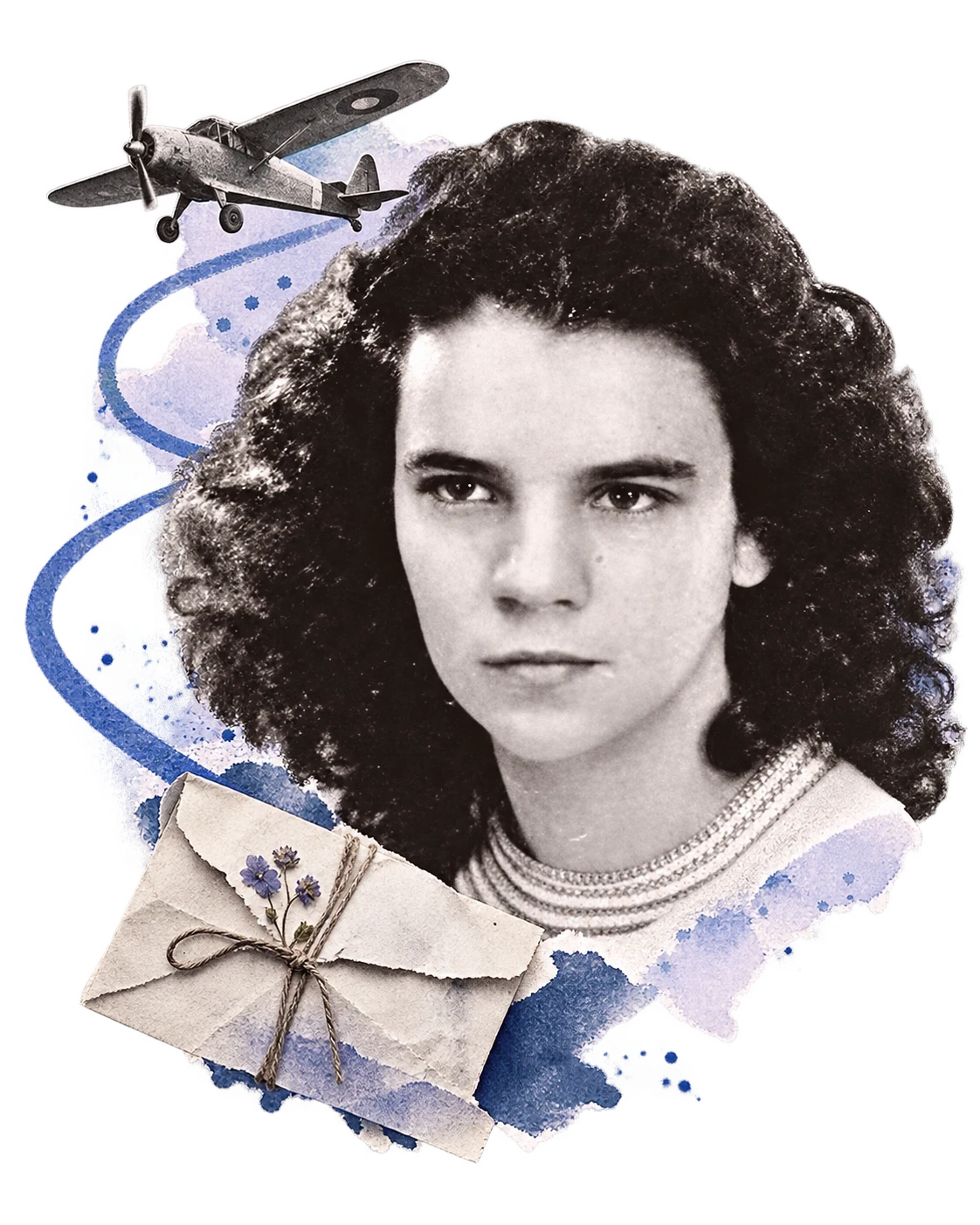
The tragedy was hauntingly connected to key figures in Israeli history. On the morning of August 3, 1948, sisters Ruth and Rauma were sitting in their parents' living room in Rehavia (Ruth, the wife of Moshe Dayan, and Rauma, who would later marry Ezer Weizman). Ruth, standing by the kitchen sink, saw through the window a "Primus" aircraft slowly taking off from the makeshift airstrip in the Valley of the Cross. Suddenly, the engine sputtered and stopped; before the plane could gain altitude, it plummeted like a stone to the ground. Ruth and Rauma rushed to the site in Moshe Dayan's private car, equipped with sheets and disinfectants. When they reached the wreckage, they saw a terrible sight they would never forget: two intact bodies lying motionless beside the shattered plane. One of them was that of Zohara Levittov, the legendary fighter and pilot.
Zohara was known to the public as "Shmuelik's Zohara" - Shmuelik was Bruria's brother. Their love story had become famous back in their Palmach days, when the two signed a moving "commitment" to marry as soon as they were released from active service. Zohara was an exceptional woman - witty, beautiful, strong-minded, and endowed with rare leadership ability. She met Shmuelik at Ein Harod, where he served as a commander. Shmuelik himself was a gifted young man with an exceptional talent for writing, who grew up among cultural giants such as Bialik, Ben-Zvi, and Berl Katznelson. In his letters to Zohara, he expressed the depth of his feelings: "Your appearance on the horizon of my life melted the terrible mask... Do you too feel the pain of our 'heartstring'?"
Their love burst into flame after the Night of the Bridges in July 1946, during which Zohara was wounded in the eye. When they returned to Ein Harod as a couple, they shared a tent and spread a light and warmth that moved everyone who saw them. Even when military duties forced them apart, they continued to exchange longing-filled letters: "No distance will change the fact that we are Shmuelik of Zohara and Zohara of Shmuelik," he wrote to her in 1946, and she replied wistfully: "Even my pen misses you."
The end came unexpectedly on Friday, May 2, 1947. Shmuelik was asked to help with a live-grenade training exercise at the nearby kibbutz of Geva. During the exercise, the grenade exploded, and Shmuelik was killed instantly along with two of his trainees, before he had turned twenty. Thousands accompanied him on his final journey to the Mount of Olives, among them Yitzhak Ben-Zvi, who eulogized him with the words: "Shmuel fell at the foot of the Gilboa, in soil sanctified by sweat and blood."
Zohara collapsed under the weight of her loss. She continued to write heartbreaking letters to Shmuelik: "Come back to me, my child. You vanished from the horizon of my life like the sun that has set and will not rise again." She devoted her time to editing a book in his memory with her father and Shmuelik's father, Yehuda Even-Shmuel. In a tragic and haunting turn, she died in the same plane crash in 1948, while on her way to meet Shmuelik's father.
This love story and tale of bereavement became part of the Israeli ethos. It was commemorated in Loving Until Death by Devorah Omer and Like the Radiance of the Sky by Ofer Regev, as well as in the famous play Shmuelik of Zohara, which was staged in 1981.
Bruria, who was living in the United States at the time, had to experience the terrible family tragedy from afar, but the loss had a profound and lasting effect on her and her family. At the age of 48, she adopted her daughter Tammy, and in a moving and symbolic Israeli full circle, Tammy later married Oded Levittov, the nephew of Zohara, the beloved of the late Shmuelik.
To give their daughter the best possible environment in which to grow up, Bruria and Zellig Harris decided to immigrate to Israel in 1960 and joined Kibbutz Mishmar HaEmek. At the kibbutz, far from the spotlight of Princeton, Bruria became part of kibbutz life and worked as a driver, a postal worker, and a factory worker, until she finally agreed to return to academia and teach mathematics at the kibbutz's educational institution and later at the University of Haifa. Alongside her work, Bruria loved taking part in the kibbutz's cultural life, singing and playing at community events. Her relationship with the State of Israel was complex, combining deep commitment with sharp criticism, as the mathematician Professor Shmuel Agmon, an Israel Prize laureate, recalled: "It was often difficult to live up to the high, uncompromising humanistic standards she set for herself and those around her." Bruria Kaufman made a major contribution to establishing theoretical research in Israel during her years at the Weizmann Institute (1960-1971) and the University of Haifa (1972-1988). Among other things, she collaborated with the physicist Harry Zvi Lipkin on research into the "Mössbauer effect" - a physical discovery that makes it possible to measure tiny changes in the energy of an atomic nucleus, a tool that remains a crucial component of nuclear physics and chemistry. Public recognition of her work extended beyond academia, and in 1965 she was chosen as one of the first two women on the board of the Israel Broadcasting Authority.
In 1982, the family moved to Tel Aviv and then on to Philadelphia, where Zellig taught at the University of Pennsylvania (by this time he had adopted wholly anti-Zionist positions). There too, Bruria displayed her distinctive character and volunteered as an office worker at an institution that assists people with disabilities. After Zellig's death in 1992, she moved to Arizona to be near an old acquaintance, Nobel Prize-winning physicist Willis Lamb. Their connection had begun four decades earlier, when Bruria tried to suggest a simpler and more elegant mathematical model for one of his theories, and at the age of 75 she returned to work alongside him on active scientific research. After Lamb's wife died, the two married, but the marriage did not last long.
In her final years, Bruria chose to return to Israel, to Kiryat Tivon, to live what she called "the best years of her life," alongside her daughter and granddaughter Noam. When she was asked on her deathbed what she thought God would say to her when she arrived in heaven, she replied with her characteristic wit that she already knew what she would say to Him: "Where does Bach sit?"
In January 2010, at the age of 91, Bruria Kaufman died in Kiryat Tivon. In her will, she directed that her body be donated to science, a final gesture from a woman who had devoted her life to understanding the laws of the universe. She left behind a world a little better understood and an entire generation of scientists continuing along the paths she blazed with her wisdom.




תגובות
עדיין אין תגובות.