
The disease gradually robs patients of their independence. It begins with chronic fatigue and progresses to weakness in the limbs, forcing patients to use crutches for years. Although the disease affected around 3 million people each year, there was no adequate medical treatment until the breakthrough.
Ilan Tamir and Multiple Sclerosis
My friend Ilan Tamir is one of those people who can make you admire them after a short conversation. A lieutenant colonel in the reserves, he was formerly a fighter pilot in the Israeli Air Force and a pilot for El Al. He flew F-15 aircraft (the Baz, or Falcon) in Squadron 106 (Spearhead) and Squadron 133 (Knights of the Twin Tail), served as an instructor at the flight school, and was an outstanding swimmer (and always made sure I felt slow next to him at spin class). Ilan's life changed in the summer of 2006, when he was diagnosed with multiple sclerosis. He had to say goodbye to his helmet and flight suit, and today he gets around with crutches and lives in an apartment adapted to his needs. Looking back, Ilan had suffered from symptoms of the disease, such as exhaustion and fatigue, followed by difficulty walking and dragging his feet. We'll return to Ilan later.
Around 3 million people around the world are diagnosed with multiple sclerosis each year, and the disease is three times as common in women as in men. Professor Jean-Martin Charcot, a French neurologist and psychiatrist, was the first to diagnose the disease as a distinct condition, in 1868. Multiple sclerosis (MS) is one of the most complex and fascinating challenges in modern neurology. It is a chronic inflammatory disease, autoimmune in nature, that attacks the central nervous system, including the brain and spinal cord. At the root of the disease is a malfunction of the immune system. Instead of carrying out its traditional role of protecting the body from foreign invaders such as viruses and bacteria, it mistakenly identifies the body's own components as enemies. The main target of this attack is myelin - a fatty substance that coats nerve-cell fibers (axons) and serves as an insulating and protective layer.
Myelin is critically important to human functioning. It enables the rapid, efficient, and smooth transmission of electrical signals from the brain to the body's various organs. Damage to the myelin, a process known as demyelination, leads to the formation of scarred, hardened areas called sclerosis. When a nerve signal encounters these areas, it slows down, may become mixed up with other signals, or may stop altogether, completely disrupting communication between the brain and the rest of the body. Over time, this process can become irreversible and lead to the complete destruction of the nerve fibers themselves. Try to imagine an electrical cable whose plastic coating is torn, leaving the wire inside exposed. This can cause a short circuit that stops the current from flowing and may even start a fire.
Diagnosing the disease is a complex process. The symptoms of multiple sclerosis are varied and inconsistent, and depend on the precise location of the damage in the nervous system. Patients may experience sensory disturbances such as numbness and tingling (pins and needles), weakness in the limbs, vision problems, dizziness (vertigo), and difficulty with balance. Beyond its physical effects, the disease has a profound impact on quality of life, causing extreme fatigue, difficulty concentrating, and mood changes, including depression. To this day, it is not clear what causes the disease, and there is not enough knowledge to describe definitively the combination of factors that lead to its onset.
Copaxone: From Lab to Drug
Until 1993, there was no proven preventive treatment for the disease. The first approved treatments were different forms of interferon beta, known by their brand names, such as Betaseron, Avonex, Rebif, and Plegridy. Copaxone, known by its chemical name, glatiramer acetate, came into use around the same time as the first interferons, beginning in the 1990s. Copaxone is administered by injection and has been found effective in slowing the rate of relapses in patients with relapsing-remitting disease. Unlike interferon beta, which can cause flu-like symptoms and depression, Copaxone's side effects mainly include local skin redness and, in rare cases, a temporary feeling of pressure in the chest and harmless anxiety.
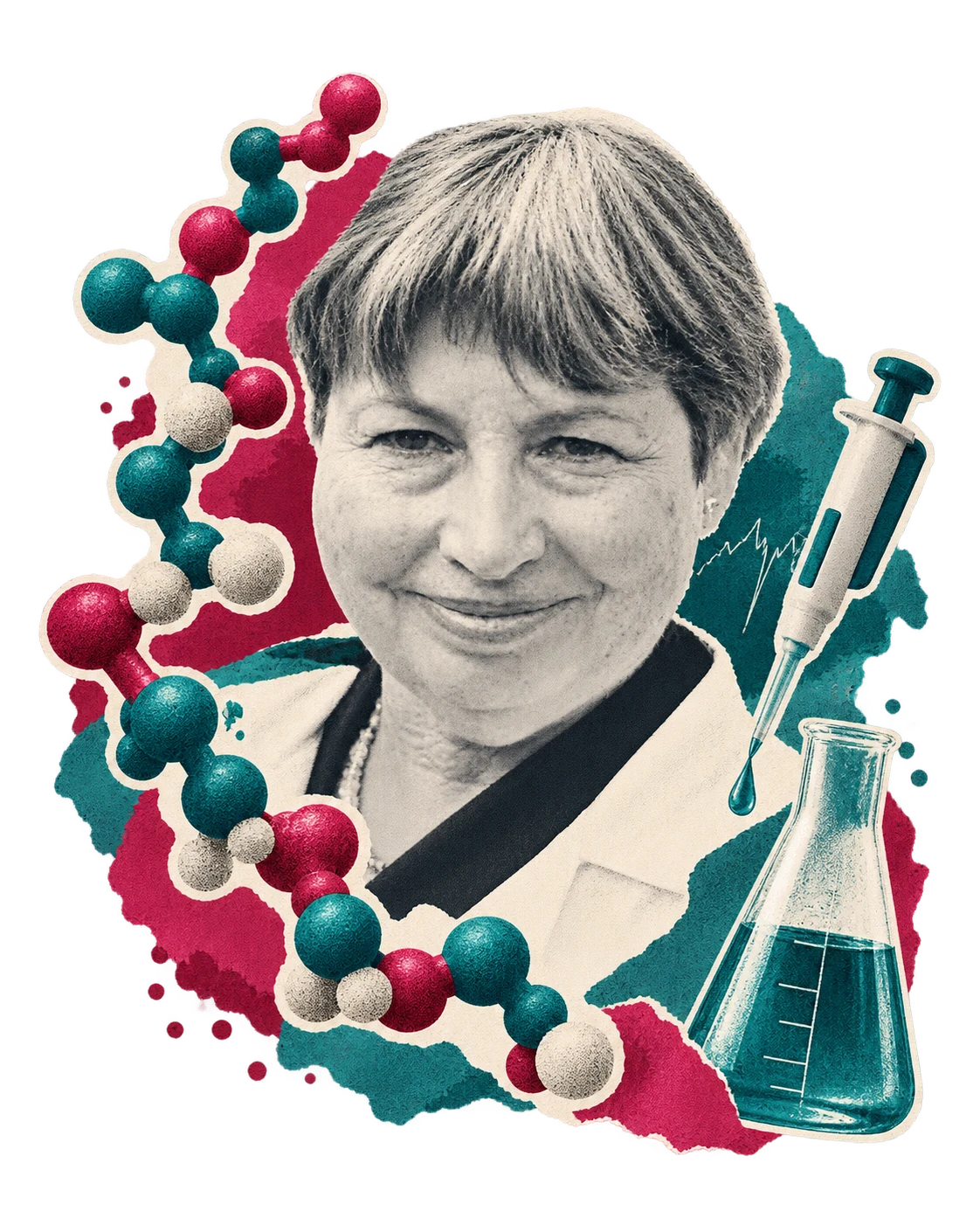
The history of the development of Copaxone, or by its scientific name, glatiramer acetate, is one of the most fascinating stories in the history of Israeli and global science. It began in the late 1960s at the Weizmann Institute of Science, led by Professor Michael Sela, Professor Ruth Arnon, and the young scientist Dr. Deborah Teitelbaum, the heroine of our story. The original research aimed to create a model of multiple sclerosis in order to better understand its mechanisms. The researchers sought to synthesize protein-like molecules, known as copolymers, designed to mimic the components of myelin and cause the immune systems of laboratory animals to attack them and develop a disease resembling multiple sclerosis.
For more than a year, Deborah Teitelbaum, then a doctoral student, worked on synthesizing various substances and tried to induce the disease in laboratory animals. All the experiments failed, and the injected substances caused no symptoms of disease. At this point, instead of abandoning the research, the team came up with a revolutionary idea: if these artificial polymers did not induce the disease, perhaps they actually worked to inhibit it by competing with the body's original proteins. In other words, perhaps they had stumbled upon a way to slow the disease.
In 1971, the discovery became a scientific reality. The copolymers, and Copolymer 1 (Cop 1) in particular, proved remarkably effective at suppressing and preventing the disease in animals. It turned out that Cop 1 not only prevented the disease from developing when administered before the harmful stimulus, but could also suppress symptoms in animals that had already become ill.
The transition from the laboratory to widespread clinical use took almost three decades of intensive work. In 1974, the first patent was registered by the Weizmann Institute, with Sela, Arnon, and Teitelbaum listed as equal inventors. In 1987, the pharmaceutical company Teva received a license to develop and commercialize the drug, a move that transformed the company and the Israeli economy. Until that year, Teva had been engaged in distributing generic drugs. In other words, it was a company that waited for the patent on a drug developed by another company to expire, then developed a drug containing the same active ingredient, at the same dosage and in the same form of administration (such as a tablet or syrup) as the original drug. This meant that Teva did not invest in developing new drugs.
Copaxone was Teva's first original drug. It was launched in Israel in late 1996 and in the United States in March 1997, and quickly became the company's main profit driver. That was true even in the year of its full U.S. launch. Within a few years, Copaxone became the leading drug for treating multiple sclerosis in the United States, with a market share of more than 25 percent. Within three years, global sales of Copaxone had reached $247 million. Copaxone became Teva's most profitable drug, generating significant available capital that enabled the company to acquire other companies. Over the years, Copaxone accounted for more than 60 percent of Teva's operating profit.
Deborah Teitelbaum and the Road to the Patent
Deborah Savitsky was born in Tel Aviv in 1941 to parents who had immigrated from Poland in the 1930s. She attended Ahad Ha'am Elementary School, where it was already clear that she was a gifted child. In high school, she became interested in science and studied biology. In 1962, she married Haim Teitelbaum, whom she had met in the army. Haim later served as head of the Maintenance Department in the Quartermaster Directorate, holding the rank of colonel, and as deputy head of the Planning Directorate, holding the rank of brigadier general. After completing her military service, Deborah began studying biology at Tel Aviv University and completed her master's degree in 1966. She pursued her doctoral studies at the Weizmann Institute under Professor Ruth Arnon in the Department of Immunology. There began the journey that led to the development of Copaxone.
One of the most significant turning points in Deborah Teitelbaum's biography was her decision to give up the conventional path toward an independent academic career. After completing her doctorate in 1974, she chose not to go abroad immediately for postdoctoral training, a crucial step for anyone hoping to become a professor and head an independent research group. The reason was family-related. Her husband, Haim, served in demanding military positions and was away from home for long periods. Deborah chose to take on most of the responsibility for raising their two children, Shay and Sagit, and remained at the Weizmann Institute as a research fellow.
Professor Ruth Arnon noted that this decision may have benefited the Copaxone project, since Deborah remained an active and central partner in its development throughout, whereas on a different path she might have moved on to research other subjects. The personal cost, however, was clear: Deborah did not become a professor or head her own laboratory, despite making a scientific contribution equal to that of her senior colleagues, who received prestigious awards.
Only in 1980, when circumstances allowed, did Deborah go for a year of postdoctoral training at Tufts University in the United States. By then, however, it was too late to begin the academic track toward an independent faculty position. She continued working at the Weizmann Institute as a senior staff scientist and served as Teva's main liaison and consultant on the drug's clinical trials and biological aspects.
“Her doctoral work was essentially the foundation for the development of Copaxone. That's why she is listed on the patent as an equal contributor,” Professor Arnon later said. “She made a fantastic contribution to the Copaxone project, both through her doctoral work and in the years that followed. It was her project.”
Some of the drug's royalties went to the Weizmann Institute, and over the years those hundreds of millions of shekels funded other research. Another portion of the royalties went to the researchers named on the patent. According to estimates, the research team, including Deborah, earned tens of millions of dollars, some of which was invested in advancing science, start-up companies, and philanthropy. Thanks to the substantial royalties, Professor Sela became the patron of the Batsheva Dance Company.
It is important to note that Deborah's work built on the work of giants like her. As early as the 1950s, Professor Ephraim Katzir of the Weizmann Institute of Science (later the fourth president of the State of Israel) began studying the properties of proteins, the building blocks of every biological system. For his research, he developed simple synthetic models known as “poly-amino acids.” His student at the time, Professor Michael Sela (later president of the Weizmann Institute and an Israel Prize laureate), decided to examine the effect of these synthetic molecules on the immune system. Sela, together with his student at the time, Professor Ruth Arnon (later president of the Israel Academy of Sciences and Humanities and an Israel Prize laureate), and Dr. Deborah Teitelbaum, conducted a long series of groundbreaking experiments and studies, which in turn ultimately led to the development of Copaxone.
Later Research and Farewell
Deborah did not rest on her laurels after Copaxone's success. She continued researching the drug's mechanisms almost until the end of her life. Among other things, she led studies on the possibility of taking Copaxone orally. In 2007, shortly before her death, she took part in a groundbreaking study that identified genetic characteristics affecting how different patients respond to the drug, a significant step toward personalized medicine.
Deborah died of cancer in 2008, aged 67. After her death, her children established a research fund at the Weizmann Institute in her memory and in memory of their late father. The fund promotes collaborations between the Institute's scientists and doctors in hospitals, a fitting expression of her approach to life, which always sought practical medical applications for basic science.
It is difficult to overstate Deborah's contribution to the lives of millions of people around the world, from the time the drug was approved to this day, including the life of my friend, Lieutenant Colonel Ilan Tamir. At the same time, we must remember that the drug only slows the disease; it does not stop it. We are looking for the next “Deborah,” who will soon find a drug that stops the disease and even returns patients to their former condition, so that I can fulfill a dream: to hear Ilan over the aircraft radio or the cabin loudspeaker, announcing from the cockpit to passengers the flight route and the weather at their destination.
Lieutenant Colonel Ilan Tamir wrote a book about coping with his disease, titled The Falcon Prince: “This book is my mission. It's important to me to reach as many people as possible... I'm not talking only about people like me who have been diagnosed with multiple sclerosis, but about every one of us. Life confronts us with different challenges, and we have to know how to see the glass as half full. I told my story with complete honesty and humility. I hope people will learn optimism from me, and carry it forward.”
Whenever I correspond with Ilan or speak with him, I am reminded how much we owe Dr. Deborah Teitelbaum.
To purchase the book


תגובות
עדיין אין תגובות.