
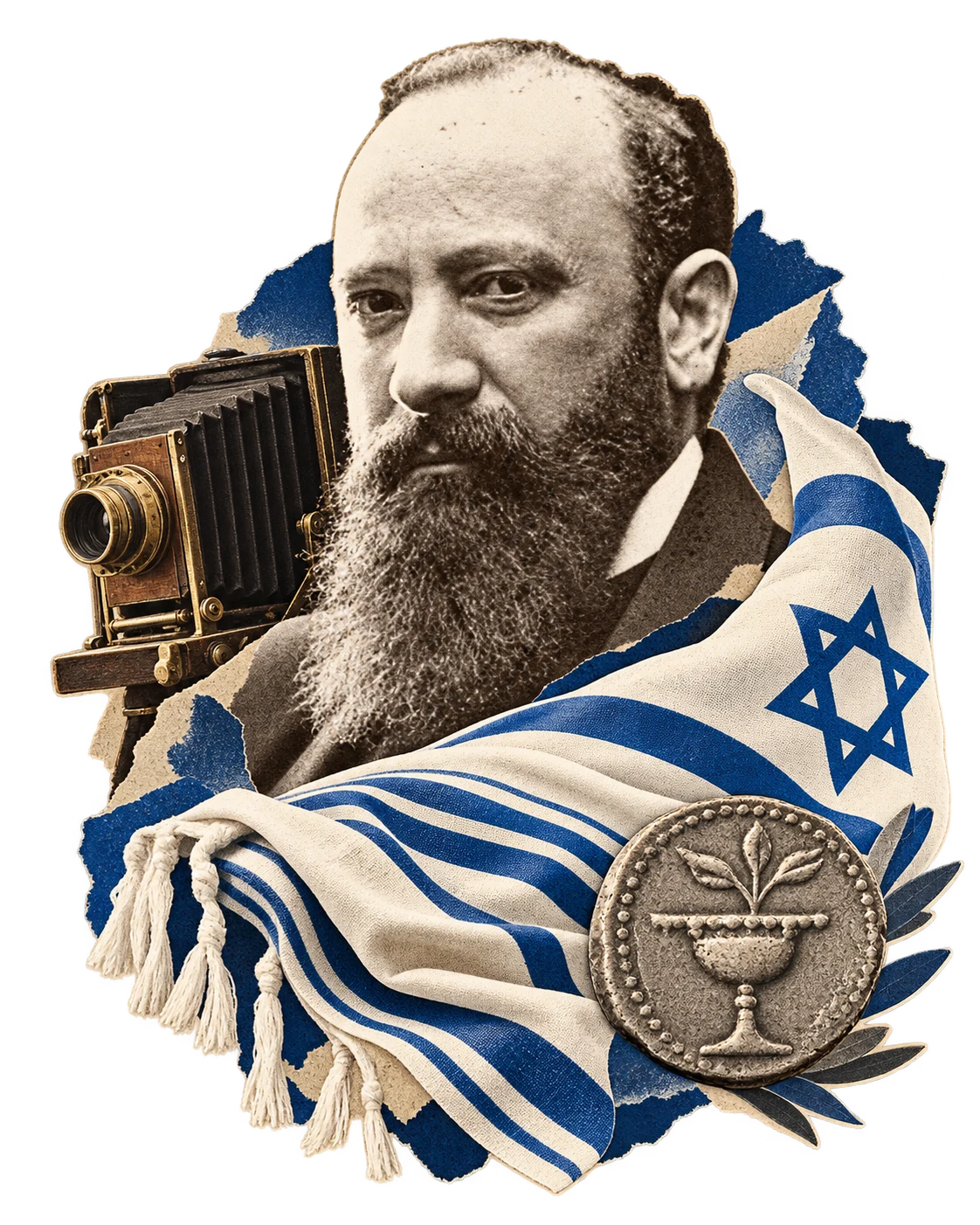
He designed the Israeli flag and revived the shekel. Herzl's right-hand man and close friend, he was also responsible for the famous photograph of Herzl with Kaiser Wilhelm II.
David Wolffsohn On Herzl's only visit to the Land of Israel, toward the end of 1898, he was accompanied by a small delegation, whose most prominent member was David Wolffsohn, the right-hand man and close friend of the man who envisioned the Jewish state. Wolffsohn was the delegation's financial officer and an adviser on Hebrew and Jewish tradition. The purpose of the visit was to meet the German emperor, Wilhelm II, who had come to the country hoping to extend German influence in the East and strengthen relations with Turkey, which then ruled the country. Herzl wanted to ask him for a charter (permission) for Jewish settlement in the country. On the fourth day of his tour, Herzl met the emperor at Mikveh Israel. Wolffsohn understood the significance of the occasion and took two photographs with his Kodak camera. "I wouldn't give the photographic plate to anyone, not even for ten thousand marks," he boasted. Herzl understood the power of an image at the time and enlisted the photograph to promote his Zionist idea, both among the Jewish people and with world leaders who could help him establish a home for the Jewish people in the Land of Israel.
The Photograph and the National Flag
When the photographs were developed, it turned out that all the camera had captured was the emperor leaning over his horse and... the tip of Herzl's left foot. To recreate the moment, Herzl was photographed again on the roof of the hotel in Jaffa, and the two photographs were combined to make the famous image of Herzl and the emperor at Mikveh Israel. A statue commemorating the occasion now stands at the site of the historic meeting.
Alongside that famous photograph, David Wolffsohn left us another celebrated symbol, as he himself recounted: "At the command of our leader Herzl, I came to Basel to make all the preparations for the First Congress. Among the many questions that occupied me then was one that was not great, but was not easy either. It contained something of the great Hebrew problem. What flag would we use to decorate the Congress hall? What would its colors be? We have no flag. This thought caused me great pain. The flag had to be created. But which colors should we choose? Then an idea flashed through my mind: Why, we do have a flag, white and blue. The tallit in which we wrap ourselves for prayer is our symbol. Let us take the tallit from its case and unfurl it before Israel and all the nations. So I ordered a blue-and-white flag with a Star of David on it. And that is how our national flag came into being."
From a Hard Childhood to Zionism
David Wolffsohn was born in Lithuania in 1855. He grew up in an ultra-Orthodox home and, as a young man, moved to Memel in Germany, where he became friends with Rabbi Dr. Isaac Rulf, who introduced him to Zionism and the German language. At 18, he lived in the home of David Gordon, editor of the newspaper Ha-Maggid and one of the leaders of the Hovevei Zion movement. Wolffsohn's days as a porter in the market and a match seller, just so he could buy a piece of bread at the end of each day to quiet his hunger, were very hard.
After several years of hardship, he found work as an agent for a large timber company owned by a Jew, where his true abilities came to light. He was honest and charismatic, and he excelled at sales. This success gave him confidence, and he became a wealthy independent timber merchant. At 25, he married Fanny. When Fanny became pregnant, he was overjoyed, but their son died at birth, and they remained childless.
In 1884, Wolffsohn opened an agency called Bernstein & Wolffsohn. He was one of the leading members of the Jewish community in Memel and even financed the construction of a synagogue there. Four years later, he moved to Cologne, a large and important city in the heart of Germany, where he traded in timber for railway sleepers. There, too, he became one of the city's leading merchants and community activists. At the same time, he began working on behalf of Zionism with Isaac Bodenheimer, one of the early directors of the Jewish National Fund, and established the Society for the Promotion of Jewish Agriculture in Syria and the Land of Israel.
David Wolffsohn's life changed after he read The Jewish State. "When I read it, I felt like a different person," he wrote. Herzl, the book's author, was then a young doctor of law. David Wolffsohn met him, and a deep friendship was born. Over the years, Wolffsohn became Herzl's confidant and remained loyal to him even in the most difficult times. Herzl thought highly of him and immortalized him in his book Altneuland as the character David Litwak. In August 1896, Herzl wrote in his diary: "There was vigorous opposition to me in Berlin. Wolffsohn alone was on my side, and through his efforts he managed to prevent the Zionists from openly taking a negative position toward me." At the end of 1898, Herzl wrote to him: "My dear Dada! (the affectionate name Herzl gave him), for God's sake, do not let things fall asleep, or all my efforts will be in vain, all our achievements will count for nothing, and all my work will be brought to a standstill." David Wolffsohn replied: "Rest easy, my dear friend, your Dada is not asleep!"
When the first Zionist bank was founded, with Wolffsohn among its founders, he was appointed its first president. Herzl saw in him all the qualities and abilities the role required: integrity, an understanding of finance and business, and a clear vision of the ultimate goal. When the time came to decide whether to lend money to Turkey, which ruled the country, in exchange for a concession to establish a state there, or, as others wanted, to invest in agriculture in the country, Wolffsohn favored the Turks, thereby turning the bank into a political tool.
David Wolffsohn brought the shekel back to life, as he recounted: "When the speakers at the Congress discussed the monetary levy that every Zionist had to pay to the organization, they could not find a name for it. Some called it 'Beitrag,' others 'contribution,' and so on. Seeing this confusion, I began thinking of a name that would satisfy everyone, and realized that no name was more fitting than 'shekel.' I had only to make the suggestion, and the name immediately became the property of every speaker." And so the annual membership dues of the organization were called a shekel, worth one franc.
At the Head of the Movement After Herzl
Herzl's death in 1904 came unexpectedly. The political leadership of the Zionist movement was left without a successor, and the movement was plunged into a serious crisis. Max Nordau was offered the role first, but when he declined, Wolffsohn agreed to step into Herzl's shoes, tempering expectations as he said: "But we will never have another Herzl." He began serving as president of the movement at the Seventh Congress in 1905.
In his will, Herzl wrote to him: "I have always considered you the most faithful of my faithful. Farewell, Dada, and do not forget me," and appointed him guardian of his children after his death.
From that moment, Wolffsohn took the reins and set about reorganizing the movement. First, the offices moved from Vienna to Cologne. Nahum Sokolow was appointed secretary-general, and the movement's newspaper, Die Welt, which had until then been published in German, was printed in Hebrew under Sokolow's editorship and given a new name, HaOlam.
In January 1906, Wolffsohn initiated the World Conference on Migration Problems in Brussels, and that same year renewed negotiations with England over the establishment of a Jewish settlement at El-Arish. During a visit to South Africa toward the end of the year, Wolffsohn was nicknamed the "uncrowned Jewish king." At the Eighth Congress, he was appointed president of the World Zionist Organization (at the time, the role was equivalent to that of prime minister of the Jews), a position he held until his resignation in 1911.
In July 1908, he traveled with Sokolow to St. Petersburg to meet Russian Prime Minister Pyotr Stolypin. He was warmly received and was promised support for the Zionist idea, as well as concessions for the Jews of the country. That same year, he also visited Hungary, where he likewise won support for the Zionist idea. Around that time, the Palestine Office was established in Jaffa under the direction of Dr. Arthur Ruppin, the father of the labor settlement movement in the Land of Israel. Meanwhile, the Zionist bank founded by Wolffsohn expanded and provided economic lifeblood to the settlers' cooperative associations in the country. In this way, the bank became the most important financial institution serving Jewish settlement in the country.
Despite all this, David Wolffsohn was no Herzl and was not accorded the same respect. In a speech at the Ninth Congress in 1909, he said with great pain: "I am furiously accused of every offense in the world. One demands that I be an eagle, another demands that I be a lion. In a word: they demand that I be Herzl." Despite this, he was reelected president and proudly announced that, for the first time, the central office was free of all debt.
Toward 1910, he fell ill and moved to an estate he had bought in Frankfurt. A year later, he resigned as president and retired from all political activity. Everyone expressed their gratitude, noting "that he not only knew how to preserve Herzl's great legacy, but even managed to enlarge it." Even his opponents thanked him. Menachem Ussishkin, one of his opponents, bid him farewell with these words: "I wish to bid farewell to the hero of this Congress, David Wolffsohn. He is a hero in the sense of the Sages' saying: 'Who is a hero? One who conquers his own inclination.'"
Herzl and his wife Julia had three children. In his will, Herzl directed that his friends David Wolffsohn, Moritz Ritchfeld, and Johann Kremenezky be appointed guardians of his children. After Herzl's death, it emerged that he had left his family without adequate sources of income (Paulina was then 14, Hans 13, and Trude 11). The three guardians and the Zionist movement took responsibility for the young orphans, including their financial support. At first, the youngest, Trude, was sent to live with her aunt Ella, but after Wolffsohn's wife died, she moved into his home and helped him both with running the household and with the affairs of the Zionist movement. Trude was the only one of Herzl's children to start a family. She married a Czech industrialist who was a friend of Wolffsohn's, and they had a child, Herzl's only grandchild. She herself died of starvation in March 1943 at the Theresienstadt camp, and her son took his own life when he was told of her death.
In the summer of 1914, Wolffsohn was lying in a sanatorium in Hamburg. When he closed his eyes for the last time, Trude, who loved "Uncle David" dearly, was standing by his bedside. David Wolffsohn was buried in the cemetery in Cologne.
Wolffsohn bequeathed his entire fortune to Zionist causes. His money was used to build the National Library building on Mount Scopus in Jerusalem, called the David Wolffsohn House; today it houses the Faculty of Law and the Law Library. In his will, he set aside money to bring Herzl's remains to the Land of Israel. In 1952, Wolffsohn's and his wife's remains were also brought to Israel and buried on Mount Herzl in Jerusalem. Kibbutz Nir David (originally Tel Amal), Wolfson Hill on Mount Carmel, and streets throughout the country were named after him.
תגובות
עדיין אין תגובות.