
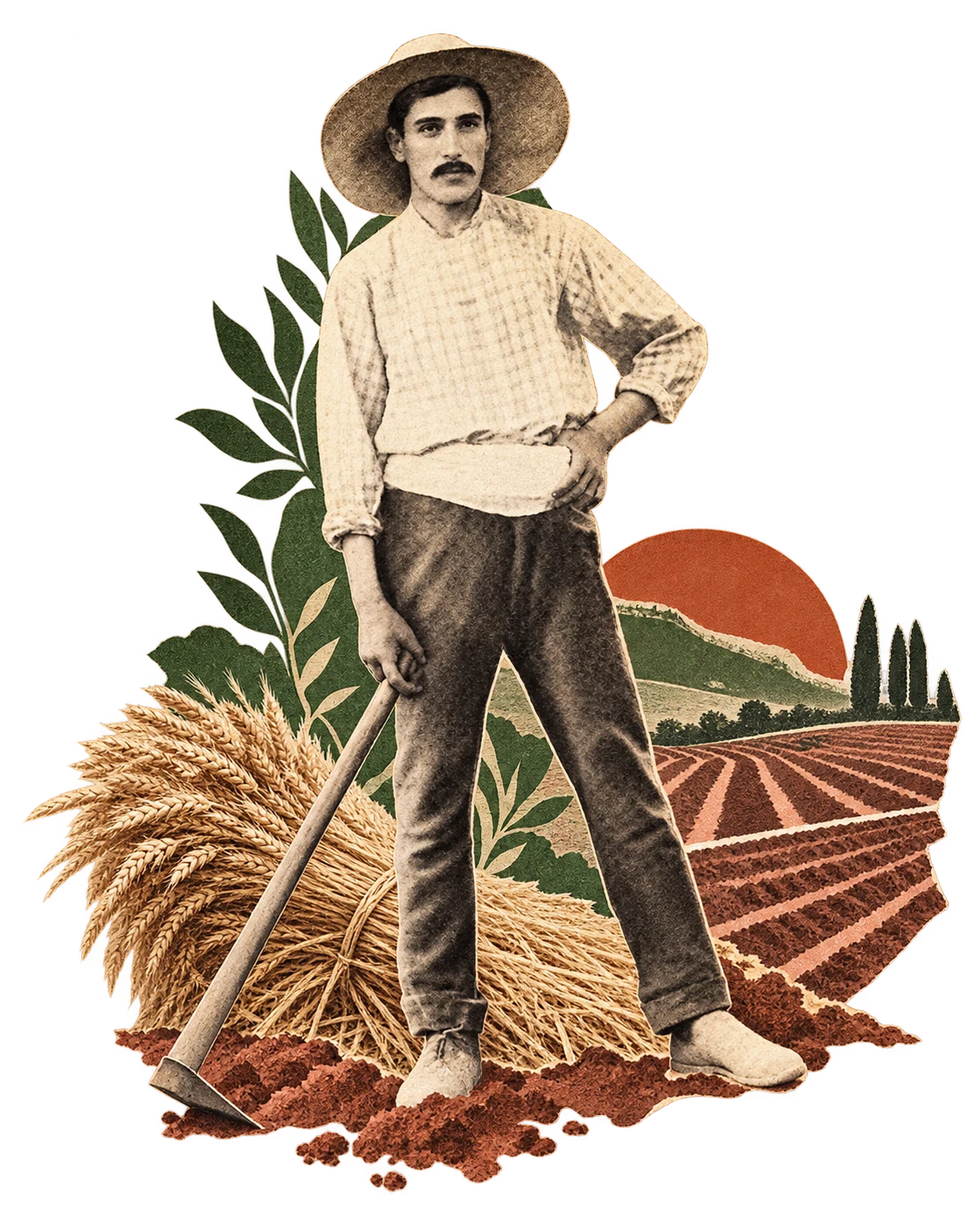
The first “King of the Hoe” in the Land of Israel. Rotberg was modest, and when he worked for pay in the Haganah, he felt deeply ashamed that he was “living at the public’s expense.” He believed in immigrating to the Land of Israel, redeeming the individual through agricultural labor, and creating a better, more complete person, connected to the land and its history.
From Ukraine to Working the Land
The first “King of the Hoe” in the Land of Israel. Rotberg was modest, and when he worked for pay in the Haganah, he felt deeply ashamed that he was “living at the public’s expense.” He believed in immigrating to the Land of Israel, redeeming the individual through agricultural labor, and creating a better, more complete person, connected to the land and its history.
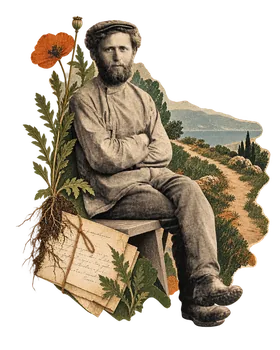
Meir Rotberg was born in Ukraine in 1887 and received a traditional education in a heder. In 1905, Meir immigrated to the Land of Israel, where he met his soulmate, Noah Naftolsky. The two worked together sorting and packing tobacco in the colony of Ness Ziona, and later worked growing field crops. Meir was both physically and spiritually strong. He excelled above all in his work ethic, his devotion to his work, and his perseverance. In those days, every plot was hoed deeply to expose the roots of weeds, especially deep-rooted Bermuda grass, known as injil. Rotberg would attack it with his hoe and say that he was battling the injil within himself.
A.D. Gordon, too, was photographed with a hoe. His opponents liked to claim that he only posed for photographs and did no actual work, while his admirers said he worked slowly but thoroughly. The hoe held exceptional importance for the pioneers, to the point that during the Second Aliyah they crowned the first “King of the Hoe” in the Land of Israel: the man who knew how to hoe the greatest number of irrigation basins beneath the orchard trees. The first king was Meir Rotberg.
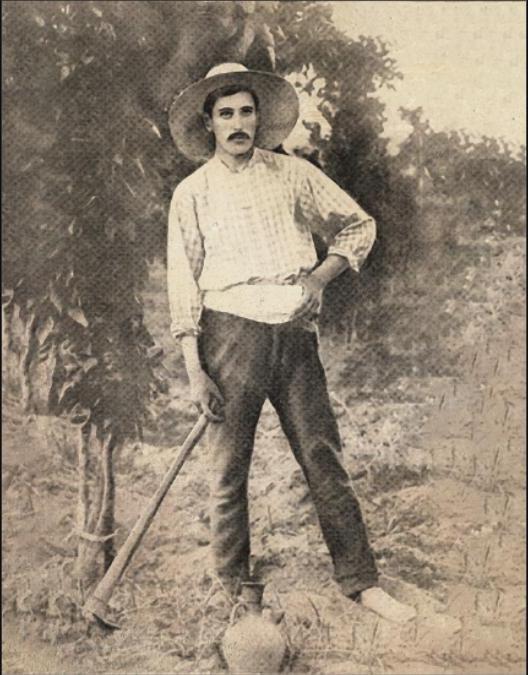
Do not take the title “King of the Hoe” lightly. In those days, it was a coveted honor. The hoe was a message - a banner of purpose and a symbol of the aspiration to revive the land, redeem the soul, sink roots deep into the soil, and make it clear: We are here to stay. We will make the wilderness bloom and open new horizons.
When Levi Shkolnik, later Levi Eshkol, immigrated to the Land of Israel, he was a quiet young man. Like those before him, he joined the group of the first “King of the Hoe” in Petah Tikva, and it was immediately clear that the second King of the Hoe had arrived. Thus was crowned the man who would one day become prime minister and seek to repair the land with a hoe, with water, and with a wonderful sense of humor.
In 1909, Meir Rotberg joined the first nucleus of the Kinneret group, which had gathered at Kinneret Farm, alongside Ben-Zion Israeli and Noah Naftolsky, known as the “Together Trio.” They lived with Menachem Shmuelowitz and other workers in the Motor House, where they worked and stood guard. Following disputes with the farm’s agricultural manager, the agronomist Moshe Berman, they were forced to leave and went to work in Sejera and Mas'ha.
In 1913, Meir was sent as a delegate of Hapoel Hatzair to the 11th Zionist Congress in Vienna. On his way back to the Land of Israel, he met Haya, a young Jewish immigrant, aboard a ship at the port of Odessa. The two married in the Land of Israel. Haya accompanied Meir through most of the stages of his life and was herself active in settlement and immigrant absorption.
Joining the Defense Establishment
When World War I broke out, Hasan Bey, the military governor of Jaffa, demanded that all Jews hand over every weapon they possessed. But Meir Rotberg and his friends Avraham Herzfeld, Eliyahu Dayan, and David Bader instead called for strengthening the force. This led Meir to his second career: the defense organization of the Jewish community. He joined the “Thirteen,” or the “Jaffa group,” as they were known, together with Avraham Krinitzi, Eliyahu Golomb, Moshe Shertok, Dov Hoz, and others, and took on the task of acquiring, storing, and transporting weapons as needed. He gathered the weapons in a warehouse in Jerusalem’s Mea Shearim neighborhood. His wife Haya brought the weapons there from Qalandia, and from there David Tidhar transported them to Tel Aviv.
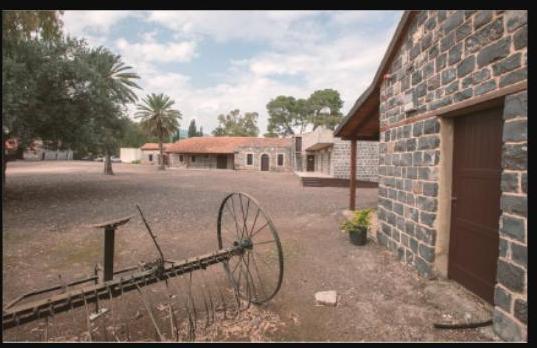
During the “migration” - the expulsion from Jaffa and Tel Aviv to the north of the country - Meir served as a guard in Kinneret. There he turned his attention to the threat of famine facing the workers in the colonies of Judea. On his suggestion, the crops from Degania and Kinneret were pooled, and additional resources were secured to purchase grain from the Galilee and transport it by wagon to Judea.
After World War I, Rotberg resumed coordinating the purchase of weapons from Arabs and from abroad. He organized their distribution to farms and settlements, making sure that each farm had the amount of weaponry it needed. He treated every penny of public money as sacred: he cut expenses to a minimum, and even for small costs, such as a phone call or a bus ride, he would submit accounts and receipts.
Just as Meir regarded the hoe, so he regarded weapons. He said: “This pistol, and all the other instruments of destruction, carry curses and blessings that are known to all. For us, they are not idols to which we will become enslaved. When the day comes that humanity can live safely without them, we will surely be among the first to turn weapons into tools of labor. But until then, heaven forbid that we disregard the blessing contained in these weapons. This is especially true for us, in our circumstances. These weapons are very dear to us, both because they cost us a great deal and because of the great blessing they hold for us when the need arises. More than that, these weapons are sacred to us. We must therefore be a group of people of the highest moral standards, so that the sanctity of our weapons is not tarnished by unjustified use, by negligence or carelessness that could bring disaster upon us, or by associating with unscrupulous, greedy people who would not hesitate to hand them over to our enemies.”
These simple words, and the tone in which they were spoken, had a decisive influence on people’s attitude toward weapons.
When he worked for pay in the Haganah, he felt deeply ashamed that he was “living at the public’s expense.” He preferred to work alone, without a secretary or an aide, and did every task himself, large or small. He traveled in vehicles with concealed compartments that carried weapons, so as not to waste money on travel expenses and so that he would not have to entrust anyone else with keeping watch over the precious cargo along the way.
His Final Years
1940 was a bad year for Meir Rotberg. Following a reorganization of the Haganah, he was removed from its leadership and left the organization entirely. That same year, he suffered a serious spinal injury in a car accident. The injury forced him to stop working, and he bore his pain in silence until his final day. No one remembered his contribution.
His friend Noah Naftolsky bought two dunams beside his own land in Givatayim and built a house there for Meir and Haya. Leaning on each other, Meir and Noah would go for walks around the neighborhood, remembering their friend Ben-Zion Israeli, who had been killed, and talking until Haya called them back. Meir Rotberg died in August 1951 and, at his request, was buried in Ein Harod.
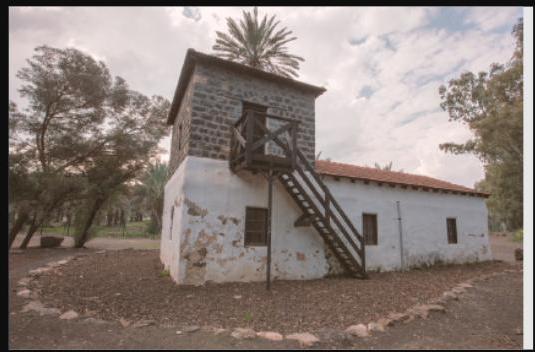
After Noah Naftolsky and Meir Rotberg died, Haya was left alone in the little house on the hill, growing vegetables for the chickens as if she were still in the yard at Kinneret. She was lonely, her condition deteriorated, and she suffered from the ailments of old age. Eventually, her sister Tova brought her to her home in Ein Harod. The house in Givatayim was left deserted, its door open, and all the notebooks in which Haya had written her memoirs were scattered across the floor. One day, David Matz entered and discovered Haya’s diaries. He gathered them into a book, which he completed only after her death. Hence the title, “A Late Book” / Haya Rotberg (1987).
תגובות
עדיין אין תגובות.