
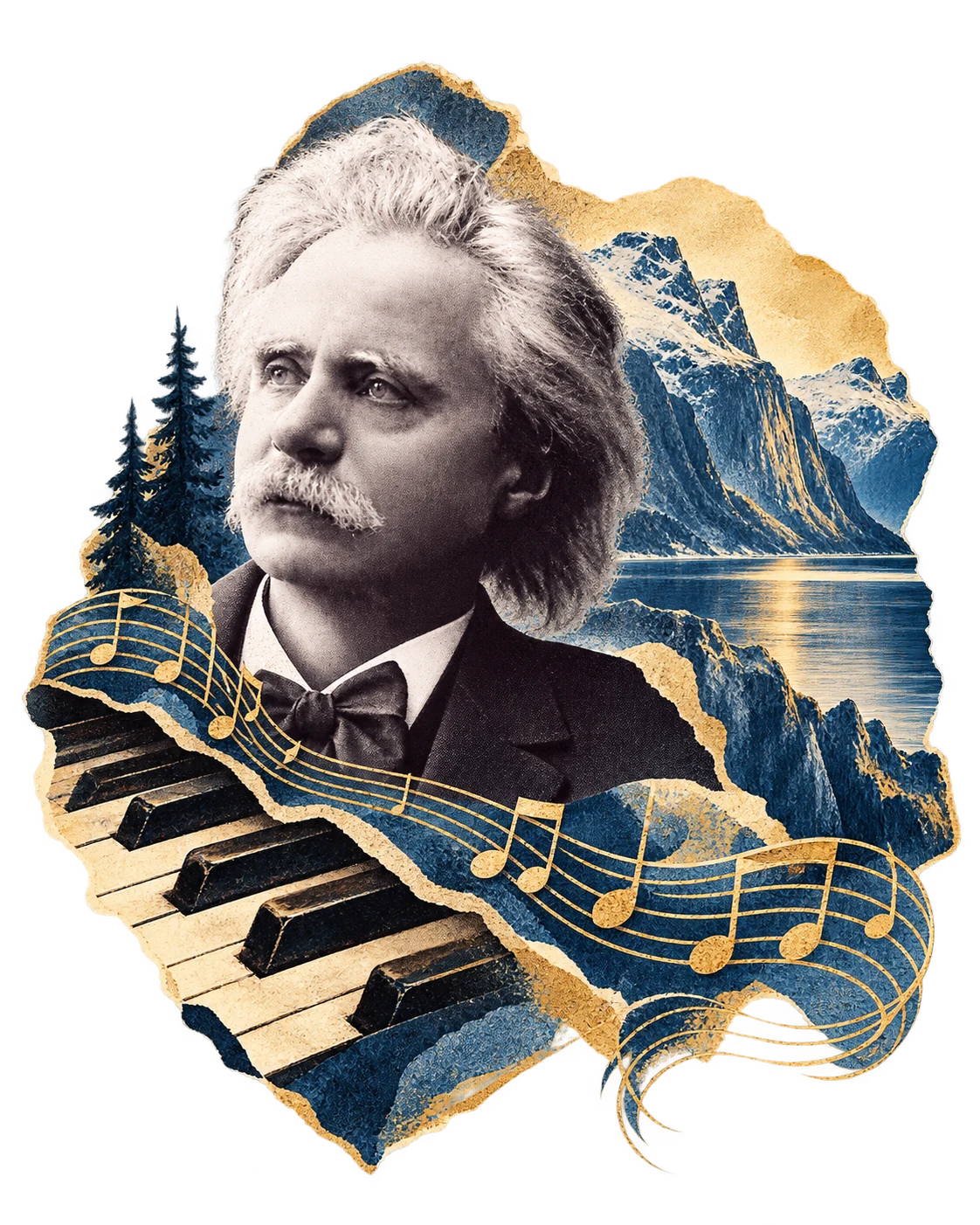
The warm melodies of the cold north,
Bergen, Leipzig and Nina
They were both short in stature, fair-haired, and blue-eyed. Happy and cheerful, they delighted in the stunning view from the window of their home. They both loved their beautiful country. For hours, they wandered together through the mountains surrounding their home. They were both musicians, among Norway’s cultural creators. Edvard Grieg was born in Bergen in June 1843 to a prosperous family. His father, Alexander, was of Scottish descent and served as the United Kingdom's consul in Bergen. His mother, Gesine Hagerup, came from a well-established Norwegian family, and, as an excellent pianist, was his first music teacher. He wrote his first compositions at the age of nine. At the age of 15, he traveled to Leipzig, Germany, to study at the conservatory with the renowned Jewish composer and teacher Ignaz Moscheles, with whom he studied for four years. This teacher instilled in his pupil a deep appreciation for the Jewish people. Edvard and his cousin Nina Hagerup grew up together in Bergen. When Nina was eight, she moved with her parents to Copenhagen. The next time Edvard saw her, she was already a grown young woman. His childhood friend had become a beautiful woman, a singer with a lovely voice, as if she had been made for Edvard's plays. Even before he fell in love with Norway and music, Edvard felt himself burning with passion for Nina. And at Christmas 1864, in a salon where young musicians and composers had gathered, Edvard gave Nina a collection of sonatas about love, titled "Melodies of the Heart," knelt down, and asked her to marry him. Nina held out her hand and said yes.
Their families did not welcome this marriage, and against their wishes the lovers married in July 1866. Unable to bear the pressure from their relatives, they moved to Christiania (today Oslo) in 1867. Together, in their great love and most devoted friendship, they experienced both joy and sorrow on the journey of their lives.
And so he wrote to her: "You are the thought of my thoughts from now on." And she answered him: "You are the sun of the sun, you are my bright light..."
Edvard dedicated some of the music he wrote to Nina. She performed his romantic songs, and he completely lost his head: "I don't think I had any more talent for composing songs than for other genres of music. How did it happen that these songs played such an important role in my work? Yes, simply because I, like all other mortals, became a genius. My genius was love." It was the happiest period of his life. It seemed as if Edvard had grown wings. He soared, worked tirelessly, and inspiration rested upon him and would not let go. During this period, he wrote one of his finest works. In his music, one can hear his great love of nature, that mysterious nature. One could hear tales of dwarf trolls, Norse gods, Viking heroism, human strength and courage, and the joy of a village festival...
Loss, Peer Gynt and Troldhaugen
Alexandra, the daughter of Nina and Edvard, who resembled her parents with her golden hair and blue eyes, died about a year after she was born. The pain of the loss remained forever, though life went on. Their love for their daughter who had passed away was poured out on all the children around them. In the woods around their home, Edvard and Nina could spend hours walking with children from nearby villages. He told them fairy tales that he himself loved and knew well. Edvard even built himself a house at the edge of the forest, where he shut himself away to write music and play the piano. The children would quietly make their way beneath the windows and listen. In 1874, Edvard received a letter from the Norwegian playwright Henrik Ibsen, who asked him to write incidental music for his satirical drama "Peer Gynt." The two orchestral suites he wrote for the play brought Grieg international fame and financial security. The story of Peer Gynt is a story of hope. Even on the threshold of death, Peer Gynt holds on to his love for one person and keeps the light in his soul.
That same year, Edvard received a government grant that enabled him to return to his hometown of Bergen. In 1885, he moved with his beloved Nina to the Troldhaugen estate on the shore of the Bergen fjord, on the city's outskirts. Remember his first teacher, the Jewish teacher who left such a deep mark on him? In 1899, Grieg was invited to conduct a concert of his works in Paris. The invitation came shortly after the retrial of Alfred Dreyfus, the Jew who had once again been convicted of espionage. Grieg decided to decline the invitation and wrote a letter to Colonne, who had invited him, which was also published in the press. This is what he wrote: "Shocked by the shameful way in which your countrymen treat law and justice..." He therefore had no desire to perform before a French audience. The publication of the letter caused an uproar, in the wake of which Grieg received many abusive letters. Only in 1906, when Dreyfus was acquitted and his rank restored, did Edvard agree to perform his work in France and conduct the concert himself. About a week after that concert, Edvard passed away at the age of 64.
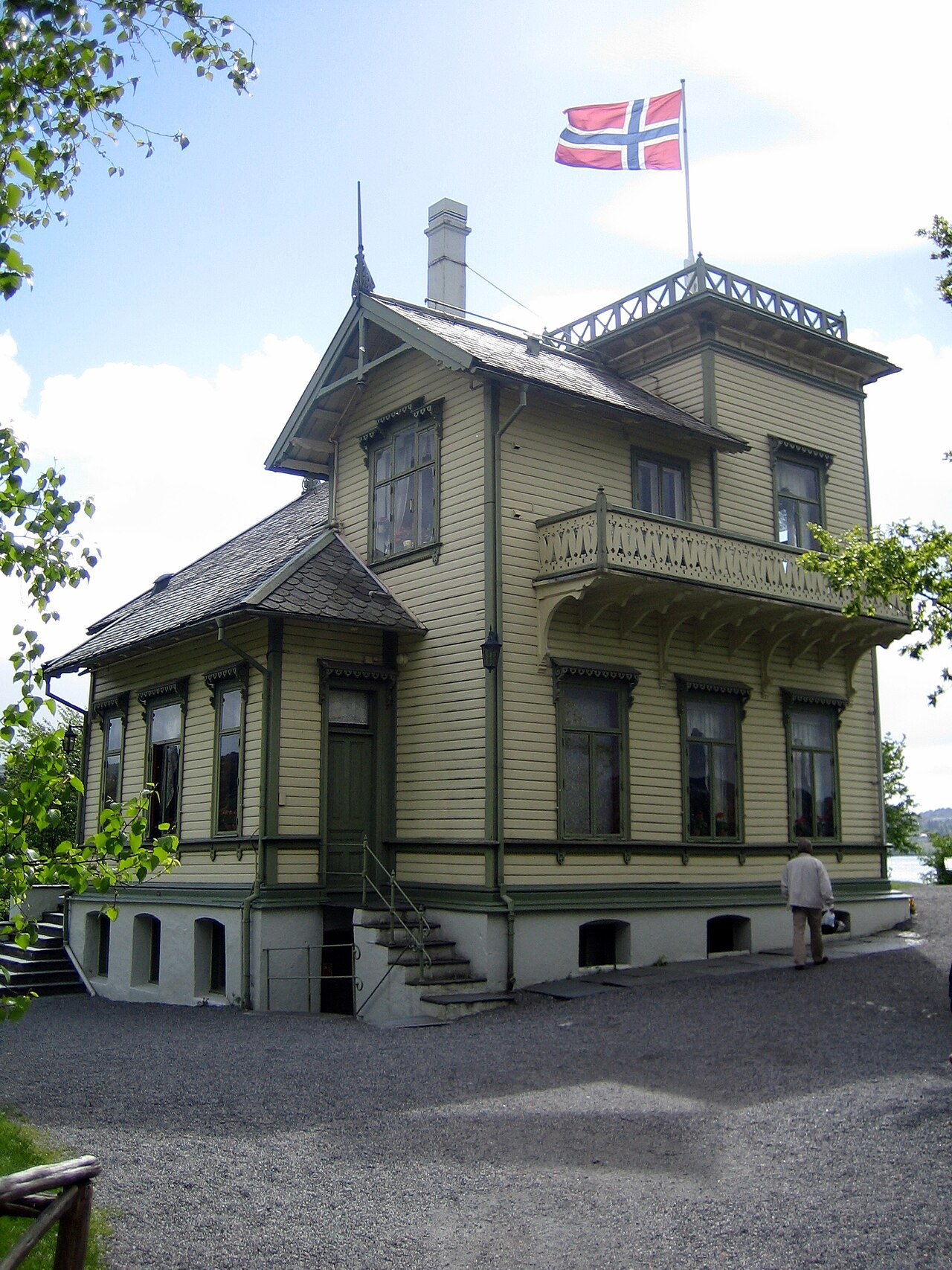
Edvard Grieg was buried at the Troldhaugen estate, where he had spent the last 22 years of his life with Nina. Grieg was not a virtuoso, but no one could remain indifferent to his performances of his own works. His music held so much charm and spontaneity. At one concert, Nina saw her beloved described as a "great composer," with her own name beside it. Tears of gratitude streamed down her cheeks
"The melody swelled, rose, ran wild like the wind, rushed along the treetops, tore at the leaves, shook the grass, and struck her face with cool sprays. Nina felt a gust of air coming from the music and forced herself to calm down."
The musician and storyteller and his Nina remained, to the end of their lives, children with eyes wide open and the same wide-open hearts. Nina died 28 years later at the age of 90, and then the couple were reunited. They are buried in one grave.
Here is a legend of love, embodied in music...




תגובות
עדיין אין תגובות.