
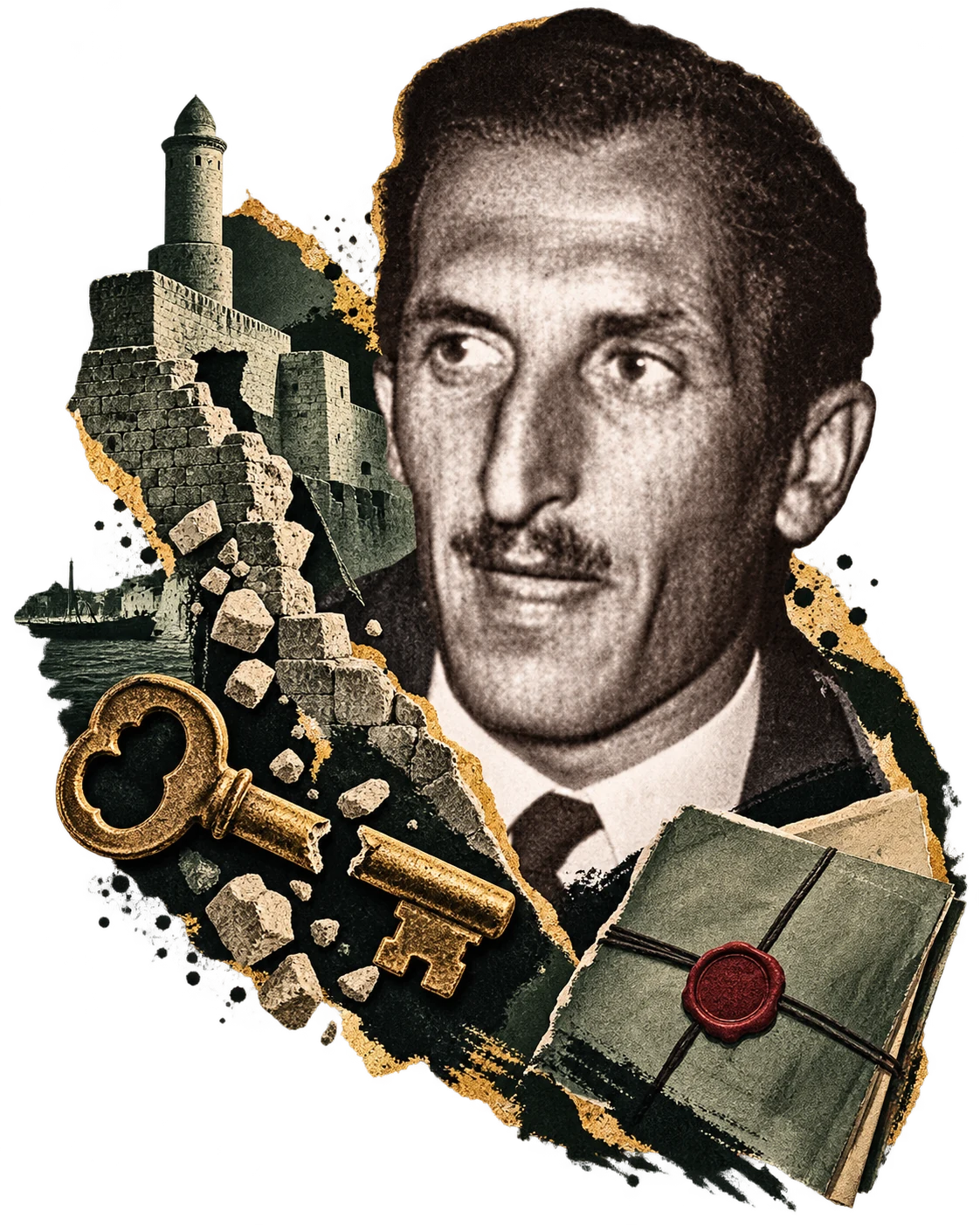
The story of 'Beggar' reveals the remarkable life of an exceptional, unassuming Irgun fighter whose actions had a decisive impact on Israeli history.
The Nickname 'Beggar' and the Escape from the Russian Compound
Bank robberies were one way to replenish the Irgun's depleted coffers. During one operation, the robber Eliezer Sudit Sharon lingered in the bank to pick up coins that had fallen on the floor, even as the British were chasing him. From then on, he was nicknamed 'Beggar.' Eliezer explained that his commander, Menachem Begin, had said, "Every penny counts."
On September 13, 1946, Eliezer Sudit took part in an attempt to break into the Ottoman Bank in Jaffa. The operation lasted longer than planned, and when the robbers emerged, they ran into an Arab mob that attacked them. One of the robbers was stabbed and died shortly afterward, and three were captured, including Eliezer Sudit, who was sentenced to 15 years in prison. When he arrived at the Russian Compound prison, he was told to hand over his clothes and put on a prison uniform. But Eliezer managed to confuse the storekeeper and keep the khaki clothes he had been wearing. One Friday, after obtaining a police cap, Eliezer made a police badge number out of a thin piece of tin, put on the khaki clothes he had arrived in, and on 21.06.1947 escaped from prison disguised as a police officer. Since Eliezer, who was from Tel Aviv, did not know Jerusalem, Haim Reznik prepared a map and a hideout for him and told him to ask, "Is Yoram home?" (Yoram was Haim Reznik's Irgun code name); then he would be able to enter the house. When he arrived at the home of Yitzhak and Leah Brandwein, Leah opened the door, and the policeman standing there asked her, "Is Yoram home?" She replied, "There is no Yoram here." The policeman left, and a few minutes later the district commander, Mordechai Ra'anan, arrived. When Leah described what had happened, Ra'anan clasped his head in his hands and said, "Oh no, that was 'Beggar,' who just escaped from prison!" It turned out that in all the complex planning of the escape, Ra'anan had forgotten to tell Mrs. Brandwein about 'Beggar's' planned visit.
Meanwhile, Eliezer Sudit continued to the second address he had been given, the home of the Greenwald family, where he hid. In June 1948, Eliezer Sudit returned to the Brandweins' home and asked them to be his wedding attendants when he married his girlfriend, Dror Gurion. Dror was an Irgun member and an announcer on the underground radio station. She was the daughter of Tzipora and Yitzhak Gurion, veterans of the Revisionist movement. Their wedding, held on the roof of a house in Jerusalem, was officiated by Rabbi Aryeh Levin, who was close to members of the underground movements.
Another consequence of that episode was the 'Night of the Floggings.' Benjamin Kimhi, 17, was also captured with Eliezer. He too was accused of shooting at the bank manager, and was sentenced to 18 years in prison and 18 lashes. The flogging was considered humiliating, and the Irgun announced that it would respond harshly: "We warn the oppressive government against carrying out this degrading punishment. If it is carried out, the same punishment will be imposed on British army officers. Each of them will be liable to receive 18 lashes." On Saturday, December 28, Benjamin Kimhi was flogged, and that very night the Irgun made good on its threat. In Netanya, a captain from the 6th Airborne Division was flogged; in Tel Aviv, two British sergeants were flogged; and in Rishon LeZion, another sergeant was flogged. This was a grave insult to the British, and the High Commissioner abolished flogging as a punishment.
From Aliyah to the Irgun
Eliezer Sharon Sudit was born in 1925 in Bessarabia (now in Moldova). The family moved to Odessa, and in 1936 immigrated to Palestine, settling in Netanya. At the age of 14, Eliezer joined the Irgun and distinguished himself through his courage, original thinking, survival skills, and rare bravery. An explosives expert, Eliezer took part in and commanded many operations. Eliezer Sudit and Lehi fighter Eliezer Ben-Ami assembled the explosive device hidden in an orange, which the condemned Lehi fighters Moshe Barazani and Meir Feinstein used to take their own lives in a British prison. Years later, Sudit asked to be buried beside them on the Mount of Olives.
The Irgun needed weapons, and on April 6, 1948, Eliezer and nine other men, disguised as British soldiers, boldly raided a British artillery battalion's arms depot and emptied it. Among the spoils was a half-track. "It was the first and only half-track we had at our disposal," 'Beggar' recalled. They had to move it to the Petah Tikva area: "...On our way we came across military convoys heading toward Haifa, including half-tracks, and their crews waved to us in greeting... We waved back and congratulated ourselves for having changed the numbers on the personnel carrier," Eliezer recalled.
Eliezer's ability to think outside the box came to light during the conquest of Jaffa. After two days of fierce fighting, Menachem Begin, the Irgun commander, ordered the fighting to stop. "But that night something strange happened," Begin wrote in his book The Revolt. "For the first time, the organization's soldiers rebelled against me and simply refused to obey the order to retreat." Eliezer had an idea: advance through the buildings by knocking down their walls, and protect the flanks by building walls of sandbags. Begin said that 'Beggar' was the first to rebel. Eliezer wrote: "After two days of fighting, I had the feeling that we could break through from house to house. I spoke with the other commanders, and they agreed with me. I ran downstairs, grabbed Gidi, and said to him, 'We're not leaving!' A faint smile crossed Gidi's weary face."
The book Gidi and the Campaign to Drive the British Out of the Land of Israel (by Yosef Evron) says: "Tell the commander that," he said, giving 'Beggar' a light pat on the shoulder. 'Delegations began arriving in the map room,' Begin recalled. 'They spoke with one voice: We will not leave the campaign...'" Begin concluded: "The soldiers' mutiny had won... It was decided to cancel the order to retreat..."
The Reparations Affair and the Attempt on Adenauer
There is no doubt that one of Germany's most impressive leaders was Konrad Adenauer (in 2003, Germans voted Adenauer the greatest German of all time). When he was elected the first chancellor of West Germany (1963-1949), he repudiated the Nazi regime that had persecuted him. Adenauer secured the historic reconciliation agreement between Germany and France, which led to the European Common Market. His greatest achievement was the reparations agreement between Germany and Israel. In April 1951, David Horowitz, then director-general of the Ministry of Finance, and Chancellor Konrad Adenauer held a secret meeting. At this meeting, the chancellor expressed his desire to compensate the Jewish people and to declare that Germany accepted responsibility for the Nazi crimes against them. On September 27, 1951, Adenauer made the declaration from the Bundestag podium, saying: "The overwhelming majority of the German people abhorred the crimes committed against the Jews and did not participate in them... Yet crimes beyond description were committed in the name of the German people, and they call for moral and material restitution."
On January 6, 1952, the agreement was brought before the Second Knesset for approval, and a resolution was passed authorizing the government to conduct the negotiations. From that moment, the country was in an uproar. It was one of the most bitter debates the country had ever known, and the arguments continue to this day. The opposition reached its peak on January 7, 1952. A protest against the agreement was held outside the Knesset. Menachem Begin, chairman of the Herut party and a member of the Knesset, addressed the demonstration and spoke out fiercely against the government: "This government, which will begin negotiations with the murderers who exterminated our people, will be a wicked government, basing its rule on the bayonet and the grenade..."
About three months later, on March 27, 1952, a German police bomb-disposal officer was killed while trying to defuse a package bomb sent by mail to Chancellor Adenauer. Suspicion fell on five Israelis who were former Irgun members. Eliezer Sudit was arrested in France with various weapons in his possession. He was sentenced to four months in prison and deported to Israel.
In June 2006, Eliezer Sudit wrote in his diary that Menachem Begin had been personally involved in an attempt to assassinate Adenauer. Sudit himself had proposed the operation to Begin in order to prevent the reparations agreement with Germany, and Begin had agreed - "to any response, provided that the reparations agreement was prevented."
Serving the Mossad and the Cukurs Affair
After the Altalena affair, Eliezer took command of the Irgun's Jerusalem battalion and took part in the conquest of the Arab village of Malha. When the Irgun was disbanded, he joined the Givati Brigade. On June 3, 1948, he led a force of 11 soldiers who infiltrated an Egyptian military concentration in Ashdod, sabotaged several vehicles, blew up an ammunition depot, and killed Egyptian soldiers. Two weeks later, he took part in Operation Kedem, the last attempt during the War of Independence to capture Jerusalem's Old City. For the operation, 800 fighters from the three organizations - the Haganah, Irgun, and Lehi - were assembled. Eliezer Sudit commanded a reserve force stationed at the Rotterdam Monastery. The operation ended in failure.
In 1959, Sudit was recruited to the Mossad by Yitzhak Shamir, who would later become prime minister. Eliezer took part in several operations in Europe, South America, and Lebanon that are best left unspoken. One of the operations that is known could easily provide the basis for a thriller: The black Volkswagen Beetle pulled away from the gas station and continued along the streets of Montevideo, the capital of Uruguay. The car's passengers seemed like old friends. They talked excitedly about the business they would do together and how much they would make from the opportunity that had come their way.
On 23/02/1965, five men wearing nothing but their underwear waited in a villa in one of the city's suburbs. They were tense because they knew they were taking part in an operation that must not go wrong.
The black Volkswagen stopped in front of the villa, and its passengers got out. When they entered the house, the five men fell upon one of them and began beating him. He managed to bite one man's hand and run to the door. At that point, he tried to draw the gun he was carrying, but one of his attackers reacted quickly and struck him on the head with a hammer. In a daze, he called out to his assailants, "Let me speak!" One of them approached and shot him in the head. The body was placed in a large crate. The men cleaned the blood off themselves, got dressed, and quietly left the apartment. They drove to the airport and from there flew to the Land of Israel. Two weeks later, on March 7, 1965, newspapers reported that the body of Nazi war criminal Herbert Cukurs, responsible for the murder of 30,000 Jews during the Holocaust, had been found in a crate in Uruguay. A note beside the body said that he had been executed by those "who can never forget."
Herbert Cukurs was born in 1900 and was one of Latvia's national heroes. He earned his fame by flying from Lithuania to Gambia in Africa in a plane he built and piloted himself. When the Nazis came to power, Herbert Cukurs became an aide to the leader of the Nazi Party in Latvia. Cukurs was known for his cruelty and would torture his victims. Among other things, he shot children while pushing them off a roof. One survivor said that on November 10, 1949 he had seen Herbert Cukurs shoot 500 Jews with his own eyes. On another occasion, he locked dozens of Jews inside a synagogue and set it on fire with them inside. Cukurs was known by the nicknames 'the Butcher of Riga' and 'the Hangman of Riga.' After the war, he fled to Brazil, and it was clear to the Mossad that he could not be eliminated on Brazilian soil. Mossad agent Yaakov Meidad lured him to Uruguay with the promise of doing business, and he was killed there. The assassination team consisted of Yosef Yariv, Ze'ev Amit (Slutzki), Yaakov Meidad, Moshe Levin, and Eliezer Sudit.
Eliezer Sharon Sudit retired from the Mossad in 1980. Years later, he wrote the book In the Service of Conscience about the reparations affair. He died on February 5, 2011, at the age of 86, and the word 'Beggar' was inscribed on his gravestone. His son Ze'ev Sharon became religious and currently heads the Arzei Levanon pre-military academy in Shiloh.
תגובות
עדיין אין תגובות.