
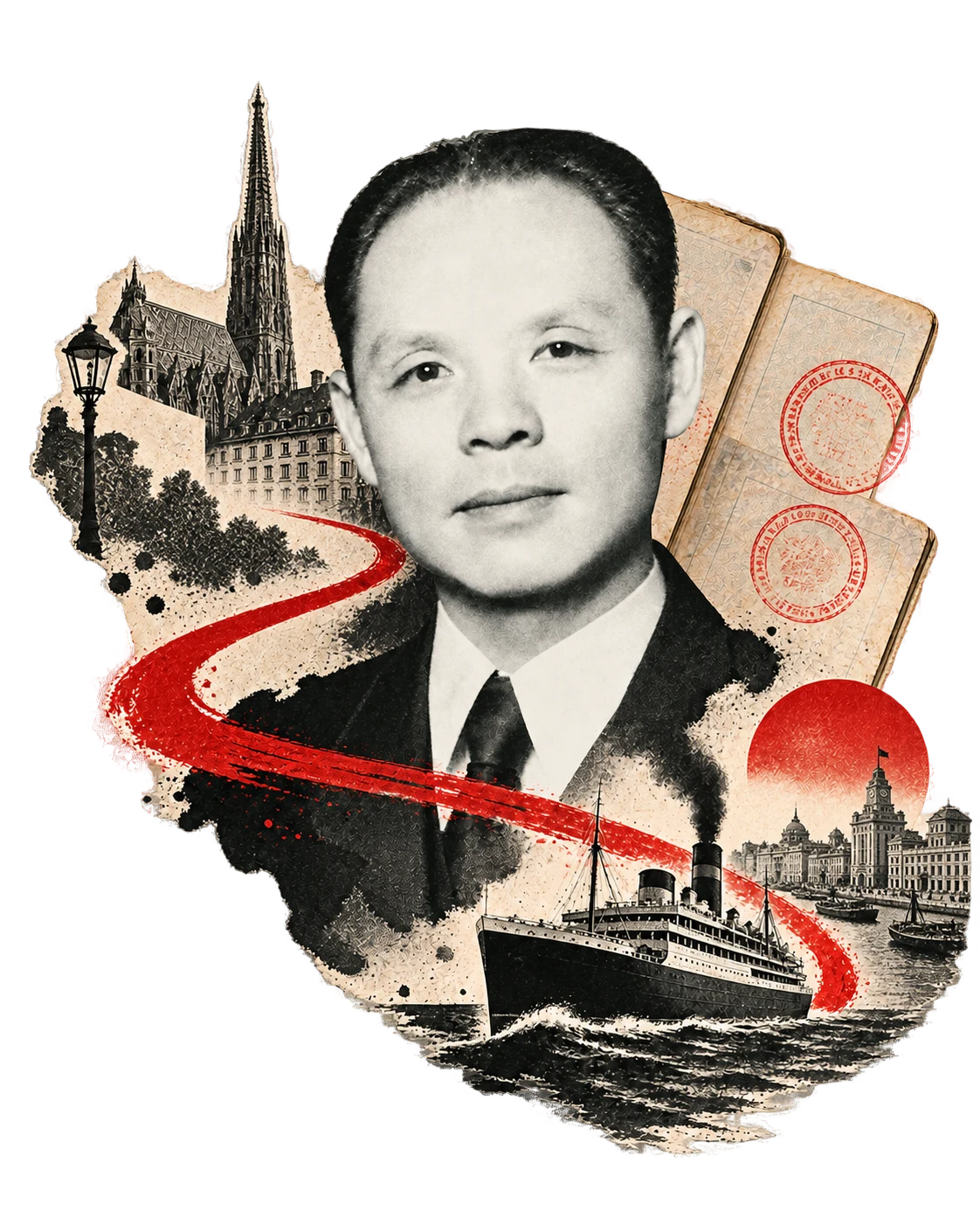
Dr. Feng-Shan Ho died in 1997 at the age of 96 and was buried in a modest ceremony. Only after his death did his remarkable story begin to come to light, earning him recognition in his native China and in Israel. This is the story of 'the Chinese Schindler.'
"When I saw the tragic fate of the Jews, I thought it was only natural to feel compassion and want to help. From the perspective of humanity, this is how things should be." So said Dr. Feng-Shan Ho, known as 'the Chinese Schindler.' Those who knew Dr. Ho described him as a warm, sensitive person, an intellectual with great charm, charisma, and compassion.
For many years, Germany's territory was made up of many small states and tribes. In 1871, the Prussian chancellor Otto von Bismarck ('the Iron Chancellor') united all the German-speaking states into one large country. A remnant of that period is the fact that Germany still has more names in different languages than any other European country, echoing the days when many states and tribes lived within its borders.
His Youth and the Start of His Path
Feng-Shan Ho was born in China in 1901 to a poor family living in the city of Yiyang, in Hunan Province. At the age of seven, he lost his father, and his mother, forced to shoulder the burden of supporting the family, worked in the homes of wealthy people. Despite the difficult start in life, Feng-Shan Ho was exceptionally intelligent and fiercely determined to succeed. At the age of 20, with help from one of his father's friends, he began studying at university. He was an outstanding and popular student, led the youth association, and captained the university's soccer team.
Otto von Bismarck's 1871 unification did not include Austria, which was the only German-speaking country left outside his union. European countries feared that a union between Austria and Germany would make Germany the most powerful country in Europe. They blocked the possibility of unification by signing the Treaty of Versailles and the Treaty of Saint-Germain (1919), which explicitly prohibited Austria from being incorporated into the German state.
After completing his studies, Feng-Shan Ho's career began to take off, and by the age of 27 he was working in his province's foreign ministry. A year later, he began studying at the University of Munich. It was the first time in his life that he had seen Jews. By the age of 30, he had earned a doctorate, returned to China, and begun teaching at Hunan University. At the same time, he studied international law and American literature at the University of Chicago.
Vienna Under the Nazis
Adolf Hitler was born in Austria in April 1889. He would later become the chancellor and Führer of Nazi Germany. As soon as he came to power in January 1933, Hitler sought to merge his homeland with Germany, disregarding the Treaty of Versailles. In 1935, he committed the first breach of the treaty by introducing conscription into the German army and rearming it. This move met with no response from France or England, emboldening Hitler to make his next breach. In 1936, once again in violation of the Treaty of Versailles, Hitler sent German forces into the Rhineland, and again the powers did not respond.
In March 1938, Hitler's dream came true. The Anschluss - the union of Austria with the Reich - got underway, and the world remained silent. When the German army invaded Austria, there were about 200,000 Jews living there. On the very day of the invasion, Jewish shops were marked, and violence against Jews began. Much Jewish property was confiscated, and many Jews were stripped of their jobs and livelihoods. Soon afterward, the race laws were announced, followed by blatant and sadistic public humiliation. Vienna's Jews were gathered at mass events called 'street-scrubbing celebrations,' where they were forced to scrub the city's streets before cheering crowds. Two months after the invasion of Austria, deportations of Jews to the Dachau concentration camp began.
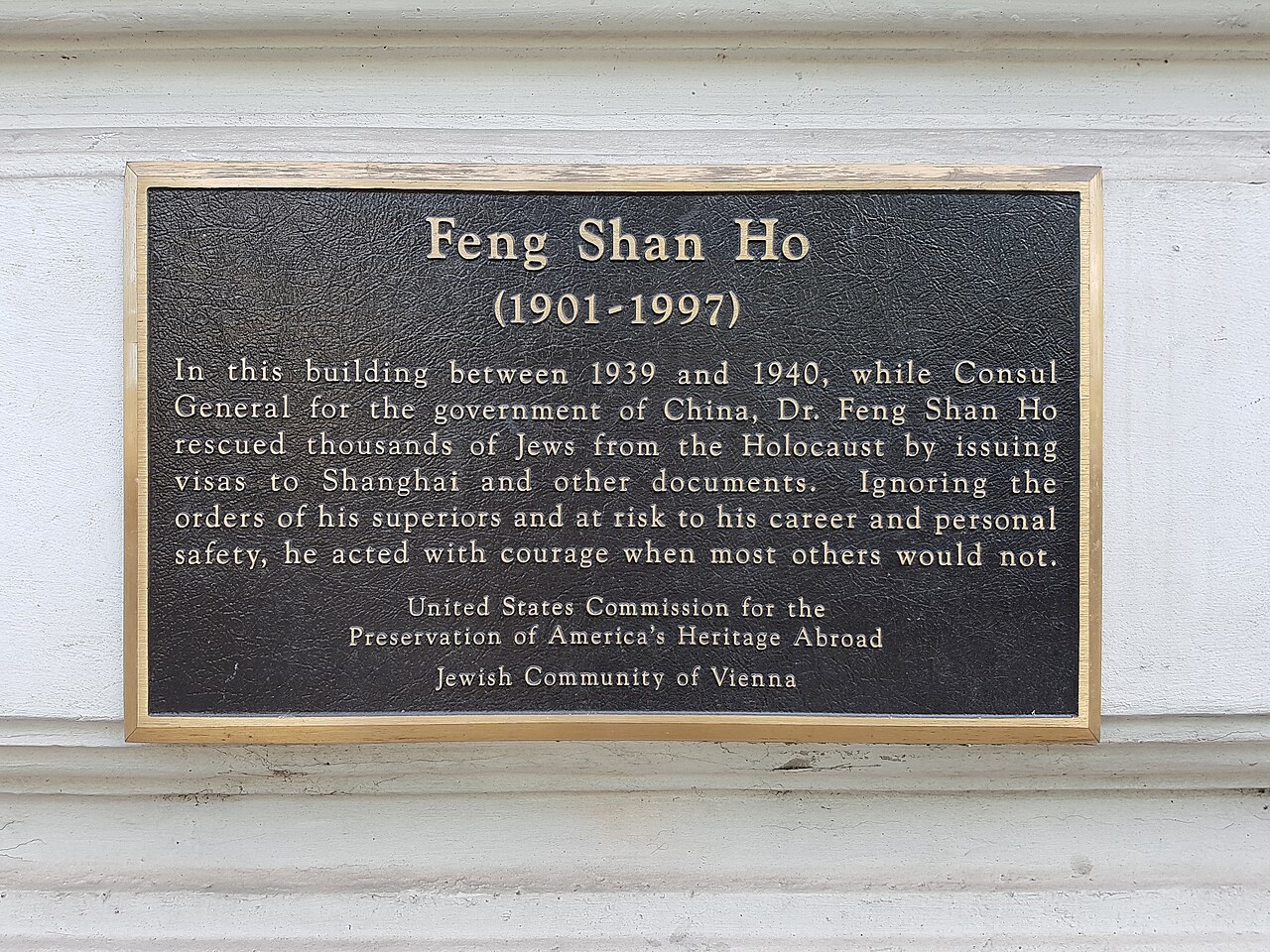
In November 1938, a pogrom took place throughout the Third Reich, which by then included Austria. It would be remembered as 'Kristallnacht' because of the shards of glass left on the ground, evidence of the shattered windows of Jewish homes and businesses. By the end of that night, 91 Jews had been murdered. After Kristallnacht, most diplomatic missions, led by those of the United States, Britain, and France, shut their doors and did not allow Jews to obtain entry visas, except for a few fortunate individuals.
For about forty years, Dr. Feng-Shan Ho served the Republic of China in its foreign ministry. He first served as second secretary at the embassy in Turkey, and from early 1938 as first secretary at the embassy in Austria. When he arrived in Vienna, he became part of high society and made friends, including many Jews. In the dark days after Austria's annexation, when everyone was afraid to defend Austrian Jews, Dr. Feng-Shan Ho's life-saving work stood out. Courageously, he decided to enable Jews to reach Shanghai by issuing visas, and the more the Nazis persecuted him, the more determined he became. Word spread quickly throughout Vienna that a narrow path of escape from Austria was open, and by the autumn of 1938 long lines of Jews were waiting outside the Chinese consulate. "Long lines outside the consulate. And while people waited, Gestapo men harassed and beat them," recalled Gerda Kraus, who received the long-awaited visa along with her husband.
Dr. Feng-Shan Ho acted in direct defiance of the orders he had received. Chen Jie, the Chinese ambassador to Germany, who was also responsible for the mission in Vienna, demanded that Dr. Feng-Shan Ho stop issuing visas so as not to damage relations with Germany. But Dr. Ho ignored the demand and followed his conscience.
After about two years of work, Dr. Ho began to feel that the ground was slipping from beneath his feet, and sent his wife and daughter to the United States. The Nazis tried to stop him by confiscating the consulate building on the grounds that it was Jewish property. This did not stop Dr. Ho either. He used his own money to rent a small apartment and continued issuing visas from there. In May 1940, Dr. Feng-Shan Ho left Vienna and arrived in the United States. A year later, he returned to China to help fight the Japanese, joined the Nationalists, served as a member of the military delegation to the United States, and became head of the foreign ministry's intelligence department.
While Dr. Feng-Shan Ho was occupied with the Second World War in Europe, his homeland was embroiled in a civil war. The Chinese people were divided between the Chinese Nationalist Party (Kuomintang) and the Chinese Communist Party (CPC). The war ended in victory for the Communists, who established the People's Republic of China under Mao Zedong, while the Nationalists fled to Taiwan and established the Republic of China under Chiang Kai-shek.
In 1947, Dr. Ho was appointed China's ambassador to Egypt. But after the Communists' victory, he decided to join the Nationalists under Chiang Kai-shek, who had fled to Taiwan. Nevertheless, he remained in the foreign service until 1973 and, among other posts, served as ambassador to Mexico, Bolivia, and Colombia.
Recognition of His Work
After retiring, he moved to San Francisco. In 1990, he published his memoir, 'My Forty Years in Diplomatic Life,' in which he also recounted his role in saving the Jews of Austria. In September 1997, at the age of 96, Dr. Feng-Shan Ho died.
During his lifetime, his story did not receive public attention. Only after his death did his daughter Manli begin researching his work during the Second World War and locate several families saved by the visas he issued. In April 2000, when an exhibition at the United Nations headquarters featured diplomats who had saved Jews during the Holocaust, Dr. Feng-Shan Ho was given a place of honor.
The State of Israel also gave Dr. Ho the recognition he deserved. At a ceremony held at Yad Vashem in January 2001, Dr. Feng-Shan Ho's children were presented with a certificate recognizing him as Righteous Among the Nations, in recognition of the fact that "during the years of the Holocaust in Europe, he risked his life to save persecuted Jews from their persecutors."
Although he was a Nationalist, on his hundredth birthday in September 2001, the authorities in Communist China honored his work. An exhibition in his memory opened at the school he attended in Beiyang, and since August 2005 an exhibition about the Chinese diplomat's work has been on permanent display at the city's municipal museum. Today, the exhibition covers an area of 600 square meters and displays hundreds of items from Dr. Ho's life.
In September 2007, ten years after Dr. Ho's death, his ashes were brought from San Francisco to his hometown, and a memorial wall was erected beside his grave, where visitors can write messages in memory of 'the Chinese Schindler.' "In those times, one man climbed to the heights of humanity simply by remaining human," wrote Nobel Peace Prize laureate and Auschwitz death camp survivor Elie Wiesel. On the tenth anniversary of his death, the book 'The International Righteous One - Dr. Feng-Shan Ho' was published in China.
In 2009, the musical work 'Quiet Skies - A Tribute to Feng-Shan Ho' was written in Israel by composer Michael Wolpe, a member of Kibbutz Sde Boker: "This work was composed as a tribute in memory of Feng-Shan Ho... After reading the story of Feng-Shan Ho's life, I went for an evening walk along the edge of the desert... I thought about the quiet skies above me, and the great privilege I have of living in this tranquility. All my life I have been grateful to the good people who saved my family and made it possible for me to stand here now, so peaceful and happy."
On the memorial wall beside Dr. Ho's grave is a quotation from the diary of Hannah Szenes, the Jewish parachutist from the Land of Israel, which beautifully captures the memory of the brave Chinese diplomat: "There are stars whose light reaches the earth only after they themselves have vanished and are no more. There are people whose radiant memory shines after they themselves have vanished and are no more. These lights that glitter in the darkness of night are the ones that show humanity the way."
תגובות
עדיין אין תגובות.