
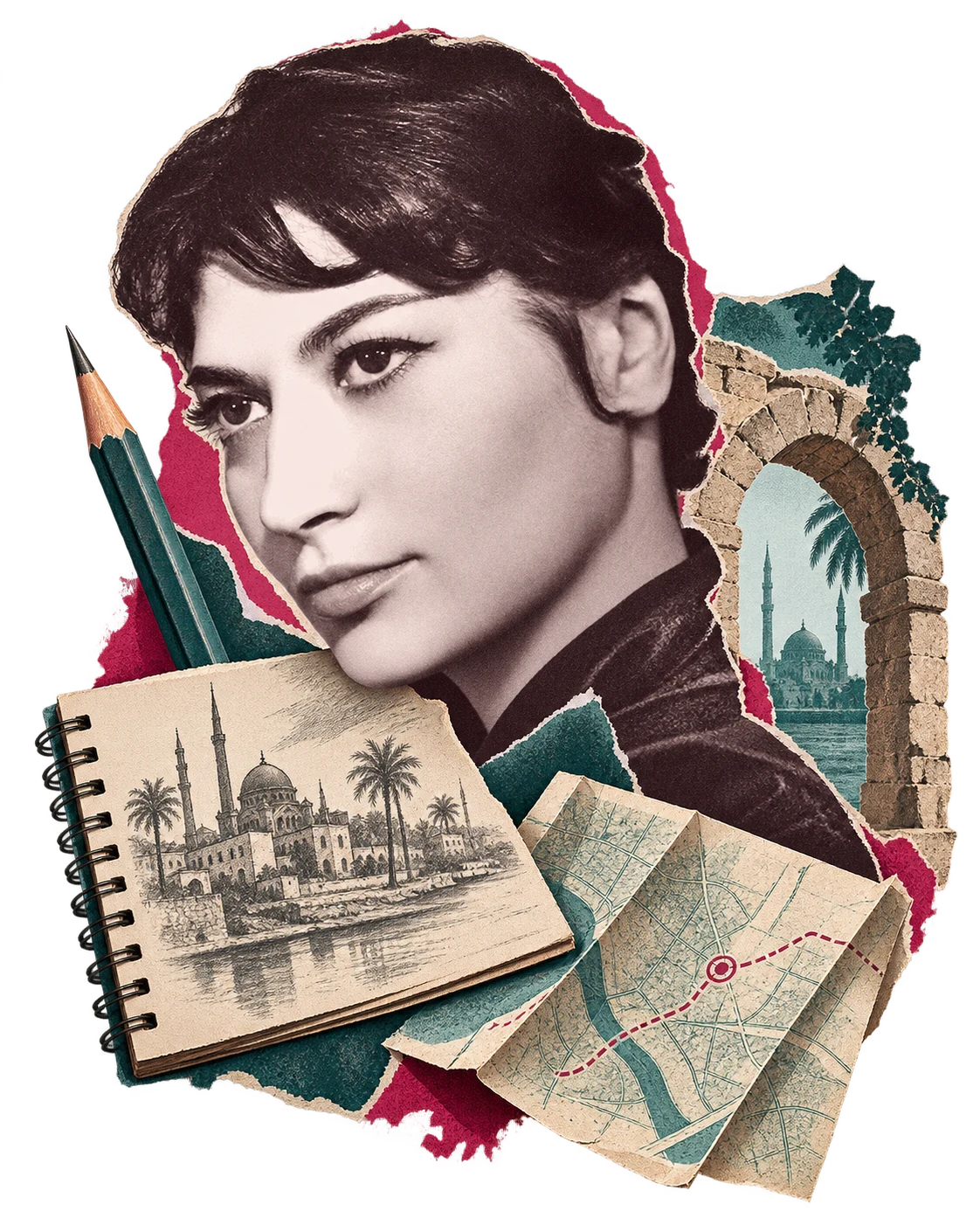
No one could have guessed that this beautiful, talented, and intelligent artist, who knew how to win people over, was a dangerous Mossad agent.
The ringing of the doorbell unsettled Isabel Pedro. The new immigrant from Uruguay, living alone in a modest apartment in Givatayim, was not expecting visitors. She left the security chain fastened and opened the door just a narrow crack. The two young men standing outside tried to reassure her: "There's nothing to be afraid of. We'd like to offer you a job abroad related to security matters." That moment changed the course of her life. For the next three years, she lived under immense strain in a foreign, hostile country, where a small misstep could, at best, cost her many years in prison or, at worst, her life, as had happened to the spy Eli Cohen, who was executed in Damascus.
Roots in Montevideo
Isabel was born in 1934 to a Zionist family living in Montevideo, the capital of Uruguay. Her father, Yitzhak, was born in Poland but immigrated to the Land of Israel as early as 1921. He was one of the founders of Kibbutz Givat Hashlosha and helped pave the famous Tiberias-Tzemah road. Despite this, he emigrated to Uruguay and joined his sister, who was already living there. Isabel spoke of her family roots on her father's side as originating in Toledo, Spain: "According to the tradition passed down in my family from generation to generation, one of my ancestors, known as Don Pedro, was responsible for buying thoroughbred horses for one of the kings of Spain... His occupation saved him and his family from the Inquisition. They were not even required to convert... In 1531, Don Pedro and his family left Spain with the king's permission and settled in Holland. The Low Countries gave Spain's forced converts the chance to rebuild their lives. A few years later, the Pedro family split up. Some stayed in Holland, some emigrated to Britain, and some went to Poland and settled in the town of Zhoromin." Isabel was descended from the Polish branch. In Uruguay, her parents, Yitzhak Pedro and Genia Malbiak, married, and her father worked in the clothing trade. His business later expanded, and he established a linseed oil factory.
Isabel studied architecture and painting at the University of the Arts in Montevideo. At the same time, she studied piano and ballet, and was active in the Zionist youth organization Hebraica, which encouraged immigration to the Land of Israel and discouraged intermarriage.
"One day, Israel's foreign minister, Golda Meir, came to Montevideo, and we performed in front of her," Isabel recalled. Golda Meir beckoned to Isabel to come closer. "'Do you speak Yiddish?' she asked. I, with the audacity of youth, replied, 'I'm not a gentile.' Meir then turned to me and said, 'We need you with us.' To this day, I can still feel the blush spreading across my face."
Aliyah and Enlistment
At 19, Isabel married a local Jewish man, but they separated a year and a half later. She waited seven years for the divorce she longed for, and when she finally received it, she hurried to immigrate to the Land of Israel. About 300 friends accompanied her to the port, where she boarded a Spanish passenger ship bound for Europe. On the way, she befriended a young officer named Juan Antonio. "He gave me his family's address in the Castile region of Spain and invited me to visit. Our group disembarked at the port of Genoa, and I said goodbye to him. It never crossed my mind, not even for a moment, that I would one day serve in Israel's security services, or that a chance encounter with a Spanish naval officer would turn him into an indirect mail carrier for sending sensitive security messages to Israel." She disembarked at Genoa and boarded the ship Moledet. In Israel, she was sent to study Hebrew at Kibbutz Usha. She then rented an apartment in Givatayim and began studying interior architecture in order to obtain professional certification in Israel.
After the two young men at the door reassured her, she invited them inside. They surprised her with their knowledge of her family's history, but avoided answering her question about who had sent them. "They only made it clear that the people who had sent them were certain I could perform a useful role for the State of Israel outside its borders," she recalled. They parted with the understanding that they would return a few days later to hear her answer. Isabel was afraid: "I was only 28, and I suspected that people involved in trafficking women for prostitution, especially among innocent new immigrants, had been following me." Isabel was beautiful, spoke six languages, knew how to win people over, and lived alone. All of that, no doubt, gave her good reason to worry. She went straight to the Jaffa police and asked them to check whether the men really represented an official state security agency. Two days later, a policewoman came to her apartment and told her, "It's a serious offer."
After a series of training courses and exercises at the School for Covert Operatives (spies) in Tel Aviv, Isabel was tested in a number of assignments. One was to infiltrate a power station from the sea. She succeeded and proved that she was brave, creative, and had an excellent memory. The next assignment was to photograph a military base in Netanya. During this mission, one of the base's officers caught her. "I don't speak Hebrew," she replied in a French accent. She was taken to the Netanya police station, where she continued to say, "I don't speak Hebrew," when questioned by the officers. She was transferred to Jaffa, where a French-speaking investigator questioned her. She insisted that she knew nothing, had no idea what all the fuss was about, and was, in fact, a painter and photographer by profession. As the interrogation went on, she asked to call a "friend." She called the emergency number she had been given, and that "friend" got her out and told her she had failed the assignment. But as far as Isabel was concerned, she had passed, since she had not given away any information. After the assignments, she continued her studies in Morse code, aerial photo interpretation, map reading, and training with various weapons.
When it was time for her to go into the field, her command of French and lack of Arabic pointed her toward Lebanon or Egypt. "I preferred Egypt, partly because I loved its magnificent antiquities," Isabel recalled.
Preparing for the Mission Abroad
In early April, Isabel flew to Paris and met with her handler, "Michael," who commanded the Gulf Operations Unit, which planted spies and ran agents in target countries. "Michael" was the codename of Yitzhak Shamir, who later became prime minister of Israel. "I spoke with him three times. He asked me questions, and judging by my answers, I must have made a very good impression on him. After our third meeting, when it was decided that I would go to Egypt, he said to me, 'Please get up, go and do whatever you like, wherever you like, whenever you like.' I don't think there could be a greater compliment than that. It was a complete expression of the trust he placed in me." She added: "He had a strong character and knew exactly what he wanted and how to get it... When he trusted something, he had a clear basis for knowing that his judgment was right. He had an excellent ability to read people. When he met someone, he knew whether they could be trusted or not. If he had sized me up after three meetings, that was the best sign that he knew exactly what he was doing." "Egypt," Yitzhak Shamir told her, "is important to Israel in every way imaginable. Your role will be to travel around the country, keep track of anything military-related, take note of unusual events, listen in on what is happening among the elites, make contacts, and use your senses as you see fit."
Speaking about her cover story, she said: "I was assigned to mingle with circles of the Russian aristocracy who had fled their homeland during the Communist Revolution and become part of French society. They spent long hours at the Café de la Paix on the Right Bank of the Seine." Isabel found the assignment easy, and before long she had become a well-liked and welcome member of those circles. From Paris, she went on to Italy: "I met with the Mossad representative, 'Aryeh.' In Rome, I kept track of the locations of the various foreign embassies and consulates, including the Arab ones, as well as other sites that seemed important to me." Finally, she went to Spain and visited the parents of Juan Antonio, the officer she had befriended on the voyage from Uruguay to Genoa. "I asked them to forward items of mail to Israel for me from time to time. I explained that I had set off to travel the world and didn't want my family in Israel to know where I was. So I let my parents know that I was well and sent them photographs, travel guides, and the like." In this way, she got them used to forwarding materials for her and also completed her cover story. When she met Juan Antonio's family, she was surprised to learn that a relative of theirs was in Egypt at the time. He was an expert in unconventional weapons and was working with German scientists on their production.
The last detail that needed to be dealt with was her passport. Since her personal passport bore Israeli stamps, she flew to Amsterdam, where she poured red nail polish over it - a "good reason" to visit the Uruguayan embassy in Amsterdam and get a new passport. She returned to Paris and continued on to Milan to obtain an Egyptian visa. The Egyptian consul began questioning her about the purpose of her visit, and she replied that she was coming for an extended stay to study archaeology. "The consul was more impressed by my bare legs, and no further questions were asked," she later recalled.
The Mission in Egypt and the Way Forward
In early 1963, she arrived in Egypt with a double-bottomed suitcase concealing a Morse key and a radio. This was no longer an exercise; she was now in an enemy country. At the time of her arrival, local Jews whom Israel had sent on sabotage missions had already been in prison there for seven years. She settled at the Semiramis Hotel in an upscale neighborhood, intending to move among high society and gather information. The first thing she did was make contacts at a local hair salon because "hairdressers like to talk, and you can hear from them both news and gossip about people in high society, civilian and military." At the salon, she met the owner of an antiques shop called Ali Baba, who had connections to high society. Through him, she met a young archaeologist with whom she went on excursions around Egypt.
On one of the excursions, she discovered that the Egyptian army was transferring weapons to Sudan. On another trip, she found the location of a huge airfield with Soviet Tu-16 aircraft and memorized the call signs of all the planes. At the port of Alexandria, she kept an eye on military ships. On another excursion, she sailed near the Aswan Dam and befriended the ship's chief officer. After he bragged to her that he had the dam's plans, Isabel managed to photograph them without being noticed and sent the materials through Juan Antonio's family in Spain: "Of course, they didn't know what was in the envelopes."
At one hotel facing the pyramids, she met a senior journalist who was close to the Egyptian regime. He introduced her to a senior army officer in the armored corps, who brought her to an exclusive sports club where Egypt's high-society women spent their time. Through her connections, she met a television personality who offered her a job hosting a French-language television series about art. An Egyptian producer also offered her a part in a film about the search for an ancient Egyptian treasure. All the while, Isabel continued to paint and take photographs, exhibiting her work, which also won awards.
After three years of dangerous work, and after Eli Cohen was captured in Damascus and the spy Wolfgang Lotz ("the Champagne Spy") was captured in Egypt, Isabel returned to Israel in 1965 and continued working in interior architecture. She exhibited her paintings in Switzerland, Germany, Belgium, and Washington, where they were also recognized and won awards.
As part of her work, she designed the home of former Mossad chief Isser Harel: "His wife welcomed me into their home, and I completely transformed their home... Isser would come in, look around, say, 'Very good,' and say no more. He was so discreet that he never asked me anything about Egypt."
Isabel Pedro married Ben-Ami Kaplan, a well-known Irgun fighter and a descendant of Rishon LeZion’s founders. The couple had two sons, Eilon and Asaf. "It was all because of his mother, really. She fell in love with me, grabbed hold of me, and said, 'You're mine.' My husband hadn't even seen me before his mother made the decision for him. After the wedding, it turned out that some of his relatives and friends were very close to the Mossad, so I became part of that extended family. If it weren't for my past, maybe I wouldn't have ended up there in particular," she recalled nostalgically. Asked, "What do the children say about their spy mother?" she replied simply, "For many years, they didn't know at all. I didn't tell them. Later, when they learned about that chapter in my past, they took it for granted. That's their mother. She's such a badass."
Isabel Pedro died in Tel Aviv on April 27, 2023, at the age of 89.
תגובות
עדיין אין תגובות.