
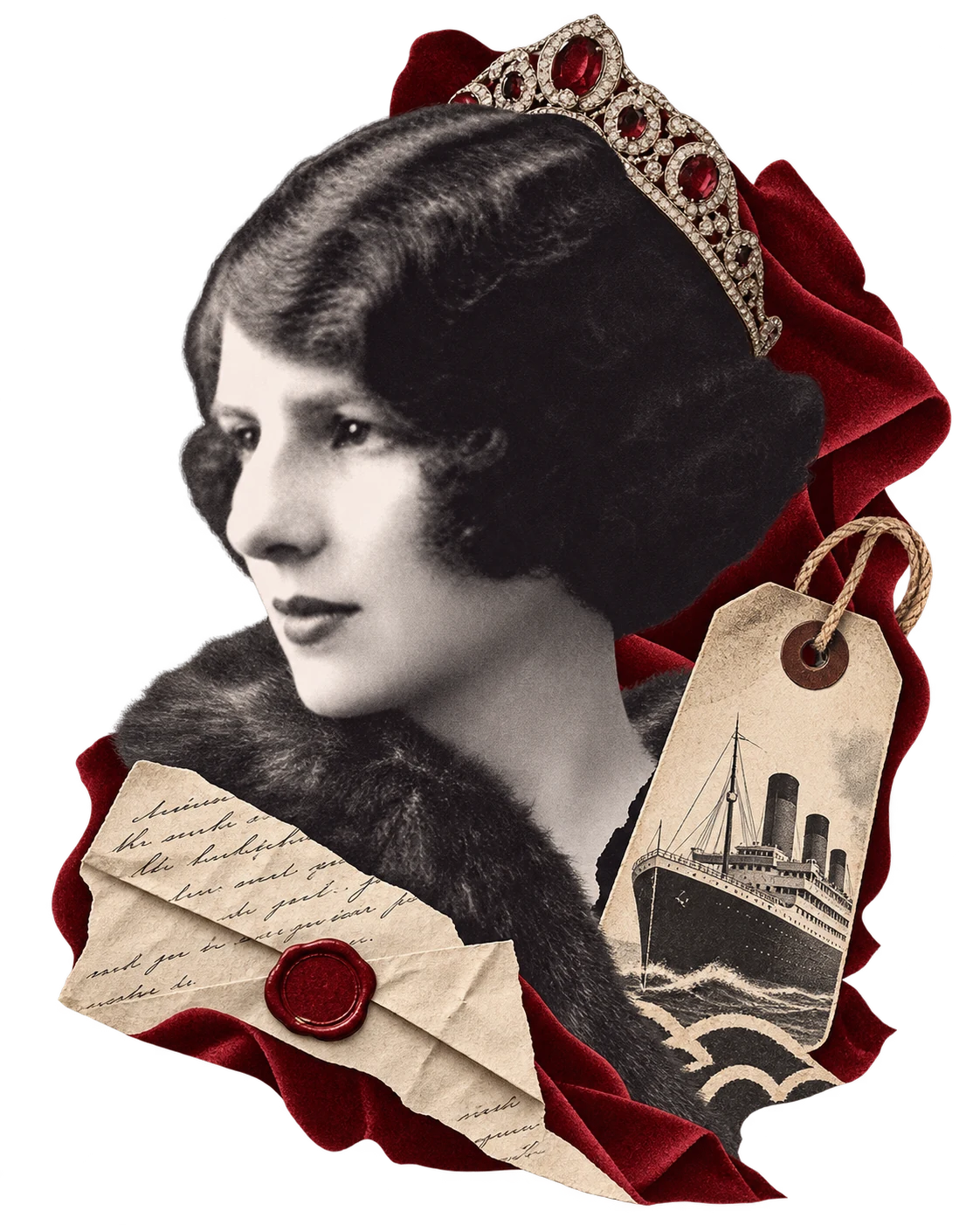
Just as Napoleon saw Josephine walking for the first time and fell in love with her immediately, and just as Titus fell in love with the way Berenice, daughter of Agrippa, King of Judea, walked, so King Carol II of Romania became captivated by Magda Elena Lupescu's walk.
Carol I and the Royal Succession
The Romanian boyars (nobles) preferred to appoint a non-Romanian noble as ruler of Romania, so that he would not favor one group of Romanian boyars over another, and because he would have good connections with Europe's leading royal houses. In 1866, the boyars approached the German prince Karl Anton and offered the position to one of his four sons. The second son, Carol, was chosen to rule Romania; he would become a captain (an artillery officer).
The Austrian authorities looked unfavorably on the union of the two principalities and the choice of a member of the rival dynasty. There was great fear that they would try to capture Carol, so in May 1866 he was smuggled into Bucharest in disguise, carrying forged papers. In 1881, Carol was sworn in before the Romanian parliament and proclaimed ruler of the Romanian principalities. Carol was crowned as Romania's first king and from then on was known as King Carol I.
The Romanian constitution stipulated that the crown would pass by inheritance, but since Carol I left no heir, the monarchy was to pass only to the male descendants who came after him. Ferdinand I (and the last), Carol I's nephew, succeeded him. Ferdinand married his cousin, Princess Marie of Edinburgh, granddaughter of Queen Victoria of the United Kingdom. The couple had three sons and three daughters. The eldest son inherited his father's throne and became Carol II.
Carol II was the first prince to be born in Romania. But unlike those before him, who were interested in artillery and botany, Carol II was interested in women.
The prince did not behave as expected of him. In 1918, at the height of World War I, Carol abandoned his military post and fled from Bucharest to Odessa with his beloved Ioana Maria Valentina Lambrino, better known as Zizi Lambrino, the daughter of a Romanian general from an old aristocratic family.
Marie, Carol's mother, could not bear the disgrace, and wrote to him: "If I were a man, and above all a fighting man, I would always be with the soldiers at the front, like a flag to which their hearts would turn. A flag flying before the eyes of all the fighters. You do not understand what a glorious opportunity you are throwing away. You could have become the army's idol, won the army's trust and been its hope, but instead you are nothing but an overgrown boy wasting his time." That August, Carol II married Zizi Lambrino in the Orthodox Church in Odessa, after informing the Romanian consul of his intention.
While Carol was receiving his mother's letter, his wife told him she was pregnant, and on August 1, 1919, Carol II decided to renounce his rights as crown prince. Their son was born in early January 1920, and they moved to Paris, where they lived on an allowance from the royal family. The royal family had not yet given up on the idea of "reforming" him, and to put pressure on Carol, his allowance was stopped, breaking his spirit. Carol left his wife, returned to Bucharest, and agreed to his father Ferdinand's plan to travel around the world so he could forget Zizi.
On that trip, he "happened" to meet Princess Helen of Greece, the very princess his mother had intended him to marry, hoping Helen would make him forget his wife. And it worked. Carol divorced Zizi and married Helen in the Cathedral of Athens. Less than seven months after their official wedding, Carol and Helen's son Mihai was born.
The Affair with Magda Lupescu
Carol's next love came in the form of a red-haired, green-eyed Jewish woman. Her walk was the most beautiful in Europe. Just as Napoleon saw Josephine walking for the first time and fell in love with her immediately, and just as Titus fell in love with the way Berenice, daughter of Agrippa, King of Judea, walked, so King Carol II of Romania became captivated by Magda Elena Lupescu's walk.
Magda was the daughter of a pharmacist named Nahum Greenberg, who converted to Christianity and changed his name to Lupescu, and Eliza Falk, a dancer from Vienna who was also Jewish and converted to Christianity. The Lupescus converted in order to obtain a license to open a pharmacy, a license that was not granted to Jews. Unlike her parents, Magda, who married a non-Jewish officer named Timpiano, never converted.
Like many members of royalty, Carol sponsored all kinds of community events, and each one was documented by the king's photographer, who was Jewish. One day, when Carol entered the photographic laboratory to look at the negatives, he noticed a photograph of a beautiful woman. Carol asked who she was, and the photographer replied that it was Magda Lupescu. On 14/2/1925, Carol met Magda, was captivated by her walk and her charms, and fell in love with her.
King Ferdinand, Carol II's father, was already desperate. He announced that he would tolerate no further scandal and that Carol must immediately end his relationship with Mrs. Lupescu. And indeed, Magda disappeared from view. At that time, Alexandra, the Queen Mother of England and widow of Edward VII, died, and Carol was sent to represent the Romanian royal family, since they were related by blood. Immediately after the funeral, Carol disappeared and suddenly turned up in Milan, Italy, in the company of Magda Lupescu.
The surprise was reported in every Italian newspaper, but Carol decided that this time he had found the love of his life, and wrote to his mother: "Dear Mother, I am giving up everything. I am still young. I am not afraid of work. I will manage to support myself. It would be better if they announced that I had died in a car accident and drowned in an Italian lake."
His wife Helen wrote to him: "My dear Carol, why not say that you need a six-month vacation?" (She estimated that it would take him that long to get over this love.) "The letters you sent can be hidden, and no one will know what kind of life you are building for yourself, after becoming accustomed to getting everything you wanted. Our son (Mihai I) goes into your empty room looking for you and keeps asking where Daddy is."
In 1927, King Ferdinand died, but since Carol II had renounced the throne, it passed to his son Mihai, Helen's six-year-old son. The government did not want a merely ceremonial king, and applied enormous pressure to bring Carol back. But everyone, without exception, made his return conditional on his breaking up with his beloved Magda, or, as the newspapers called her, "the Jewish whore."
On 08.06.1930, Carol landed at Bucharest airport and was proclaimed King of Romania, while his son Mihai was proclaimed crown prince. His mother, Queen Marie, wrote: "Carol is a great sinner, there is no doubt about that, but say what you will, he is a man." Later, when things had calmed down, Magda Lupescu reappeared. Helen, Carol II's wife, left Romania and left her son Mihai behind. Magda established a small court of her own, but the clergy and the aristocracy shunned her. Bankers, industrialists, and writers attended her parties, and she became Romania's unofficial queen.
War, Escape and Exile
In 1937, Carol wrote: "My heart and soul wish her nothing but happiness. Her relationship with Mihai is good and improves every day. I feel an absolute need to be near her. She is an inseparable part of my personality. My love for her is as deep as ever; I have no life without her."
In 1937, Hitler established the "Iron Guard" in Romania. The Nazis were furious about this relationship. That same year, Carol said of the Nazis: "The Western nations are blinded when it comes to Hitler. The small nations give in and immediately snap to attention when Hitler appears. I remain true to my previous decision to protect our political and economic independence, and to achieve this goal we need the help of our Western friends."
The Germans invaded Romania. Europe entered a dark and oppressive period. Tension hung in the air, and Carol wrote in his diary: "Fifteen years have passed since we came together..., our love is an unshakable rock, the essence of my life... a supreme refuge in difficult times. Without her love, I have no life at all."
Carol II understood that he had to flee and asked to take his son with him. Magda prevented him, saying that Mihai should be left in Romania and that she was sure no harm would come to him.
Carol and Magda fled to Portugal, from there to Mexico and Brazil, and then back to Portugal. At a certain point during their flight, Magda fell gravely ill, and when they were certain she had only a few hours to live, the king announced that he wanted to marry her. And so the daughter of a Jewish pharmacist from a provincial town in Romania became the only Jewish princess since the destruction of the Second Temple.
Magda outlived Carol by another 25 years and died in 1978.

תגובות
עדיין אין תגובות.