
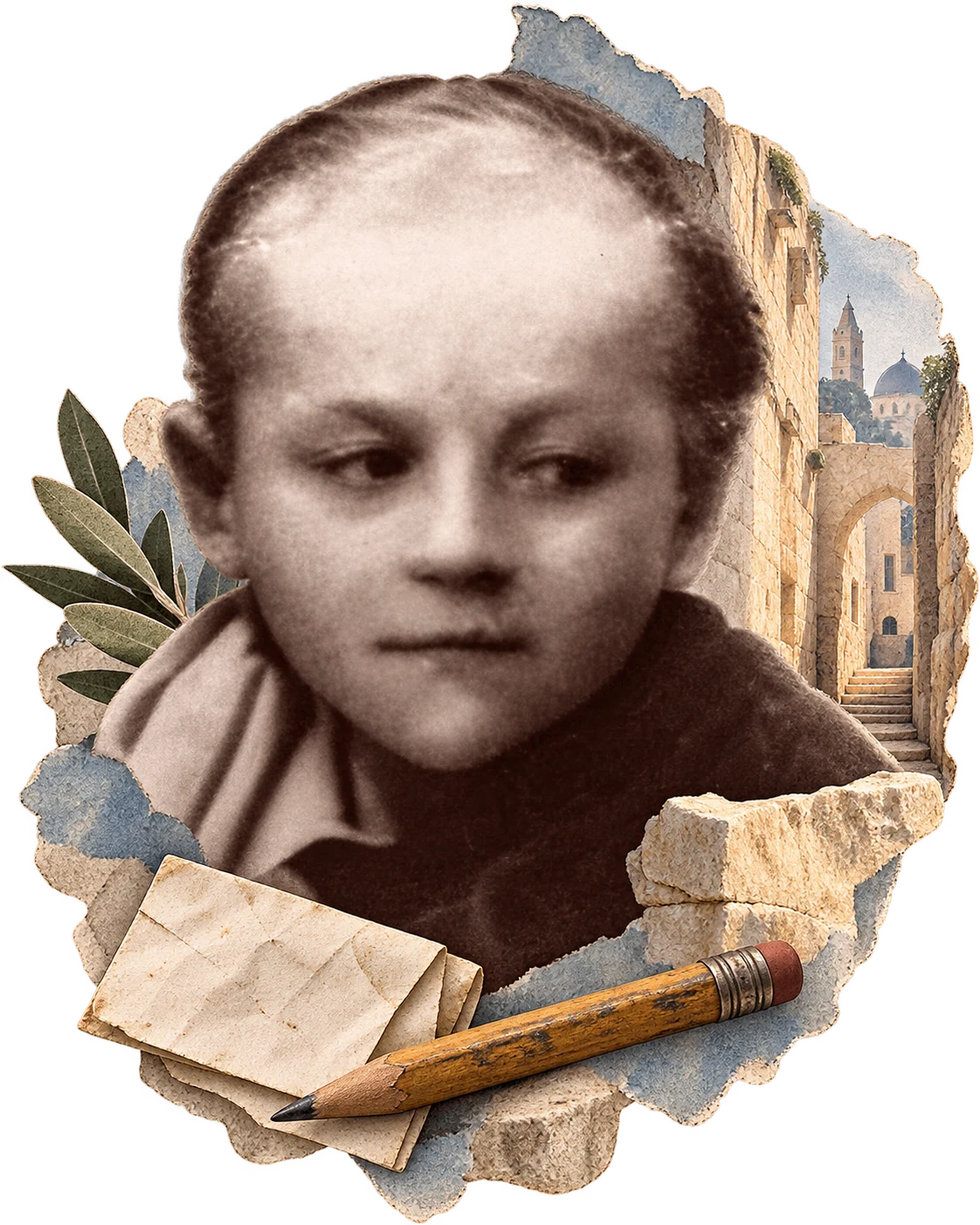
Not a man, but a tender young child; not a young soldier, but a ten-year-old fighter; not child's play, but a bloody war.
On December 2, 1947, three days after the United Nations partition resolution, the battle for the Jewish Quarter began. Anyone who left could not return. The Quarter was under siege...
Nissim Gini was born in 1938 in the Jewish Quarter of the Old City. His mother, Miriam, immigrated from Morocco, and his father, Yitzhak, came alone from Turkey, following his own father, who had been a soldier in World War I and had fallen in battle in the Land of Israel. Nissim was the third of their four children. He spoke Arabic fluently and, like many children of the Old City, spent his childhood playing with the Arab neighbors.
When the UN resolution to partition the country was adopted, Nissim was nine, and his games with his Arab friends came to an end. His father, Yitzhak, who worked at several bakeries in Mahane Yehuda, could no longer return to the Jewish Quarter, which was under siege by the Jordanian army. Nissim, who saw himself as a soldier like his grandfather, was recruited by the Haganah to defend the Quarter. With no telephones or radios, Nissim served as a messenger between the positions. He relayed information as he darted between the positions and through the rubble. Nissim was also an excellent lookout: no one suspected that a running, nimble boy was pinpointing the locations of Jordanian snipers.
On the night of May 18-19, 1948, a Palmach unit tried to break through to the Jewish Quarter. The unit's fighters, who had captured Mount Zion, had endured several days of fierce fighting, so it was decided to ask a number of volunteers to break through to the Quarter. Twenty-two people volunteered for the mission, under the command of David (Dado) Elazar, who would later become Chief of Staff. Benny Maharshek, the officer in charge of mortars and information (the Palmach's "political commissar"), addressed them and said: "Fighters! For some two thousand years, since the days of David, no Jew has broken through and crossed the walls of the Old City. Take heart and press on!"
The Family Under Siege
Nissim's mother, Miriam, survived smallpox in Morocco but was left blind in one eye. Two weeks after giving birth to her daughter Haya, she also lost the sight in her other eye. The siege of the Quarter forced Miriam to cope alone with her blindness and her four children. She had to move because their home was beneath a Jordanian sniper position.
Nissim's sister, Haya, volunteered as a nursing assistant and cared for the wounded. His older brother, Natan, also served as a messenger, and only Aryeh, the youngest, who was eight at the time, stayed at home with his mother. Haya described the preparations for the battles: "Most of the population volunteered to help... The adults and the elderly sewed sacks and filled them with sand to place at the positions, in the windows, and in openings facing the Jordanians. The children collected every empty can from the streets. They made improvised hand grenades from those cans. The children also served as lookouts and messengers. The army made small openings that the children could squeeze through to get between the positions. Some of the older boys who were supposed to fight were so frightened that they shirked their duty and sat huddled and trembling in their homes, but most volunteered."
At two in the morning, Zion Gate was blown up. Dado shouted, "Follow me!" and ran forward. After a few meters, he turned around and saw he was alone - everyone else had fallen asleep. Dado shook them awake, and together with the volunteers, they broke through to the Quarter. When they arrived, the residents of the Jewish Quarter were sure that the Palmach soldiers would immediately storm the Old City, but that did not happen. Ninety Haganah members entered the Quarter and reinforced its exhausted defenders, while the Palmach men left to fight in other sectors.
In those days, the brothers Natan and Nissim rarely got to see each other. One shift followed another, and Natan hardly ever made it home. But he would never forget May 27... This is how Natan told the story of Nissim: "He had lunch with Mother... He had a gut feeling. He told her, 'Mother, this is my last meal. The last meal we'll eat together.' Just then, they came and knocked on the door. They called for him. It wasn't even his shift; he was supposed to be off. 'The one who was supposed to report to the position hasn't shown up. Go take his place,' they ordered him. Mother asked, 'What do you want with him? He just got here. He hasn't even had a chance to eat. Give him a few minutes.' They said, 'No, ma'am. He has to report now.' His position was on the outer edge. You could see everything happening around the Quarter from there. Nissim understood things like a grown man, even though he was a child. He said, 'What do you want me to do, sit at home while others die?' And he left, leaving his plate full behind him."
In the fighting for the Quarter, the Haganah, Etzel, and Lehi cooperated fully. They rotated forces at the positions, and even shared logistical support and a grenade-making workshop. Some 600 Jordanian soldiers fought against the 200 poorly armed defenders, among them children and elderly people.
"I'll be back soon," Nissim answered his mother, and ran outside. After completing his mission, he returned to his sentry post, where he noticed suspicious movement. Nissim raised his head and was hit by a sniper. His sister Haya met him at the hospital: "He was wounded at his post and rushed to the hospital, which was very close. I was caring for the wounded, and suddenly I saw them bringing him in. I panicked and started screaming and crying. The nurses took me aside and calmed me down. They said to me, 'This is war. You know there's nothing to be done. Look, there are so many wounded and dead,' but I answered, 'He's my brother, he's my own blood!' Then I sat beside him and tried to talk to him. I called his name. For one second he opened his eyes and looked at me, and that was it. That's my last memory of him. He couldn't speak because he had lost so much blood. The bullet entered through his jaw and came out through the back of his head. If they had had all the necessary means to treat him and enough units of blood to give him, they might have saved him, but they didn't. When I got home, I didn't tell Mother anything. In the morning, Shoshana came and told me that Nissim had died of his wounds. Mother didn't find out until noon." Nissim was ten years old when he died. The next day, the Quarter fell.
The Fall of the Quarter and Remembrance
On Friday, May 28, 1948, at 4:00 p.m., after 13 days of continuous fighting and six months under siege, Moshe Rusnak, the Quarter's last commander, signed the instrument of surrender before Abdullah al-Tal, commander of the Jordanian Legion.
At the surrender ceremony, Abdullah al-Tal lined everyone up and asked the fighters to step forward. Thirty-five young fighters, some of them children, stepped forward. Abdullah separated another 290 people and added them to the "fighters," including a 78-year-old fighter... At the surrender ceremony, he said: "If I had known there were so few of you, I would have come after you with sticks."
This is how Natan told it: "The residents were told to leave their homes for shelters, then they were told to go back home, and after that they were called out to the shelters again. The Jordanians shouted at us, 'Deir Yassin, Deir Yassin.' We didn't know what had happened there, but they did, and they wanted revenge on us. A Jordanian general stood there and announced over a loudspeaker that King Abdullah had ordered that the Jews be allowed to leave as they wished and not be harmed, and that any Jordanian soldier caught harming a Jew would be put on trial." The fighters were taken out through Lions' Gate and brought to Jordan, where they were held for about nine months in harsh captivity. The women and children, including Nissim's brother and sister, were taken out through Zion Gate and transferred to Katamon.
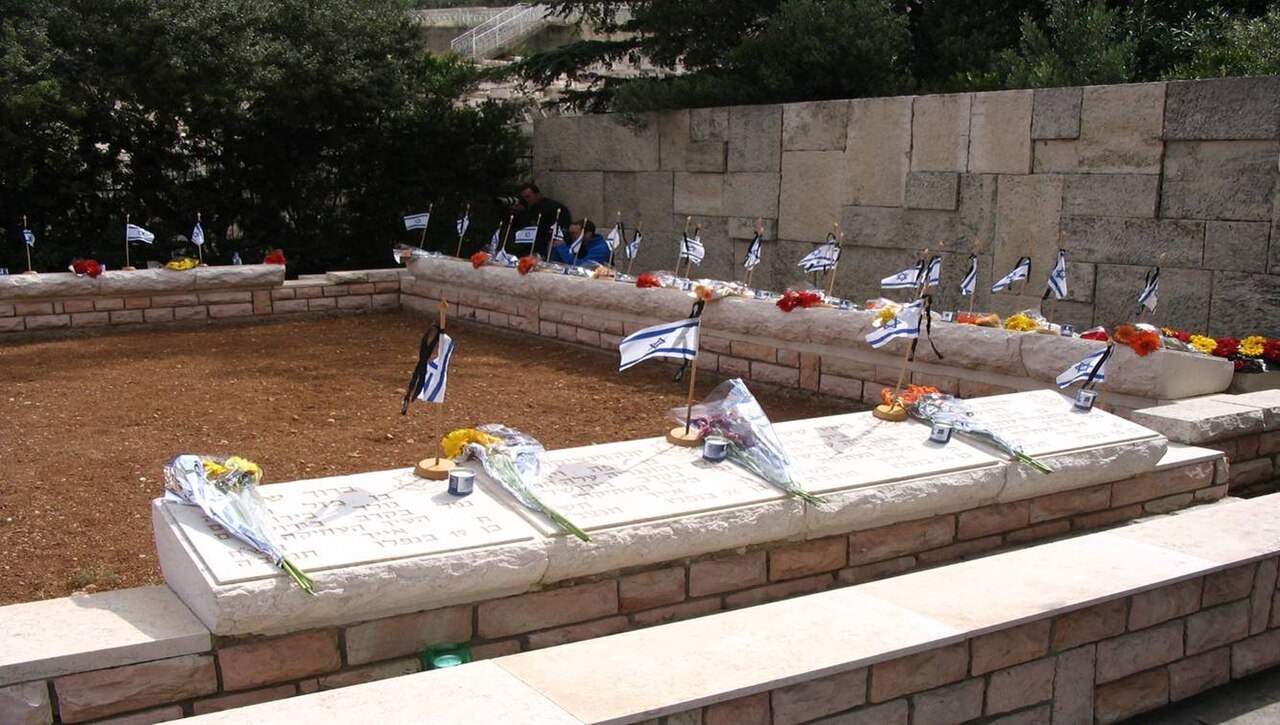
Thirty-nine soldiers fell defending the Quarter, and about 130 more were wounded. Thirty-four fighters and civilians were buried in a mass grave. Later, the Jordanians found another 14 soldiers' bodies and buried them together in a grave in the narrow alley beside Batei Mahse Square, where a memorial now stands.
The fall of the Quarter was the greatest and most bitter defeat we suffered in the War of Independence. The Quarter was abandoned after Jews had lived there for about 700 years.
After the Six-Day War, Israel returned to search for the fallen. The Jewish Quarter was in ruins, and identifying the mass grave was difficult. Once the grave was located, efforts began to identify the dead, and Nissim was identified by his baby teeth. At a state funeral, the fallen were buried in a mass grave on the Mount of Olives. Nissim Gini's name was engraved on the memorial erected in the military cemetery on Mount Herzl - the youngest person among Israel's fallen in its wars. Smadar Shir wrote the book "Baby Teeth" about Nissim Gini.
The only photograph of Nissim that remains is the class photograph. A child-soldier in an oversized skullcap.
תגובות
עדיין אין תגובות.