
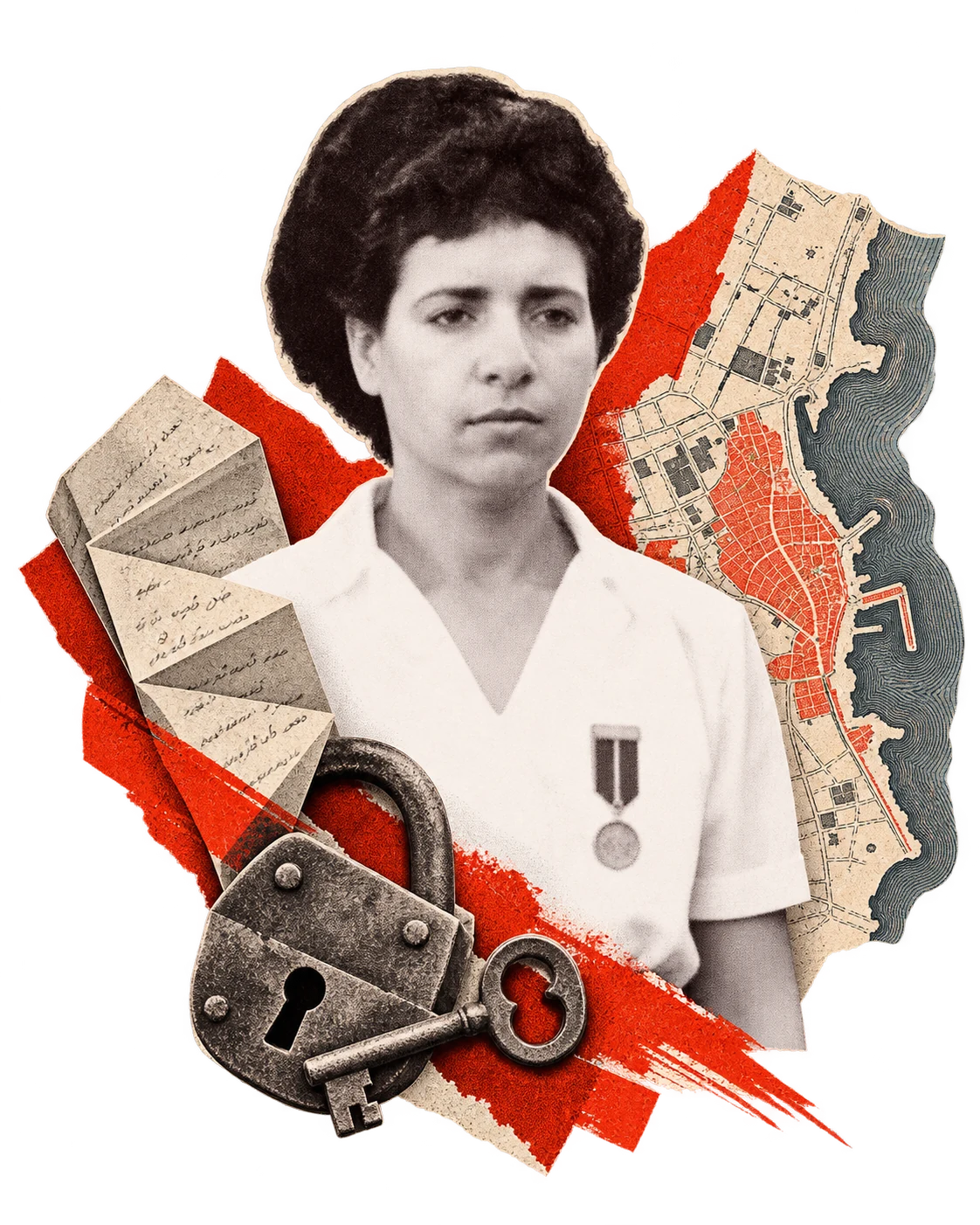
An Irgun fighter who took part in heroic missions that became part of the organization's lore, she became known after being sentenced to life imprisonment.
Mourning for Jabotinsky
In the summer of 1964, after a major dispute among the nation's leaders, the coffins of Ze'ev Jabotinsky and his wife Johanna were brought to Israel for burial. They were received at the airport in an impressive ceremony, and a guard of honor made up of loyal Irgun members accompanied their coffins. Among them was Rachel Levy, who was chosen to lay a wreath on Johanna's coffin. Rachel had received the news of Jabotinsky's death in the summer of 1940 with great sorrow and wrote in her diary: "What can I say, I, the only one here in prison, mourning with thousands of mourners for our great president... The shepherd is gone and left a flock standing stunned and alone in the battle. That 'man of iron' is gone and will not live to see Israel rise again. A prophet has been taken from us, one who sacrificed his heart for the people and the homeland. That lion will roar no more, and who will take his place? My heart, my heart, for you, my president! Would that I could die in your place. My heart is broken, and I no longer have the strength to bear this calamity that struck like a sudden blow in the midst of our dreams... And at night, alone with an army of infernal thoughts, I sat by my window as a mighty wave of sorrow welled up in my heart. I raised my hand to my mouth to stifle the cry rising from my throat... No one can hear my scream, only the mountains, the stars, and the darkness."
In 1936, the Arab Revolt began. It was directed mainly against the British and their intention to allow the establishment of a Jewish state, as expressed in the Balfour Declaration: "His Majesty's Government views with favor the establishment in Palestine of a national home for the Jewish people." The revolt continued until March 1939, when the British published the (third) White Paper, whose main points were: "Palestine cannot belong to the Arabs or to the Jews. The British Government makes clear that it has no intention of turning the Arabs into subjects of a Jewish state against their will." The British also began restricting immigration to Palestine: "The Jewish immigration quota for the next five years will be a total of 75,000 persons." All this was happening while the Nazi killing machine was operating in Europe...
These were unbearably difficult days for the Jewish community in Palestine. On the one hand, Arabs rioted and massacred Jews; on the other, the British ignored these acts and even imposed restrictions on the Jewish community. The underground fighters decided to abandon the policy of restraint and began attacking Arab population centers. Not all the retaliatory actions succeeded. One failure came in July 1938. Yaakov Raz, an Irgun fighter, walked into the Old City market disguised as an Arab, carrying a booby-trapped basket on his back. The Arabs had declared a general strike that day, so when Yaakov put the basket down beside one of the locked shops, passersby began to suspect him. The Arabs seized and stabbed him, then took him to be questioned by British intelligence. Yaakov Raz did not survive and died a few days later.
Rachel Joins the Mista'arvim
Rachel (Ohevet-Ami) Habashush was not yet 17 when she joined the Irgun. She had a Middle Eastern appearance and spoke fluent Arabic (her father had immigrated from Yemen and her mother from Morocco). At first, she was offered intelligence work, but Rachel vowed to succeed where Yaakov Raz had failed. She insisted on becoming a fighter and taking part in operations. Her determination paid off, and she joined the organization's unit of fighters who posed as Arabs.
The arrest of Irgun commander David Raziel in May 1939 led the organization to carry out retaliatory operations against Arabs. A group of Arab-looking fighters, including Rachel Habashush, went to the Rex Cinema in Jerusalem to see the film Tarzan. A few minutes after the film began, a loud explosion rang out, and Rachel and her comrades managed to escape amid the commotion in the hall. The operation claimed the lives of five people and wounded 18. It was considered a partial success, since a Jewish man and woman were among the dead.
Rachel Habashush was born in 1922 in Jerusalem's Ruhama-Mekor Baruch neighborhood, to Nissim and Aliza (Farha) Habashush. Her father was a builder who had immigrated from Yemen as a young man and was one of the students of Nissim Behar (head of the Torah and Work school). Members of the underground held training sessions in the basement of their home. Rachel's older brother Yehi'el was a member of the Western Wall Company and later commander of the Irgun's "Otzaron." Her brother Yitzhak enlisted in the British Army at 16 and served as a driver. After his discharge in 1946, he joined Lehi and served as commander of the Lifta camp and later of the Dror camp in the Talbiya neighborhood. In Lifta he also met Ruth, his future wife, who had joined Lehi as well. Following the assassination of Swedish Count Folke Bernadotte, nearly 200 Lehi members were arrested and imprisoned in jails across the country. Among those arrested were Ruth and Yitzhak, who were held in Acre Prison. Rachel Habashush became famous after a solo operation went wrong. The operation was scheduled for June 9, 1939, when Arab families came to visit their relatives at the Central Prison in the Russian Compound. Rachel's commander, Yaakov Eliav (Yashka), wanted to assassinate "members of the Arab gangs who had already been tried and were sitting in prison [...] as well as their visitors." Rachel was driven by car close to the prison and from there walked uphill along steep St. Paul's Street, her face covered by a veil. She carried a basket full of vegetables with a heavy bomb at the bottom. Rachel stopped an Arab boy selling ka'ak and asked him to help carry the booby-trapped basket, whose contents, she said, were for her brother.
The boy grew suspicious because of several mistakes Rachel made: the Arabic dialect she spoke, the basket's heavy weight, and, above all, the fact that the bread in the basket was "Jewish bread," not a typical Arab loaf. The boy put the basket down in the square opposite the Russian Compound and shared his suspicions with one of the Arab policemen there. The policeman went straight to Rachel and explained that everyone had to be cautious at such a time, then demanded to search her belongings. Rachel flatly refused and pushed him away. The Arab policeman called for help from two British policemen, and together they took the basket from her. After discovering the bomb, they realized it was a time bomb and summoned Fred Clark, a bomb-disposal expert, who defused it. He was surprised to find that it was an explosive charge weighing 15 kilograms, with the timer set for 11:00. Clark was killed two days later while trying to defuse an explosive envelope the Irgun had placed in the mailboxes at Jerusalem's central post office.
The Trial and the Verdict
Rachel was arrested and taken for questioning. She refused to answer her interrogators' questions and declared that she would give her account only in court. She was transferred to the women's prison near the Russian Compound, and four days later stood trial in a case that attracted attention in Palestine and abroad. On June 13, 1939, the newspaper Haaretz published this report: "The accused is a short young woman with large black curls and a round face that betrays little of her feelings. She listens attentively to the proceedings and sometimes responds to witnesses' statements with a smile. Sitting beside her on the defendants' bench are her father (Nissim Habashush), her mother, and her older sister, with an armed British policeman between them. On her other side sits an Arab policewoman in uniform, with another armed British policeman beside her. Her father, an elderly Yemenite Jew, appears calm despite the gravity of the accusation against his daughter. So does her mother... For the first time since the military courts opened 18 months ago, representatives of Arab newspapers from Palestine and Egypt are among the journalists. The trial began amid palpable tension. About a quarter of an hour before the judges entered, the audience waiting for the trial to begin was admitted. A few moments before nine, the prosecutor brought in a basket, a large tin box (which contained the bomb), and several other small objects, and placed them on the table in front of him. Everyone examined the objects from a distance. A few moments later, the accused was brought in, accompanied by an Arab policewoman and four armed British policemen. As soon as she had taken her seat, three judges entered and the trial began. In response to the presiding judge's question, the accused answered loudly: 'I am not guilty.'"
One of the main issues raised at her trial was Rachel's age. If she was over 18, she could be sentenced to death. The prosecution called a government doctor who claimed, based on an X-ray of her bones, that Rachel was between 19 and 20 years old. In response, the defense attorney, Mr. Goitein, called a Jewish doctor who specialized in X-ray examinations and had practiced in Palestine and Egypt for 18 years. He said that he had examined the X-rays taken by the government doctor and concluded that the accused was under 18, taking into account that she was the daughter of parents from the East. He argued that the difference between Europeans and people from the East (Jewish or Arab) in X-rays could be as much as a year and a half. This was especially true given that the accused's father was from Yemen, while her mother was from Morocco. In the end, the court accepted the defense's argument and ruled that Rachel was under 18.
The verdict: The accused, Rachel Ohevet-Ami Habashush, was sentenced to life imprisonment.
"The accused received the verdict without any sign of emotion, and after shaking hands with her defense attorney and her parents, she was taken back in a closed car to the women's prison on St. Paul's Square, accompanied by a strong guard of British policemen and an Arab policewoman," Haaretz reported.
The Irgun planned to rescue Rachel from the women's prison in Jerusalem, but the plan was never carried out. Rachel was transferred to Bethlehem Prison and began serving her sentence in July 1939.
The Prisoner Becomes a Symbol
Over the years, her story was used by various groups for different purposes. The London Times wrote that the British saw no difference between Jewish and Arab acts of terror: "Jewish terrorism, whose existence is beyond doubt, is deplorable, as deplorable as Arab terrorism, but it greatly diminishes the Jews' moral standing and colors their struggle in a grim hue at the sight of which the soul shrinks." The paper also added: "This is the first time the authorities have succeeded in finding conclusive proof of the origin of the bombs responsible for the fatal incidents. One might have suspected they were Jewish in origin, but the public lacked conclusive proof."
The affair made headlines in every newspaper in Palestine and abroad. The extensive publicity surrounding a young woman who had intended to harm men and women caused unease, as reflected in the commentary of Jewish newspapers published in Poland, and naturally sparked disputes between Zionists and non-Zionists, and between the right and the left. The latter portrayed her as an unthinking young woman sent on her way without being aware of all the dangers. The poet Uri Zvi Greenberg responded to them in the Polish Revisionist movement's publication, writing that Rachel Habashush's action was no different from the radical actions of other women of that period, including members of the Bund and Hashomer Hatzair, and that Rachel understood the political reality and knew the risks, and therefore should be regarded as nothing less than a heroine.
The Irgun celebrated her and compared her to Sarah Aaronsohn, a member of NILI who took her own life in detention. Rachel herself knew she had become a tool of propaganda and wrote candidly in her diary: "I knew my life was ruined and that I would spend many years behind gloomy walls. I think that night I wept quietly, burying my head in the filthy mattress that served as my bed." A year into her imprisonment, when she learned of Jabotinsky's death, she wrote despairingly in her diary: "No one can hear my scream, only the mountains, the stars, and the darkness."
Some newspapers urged their readers to go to Bethlehem Prison and shout to her: "Rachel Habashush, it's us," adding, "Through her we will speak in another language, the language of the Yemenite woman." Like Trumpeldor's grave at Tel Hai and Sarah Aaronsohn's grave in Zikhron Ya'akov, Bethlehem Prison became a pilgrimage site for members of Betar. On one occasion, Rachel received a delegation of no fewer than 200 visitors. She climbed onto the prison roof to greet them, wearing a white dress and a blue scarf, the colors of the future state's flag. She became the national symbol of the Hebrew woman. In June 1942, her mother wrote a letter to the High Commissioner, asking him to show her consideration, since she was asking not only on her own behalf but on behalf of the entire Jewish community in Palestine.
As time passed, it seemed that Rachel would spend many more years in prison. A letter sent in September 1942 to the British General Officer Commanding in Palestine stated: "In view of the circumstances of the case, it was quite clear that this girl had not acted on her own, but had served as an instrument in the hands of others, acting on their instructions and under their guidance." It went on to say that "a family friend reports that members of this girl's family were murdered or seriously wounded in the disturbances of that year" (1929). Near the end, it added that "the girl is a member of an honest and respectable family, and one of her brothers served in the government" (Yitzhak), and promised that "if the girl is released in time, there is every chance that she will become a useful and respectable member of society."
Seven years later, in 1946, the first Jewish woman serving a life sentence received a pardon from the High Commissioner and was released from prison.
Her Death and the Memory She Left
At the time, those who had given their lives were celebrated, and because she survived (although she had spent the best years of her life in prison), her story faded among the pages of history. Rachel (Ohevet-Ami) Habashush died in 2011. In her eulogy, her sister wrote: "Ze'ev Jabotinsky was called the first prisoner in Judea when he sat in Acre Prison, and you rightfully earned the title of the first female prisoner in Judea. You were sent by the Irgun and the state-in-the-making on a mission that put your life at risk, and you carried it out without hesitation or doubt... Upon your release from prison, you closed a heroic chapter in your life and opened a chapter as a wife and mother, with children, grandchildren, and great-grandchildren. With extraordinary humility and modesty, you rebuffed the advances of the party, the media, and members of Knesset. You said, 'I did what I had to do, and that was the end of the matter.' Even we, your family, could not get you to talk about it, and you gently but firmly turned us away. Rest in peace, and watch over all those who love you from above."
Rachel's diary was given by her daughter, Aliza Meltzer, to the Underground Prisoners Museum in Jerusalem. Photo: Rachel Ohevet-Ami holding a wreath. She was chosen to represent the Irgun's women fighters when the coffins of Ze'ev Jabotinsky arrived
תגובות
עדיין אין תגובות.