
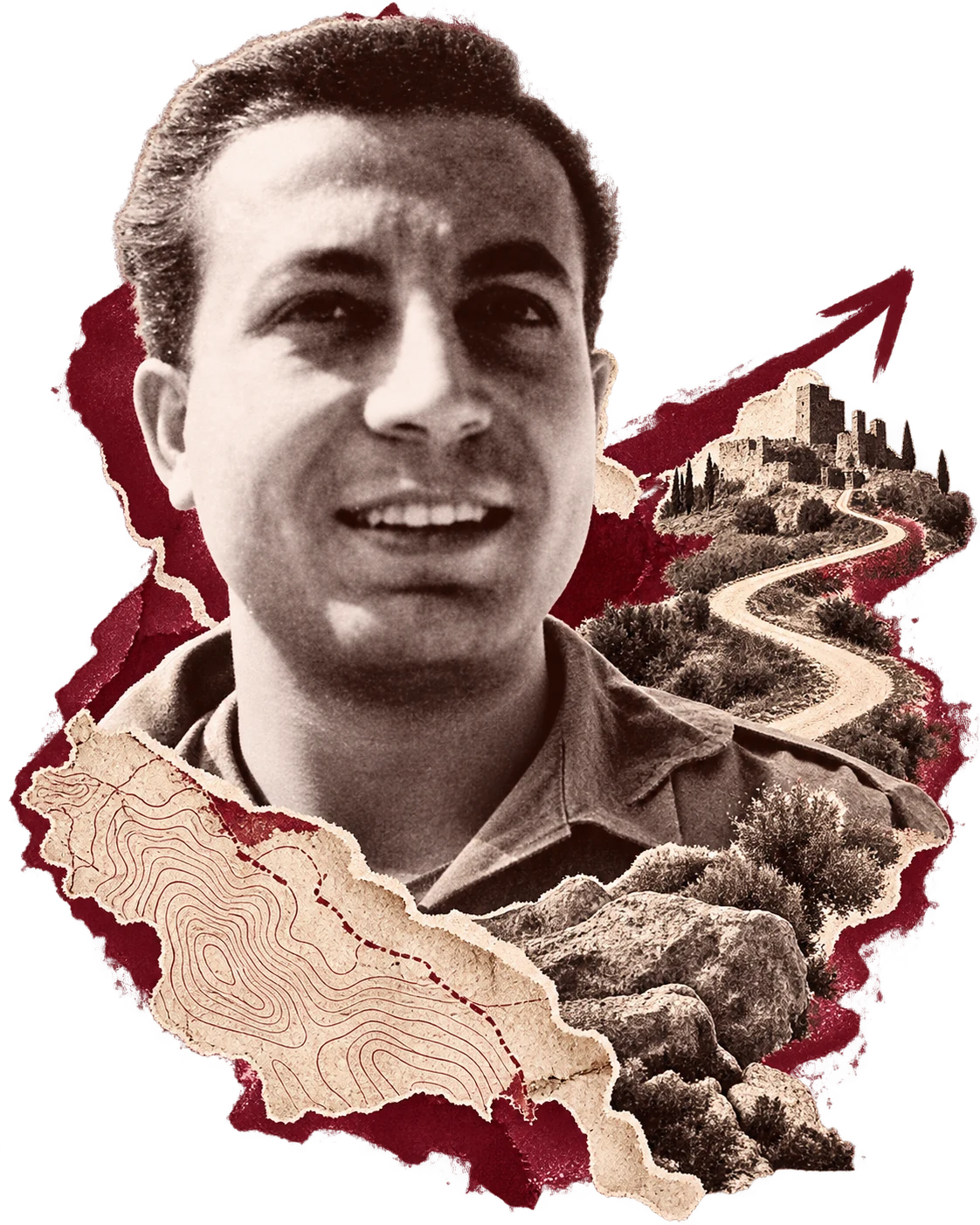
The battle was lost, and it was clear that few would survive. Someone had to wear down the enemy to make the retreat possible, knowing he would not be able to save himself. This is the story of a commander who lost his life protecting his soldiers with his body.
Shimon Alfasi On November 30, 1947, the day after the UN decision to partition the land, the War of Independence began.
The Struggle for the Road to Jerusalem
Until April 1948, fighting was marked by battles in mixed cities such as Safed and Jerusalem, as well as combat along the roads leading to besieged settlements. Those settlements received food, medicine, and ammunition in armored convoys.
On March 27, 1948, a convoy set out from Nahariya for the besieged kibbutz of Yehiam. Near the village of Kabri, the convoy was attacked, and 46 fighters were killed in the battle. That same day, a convoy left Jerusalem to help the Etzion Bloc. On its way back to Jerusalem, it was ambushed, and 15 fighters were killed and about 40 wounded. Four days after these two disasters, a convoy set out from Kibbutz Hulda for Jerusalem. It was attacked near the village of Khulda, and 22 fighters were killed in the battle.
The deaths of 83 fighters in four days, along with dozens of wounded, made clear that things could not go on this way.
The second phase of the war lasted until mid-May, when the British Mandate ended and British forces withdrew. At this stage, it was decided to take control of areas along the roads, and the first route chosen was the road to Jerusalem.
Ben-Gurion's view of the road to Jerusalem was: "Without a road (to Jerusalem), there is no Jerusalem. Without Jerusalem, there is no state." Another indication of the road's importance can be found in the words of Benny Maharsak (the information officer) at a Memorial Day ceremony held at Kiryat Anavim, at the foot of the Harel Brigade monument: "In all military history, anywhere in the world, there has never been another army unit whose entire front was no wider than a road, and that width determined the fate of a country!"
By the time the War of Independence broke out, Shimon Alfasi had already taken part in several operations as a demolition platoon commander. He participated in the attack on the village of Yazur (later Azor, near Holon), in the blowing up of Hassan Salameh's headquarters near Ramla (alongside Yaakov Hodorov, later goalkeeper for Israel's national soccer team), and in escorting convoys on the road to Jerusalem, experiencing firsthand the importance of opening the route to the city.
One of the villages from which fire was opened on cars traveling to Jerusalem was al-Qastal, and many were killed or wounded by the gunfire. On January 25, a battle took place between Palmach units and local Arabs, ending thanks to British intervention. Ten Palmach fighters were killed in the battle.
Another battle took place at Castel on March 18, 1948. Two Palmach platoons took part, and their commander, Gideon Palai (Johnny), was killed. His friend Haim Guri wrote the poem "Johnny" in his memory, beginning with the words, "Tonight we saw your face again, our friend Johnny." After that battle, about 100 residents of the village abandoned it.
Shimon Alfasi in the Palmach
Shimon Alfasi, the son of Tziona and Moshe, came from a family with deep roots in the land. When he was 13, during his bar mitzvah celebration in Tel Aviv's Shapira neighborhood, Arab rioters attacked the synagogue (the 1938 riots), and Shimon vowed to take revenge. In 1943, Shimon enlisted in the Palmach and received military and agricultural training at Kibbutz Givat Brenner. He took part in the Night of the Bridges and Black Saturday. In June 1946, he was arrested along with many others and imprisoned in Rafah for six months.
In late March 1948, following the failure of the three convoys, word spread that Abd al-Qadir al-Husayni, the region's Arab leader and son of Musa Kazim al-Husayni (mayor of Jerusalem in Ottoman times and at the beginning of the British rule), intended to take control of the Castel ridge and cut off Jerusalem.
Shimon's mother, Tziona, said that he had a strong sense of justice. When he was in the platoon at Givat Brenner, he had a Yemenite friend who was picked on by a Romanian boy. One day, Shimon grabbed the Romanian from behind, put a sack over him, and tied him to a fence. The Romanian yelled, and his friends asked, "Alfasi, what did you do?" He replied, "Here in this country, there is no Yemenite, no 'Frenk,' and no Ashkenazi. We are all Jews." On another occasion, in winter, he came home soaked to the bone after helping illegal immigrants disembark. "I told him," his mother recalled, "'Take care of yourself,' and he answered, 'I'm taking care of the Jewish people.'" Shimon was strong, handsome, tall, and gentle in spirit. He knew the land well and was also a scout and guide.
The mission of retaking Castel was assigned to Uzi Narkiss, the Palmach commander in the area. Despite the risk of getting into trouble with the British, Uzi agreed to take on the mission, on the condition that immediately after the conquest, a Haganah force would arrive to replace his troops and hold the position.
On the night of April 3, 1948, a force under the command of Eliyahu Sela, nicknamed Ra'anana, captured Castel without heavy resistance. The next day, as promised, it was replaced by a Haganah force under Mordechai Gazit.
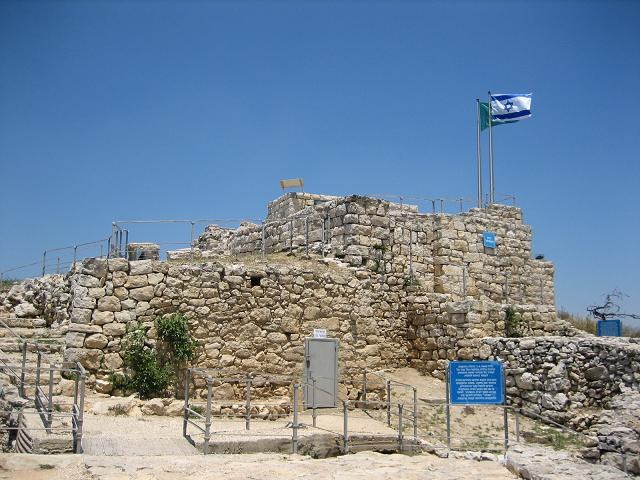
It is worth noting that Mordechai Gazit's men called the operation to take control of Castel "Nachshon," after Nahum Shoshani (Nachshon was his Haganah nickname), who fell at an outpost south of Castel after staying behind as the last defender to protect those retreating. They did not know that by the time the operation to open the road to Jerusalem was being planned, it had already been named "Nachshon," after Nachshon ben Aminadav, the first to plunge into the Red Sea before it parted in two.
On the day Castel was captured, Kamel Ariqat, Abd al-Qadir's deputy, arrived there with 100 fighters and hundreds more villagers from the surrounding area. At 2:00 p.m., the attack on Castel began, and some of the defenders abandoned their positions around it. Abd al-Qadir was in Damascus at the time, trying to acquire weapons for the coming attack. During the discussions, when he learned that the Jews had already captured Castel, he confronted Ismail Safwat, head of the Arab League's Military Committee, and asked for artillery. Safwat preferred to allocate the resources to Fawzi al-Qawuqji's Arab Liberation Army, a better-trained fighting force than Abd al-Qadir's collection of soldiers and villagers. "Traitor, history will condemn you. I am going back to capture Castel, with or without heavy weapons. I will capture it or fall in battle," Abd al-Qadir told Ismail Safwat, then left the room, disappointed and angry. He reached his headquarters in Birzeit and began planning the next attack on Castel.
Shimon Alfasi's mother spoke about his social life: "Many of his friends would come to our house... They'd arrive dirty and hungry and make coffee at home in a finjan. Sometimes, when there was no food in the house, they went to eat at my sister's. I remember Rabin and Dado, and Rafoul, who served under him and came by one Friday to get bourekas... Girls were always chasing after him and falling in love with him. We wanted him to get married and kept trying to persuade him, but he said he wouldn't marry until the war was over. Deep down, he probably knew he wouldn't come back. He always said he wouldn't return to Tel Aviv and would live only on a kibbutz. He loved Givat Brenner so much."
The Last Battle at the Castel
At 4 a.m. on April 8, while dawn had not yet broken and visibility was poor, company sergeant major Meir Carmiel spotted three figures. He was sure they were scouts from the reinforcements that had arrived from Kiryat Anavim, as he had been promised. Meir, dressed in a British uniform, shouted to them in Arabic, "Ta'alu ya jama'a" (Come on up, everyone), and they replied, "Hello, boys," in an Arabic accent. Deputy company commander Yaakov Salman yelled, "They're Arabs!" and Meir fired a burst of bullets. When daylight came, one man was found dead, and a search of his pockets turned up an Egyptian driver's license in the name of Abd al-Qadir. A later inquiry established that Abd al-Qadir had come up with his deputy, Kamel Ariqat, and his aide, Arafat. Abd al-Qadir was killed, while the others managed to escape. Yoram Kaniuk, who took part in the battle, claimed that the person who fired was Moshe Katzenelson (Berl Katznelson's nephew).
The rumor that Abd al-Qadir was at Castel, though it was unclear whether he was wounded or dead, spread quickly. A "faz'a" was immediately declared - a call for residents of nearby villages to come and fight. Within a few hours, about 1,200 fighters had assembled, intent on finding Abd al-Qadir. The fighters and commanders knew nothing of the Arab mobilization, and felt that there was a lull in the fighting. This allowed Uzi Narkiss to arrive with two armored vehicles carrying supplies and ammunition. The position of the Haganah fighters improved, and it seemed they would be able to hold out.
At 10:00 a.m., the major attack began from the south. Heavy fire made it impossible to move through the area. Some of the fighters, who had been fighting for several nights in a row, fell asleep at their positions. Urgent messages were sent to Palmach headquarters in Kiryat Anavim requesting reinforcements, warning that otherwise they would have to retreat. It was not until 1:30 p.m. that reinforcements set out from Kiryat Anavim, under the command of Nahum Arieli and his deputy, Shimon Alfasi. At 2:00 p.m., Arieli joined Gazit, commander of the Haganah force, and together they assessed the situation and concluded that they had to retreat. Shimon Alfasi ordered his men: "The privates will retreat, and the commanders will stay behind to cover them" - a saying that later became a symbol of command in the IDF. Many of those retreating were hit, and only four survived, among them Mordechai Gazit, who was wounded in the head. They managed to reach Arza. All the Palmach men who stayed behind to cover the retreat were killed, and all the wounded left on the mountain were murdered. No prisoners were taken in this battle. Nahum Arieli's body was found only two weeks later. Shimon Alfasi, who was shot in the head, was among those killed. He was 23 years old.
On April 11, 1948, 18 Palmach men and 31 HISH fighters were buried at Ma'ale Hahamisha. On November 19, 1953, they were reinterred at Mount Herzl.
The writer Yoram Kaniuk, who fought in the battle, eulogized Shimon Alfasi and spoke about the kind of man he was: "Shimon Alfasi was an extraordinary, pivotal figure for me. I am alive thanks to him and his words, quite literally. I was in the Palmach squad... stationed at Castel to reinforce the HISH force defending the position after its capture... In the morning, hundreds of Arabs charged us in a mass faz'a... Suddenly I saw Shimon Alfasi, whom I knew, stand up straight and shout the order: 'Privates, retreat! Commanders, stay behind to cover them!' We were privates, and Shimon and many other commanders were killed at Castel. After the battle, my squad no longer existed... I will never forget the sight of Alfasi standing there, shouting the order. I am alive because of him, and that is why his name is so deeply etched in my memory. I live with the feeling that Alfasi never received the heroic recognition he deserved."
Yoram Kaniuk described Shimon Alfasi as "the hero among men."
תגובות
עדיין אין תגובות.