
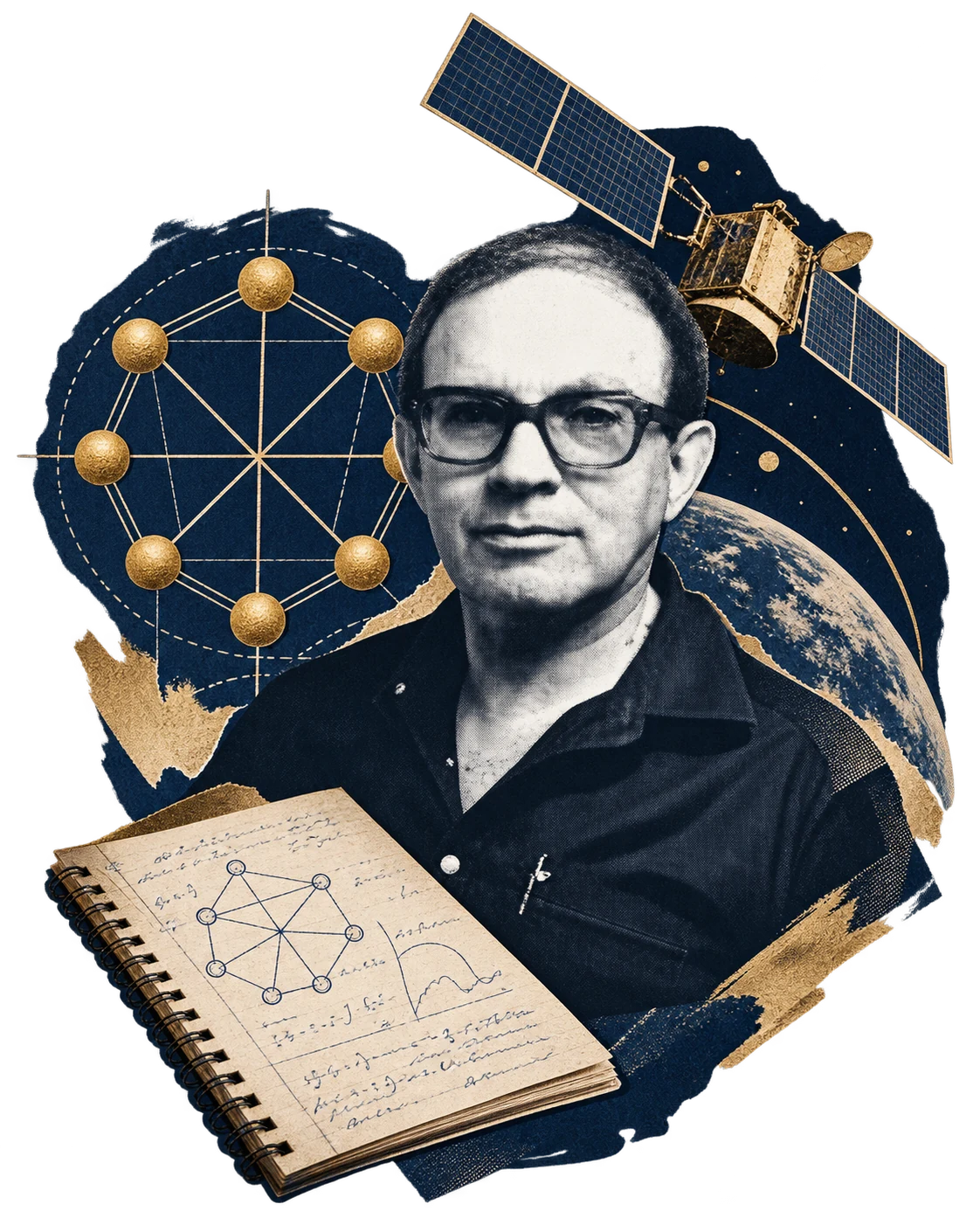
A world-renowned physicist, senior intelligence officer, born genius, politician, and Renaissance man. These are just a few of the titles that describe this remarkable man, whose achievements over eighty years would have required an ordinary person to live twice as long to match.
Prof. Yuval Ne'eman.
The Mendeleev Analogy
Every high school graduate knows the periodic table of the elements. The first version appeared as early as 1869, after the Russian chemist Dmitri Mendeleev arranged the elements according to their atomic numbers and properties. His genius was evident in two main ways: he left empty spaces in the table for elements not yet discovered, such as gallium and germanium, and he accurately predicted the physical and chemical properties of those missing elements. When Mendeleev published his table, only about 63 elements were known. Today, the table includes 118 confirmed elements. Mendeleev was nominated for the Nobel Prize in Chemistry in 1906.
Until the 1960s, the world of physics was in complete disarray. Scientists kept discovering new subatomic particles - around a hundred different kinds - but no one had any idea how they were related. The situation was like chemistry before the periodic table: a collection of details without an overall picture.
The breakthrough came in 1961, from an unexpected direction. Yuval Ne'eman, then a physics doctoral student and Israel Defense Forces attaché in London, proposed a bold idea. He used a sophisticated mathematical tool to organize all the hadrons - the 'heavy' particles, such as the proton and neutron, that are affected by the strong nuclear force - into an orderly table.
Ne'eman discovered that the particles fell into families with a kind of symmetrical geometric structure. He called his model the 'Eightfold Way' because its central group contained eight particles. Just as Mendeleev had left empty spaces in his table of elements, Ne'eman identified a gap in his. He predicted the existence of a particle not yet seen, the omega minus, and calculated its properties accurately. In 1964, when the particle was discovered in a laboratory in New York, exactly as Ne'eman had predicted, the scientific world was stunned. This proved that Ne'eman's order was not coincidental, but reflected a deep law of nature. Ne'eman did not stop at arranging the table. He was the first to understand why the particles were arranged that way: they were not ultimate elementary particles, but were made up of even smaller particles. While the American physicist Murray Gell-Mann called them quarks - a name that became the worldwide standard - Ne'eman proposed the Hebrew name kortim for them.
Like Mendeleev, Prof. Yuval Ne'eman did not win the Nobel Prize, despite publishing the discovery before Gell-Mann did - in February 1961, compared with Gell-Mann's March - and despite the fact that they independently reached similar results at the same time. The 1969 Nobel Prize was awarded to Gell-Mann alone. Many believe that Ne'eman's working alone, without the backing of a powerful scientific establishment, and alongside his security and political work in Israel, kept him from receiving the prize.
Mendeleev gave his name to mendelevium, the 101st element in the periodic table. Nothing in Ne'eman's field of research bears his name.
Childhood in Tel Aviv and Egypt
Yuval Ne'eman was born on May 14, 1925, in Tel Aviv, a city then in its infancy, marking just 14 years since its founding. He grew up in a family whose roots ran deep in the land and in the history of the Jewish community in Palestine. As a child, he displayed phenomenal quickness of understanding at the Herzliya Hebrew Gymnasium. He celebrated his bar mitzvah in tenth grade, having skipped three grades, and graduated from high school at 15 with unprecedented honors: "My report card was all 'very good' except for physical education, where it said 'satisfactory.' My first choice for further study was mathematics - my love of physics came later - but at the same time, it was clear to me that there were wars here and that we depended on our ability to defend ourselves," he later recalled.
For anyone familiar with his genetic inheritance, this genius came as no surprise. On his mother's side, he was the great-grandson of Zerah Mushli, the legendary watchmaker who installed the original clock on the tower in Jaffa. At the time, in 1903, this was a masterpiece of fine mechanics and precision, considered cutting-edge technology; the work required complex mathematical knowledge to calculate and synchronize gears, as well as considerable technical skill in metalworking. On his father's side, his grandparents, Abba and Sarah Ne'eman, were among the 66 founding families of Ahuzat Bayit, the community from which Tel Aviv grew. From his father's family, Yuval absorbed a spirit of technological entrepreneurship. In the heart of a developing agricultural society, where water was essential to life, the family established a factory that made pumps and became a symbol of Hebrew enterprise. His father, Gedalyahu Ne'eman, passed on his engineering skills, while his mother, Zipora née Heshin, connected him to the deep roots of Jerusalem's old Jewish community, as a descendant of the Baruch, Heshin, and Sofer families. In this distinctive home, between the factory walls and an ancient Jerusalem heritage, Yuval grew up in an atmosphere where science, industry, and Zionism were intertwined. For him, science was never just theory, but a practical tool for building the land.
Part of Ne'eman's childhood was spent in Port Said, Egypt, where he attended a French school and mastered the language. When he returned to Tel Aviv at the age of 10, his genius was already plain for all to see. Since the Technion refused to admit a student as young as 15, Yuval used the time to join the Haganah. He served as a liaison between bases and even trained women fighters in the use of weapons, among them parachutist Hannah Szenes. It was only at 16 that the gates of the Technion in Haifa opened to him, and he chose to study mechanical engineering.
Yuval Ne'eman completed his bachelor's degree (B.Sc.) at 20, but even earlier he had stood out as a public leader, elected chair of the student association. In that role, he showed early political acumen, trying to bridge the rival factions of the Lehi, Irgun, and Haganah underground movements, with a deep understanding that national unity was the key to victory over the British Mandate.
From the Technion to the Battlefield
After his studies, Yuval worked for about a year as a hydrodynamic design engineer at the family factory, but his engineering career was cut short by the outbreak of the struggle to establish the state. Ne'eman took an active part in the fighting as a company commander and deputy battalion commander in the Givati Brigade, and took part in the fierce defensive battles against the Egyptian invasion in the south. His organizational abilities and precise analysis stood out immediately amid the fighting, and he began to rise rapidly through the ranks of the young IDF. During his 12 years of service, he held some of its most senior posts, including head of the Operations Branch at the General Staff under Yitzhak Rabin, where he personally shaped Israel's military doctrine.
In the early 1950s, when Yuval Ne'eman was still a junior officer in the Planning Department, he already understood that the young State of Israel could not go on merely putting out fires or reacting to events after they happened. It had to develop a solid security doctrine of its own. Together with a small, dedicated team, he began developing a plan that went far beyond ordinary military strategy. The plan mapped out appropriate settlement patterns and even marked the country's ideal borders. After months of intensive research conducted under the mysterious codename 'Operation Nebo,' the plan took shape. It became the most comprehensive planning document the IDF had ever seen, known as the 'Lavi File,' and was placed on the desks of Moshe Dayan and Pinhas Lavon in the spring of 1954.
At the heart of the file was the clear-eyed understanding that Israel's geography was a dangerous vulnerability and that its borders at the time gave the Arab side a critical advantage. The 'Lavi File' therefore redefined how Israel would have to fight in order to survive, taking its geographic disadvantage as a starting point and warning that the country's population centers were too exposed. To overcome this lack of strategic depth, Ne'eman formulated the doctrine of the 'preemptive strike' and determined that Israel could not afford to absorb an attack. It therefore had to be the one to start the war, immediately moving the fighting onto enemy territory and seeking a rapid decision on each front separately. To illustrate the different situations Israel might face, he prepared war models named after lions: he defined 'Kfir' as a situation of holding the line under surprise attack, 'Aryeh' as a situation of waiting for a known enemy attack, and 'Shahal' as the ideal situation, in which Israel takes the initiative and attacks first before the enemy has time to prepare.
This in-depth analysis also led to the familiar structure of the IDF that remains in place today. Ne'eman identified four critical forces on which most resources should be spent: precise intelligence capable of providing timely warning, an offensive air force that could achieve air superiority, strong armored forces to win battles on the ground, and paratroopers capable of carrying out daring flanking maneuvers. In this way, the 'Lavi File' became the conceptual foundation that shaped the character of the army. Ne'eman's immense contribution lay in his ability to turn abstract ideas into an operational plan, one that many see as having sown the seeds of the overwhelming victory in the Six-Day War.
The Secret Mission in France
Prof. Ne'eman's next mission began in haste. David Ben-Gurion sent him to Paris on a critical assignment: to weave the intelligence ties that would become the young state's most secret and strategic alliance. The backdrop was France's war in Algeria, with interests converging in Cairo. "The headquarters of the Algerian underground was in Cairo and enjoyed Nasser's enthusiastic support," Ne'eman recalled. "The French wanted us to help them with intelligence and operations against the underground. We needed weapons from them, as many as possible."
After an intensive week in France, Ne'eman found himself briefing "the Old Man." Shimon Peres sat beside them. In that room, between intelligence reports, Ben-Gurion outlined his most far-reaching and daring vision. "Even then, Ben-Gurion had marked the goal of relations with France and explicitly raised the issue of the nuclear option. In other words, even then he saw the possibility that we might obtain nuclear knowledge from them as part of the cooperation."
For Ne'eman and his colleagues, the nuclear option was a means of preventing another annihilation. "You have to understand how we viewed this option. We never thought of the nuclear option as a way to achieve things that could also be done by other means. We wanted the other side to believe that we had a nuclear option for one purpose and one purpose only: out of fear that one day they would have that option and think we did not. In that situation, we had no doubt they would use it and destroy us," he later said.
The cooperation was close and dangerous, and Israeli intelligence supplied the French with valuable information about Cairo. The drama peaked when a group of French officers who refused to accept France's withdrawal from Algeria approached Israel through a secret channel with a shocking request: help assassinate President de Gaulle in exchange for an unlimited supply of weapons. The message was urgently relayed to Ben-Gurion. Without a moment's hesitation, he ordered that the French president be warned through Yuval Ne'eman. De Gaulle's life was saved, and he did indeed thank Ben-Gurion for it. But, as Ne'eman put it with dry irony, he "felt deeply humiliated that Israel had to rush to his aid."
The Sinai Campaign marked a strategic turning point for the young state. In Ne'eman's words, "The Sinai Campaign made it clear to the Arab states that they could not destroy us. In that sense, the campaign brought us years of relative quiet and a much greater sense of security. In the case of Sinai, the Russians threatened us with nuclear missiles. If we had had a response to that threat then, perhaps they would not have threatened us, or we would not have given in to their pressure and withdrawn."
After the campaign, Ne'eman continued his clandestine work, this time devoting his efforts to establishing a special relationship with the Kurds in Iraq. As part of his duties, he undertook a secret journey under a false identity that took him through Morocco, Algeria, and Tunisia, to examine at close quarters the defense networks the Mossad had established for Jewish communities in North Africa.
During this journey, a surprising chance encounter took place, straight out of a spy movie. Ne'eman recalled with a smile: "I won't say what papers I was traveling on, but in the passport line at one of the airports, a man with a long beard stood in front of me, presenting a Portuguese passport. Suddenly, beneath the long beard, I realized it was actually the head of French intelligence, traveling under a false identity on his own business."
Back to Science and the Reactor
Yuval Ne'eman's return to Israel and to the forefront of science was accompanied by a deep inner sense of urgency. Ne'eman, then 30, felt time pressing on him: "I was afraid I was missing the train, and that if I delayed any longer, I would never become a real scientist."
At the time, he was serving in London as an IDF attaché, a role that also made him responsible for the Scandinavian countries. But alongside his uniform and diplomatic work, he began building his academic future by writing a physics dissertation at the University of London. Ne'eman was an essential link in building Israel's scientific strength. He accompanied members of the Atomic Energy Commission in negotiations with France and Britain, proving his abilities not only in the laboratory but also in diplomatic negotiating rooms. While Britain and the United States feared Nasser's influence in the Middle East, he saw an opportunity. The impression in the United States and Britain at the time was that Nasser controlled the entire Middle East. The British wanted to fly in a battalion to rescue Hussein in Jordan. "So I found myself, on instructions from Israel, taking part in negotiations with the British over what they would give in exchange for the right to fly over Israeli territory. We received two submarines and 50 Centurion tanks."
The security establishment understood that Ne'eman was a rare asset and did everything it could to keep him. It funded his studies and sent him a replacement, on one condition: when he returned, he would take charge of the reactor at Nahal Soreq.
The road to a doctorate was not easy. Ne'eman struggled to find a supervisor until he approached Prof. Salam, the Pakistani physicist: "I knocked on the door of Prof. Salam, who was of Pakistani origin, and asked to be accepted as his student. I had letters of recommendation from my two professors back home. He had never heard of either of them and was not impressed at all. I remembered that I had also brought a letter from Moshe Dayan, who was not exactly a man of science. Salam read the letter, and his eyes lit up. 'Oh,' he said to me with a touch of sarcasm, 'I've heard of him, but what exactly does a military man know about physics?' Despite all that, he agreed to take me on." Under Prof. Salam's guidance, the scientific career that brought Ne'eman worldwide acclaim began.
Ne'eman was a member of the Atomic Energy Commission from its establishment in 1952 until 1984. From 1961 to 1963, he served as scientific director of the Nahal Soreq reactor and was deeply involved in concealing Israel's nuclear capabilities amid American pressure during President Kennedy's tenure. When American inspection delegations arrived in Dimona, Ne'eman planned their tour routes so they would not discover the facility's true purpose, while drafting sophisticated diplomatic responses for Ben-Gurion that preserved 'strategic ambiguity.'
From Tehiya to the Legacy
Ne'eman's political activity began as an act of ideological protest. Following the signing of the Camp David Accords in 1979 and the decision to evacuate the settlements in Sinai, Ne'eman felt that the State of Israel was making a grave strategic and historical mistake. He saw Sinai as essential strategic depth and withdrawal from it as a blow to the deterrent capability he had spent years helping to build.
Together with Geula Cohen and Moshe Shamir, Ne'eman founded the Tehiya movement. An avowed atheist, Ne'eman led a movement that brought together secular activist right-wingers and the religious-nationalist current of Gush Emunim. The combination of a world-renowned scientist and the ideology of Greater Israel gave the movement considerable prestige. Ne'eman found himself in an unusual dual role. On the one hand, Prime Minister Begin, who greatly admired him, appointed him to serve as a member and later as chair of the Atomic Energy Commission. On the other, he led the fierce protests against withdrawal from the Yamit region: "Begin would open every meeting of the Atomic Energy Commission with ten minutes of sarcastic remarks about our activities."
In the 1981 elections, Ne'eman was elected to the Knesset, and in 1982 he became Israel's first Minister of Science and Development. He served as a minister in the Begin and Shamir governments and, among other roles, as Minister of Energy and Infrastructure. Ne'eman was a hawkish and forceful voice in the cabinet. He supported expanding settlements in Judea and Samaria, pushed for the 1981 bombing of Iraq's nuclear reactor, and was the only minister to propose annexing southern Lebanon as far as the Litani River during the First Lebanon War.
In 1992, in protest against Israel's participation in the Madrid Conference, the Tehiya movement left the coalition, a move that led to the government's fall and an election in which Tehiya failed to pass the electoral threshold. Following this, Ne'eman announced his complete retirement from political life and returned to scientific research and writing.
In his final years, Prof. Ne'eman devoted himself to studying the contribution of Jews to science throughout the generations. He saw no contradiction between his cool scientific outlook and his deep Jewish identity. In his book Particle Hunters and in numerous articles, he analyzed the writings of Maimonides and Gersonides, showing how these Jewish thinkers laid the foundations of the modern scientific method before the Scientific Revolution in Europe.
Ne'eman saw the universe as a system of 'music of the spheres' - the belief that every physical phenomenon can be described through simple, elegant mathematics. For him, the symmetry within the nucleus and the symmetry of the borders of the homeland were part of the same world order, which must not be violated. He was an Israeli patriot who saw science as the only way to ensure the Jewish people's continued existence in a hostile region.
Yuval Ne'eman died on April 26, 2006, at the age of 80, after suffering a stroke. He was buried in Tel Aviv's Trumpeldor Cemetery. He left behind a large family, hundreds of students, some of whom became leaders in Israeli science, and streets across the country named in his honor.

תגובות
עדיין אין תגובות.