
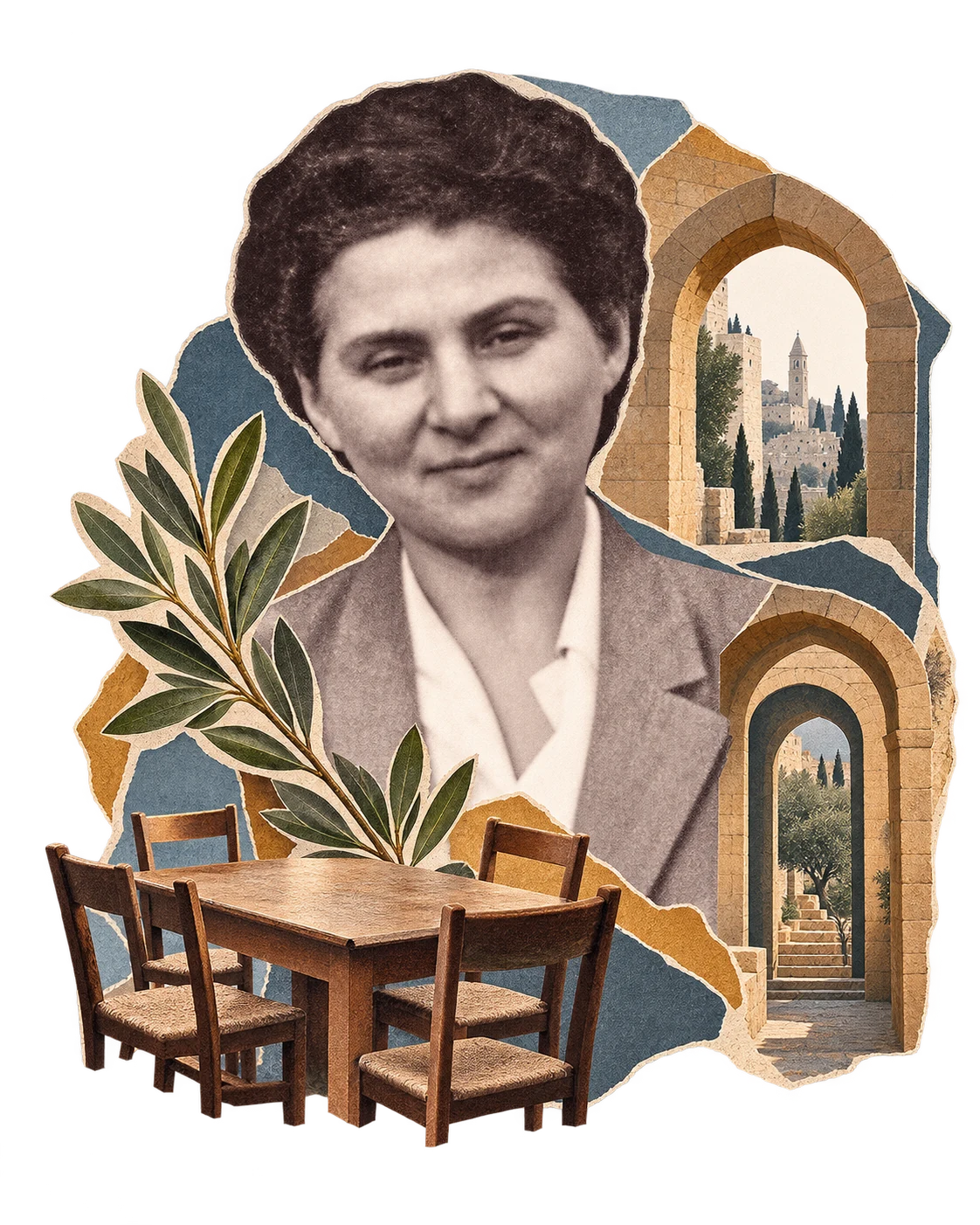
Her dream of establishing in the Land of Israel a unifying center for all Christian denominations and other religions came true, but only for a short time...
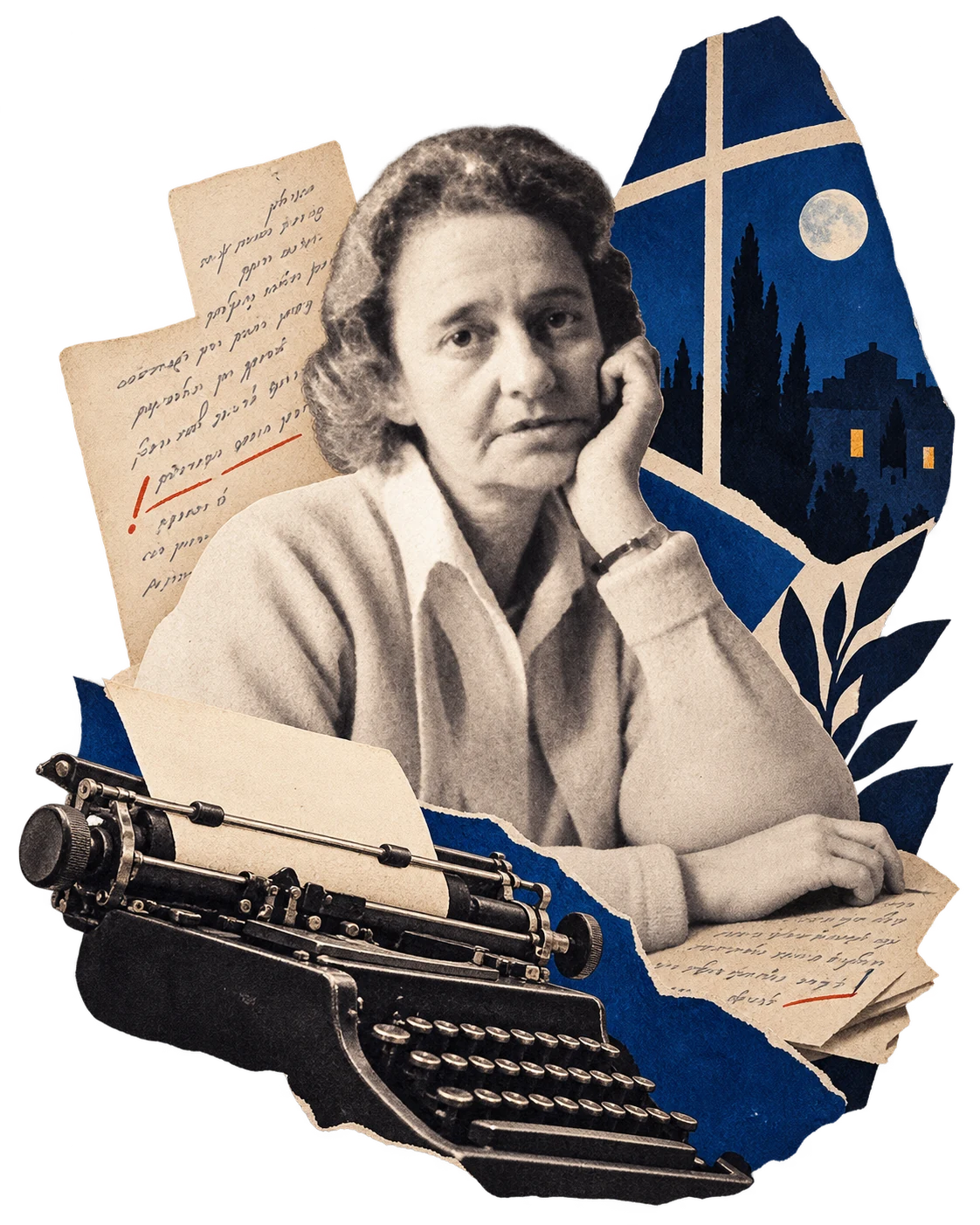
Alice May Carey had neither a wealthy or privileged family nor an important religious position. What she had was a dream and determination. With one small step, she managed to set in motion the dream of many: peace and fellowship between peoples and religions, a dream she wanted to realize in the land sacred to the three monotheistic religions.
Alice May Carey was born in November 1879 in Saint Peter Port, the capital and largest port on the island of Guernsey, in the middle of the English Channel, near the coast of France.
Alice May first visited the Land of Israel when she was 44. She worked as a volunteer at Warburton High School, which belonged to the Anglican mission, where she served as matron and taught English to the lower grades. A year later, the school administrators told her that they no longer needed her services, since the institution was about to expand and they were looking for a matron with nursing experience who could care for the students' health.
Building Har HaBikur
Alice May Carey left the school and, in 1923, moved to Ein Karem, then a village near Jerusalem. She discovered that Christian activity had been taking place in Ein Karem for many years. First, the Franciscan Order built the Church of St. John in the Mountains, as early as 1674. After that, a monastery and church were established by the Sisters of Zion, an order founded by the Jewish convert Alphonse Ratisbonne, which began its work in 1860. A decade later, Antonin Kapustin built an observatory and a village for Russian pilgrims. Another decade on, the French order of the White Fathers established a monastery and an orphanage, and the Greeks then founded the Church of St. John the Baptist in the center of the village. Nuns of the Sisters of the Rosary order established the girls' orphanage, and a few years later the Franciscan Sisters opened a girls' school.
The village's extensive religious activity was rooted in its status as a holy place in Christianity. According to Christian tradition, it is the birthplace of John the Baptist, the son of Elizabeth and Zechariah, who belonged to a priestly family that served in the Temple. John baptized Jesus and declared him to be the Son of God. Elizabeth, John's mother, was a relative of Mary, Jesus's mother. When Mary learned that Elizabeth had become pregnant after years of infertility, she went to visit her - hence the name "Mount of Visitation" - and when Mary returned home, she learned that she herself was pregnant.
A decade later, an idea began to take shape in Alice May's mind: to establish a compound with a shrine for believers in the three religions - Judaism, Christianity, and Islam. She took the first step toward realizing her idea in 1933, when she approached the fund financing the centenary celebrations of the founding of Jerusalem's Anglican Christ Church. Alice May proposed that they establish a college and a place of prayer in Jerusalem, but was turned down on the grounds that the fund had already received many requests. She refused to give up and traveled to London to enlist senior members of the Anglican Church in realizing her vision. One of them was Archbishop Anastasy, who expressed willingness to consecrate the land, thereby attracting other donors interested in investing in consecrated land. She also met with the Anglican bishop in Jerusalem, Dr. George Francis Graham Brown, and asked him to consecrate the land as well. The determined Alice May Carey even approached the Pope to enlist him in the cause.
Toward the end of that year, Alice May bought about 50 dunams on the summit of Mount Ora, near Ein Karem. Today, the communities of Ora and Aminadav, Hadassah Ein Karem Hospital, and Yad Kennedy are located there. Until then, the mountain had been known as Ras al-Rab ("the Lord's Mountain"), and Christian missionaries called it the "Shrine of Peace." Alice May named the place "Mount of Visitation." Remarkably, Alice May managed to enlist the Catholics in the "campaign," persuade the Orthodox not to object, contrary to their usual practice, and inspire the Muslims, who owned the land, to be eager to make a deal.
Two years later, she wrote to the Archbishop of Canterbury, offering him "a very beautiful site, about twelve acres, with 30 vines, fruit trees and trees... to serve as a place of perpetual prayer for eternal peace and the unity of the Christian world and of all monotheists who pray to the Eternal Will. This site is on the summit of 'Mount of Visitation'..." She went on to write that Russians, Greeks, who are Orthodox, Catholics, and Anglicans were already ready to join her project, and that Armenians and Syrians were also willing to consecrate the land. She believed that Copts and Ethiopians would support her plan in the future as well. In addition to their support, she noted that the Franciscans and Benedictines had promised their help, and that Jews and Muslims had also expressed a strong desire to pray alongside Christians for peace and unity. The sheikh who guarded the Church of the Holy Sepulchre had promised to be among the first to come and pray at the site. In her letter to the Archbishop of Canterbury, she made it clear that the project would go ahead one way or another, and that it was better for him not to miss the opportunity to join. At the same time, she printed leaflets and raised donations. Among the donors were Christian pilgrims from a variety of Christian denominations.
Even before purchasing the land, Alice May Carey went up to it with her friend Austen St. Barbe Harrison, chief architect for the British Mandate authorities in the Land of Israel and a devout Anglican. Together they placed a stone that would mark the beginning of worship on the mountain. Barbe Harrison was the architect of several well-known buildings in the country, including the Government House (1928), the Rockefeller Museum (1930), and the Central Post Office (1934). A quick glance is enough to see similarities between those buildings and the one established at Alice May's initiative, and to surmise that he designed the one on the mountain too.
Thanks to the donations she raised, by 1937 a small prayer shrine was standing, and Alice May invited representatives of all religions to pray there. Two buildings were erected beside it, one for women and one for men, each with six rooms. The shrine was intended as a place of seclusion and inspiration for a small number of people, so it was designed very simply and offered a sense of intimacy. Since it was intended for short stays, it had no prayer or worship facilities, no bookshelves, and not even a bathroom. Alice May moved to the site, but lived there alone most of the time, occasionally joined by an assistant, male or female. In her vision, the place would serve as a center for Christian volunteer work, a meeting point for all Christian denominations, and, in the future, for all religions.
The Agreement with the Bishopric
Once construction was complete, Alice May Carey realized that she could not afford to maintain the building, so she decided to give it to the Anglican Church, which would take responsibility for the site and its expenses. The bishop suggested that she transfer the property to the Jerusalem and the East Mission. He also suggested holding sermons and classes at the site for residents of the surrounding villages, and praying for the reunification of the Church and improved relations between Jews and Muslims. At no point did the bishop suggest what she had dreamed of - shared prayers among believers of the three religions - and perhaps for that reason she did not transfer the property to him. In the end, a compromise was reached: the buildings would be leased for five years to one of the Christian communities, and during that time Alice May Carey would develop a plan to help her raise the money needed to maintain the site and realize her dream. The bishop hoped that Alice May's dream would fade during those five years, allowing him to persuade her easily to transfer the property to him. In 1939, an agreement was signed, including the following terms:
Carey will transfer her property at Ras al-Rab to the Bishopric of Jerusalem and the East, to hasten the establishment of the Kingdom of God in the Holy Land and its spread from there. She requests that the resources be used for regular prayer, intercessory prayer for peace and the unity of the Church, and liturgical ceremonies.
The bishop will ask the trustees of the Mission to accept the property into the Mission's care, and will also suggest that the Community of the Sisters of the Love of God establish a branch at the site and work together with the Society of St. John the Evangelist.
The bishop will recommend that the trustees approve adding a floor to the hostel.
The bishop will recommend to the trustees that they purchase additional land.
After the agreement was signed, the Society of St. John the Evangelist began providing funds to maintain the site. In November 1939, in the early days of World War II, a small group attended the church's dedication ceremony. The bishop offered a prayer and blessed the stone, and Alice May set it in place. The renowned geographer Zev Vilnay, who was present, called the event "sad and pathetic." It was only two years later, when American, Syrian, Lebanese, and Cypriot refugees, missionaries, and others arrived, that the buildings began to come to life. At times, as many as forty people stayed there, including young children, some of whom lodged in Carey's private home. During this period, both Jews and Arabs came; they all ate together and prayed together. It seemed the place was about to fulfill its purpose as a house of prayer for many peoples.
Leslie Farmer, a devout Christian who was traveling at the time, wrote: "At last we climbed the winding path through the Russian village on the western hillside... until we found the 'Shrine of Peace' right at the edge of the summit... The 'Shrine of Peace' is a white stone building in the shape of a narrowing cone, which Miss Carey, a native of Guernsey and a beloved, generous woman from Ein Karem, built on this high hill near her hostel. In recent years, the hostel has served as a place of refuge for missionaries and others from Egypt, Palestine, and beyond. One day, she hopes, it will become a monastery for the Anglo-Catholic 'Sisters of the Love of God.' Usually, when we arrived, the men would enter the small sanctuary and kneel on a blue wool rug to pray together for peace: peace in our hearts, peace in the Church, peace in the world. Crescents and Stars of David were woven together with crosses in a beautiful design, since it was intended as a place of prayer for Muslims and Jews as well as Christians. In one corner there is a Greek cross with a slanting bar across it, symbolizing the 'repentant thief' who went to heaven."
A similar description appears in Haim Be'er's book Feathers: "... And at sunset they would climb together to the shrine on the summit of Mount of the Lord of the Worlds, rising above Ein Karem, and each would commune with his God in the niche Miss Carey had set aside for each of the three monotheistic religions, or in the fourth niche, intended for the guests of no religion... 'Wake up, wake up, we're not at school,' Leder snapped, and said that Miss Carey's main weakness was her romantic view of life... Miss Carey had indeed built houses full of every good thing at Ras al-Rab, waiting for the followers of her idea to flock there from all over the world, stay in her company, and help her realize her plan to unite all religions. 'But the houses aren't the point,' Leder said. 'The houses, if they are still standing and weren't destroyed in the war, will surely be taken over by the Social Services Department, which will turn them, because of their distance from the city, into a sanatorium for the mentally ill or a refuge for delinquent girls, just as the army will one day take over the church and, because of its high location, turn it into a long-range antenna base.'" (Haim Be'er, Feathers, pp. 86-88).
The Evacuation of the Site and Its Nationalization
Toward the end of 1941, the site emptied out and Alice May was left alone. Two years later, the site was leased to the Polish Red Cross.
One hot day in 1944, on her way up the mountain, Alice May felt unwell and was found to be suffering from arteriosclerosis. At the end of July that year, she moved to England and fell into a deep depression after realizing that she had lost control of "Mount of Visitation." The following year she returned to Guernsey, her birthplace, and her condition deteriorated. In Alice May Carey's absence, two guards hired by the Mission were put in charge of the site. But in 1947, on the eve of the War of Independence, a force of the Arab Legion entered the site, and by the middle of 1948 it had been captured by the IDF. The site was designated as Jerusalem's southern boundary, and civilians were barred from entering. Peace, unity, and fellowship no longer seemed to be on the horizon.
In 1956, the land and the buildings on it were sold to the State of Israel, and the site became a military base, with the shrine at its center serving today as a culture room. The building was renovated in 2000 under the supervision of the Council for the Preservation of Heritage Sites. One hostel remains within the base, and two others are located on the grounds of Mesila, a locked institution for at-risk girls.
On September 3, 1957, about a year after the site passed into the hands of the State of Israel, Alice May Carey died at Brockwell Hospital on the island of Guernsey.
Today the building is inaccessible, as are peace and fellowship...
תגובות
עדיין אין תגובות.