
What connects a battle that changed the course of history, an elite unit of lovers who swore to fight for each other until their last breath, an enormous stone statue of a lion roaring into eternity, and a secret organization from the 19th century founded to defend the right to love?
Chaeronea: a story of heroism, love between men, and one lion
Thebes and the Sacred Band
In the scorching summer of 338 BCE, on a narrow plain in the beating heart of Greece, titans clashed. Some 70,000 warriors, half from Athens, Thebes, and other cities, and half from the Macedonian army, faced each other. This battle, fought at Chaeronea, was no mere struggle over borders or control. It was a historic trial, a decisive judgment on Greece's future, and the starting point of a geopolitical revolution that would affect cultures and peoples as far away as India.
Philip II, king of Macedon, then ruled a kingdom that had once been a marginal, largely agricultural province, but under his leadership had become a militant power. He not only succeeded in subduing the powerful Greek states, but also laid the cornerstone for the mighty Hellenistic empire of his son, Alexander the Great, which would leave an indelible mark on all humanity.
The roots of this battle reach far back in time, to when Philip was still a boy and was sent as a hostage to Thebes, then the center of military power in Greece. He stayed with the city's most distinguished families, an honored captive, and there, in the home of the great general and philosopher Pammenes, he discovered the secret of Theban strength: groundbreaking military reforms, and perhaps also... the secret of Greek male love, which became both sacred and martial.
For at the heart of Thebes' military power was the "Sacred Band," a remarkable elite unit made up of 150 pairs of lovers. Yes, they were not merely soldiers, but lovers who lived and trained together and swore to die for each other. According to the historian Plutarch, himself a native of Chaeronea, this was a stroke of human genius: a union of passion (eros) and total devotion that made the band invincible. No one would abandon his beloved in battle. No one would retreat and bring dishonor upon his beloved. And when one fell, the other would fight to the death to protect his body.
The "Sacred Band," at the heart of the Theban army, was the only force in Greece daring enough to face and defeat the Spartan hoplites (heavily armed foot soldiers carrying spears).
The Sacred Band of Thebes was founded in 378 BCE, shortly after Thebes freed itself from Sparta's iron grip. During its forty years of existence, it became one of the pillars of the Theban army and a driving force in Thebes' rise to become a brilliant power, if only briefly, on the Greek stage.
The band was more than an elite unit; it was a symbol. A legend of brotherhood and courage, binding warriors together in pairs through love and profound emotional intimacy. Some believe these bonds were sealed in a nighttime rite of commitment, held beneath the moon: a vow of love and fidelity between two men. If such a rite did take place, it may have been the oldest same-sex wedding ceremony known to us, and perhaps the origin of the band's name: the "Sacred Band."
At first, the pairs of warriors were placed on different fronts within the battle formation to strengthen the fighting spirit. But soon the unit coalesced into a powerful, cohesive force, taking the field as one. In 375 BCE, under the command of Pelopidas, the band received its baptism of fire at the Battle of Tegyra, where it defeated a Spartan force three times its size and left all of Greece astonished.
The band's finest hour came six years later, at the Battle of Leuctra (371 BCE). Under the command of Epaminondas, the Sacred Band, together with the Theban army, managed to defeat the mighty Spartan force, which outnumbered it by some 4,000 warriors, and won a brilliant victory in which even the Spartan king Cleombrotus I was killed. Many regard this as the defining and most decisive moment in the warfare between the Greek city-states.
But it all came to a dramatic end that day in August 338 BCE. A fearsome Macedonian phalanx, armed with sarissas, giant six-meter-long spears, advanced across the field in measured steps. Philip, with his military cunning, stood at the head of the hypaspists (shield-bearers), an elite unit deployed against the Athenians. His 18-year-old son, Alexander, led the cavalry on the other flank. A sophisticated attack, a feigned retreat by the Macedonians, and Alexander's sudden breakthrough into the exposed center of the Athenian alliance's front: all of this lured the Thebans and Athenians into a trap. Clothes were torn, shields cast aside, and the battle became a massacre. Only the Sacred Band did not retreat, did not surrender, and did not break.
When the battle was over, Philip walked among the fields of the dead. When he reached the place where the warriors of the Sacred Band had fallen, 254 bodies lying side by side, shoulder to shoulder, exactly where they had fallen, he stood in silence. Then, with tears in his eyes, he said: "May wretchedness befall anyone who thinks these men suffered or did anything dishonorable."
After the battle, there were no forces left capable of standing against the Macedonians. In a brilliant victory, Philip sent his young son, 18-year-old Alexander, to negotiate with Athens over the terms of surrender. He offered a generous agreement: the poleis that joined him would receive his protection, and in return would be asked to provide soldiers and resources for his great campaign against the Persian Empire. The Athenians and their allies, surprised by the victor's conciliatory approach, did not hesitate and agreed.
Out of this agreement came the Corinthian League, a new political alliance modeled on Athens' Delian League and Sparta's Peloponnesian League. This time, however, unlike in the past, the alliance managed to take root, endure over time, and even shape a sense of shared Greek identity, something that had never happened before.
And in the wake of these successes, it is said that Alexander, Philip's son, exclaimed in disappointment: "Alas, my father has conquered the whole world, and has left me nothing more to conquer..."
The Lion of Chaeronea
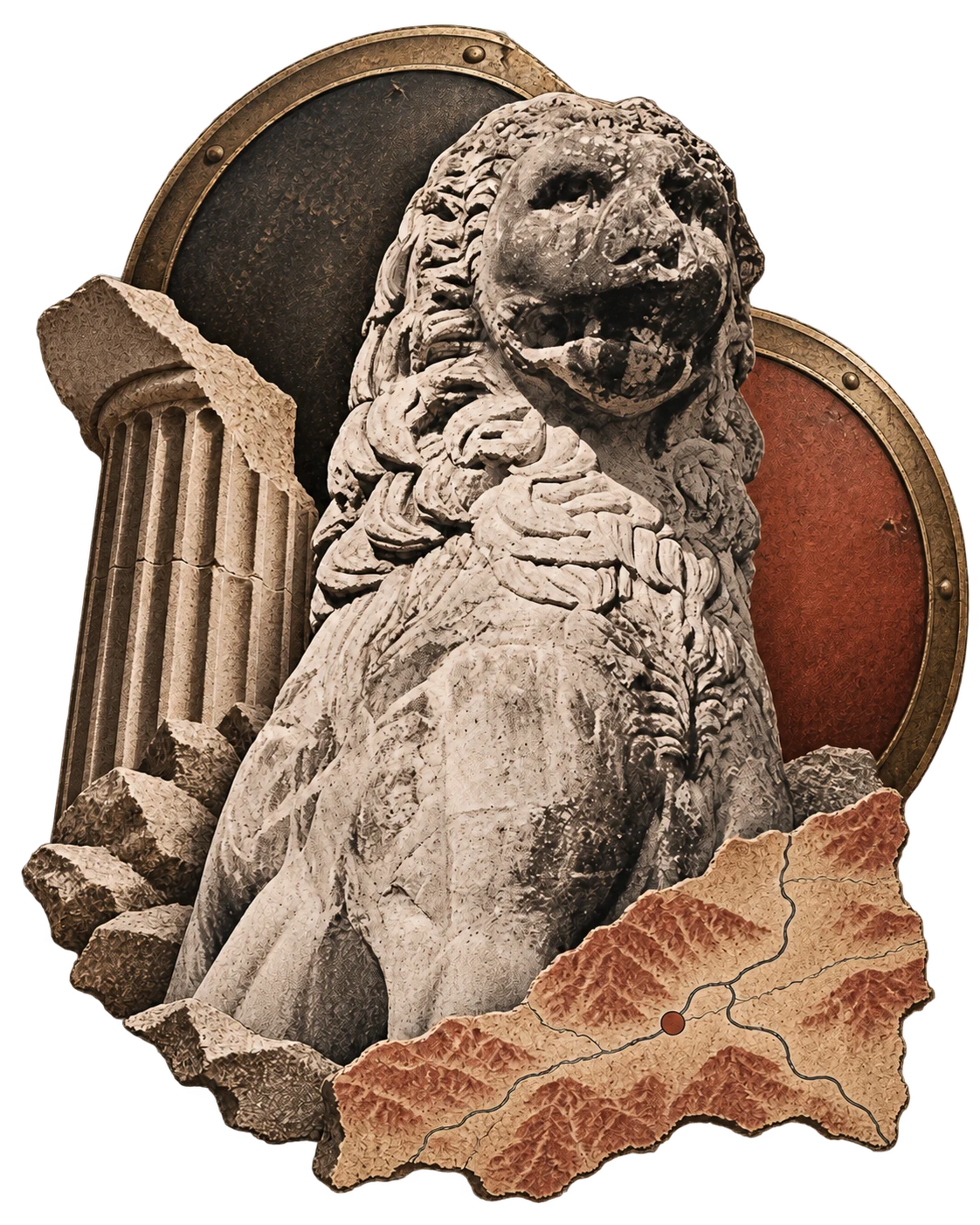
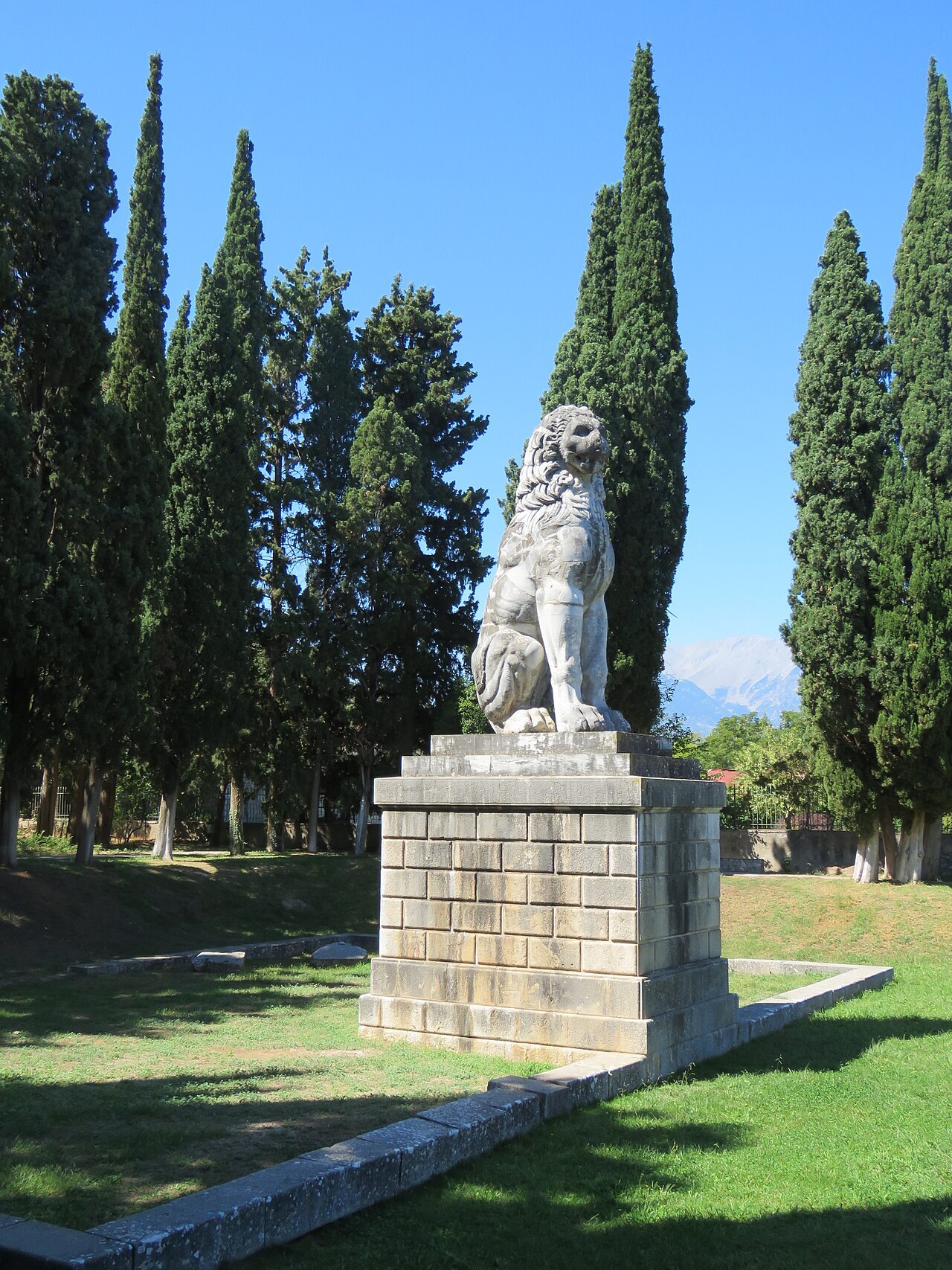
The Lion of Chaeronea There, where they fell, a mighty statue was later erected: a lion carved from stone, rising to a height of 5.5 meters. Not a lion of menace, but of honor. An eternal memorial to love, loyalty, and a friendship that endured beyond the grave. The statue was forgotten, broken, covered with earth, and survived the ravages of time. The Ottoman sultan sought to transport it to Constantinople but failed. Lord Byron saw it in ruins, but never managed to restore it. Only in 1902, after years of effort and with the help of mysterious donations, was the lion restored and returned to its place.
But who paid for the restoration?
The Order of Chaeronea: A Victorian Secret
The Order of Chaeronea: A Secret from the Victorian Era
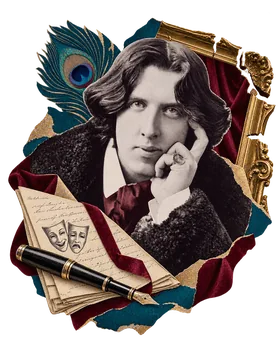
Neither the history books, nor articles, nor the signs at the lion site will tell you about the secret British organization that financed the restoration. The Order of Chaeronea, founded in 1897 by George Cecil Ives, was a secret organization devoted to LGBTQ rights, at a time when same-sex love was grounds for imprisonment. Its members, who may have included the famous Oscar Wilde, called themselves "Brothers of the Faith" and sought to build a new moral, cultural, and spiritual ethos that would challenge the rigid class structure and advance true democracy. The Order's oath of membership included the promise "Never to persecute lovers" and "All true love shall be to you as a sanctuary" (sanctuary meaning a place of spiritual refuge).
They chose their name for a reason: "Chaeronea," the name of the battle in which all the warriors of the Sacred Band died, and their symbol, the Lion of Chaeronea. The Order operated in secret, through sealed letters and coded rituals. But its contribution was preserved in stone. In the monument.
In 2023, at a country estate in Norfolk, a rare object was discovered: a signet ring belonging to the Order, engraved with the initials "Zeal, Learning, Discipline," the year 338 BCE, and the coded motto "AMRRHAO."
And despite all this, official Greece does not mention the Order. It gives it no credit. It does not recognize the Sacred Band's heroism for what it truly was: an act of love. Perhaps because even today, as in those days, it is hard to accept that love, even between two people of the same sex, can be the most powerful force on the battlefield. The story of the Sacred Band can be read in Hebrew in the book "Army of the Gods," whose authors, Eilon Lester and Shai Tovli, are a couple in real life.
Another famous battle was the Battle of Chaeronea, fought in 86 BCE. It was one of the best-known battles between the army of Mithridates VI, king of Pontus, and Roman forces led by the general Lucius Cornelius Sulla. The battle was part of a fierce struggle for control of Greece and left a deep mark on the region's history.
Centuries later, following the Fourth Crusade and the establishment of the Crusader Duchy of Athens, a new castle was built in the town of Chaeronea on the ruins of the ancient acropolis. The castle formed part of an extensive defensive system along the Cephissus Valley and was intended to protect the routes and secure control of the area. During the Frankish period, the town was called Caprena (in Spanish: la Cabrena), a name first mentioned in documents from 1381 and retained in use until the beginning of the modern era. Around the middle of the 15th century, probably in 1460, the town came under the rule of the Ottoman Empire.
תגובות
עדיין אין תגובות.