
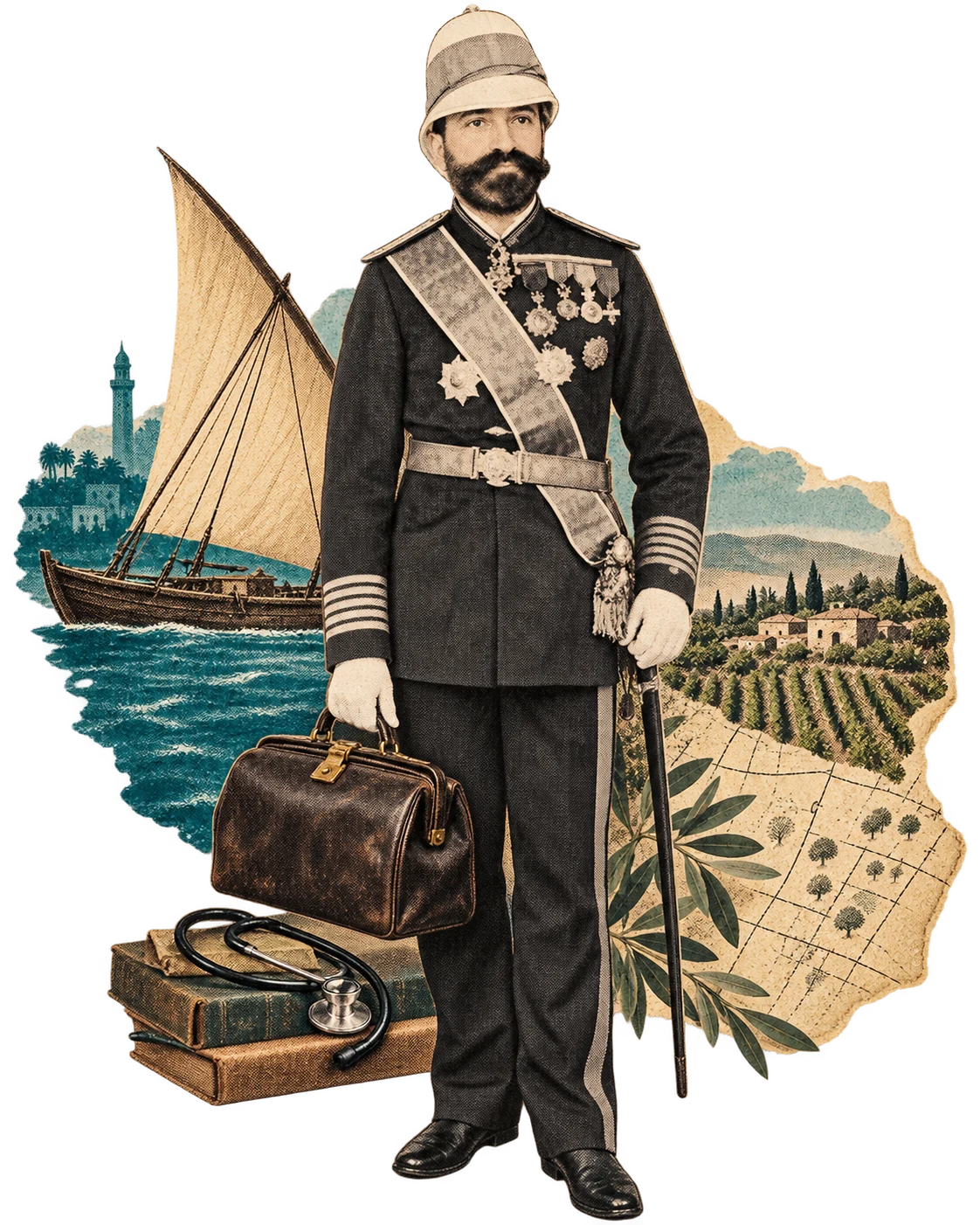
He was born in Russia to a family of Chabad Hasidim. When he grew up, he studied medicine, moved to Egypt, and there acquired the name 'd'Arbella.' He served as the personal physician to the Sultan of Zanzibar, and when he came to the Land of Israel, he tried to establish a colony in the Galilee.
In 1880, a group of Presbyterian Christians concluded that the Messiah was supposed to arrive via the Mount of Olives. Since that moment was very near, they realized that they had to hurry and prepare for his reception. To that end, they decided to raise a large sum of money and use it to buy a great quantity of white cloth, stakes, wooden beams, nails, and ropes - of the finest quality - all for a reception tent that would hold at least five thousand people. They raised the money among their friends in America and England and bought the necessary materials. The community's seal was stamped on the cloth every few meters along its length. The folded, packed tent and the other accessories were stored on Mount Scopus, in the home of their friend, the English Lord John Gray Hill. When Hill grew old, he sold the house to a Jew named Goldberg, and the tent was moved to the American consulate on HaNevi'im Street, where it remained for some time. The Hebrew University was later built on the site of the house. Fearing the tent would rot, the American consul approached Dr. Isaac Schwartz, director of the Rothschild Hospital, which was then under construction, and asked him to have the tent brought to the grounds of the new hospital and kept there. And so it was done.
From Kremenchug to Zanzibar
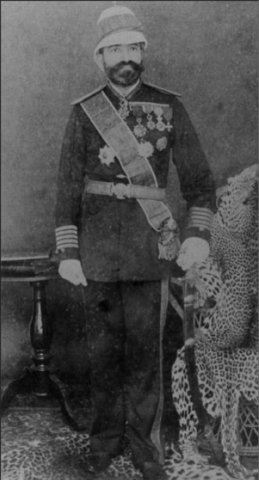
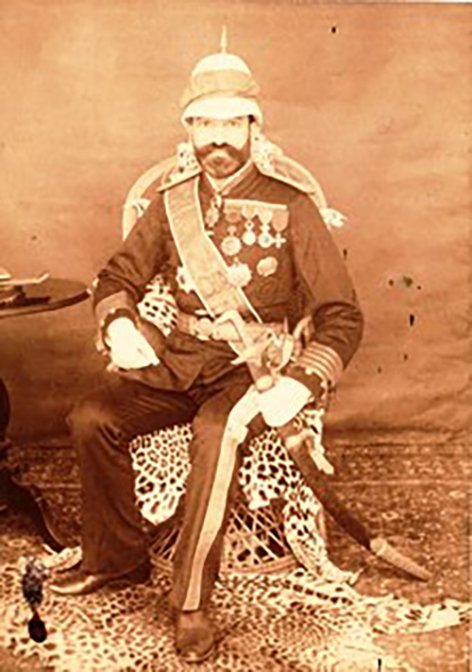
Dr. d'Arbella was born in 1847 as Isaac (Gregory) Amzislavsky, in Kremenchug, on the banks of the Dnieper in Ukraine (then Russia). His parents, who belonged to Chabad Hasidism and were merchants, were educated people and ensured that their gifted son continued his education beyond the traditional Jewish school and yeshiva. He also received a broad education at a Russian gymnasium. Isaac was sent to study at the Imperial Military Medical Academy in the capital, St. Petersburg, in 1870-1865. He continued his studies in Rome and Paris, where he received his doctorate in medicine. When he returned to Russia, he was drafted as a military physician and took part in the conquest of Tashkent in 1878-1877, where he was wounded in battle and received a medal for bravery.
In 1878, Isaac left Russia for good and traveled to England and America. When he reached Panama, he treated victims of the cholera epidemic that had broken out there. In Switzerland, he treated tuberculosis patients from the upper classes. The most distinguished among them was Umberto I, King of Italy, who was also his patron. Amzislavsky fell in love with his Christian student, Sophia Lukianov, and they married in Alexandria, Egypt, in 1879. Two years later, their daughter Sophia Rachel was born there.
In Egypt, Isaac and Sophia lived in the home of a widow named Bella. Some say this is where he got the nickname Dar (house) Bella.
In 1880, Isaac was invited by the second Sultan of Zanzibar, Sayyid Barghash bin Said Al-Busaid, to become his personal physician. He also became his adviser and confidant. Some claim that in Zanzibar he changed his surname to d'Arbella, after an island he received from the Sultan. A year after the couple arrived in Zanzibar, their second son, Gregory Nicholas Coleman, was born.
Through his personal connections with the Italian royal family, d'Arbella was appointed Italy's consul in Zanzibar. Thanks to his efforts, treaties of friendship and commerce between Zanzibar and Italy were signed in his presence in Rome in 1885. Later, Zanzibar transferred its rights in Somalia to the Italians.
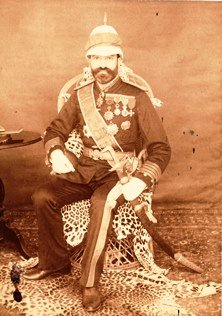
In 1883, Sophia, the woman he loved so dearly, died after a long struggle with tuberculosis.
In Rishon LeZion and Jerusalem
In 1886, while visiting Paris, d'Arbella met Baron Rothschild, who offered him the position of physician in his colonies of Rishon LeZion and Ekron, replacing Dr. Menachem Stein, the physician to the Bilu pioneers. By 1887, d'Arbella had arrived in the colony of Rishon LeZion. In the month of Nisan 5648, a notice addressed to the residents of Petah Tikva appeared in the newspaper HaTzvi: "Every Sunday, the renowned physician Dr. d'Arbella and his assistant will come to us to visit the sick of the colony, and will provide medicines free of charge to our Arab neighbors as well."
Nevertheless, there were also people who did not like d'Arbella. Elazar Rokeach wrote of him: "Physician to the corpses of the residents of the colonies of Rishon LeZion, Ekron, Petah Tikva and Gedera." In recognition of his service, Baron Rothschild gave d'Arbella a plot of land and a vineyard.
Following Isaac, his brother Yehuda Leib Amzislavsky, a Zionist activist and landowner in Rishon LeZion, and his cousin Chaim Yaakov Krishevsky, a Chabad Hasid who joined the Bilu pioneers in Rishon LeZion and redeemed land in Sejera (today Ilaniya), immigrated to the Land of Israel in 1887.
After about a year, d'Arbella moved to Jerusalem and married again, to Malia Melvina Schwartz, an immigrant from Hungary and a relative of Dr. Schwartz, director of the Rothschild Hospital. Malia and Isaac had three children: Edmondo (1892), Alfredo (1895), and Felisa (1898).
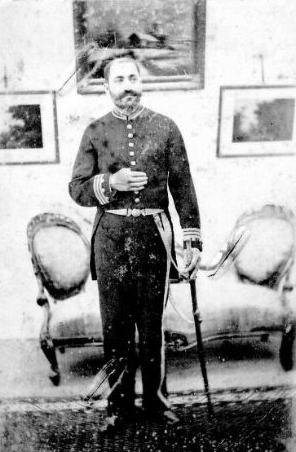
The year 1889 was a year of intense activity for d'Arbella. Early that year, he persuaded five fellow lovers of the Land of Israel, among them his brother-in-law, the pharmacist Moshe Rubovitz, who was also the first portrait painter in the country, to join him. Together they settled on the land of Sejera and became the first settlers in the Lower Galilee.
That same year, Dr. Isaac Schwartz died, and Dr. d'Arbella was appointed director of the Rothschild Hospital in his place. He held the position for about ten years, devoting most of his time to running the hospital and caring for its patients.
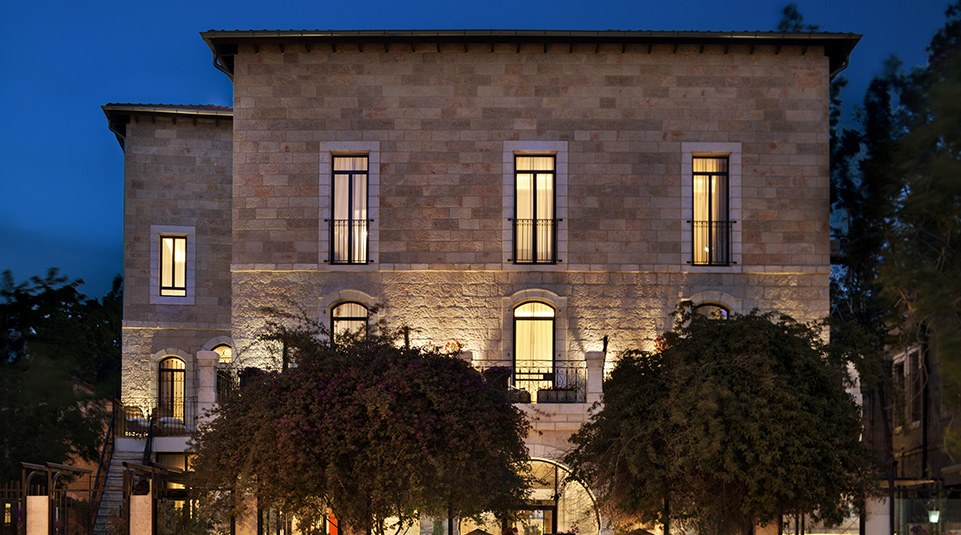
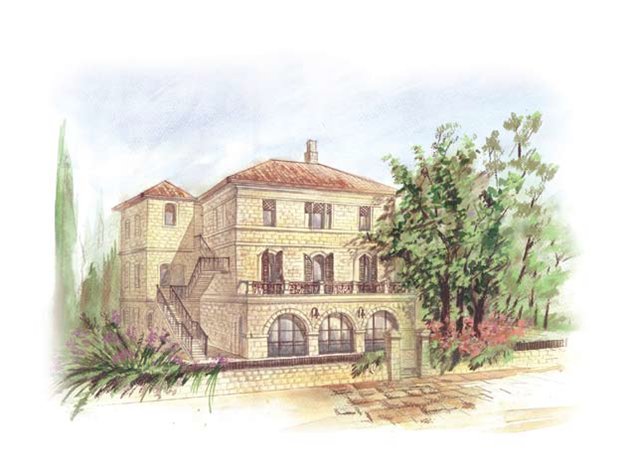
During his time in Jerusalem, Dr. d'Arbella became known as a socialite. His home, near the Rothschild Hospital, served as a social gathering place for the city's upper classes and foreign diplomats. The d'Arbellas often held balls at their home and spent a fortune on a glittering social life.
Dr. d'Arbella was exceptionally gifted. He spoke 12 languages and was also known for his civic, social, and scholarly activities. Among other things, he socialized with Eliezer Ben-Yehuda and the pioneers of the Hebrew language, who used his home as a meeting place, and was elected president of the 'Clear Language' Society, which became the foundation of the Language Committee, later the Academy of the Hebrew Language. D'Arbella also compiled a Hebrew-Yiddish-Ladino dictionary.
On February 20, 1897, several months before the First Zionist Congress, d'Arbella met Herzl in Vienna. Herzl wrote in his diary: "Yesterday Dr. d'Arbella from Jerusalem came to visit me. He is director of the Rothschild Hospital. An interesting man who looks like a tall, bald cavalry colonel, with a prominent nose, a mustache, and a strong chin. He told me wonderful things about Palestine, which is supposed to be a marvelous place, and also about our Jews from Asia. Kurdish, Persian, and Indian Jews come to his office. Strange, there are black Jews who come from India. (...) Throughout Palestine people are talking about our national plan. Ultimately, we are the heirs to the land. (...) The Jews of Jerusalem already make up the majority of the population, (...) and now the orange trees are blossoming in Palestine. Anything can be done in this country. - We must remember this remarkable man for future tasks."
Herzl told d'Arbella about his plans for the First Zionist Congress, scheduled for August that year, and about his intention, as Max Nordau would later phrase it: "Zionism seeks to establish a home for the Jewish people in the Land of Israel, secured under public law." D'Arbella was asked to prepare a report on the situation in the country and the possibilities for realizing these aspirations.
The Tent and the Farewell to Jerusalem
The year 1899 was a year of shortages at the Rothschild Hospital. There were no sheets and no firewood. On the one hand, the hospital was short of supplies; on the other, it housed a tent intended to welcome the Messiah. "Jerusalem above, and here I am below, dealing with problems... The Messiah still hasn't arrived," Dr. d'Arbella said to himself. He ordered that the beams and stakes be taken and used for firewood, and instructed that shirts for the patients be sewn from the cloth intended for the reception tent. "When the Messiah comes," he said to himself, "we'll buy new cloth and new wood for the tent." And so it was...
Several months later, a dispute broke out between Dr. d'Arbella and the household manager, Mr. Aryeh Leib Sachs.
Sachs took two shirts, two pairs of trousers, and two prayer shawls bearing the seal of the Presbyterian Christians and sent them to Baron Rothschild in Paris. The Presbyterian cross on the hospital clothes shocked the Baron, and he immediately asked Dr. d'Arbella to resign.
In 1900, Dr. d'Arbella and his family left Jerusalem and initially settled in Venice. They later moved to Palermo, Sicily, where the family converted to Christianity and became Catholic. Following an earthquake there, d'Arbella lost his fortune and was forced to leave Sicily and move to Tunis. Dr. d'Arbella established a successful clinic there and planned to return to the Land of Israel. Disguised as a Muslim, he set out on a pilgrimage to Mecca. On his return, he fell ill and died in Tunis, destitute, on June 24, 1911, at the age of 64.
תגובות
עדיין אין תגובות.