
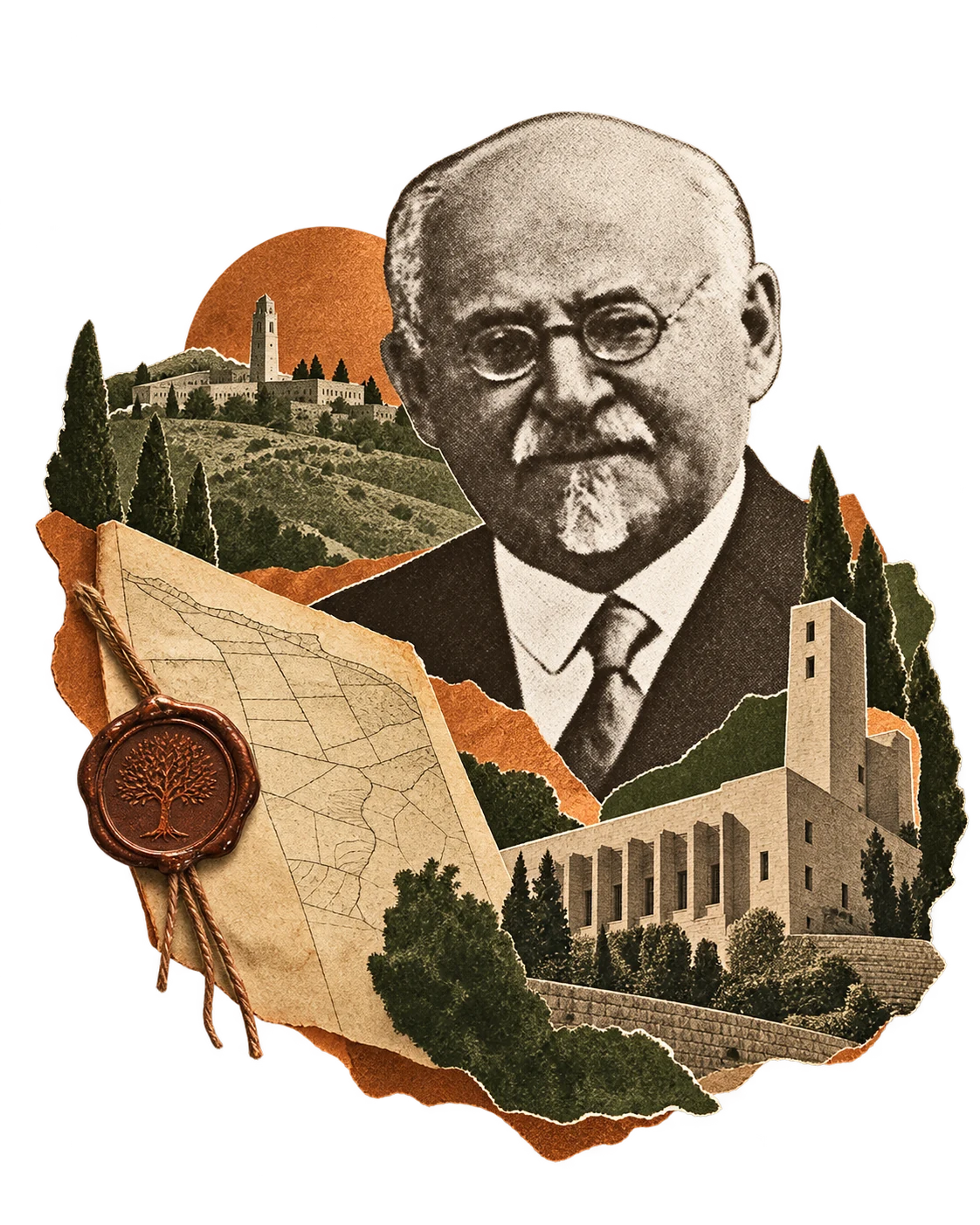
He financed the JNF's first plot of land and most of the land on which the Hebrew University was built on Mount Scopus. He donated about 30% of Ramat Gan's area, as well as the site of the Habima Theatre in Tel Aviv.
Without a doubt, he was one of the greatest Zionists. A wealthy man, he never bought himself a home outside Israel. The first building he called 'home' was the one he built at 111 Allenby Street in Tel Aviv. He donated the lands he owned beyond the Yarkon's southern bank to the Ramat Gan municipality ('Goldberg Orchard') and the Tel Aviv municipality, to which he also donated the plot on Rothschild Street where the Habima Theatre was built. Some members of his family were furious that they had not received the entire area, and for that reason they do not commemorate his memory. In addition to his immense donations, he was one of the leaders of Hovevei Zion and served as a delegate to the Zionist congresses. Yet he was a modest, quiet man who worked behind the scenes, and perhaps that is why his name is missing from the pages of history.
The Family and the Road to Zionism
Isaac Leib Goldberg was born in 1860 in the town of Šakiai, Lithuania, to a family that sold medicines. Like all the Jewish children in town, he attended a heder and a yeshiva, where he was exposed to the Zionist movement. He devoted himself to the idea of the Jewish people returning to the Land of Israel and resolved to do everything he could to advance and realize this dream. Isaac's family represented the German pharmaceutical company Bayer in Russia, but as tensions between Russia and Germany ran high at the time, the flow of medicines came to a halt. In time, Isaac grew wealthy after successfully concocting a medicine that was in high demand. He later opened a branch in London, exported goods to China, and established a company in Japan. And, as he had decided while studying at the yeshiva, he directed most of his fortune toward renewing Jewish settlement in the Land of Israel.
His wife, Rashel (Rachel), was the daughter of Yehiel Michel Pines (a cousin of Yehiel Michel Pines who shared his name was one of the founders of Petah Tikva, Yesod HaMa'ala, and Gedera). She met Isaac at the gymnasium, and they fell in love. Her father was horrified to see his daughter dating a clean-shaven Jew, so he asked the Zionist rabbi Mohliver for his opinion. Mohliver praised Isaac and said, "In ten or fifteen years, Goldberg will not boast of his father-in-law; rather, the opposite will be true, and you will praise and take pride in your son-in-law." Inspired by her husband, Rashel too became involved in Zionist activity and ran Hebrew-language courses in Vilna, taking a real risk because teaching Hebrew was prohibited at the time.
The Goldberg home was open to Zionist activity, and all the social events of Hovevei Zion and Safa Berura (Clear Language), an organization founded by Eliezer Ben-Yehuda to revive spoken Hebrew in the Land of Israel, were held there. Among others, they took the young Levi Eshkol, later prime minister, under their wing; encouraged by them, he began his Zionist activity.
A Home Open to Zionist Activity
Isaac Leib Goldberg's most notable qualities were his ability to communicate with people, understand the needs of all sides, and make peace between them - what we would now call mediation. This was evident, for example, in 1887 at the Hovevei Zion conference, when disagreements broke out among all the groups represented there. Ussishkin later recalled: "There was a clash between Odessa, Warsaw, and Bialystok, a clash between Pinsker and Mohliver, a clash between the old and the young, and all were acting for the sake of Heaven, with the building of the land in mind. Amid these clashes, the young Isaac Leib Goldberg ran from Finn to Mohliver, from Mohliver to Lilienblum, from Lilienblum to S. P. Rabinowitz... His every wish was to make peace, to reconcile and unite, and to bring about practical results... Quietly and modestly, a word was worth one sela, but work was worth two. Such was Isaac Leib Goldberg's philosophy of life."
Isaac Leib Goldberg visited the Land of Israel several times. His first visit was in 1891, as part of a delegation that examined the progress of Jewish settlement. On this visit, he met Yehoshua Hankin, helped him financially with land purchases, and toured the Baron Rothschild colonies.
When World War I broke out, while the delegation was in Germany, the Germans rounded them up along with all the other foreign nationals and sent them to Russia. Around that time, Hermann Shapira conceived the idea of establishing a land-purchasing company called the Jewish National Fund, and Isaac Leib was one of its first major donors. He was also among the first to buy shares in the Jewish Colonial Trust for tens of thousands of rubles. The trust became the foundation of the Anglo-Palestine Bank, later Bank Leumi.
After the Sixth Zionist Congress, the Weizmann family were guests at his home, where the debate over the Uganda Plan (which was supposed to be in Kenya) grew heated. At the time, no one imagined that years later their grandsons, Dan Tolkowsky and Ezer Weizman, would become commanders of the Israeli Air Force.
The news of the death of the visionary of the State of Israel, Benjamin Ze'ev Herzl, was unbearable for the Jewish people. When the Goldbergs' firstborn son was born in July 1905, they named him Benjamin Ze'ev (Bingi).
Aliyah and the Building Enterprises
Unlike some philanthropists of his stature, Isaac Leib decided to move to the Land of Israel. In 1918, at the age of 58, he arrived with his wife Rashel and their five children. They built a home at 111 Allenby Street, where they lived a religious lifestyle. Nine years earlier, he had already established an agricultural farm at Hartuv, after Bulgarian Jews' attempt to establish such a farm had failed. He introduced many agricultural innovations there, employed residents of the colony, and built them a school and a clinic. When he learned that the biblical city of Beth Shemesh, near which the biblical hero Samson had performed his exploits, and Tel Gezer, one of the cities built by King Solomon, had been discovered near the farm, his excitement grew even greater.
He had met Menachem Gnessin in Moscow, where Gnessin was hired to tutor his children. Around the time the Goldberg family moved to the Land of Israel, Menachem Gnessin's brother, the writer Uri Nissan, began establishing the Habima Theatre. It took no more than a gentle hint for Isaac Leib to donate the plot at 80 Rothschild Street on which the theatre's first building was erected (Sderot Cinema). His contribution to Israeli culture did not end there: in 1933, he financed the publication of Bialik's writings. In 1914, when the language war broke out in the Land of Israel and the Technion in Haifa planned to teach in German, Isaac Leib donated most of the land for the Hebrew University on Mount Scopus in Jerusalem.
Isaac Leib Goldberg was also a pioneer of the Hebrew press and one of the founders of the newspaper Haaretz. His name was commemorated on a very small street in Tel Aviv, where the Haaretz printing house once stood. From the newspaper's first issue, Goldberg's name appeared at the top of the paper, but it was removed when Gershom Schocken bought it. He was also one of the founders of the companies Hakhsharat Hayishuv, Achiasaf, and Carmel Mizrahi.
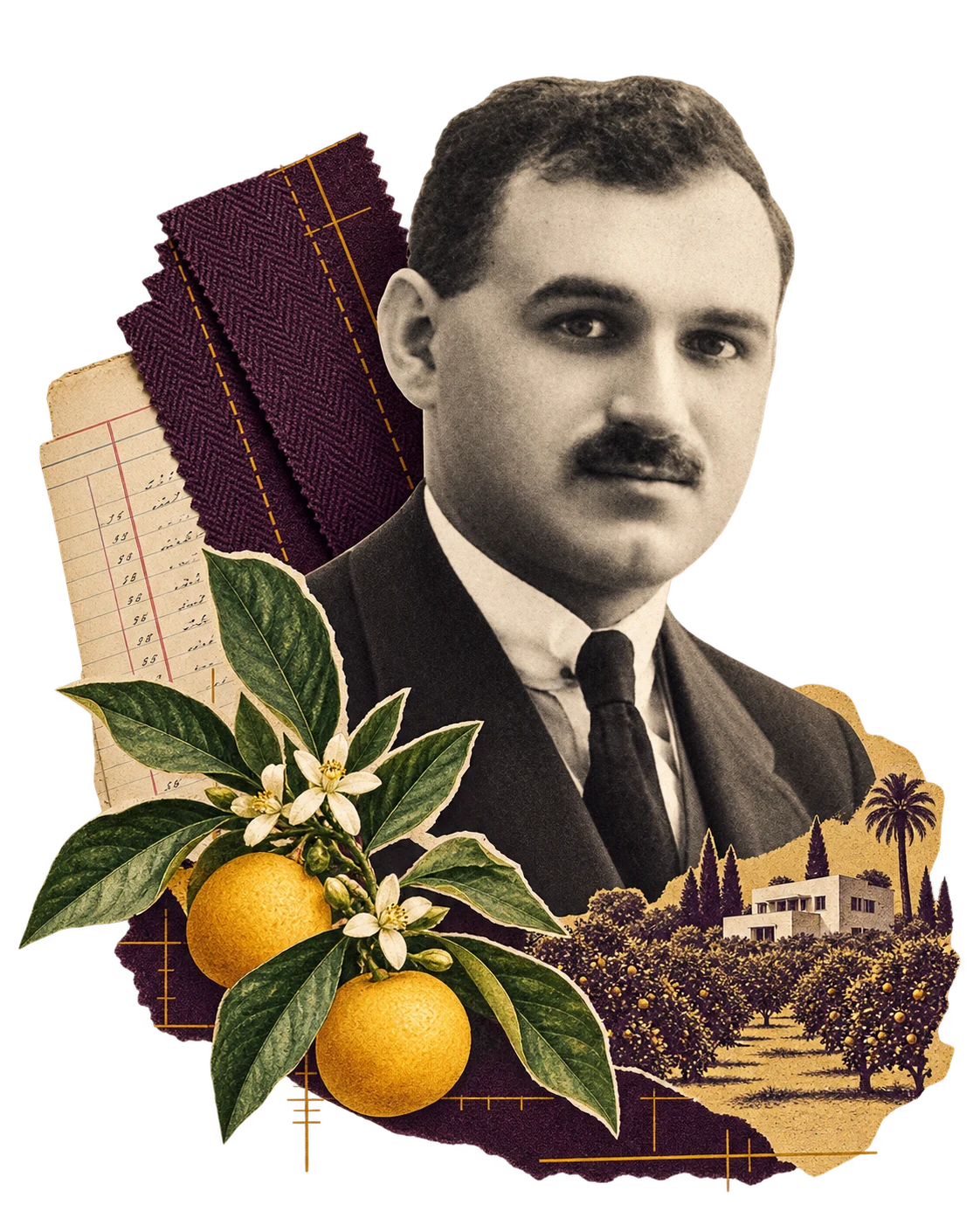
He bought the orchard now known as Goldberg Orchard from Kappus, a German Templar who lived in the Sarona neighborhood. The orchard stretched from the Diamond Exchange complex to Ramat Gan Stadium. He insisted on Jewish labor there and made sure to pay wages higher than those generally paid to orchard workers. At the Produce of the Land exhibition, held in 1929 at the Levant Fair in Tel Aviv, the oranges from Goldberg Orchard won prizes for their excellent fruit and outstanding packaging, as well as a special prize from the High Commissioner for 'the finest box of oranges at the exhibition.' To achieve these results, Isaac Leib relied on his son-in-law, the agronomist Shmuel Tolkowsky. He established the country's first mechanized packing house and, over 18 years, employed about 3,000 workers. Tel Gerisa, now Napoleon Hill, stands near the orchard, and Goldberg also assisted Professor Sukenik with excavations.
He donated part of the orchard for a neighborhood for intellectuals, where the Vatikiim neighborhood in Ramat Gan stands today. He gave one of the plots to Bialik, and donated the remaining orchard land to Ramat Gan and Tel Aviv. According to one version, both municipalities were offended that they had not received the entire orchard, and neither commemorated him as a result. The area in Ramat Gan later became Tel Binyamin, named after Isaac Leib Goldberg's son.
Binyamin too caught the Zionist bug and persuaded his parents that the country needed mechanics. He studied mechanics in London for five years and, after graduating, established an automobile company. But when he realized that the country was at a critical juncture and had to be defended, he joined a company for agricultural equipment as a partner. In practice, the company manufactured weapons to defend the country.
During the 1929 riots, after spending two consecutive days helping defend the Mekor Haim and Talpiot neighborhoods in Jerusalem, he was on his way back to Tel Aviv when he heard that the spirits factory near Yazur was under attack by rioters, with several workers trapped inside and their lives in real danger. He joined a group of Jews who rescued the workers, but on the way back, near what is now Abu Kabir, they were ambushed and Binyamin was seriously wounded. He was taken to hospital, where he died of his wounds. His last words were, "But the Land of Israel will be ours in any case."
Loss, Death and Commemoration
Isaac Leib, then 70, never recovered from the tragedy. He wrote in his diary: "Lord of the Universe, why have You afflicted me? Have I not sacrificed enough during my life for the revival and building of the land, that after all this I should be dealt another sacrifice of blood?" In his son's memory, he established a youth center and named it Beit Binyamin. The building was given to Maccabi Tel Aviv, and a plaque on it tells his story.
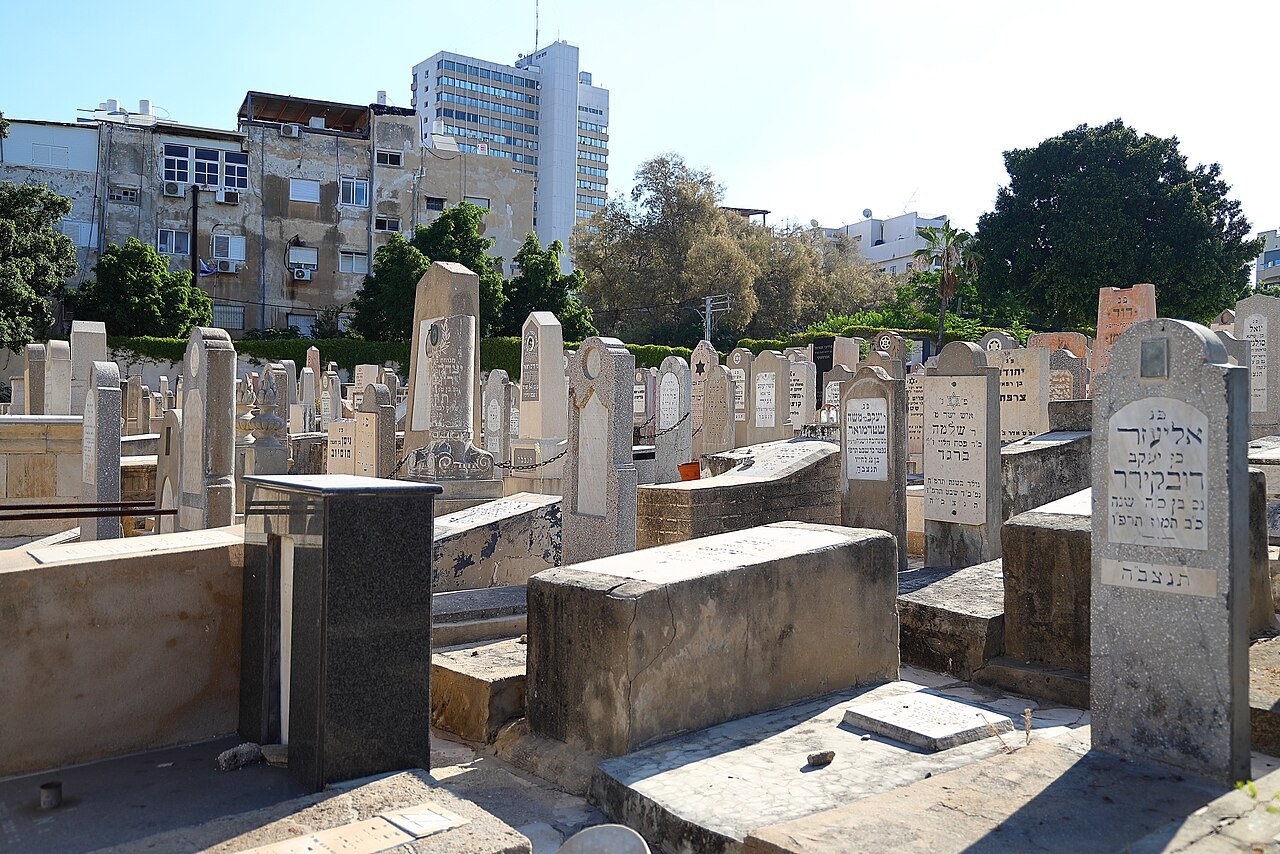
In the summer of 1935, Isaac Leib went to Switzerland to attend the 19th Zionist Congress. His condition deteriorated, and he was rushed to hospital, but he died soon afterward. He was 75. He was buried in the Trumpeldor Cemetery in Tel Aviv, beside his son Binyamin. In his will, he left half his estate to the JNF (at the time, this was the largest donation ever made to the Zionist enterprise). He appointed his friends at the Anglo-Palestine Bank, the bank he had established and financed, to handle his estate. His friends wanted to liquidate the assets quickly and sold the house at 111 Allenby Street for a low price. His wife Rachel wrote a booklet describing with great sadness how his friends had dispossessed her of her property, and how all that remained of her husband was a street about 100 meters long...
Bialik wrote of Isaac Leib Goldberg: "May my lot be with you, silent sufferers of the world, weaving your lives in secret, modest in thought and deed, hidden dreamers, sparing of words and rich in splendor, your treasured spirit concealed within you, like a pearl on the ocean floor." Gershom Gera wrote the book The Unknown Benefactor about him.
The eldest daughter, Nyota, studied law at the University of Nancy in France and became the first woman to earn a doctorate at that university. She married Shmuel Tolkowsky, a member of a Zionist diamond-dealing family from Belgium who immigrated to the Land of Israel and was among the first orchardists in Rehovot. Their daughters were Naomi and Ada (Urbach), and their son was Dan Tolkowsky, later commander of the Israeli Air Force and then one of the founders of Athena, Israel's first venture capital fund for high-tech investments. Goldberg's second daughter, Yehudit, married Yaakov Klivnov, a former Knesset member representing the General Zionists. Goldberg's youngest daughter, Shulamit, married Arno Hochfeld, owner of a silicate factory in Haifa Bay.
תגובות
עדיין אין תגובות.