
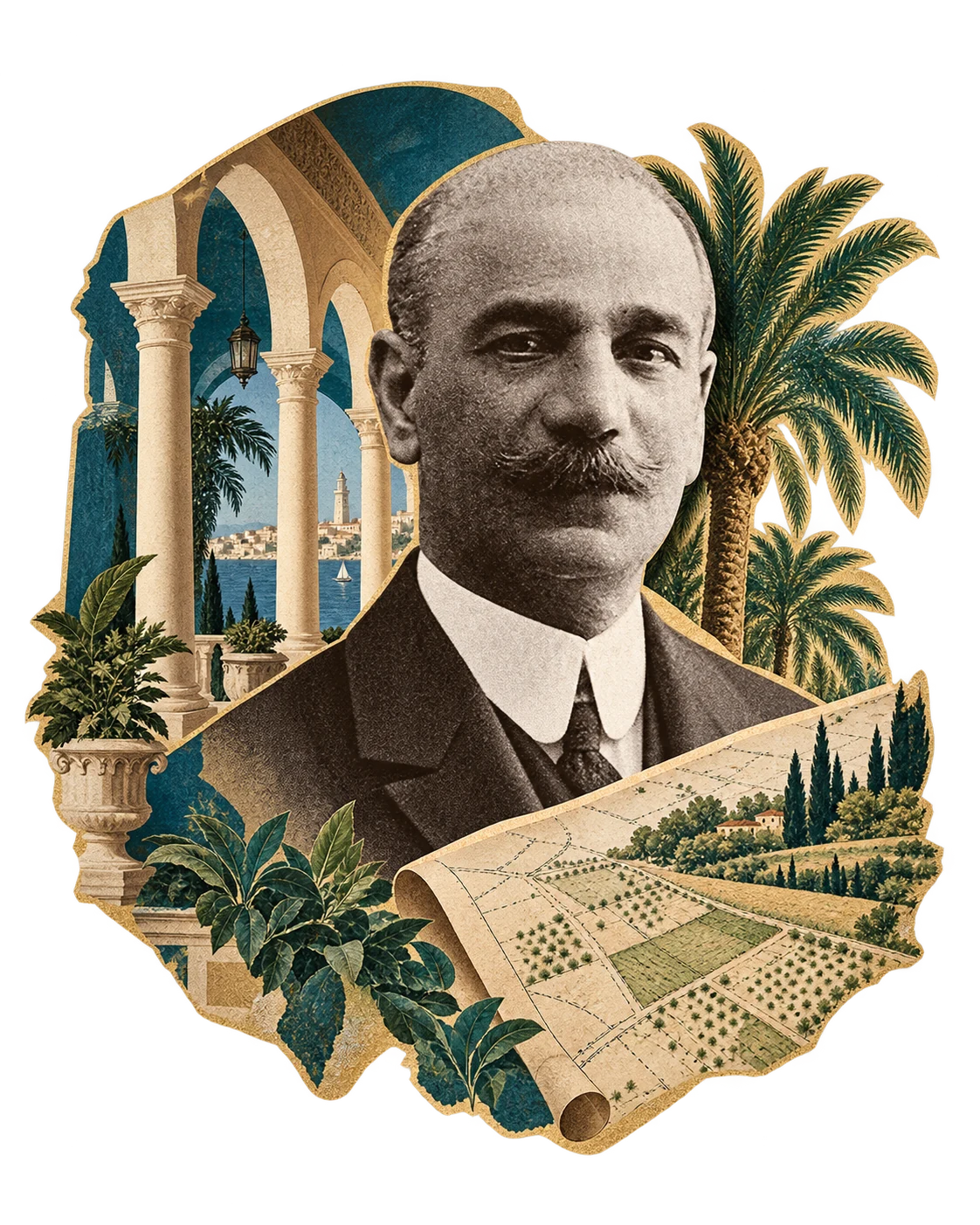
Three stories about an Egyptian Jewish baron, an extraordinarily wealthy man who supported Jewish settlement in the Sharon region and nearly bought the Western Wall, and about a magical, little-known garden.
The Road to the Title of Baron
In 1869, some 8,000 guests were invited to a celebration marking the opening of the Suez Canal. For the occasion, about 500 cooks and 1,000 servants were brought from Italy and France. During the festivities, which lasted four days, a French ship sailed in a procession, carrying Empress Eugénie, the wife of Napoleon III. Behind it sailed Egypt's ruler, Khedive Ismail Pasha, followed by Emperor Franz Joseph I of Austria and twenty military bands. Among the distinguished guests were two of Egypt's wealthiest Jews: Jacob Kattawi and Jacob Menashe Levy, who looked after Austrian interests in Egypt as part of their business dealings. At the end of the ceremony, Emperor Franz Joseph granted Jacob Menashe Levy the title of baron in recognition of his service to Austria. Solomon Green, Jacob Kattawi's great-grandson, recounted that when the emperor wanted to give Kattawi the title, several problems arose. Since Kattawi was married to two women, which was not accepted in Europe, he was asked to part with one of them. Kattawi replied that he loved both his wives, and so he gave up the coveted title. There was a different problem with Jacob Menashe Levy. The name Levy is the one most closely associated with Jews, so he was asked to rearrange his names as Jacob Levy Menashe and be known as Baron de Menashe - and so it was.
Some of the shares in the Suez Canal, which were expected to yield substantial income from tolls paid by ships passing through the canal, were held by the French government and some by Khedive Ismail Pasha, a great spendthrift who had fallen deeply into debt. In 1875, one weekend, Khedive Ismail approached Britain's prime minister, the converted Jew Benjamin Disraeli, offering to sell him his shares in the canal. Disraeli knew that the Bank of England was closed on weekends and that Parliament was in recess, so there was no one who could authorize the bank to release the sum required. He therefore asked for help from his Jewish friend Baron Lionel de Rothschild, an heir to the legendary banking family. Rothschild agreed and lent Britain the money to purchase the canal shares. Seven years after the purchase, Egypt went bankrupt and Britain took control of the entire country. Jacob Kattawi's family controlled Cairo's flour industry, and one of its sons served as finance minister and communications minister and as a member of the Egyptian Senate during British rule in Egypt. Another son was a writer, diplomat, and speechwriter for King Fuad.
As well as commercial ties, the Kattawi and Levy families were connected by marriage: Jacob Menashe Levy's eldest son married Jacob Kattawi's daughter, Simcha Allegra, and they moved to Alexandria.
The de Menashe Family's Alexandria
In the 1920s and 1930s, Alexandria was the liveliest city on the Mediterranean coast. It was distinguished by its grand homes and the soirées held in them, where families hosted exhibitions, lectures, concerts, theater, and other entertainments. The most prominent of these homes belonged to Baron Felix de Menashe, son of Jacob Menashe Levy and Simcha Allegra, and his vivacious countess wife. His eldest son, George, and his daughter Claire held concerts, and their home displayed the baron's remarkable collections, which included ancient Roman glassware from Rome and Syria, jade jewelry, enamel objects from Jaipur in India, Persian jewelry, colored diamonds, expensive watches, eighteenth-century gold tobacco boxes, Greek rugs, Turkish embroideries, and fine paintings. Some of these collections are now housed at the Fitzwilliam Museum in Cambridge. Apart from music, Baron Felix de Menashe's greatest passion was Chinese porcelain. He had the largest and finest collection in private hands anywhere in the world. Many sources describe the family's wealth, including the book My Egypt, written by the baron's granddaughter, Rachel Maccabi, a Palmach veteran who immigrated to Israel.
Baron Felix de Menashe was born in Alexandria in 1865. As the son of an aristocratic family, he studied at the finest schools in Vienna and London. At the age of 19, he was appointed manager of the firm J. L. Menashe, Sons and Partners in London, named after its founder, his grandfather Jacob Levy Menashe. In 1889, he returned to Egypt and was appointed manager of the London firm's Alexandria branch, together with his brother, Baron Jacques de Menashe. Toward the end of that year, at the age of 24, Baron Felix de Menashe married his cousin Celine Esther de Menashe, a 19-year-old born in Liverpool. About a year later, their eldest son, George, was born, and six years later their second son, Andre, was born. He died at the age of one. Four years after Andre's death, while they were in France, Esther Celine died at the age of 29, leaving Baron Felix widowed and bereaved at the age of 34.
In 1903, at the age of 38, Baron Felix married again in Geneva, to Rosa, née Bustos, who had given birth to their daughter Claire and son Jean before the wedding. Six years after the marriage, their daughter Denise was born. Rosa inspired the English writer Lawrence Durrell when he wrote The Alexandria Quartet. He dedicated the first volume to its heroine, Justine, a beautiful, sensual, restless Jewish woman who resembled Rosa. The heroine was married to an elderly millionaire named Nessim, who forgave her all her infidelities. The book is written in the first person by her British lover, a writer recording his memories... Lawrence Durrell married Claude-Marie Vincendon, Felix's granddaughter and Claire's daughter.
The de Menashe family left its mark on the city of Alexandria, establishing several institutions for the Jewish community and even building an entire neighborhood. The family founded the Menashe Jewish School, the Menashe Hospital, the Menashe Gallery art center, the Menashe Synagogue, and a boulevard of the same name, Rue Menasce (now AHMED ISMAIL).
In 1904, the Kattawi and Menashe families joined two British men, Sir Auckland Colvin and Sir Elwin Palmer, to establish an investment company. Together, they also bought land and built a new suburb in Alexandria. The first houses were built as early as 1907, and the neighborhood was called the Menashe Quarter. Among other things, the families also controlled the National Bank of Egypt. They expanded their businesses into France and England, with a different family member living in each place to manage the local enterprise. At the age of 61, Baron Felix de Menashe became president of the Jewish community in Alexandria, continuing the work of his brother Jacob, who had held the position for about 25 years.
The Days of the First World War
When World War I broke out, the Turks began deporting to Egypt Jews who were citizens of enemy countries, including Russia and Poland. Using whips, Turkish policemen dragged Jews from their homes and took them to the port of Jaffa, where they put them aboard ships and sent them to Egypt. From December 1914 to September 1915, more than 10,000 Jews were deported from among the approximately 90,000 Jews then living in the country. Among the deportees was David Ben-Gurion, who wrote in his diary: "We are going to tell the story of the Exodus from Egypt and hold the Seder beside Pharaoh's tomb. But it is not exactly an Exodus from Egypt; more accurately, an Exodus from Jerusalem." To everyone's surprise, despite the language difficulties and separation from home, life in Alexandria was comfortable, the apartments spacious, and food plentiful and inexpensive.
David Yudilovitch, one of the deportees' leaders, described the relationship between the deportees and Egypt's Jews. He wrote that the Suarez family, one of the wealthy families, refused to help, arguing "that a different policy should be followed in accepting aid: not from the community or from private individuals, since this is not a Jewish crisis but a political one, and therefore efforts should be made to ensure that aid comes from the countries whose citizens the deportees are, and which have a duty to care for them." At the same time, Yudilovitch praised the assistance offered by some of the community's wealthy members, including Baron Felix de Menashe and his wife, the baroness.
Among the deportees were Ze'ev Jabotinsky and Joseph Trumpeldor, who founded the Jewish Legion in Egypt. Its aim was to enlist in the British army and help capture the country from the Turks, and to serve as the basis for an independent Jewish military force. Some of the deportees and some young people from the local community enlisted in the Legion. Witnessing these activities, Baron Felix de Menashe began to think that the establishment of a Jewish state was only a matter of time, and that it was worth examining its investment potential.
While Jews were being deported to Egypt, the NILI underground was established in the country, led by Aaron Aaronsohn, with the aim of spying for the British against the Turks. Aaronsohn went to Egypt to make contact with the British and met Baron Felix de Menashe. The two developed a close and profound relationship, which Alexander Aaronsohn, Aaron's brother, would later make use of.
In 1917, Chaim Weizmann did not need to worry about making a living. He had become wealthy from royalties on his inventions, and therefore devoted all his time to his role as president of the Zionist Organization. Weizmann understood that the fate of the Jewish people in the Land of Israel depended on the British, and so he sought to establish ties with senior British officials in Egypt and with the Jewish community there. Weizmann believed that part of the country's redemption should come from private entrepreneurs investing their money in land purchases. He approached Lord Mond, Lord Ziv, and other wealthy Jews, who arranged a meeting for him with Baron Felix de Menashe, who was interested in investing in the country.
The Turn to Zionism and Investments in the Land
Following his meeting with Chaim Weizmann, Felix de Menashe founded the Committee for the Land of Israel (the Pro-Palestine Company) in 1918, with the aim of providing financial support to Jewish settlers in the country. A year later, he made his only visit to the country. His visit caused great excitement, and the newspaper reported: "This family's generosity is known to all. Almost all the charitable and cultural institutions in Alexandria and Egypt are supported by this distinguished family... Baron Felix, the second son of Baron Bekhor, as mentioned, who heads Pro-Palestine and arrived here last week, is the very embodiment of nobility: a highly educated man who knows many languages, is beloved by all, and above all is a great Jew to the depths of his soul, an ardent lover of Zion who loves the country and is devoted to it, and is ready to do much for its benefit and for its institutions."
At the end of the war, in 1921, Felix de Menashe combined his business skills with his knowledge of the culture and language to establish Palestine Enterprises Ltd., a pioneering joint venture between Jews and Christian Arabs, involving the Litwinsky brothers and Salim Zarifa. The company invested in land purchases and building construction. One of its projects was Zarifa Passage, a two-story commercial building at 6 Jerusalem Boulevard, built in 1921.
It was a partition intended to separate women and men, installed by Jews at the Western Wall, that sparked the 1929 riots. One of Weizmann's ideas for resolving the issue was to buy the Wall. To this end, he enlisted Baron Felix, who began negotiations with Muslim dignitaries and leaders, but the deal did not go through.
After World War I, Alexander Aaronsohn took part in two significant projects. Together with Itamar Ben-Avi, son of Eliezer Ben-Yehuda, who revived the Hebrew language, he founded the newspaper Doar Hayom and established a new association for the moshavot, called Bnei Binyamin, after Benjamin Ze'ev Herzl and Benjamin Rothschild. Its goal was "to preserve what exists and build what has been destroyed." Alexander was elected president of the movement, which brought together residents of the moshavot who wanted to establish new settlements. "With one voice, the representatives of all the young people from the villages... decided to nominate Alexander Aaronsohn as president," Itamar Ben-Avi recounted. "I was asked to be vice president... Alex's influence on the young people of the moshavot was immense, and for a time it really seemed that we had a leader of our own."
Soon after being elected president of the movement, Alexander Aaronsohn set out to raise funds in the United States. His journey took him through Alexandria, where he met Baron Felix de Menashe. He introduced himself as Aaron's brother, explained the movement's goals, and succeeded in winning the baron's support. From Alexandria, Alexander continued to the United States, where he also managed to enlist a group of influential and wealthy Jews to support the movement, including Justice Louis Brandeis, Nathan Straus, owner of the Macy's department store chain, and Miriam Fels. Fels was a wealthy widow who announced that she planned to visit the country and make a substantial donation if the first settlement were named after her husband, Joseph Fels, and called Yosefiya. When she arrived in the country, Miriam stayed at Itamar Ben-Avi's home, and afterward spent two weeks at the Aaronsohn family's home, where she fell in love with Alexander. Alexander was described as a man with "such powerful personal charm that it was difficult for men not to be swept along by him, let alone women." And so, although Miriam Fels was 25 years older than Alexander, they became a couple and left for New York together.
In 1923, Bnei Binyamin decided to establish a bank to help farmers’ sons, who faced difficult credit terms, establish themselves. The bank's management slogan was: "The most generous terms and the strongest collateral." The bank offered loans to farmers’ sons at 7% interest ("and without any commission!") for six, eight, and twelve months. Three years later, the organization decided to establish a company for planting citrus groves called Hanotea. The company's aim was to undertake every activity connected with citrus growing, but in practice Hanotea became a company for purchasing land and establishing settlements.
Baron Felix de Menashe's first two investments in the country were in the bank and in Hanotea, which he joined as a partner. To reduce the risk, he did what he always did: he invested alongside a local entrepreneur who knew the area. He bought a large tract of land, divided it into smaller parcels, and sold them to private settlers. Among the settlements established on land purchased with Felix de Menashe's money were Kfar Aharon, near Ness Ziona; Herzliya; Even Yehuda; Tzur Moshe; Kfar Nordau; and Netanya, a large part of whose founding funds came from his company partner Nathan Straus, after whom the city was named. They also bought land near Petah Tikva, where Kiryat Matlon was later established, as well as land north of Kfar Saba, where he planned to build his home. Felix de Menashe also bought land in Haifa, Jerusalem, and Tel Aviv, and helped Tel Aviv mayors David Bloch and Meir Dizengoff realize their plans to establish health and convalescent homes there. With Moshe and Emil Litwinsky, he bought the land on which the settlement of Tel Litwinsky (Tel Hashomer) was established, as well as extensive tracts around Ramat Gan. In addition to these activities, Felix and Albert de Menashe bought shares in hotels. The best known were the Panorama Hotel in Haifa and the King David Hotel in Jerusalem, built by their family friend and partner, Jacques Mosseri.
The End of Activity and the Legacy
The Arab Revolt that broke out in 1936 halted plans to build Felix's home north of Kfar Saba and brought his other investments to a standstill. His eldest son, George, began managing his businesses. Although he did little in the country, he contributed to the establishment of the Habima Theater and the Hebrew University of Jerusalem.
In 1948, amid tensions between Israel and Egypt, the family's economic activities came to an end, and the last family members left Egypt in 1956. Rachel, Baron Felix de Menashe's granddaughter, married Maccabi Mosseri in 1936. He was active in the Palmach and the Haganah, and she spent much of her life living in Hatzor.
Felix's son, Jean de Menashe, was a fascinating figure in his own right. As a child, Jean studied at the French lycée and later earned a law degree. He went on to Oxford University, where he studied philosophy, Oriental studies, and Semitic languages. There he became part of the literary elite and translated some of their works into French. The American poet T. S. Eliot said that Jean was his finest translator. Jean de Menashe spoke 15 languages, including Hebrew, Syriac, and Persian. In 1926, he converted to Christianity, but continued to take an interest in Judaism, writing a book about the Hasidic movement and another that was entirely sympathetic to Zionism. In 1935, he was ordained as a priest in the Dominican Order.
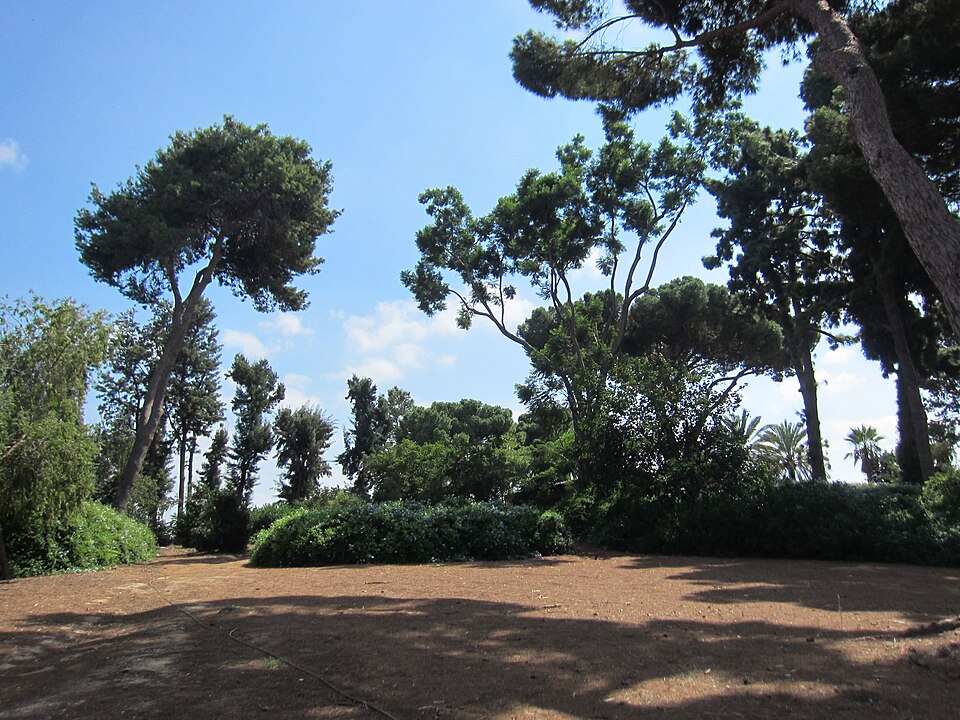
In 1943, Baron Felix de Menashe died at the age of 77. His wife Rosa died six years later. To this day, no settlement, neighborhood, or even street is named after him. The only thing bearing his name is a magical garden in northern Kfar Saba, designated as a heritage preservation site.
תגובות
עדיין אין תגובות.