
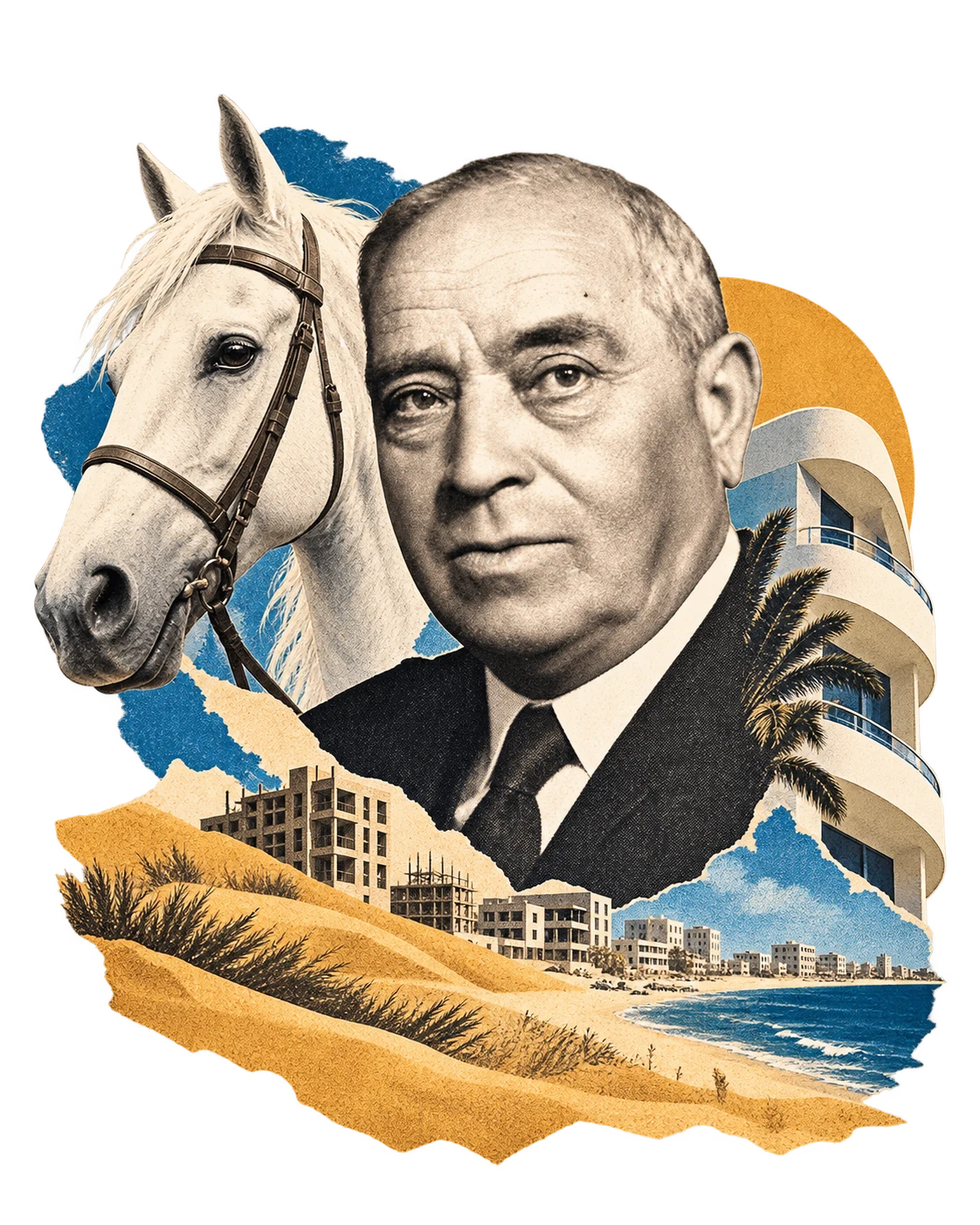
He laid the foundations of the city and earned the title "Father of the City" - this is the man whose dream came true in his lifetime.
The Vision of the Hebrew City
Meir Dizengoff was the first mayor of Tel Aviv, the first Hebrew city. In his mind's eye, he already saw the city as developed and progressive. In a newspaper interview in 1921, he said: "We are undertaking the most important experiment throughout our long exile: we want to show how we can conduct ourselves in a new, modern city that will be entirely Jewish, which we ourselves will light, protect, improve, and keep clean and healthy."
Around that time, Dizengoff established the municipal inspectorate in Tel Aviv, and it "rewarded" him with a report: "I, the undersigned, while on the seashore, saw Mr. Dizengoff enter the sea to bathe without bathing trunks. He had only a towel. I approached the sea and asked him where his bathing trunks were... The aforementioned went farther into the water, and I waited until he came out... Mr. Dizengoff replied that next time he would bring bathing trunks with him... Constable Abraham Diamant told me the same thing had happened to him with this gentleman. Please take measures against this man."
From Serbia to Ahuzat Bayit
Meir Dizengoff was born in Bessarabia (now Moldova) in 1861. He grew up in a religious home, studied in a cheder, and was educated by private tutors. In 1882, he received a draft notice from the Russian army and, unlike most Jews at the time, reported for service. He was assigned as an editor at the army newspaper.
After his military service, he moved to Odessa, where he joined the revolutionary organization Narodnaya Volya (People's Will), whose members assassinated Tsar Alexander II. When his membership in the organization was discovered in 1885, he was arrested and spent eight months in prison. His good friend Zina Brenner visited him there, brought him food, and lifted his spirits. In prison, he planned his next move, and upon his release he met with Judah Leib Pinsker and Moses Leib Lilienblum. These meetings led him to establish a branch of Hovevei Zion.
Two years after his imprisonment, he left Odessa and moved to Paris, where he studied chemical engineering. He moved to Lyon to train in the glass industry and met Baron Edmond de Rothschild, who persuaded him to immigrate to the Land of Israel and manage the bottle factory he had established at Tantura (Dor) - the first industrial plant in the Land of Israel.
In 1892, Meir Dizengoff immigrated to the Land of Israel and met again with his beautiful friend from his youth, Zina Brenner, who was 11 years his junior. They married in Alexandria, and when they returned to Tantura, Zina contracted malaria and their eldest daughter died at the age of two months. In 1894, the bottle factory closed, and the couple returned to Odessa to manage a Belgian-owned glass factory.
In Odessa, Dizengoff met Asher Zvi Ginsberg (Ahad Ha'am), Simon Dubnow, Bialik, and Druyanov (streets in the city he founded would later be named after them), and became more deeply involved in Hibbat Zion. In 1904, he initiated the establishment of the Geulah Company to purchase land in the Land of Israel. To raise money to buy the land, he sold the company's shares in Russia. Toward the end of 1905, he returned to the country as head of the Geulah Company. With the company's funds, he purchased the Jebali vineyard, where Tel Aviv's first neighborhood was established.
In 1906, Meir Dizengoff and the watchmaker Akiva Aryeh Weiss, who had conceived the idea, founded the "Jaffa House Builders' Association." The company set out to establish a modern Hebrew neighborhood outside crowded, dirty Jaffa. A lottery was held for the plots, and the 66 founders began building their homes. The neighborhood was called Ahuzat Bayit.
In 1911, Dizengoff was elected head of the neighborhood committee and remained in the position until 1921, when he was elected the first mayor of Tel Aviv.
His wife Zina accompanied him at every step: "She was like a mother to the young, emerging city, just as her husband was like a father to it. She knew how to love her people, her country, its children, and its builders with a passionate love, and above all, Tel Aviv, her beloved child. Every courtyard, every flower, and every tree was dear and precious to her," the writer David Smilansky described her.
Leading the Young Tel Aviv
Zina brought European culture to the small town of Tel Aviv. Their home became the neighborhood's center, visited by politicians and intellectuals. "Everyone came to see and be seen," Dizengoff wrote in his diary, "to tell and hear the latest news from the country and the community." Zina taught and engaged in philanthropic work, and had a special fondness for the city's children. She established a salon for the Russian elite in her home and was among those who did most to promote the French language. She spoke about the revival of Hebrew but did not have a command of the language.
In Jaffa, Dizengoff established a commercial import, export, and shipping company (M. Dizengoff & Co.) in partnership with Meir Arison (father of Ted Arison and grandfather of Shari Arison). The company still exists and today is an agent for the ZIM shipping company.
In 1910, Ahuzat Bayit was renamed Tel Aviv, after Nahum Sokolow's Hebrew translation of Herzl's book Altneuland. The name was not unfamiliar to Dizengoff: three years earlier, the Geulah Company under his management had purchased land in Ness Ziona, where it established a neighborhood and a street named Tel Aviv. At a time when the hero was the farmer from the valley, Dizengoff's hero was a member of the middle class. Dizengoff would wake early in the morning, mount his mare Meira, and set out to tour his city, observing the changes that had taken place over the past day. He would greet the residents and even lift onto his mare the children who ran toward him. At seven, he would arrive at his office to take care of administrative work, and from time to time he would ride alongside the city engineer, Yehuda Magidovitch. On one occasion, they reached the area where Atarim Square would later be built. Dizengoff dreamed of building an industrial zone there. Yehuda Magidovitch pointed out that it would be better to build hotels, restaurants, and entertainment venues near the coast, and prepare the beach for swimming, rather than establish an industrial zone. But Dizengoff replied decisively, "Jews don't like bathing in the sea."
The newspaper Doar Hayom described Meir Dizengoff's work: "Mr. Dizengoff's hands were always full of work of every kind. His small apartment was where all the activists from the cities and settlements met. Farmers, merchants, educators, cultural figures, writers, artists, and others found a sympathetic ear at the home of the alert and lively Mr. Dizengoff. Mr. Dizengoff welcomed all the members of the community warmly. In a short time, he had made friends and earned the respect of people from every circle and every walk of life. Everyone recognized that Dizengoff's 'club' was a kind of factory for creating plans and major enterprises."
During World War I, Dizengoff proved himself a true leader, not merely a mayor. In the spring of 1917, the British advanced from south to north, and the Turks feared that the residents of the Tel Aviv neighborhood might help the British against them. The Turks, under the signature of Ahmed Jamal Pasha, the military governor of the Land of Israel at the time, issued an order expelling the residents of Tel Aviv. Meir Dizengoff organized the "Migration Committee," headed it, and led the deportees to their new destination.
During the expulsion, Dizengoff traveled from Tel Aviv to Haifa and continued on to Damascus, where he established a good relationship with Ahmed Jamal Pasha, who helped him improve conditions for the deportees. Dizengoff proved himself a gifted diplomat and responsible leader, and for this he earned the title "Resh Galuta" (head of the Diaspora). During the expulsion, newspapers reported that the Turks were committing atrocities against the Jews. Dizengoff wrote: "We all went to Jerusalem. Jamal Pasha received us in his office. He took a piece of paper from his desk and said with a slight laugh: 'Our enemies, the French and the English, are looking for reasons... to undermine my honor. Have you heard the reports circulating throughout the world through the Havas Agency?' At that moment, he raised the paper in his hand and began to read it word for word: 'By order of Jamal Pasha, 100 Jews were killed in Tel Aviv, and the rest were driven out of Tel Aviv with terrible cruelty... The deportees' condition is dreadful; they are dying on the way from hunger and various diseases. Is it true that I killed even one Jew in Tel Aviv?' Jamal Pasha asked Dizengoff. 'No,' Dizengoff replied... 'Is it true that I ordered 100 people to be hanged? That is an outright lie. During all this time, I have issued death orders for only 20 people. On the day I am forced to issue a death order, I do not want to speak to or see anyone, and I do not close my eyes all night. Are the deportees from Tel Aviv being persecuted by me?' he asked Dizengoff. 'But their condition is very bad, and they are suffering,' Dizengoff replied. 'And why didn't you come to me and tell me about their situation?' he asked Dizengoff angrily. 'You know that I could punish you for this, as the mukhtar of Tel Aviv'... Dizengoff answered Jamal Pasha: 'We did not want to trouble Your Excellency, and we reported the situation to the governor.' 'The governor? Is there a governor now? You must report everything to me, and to no one else... I appoint you' - he turned to Dizengoff - 'president of the committee for the relief of the migrants. Choose two more members, one from Tel Aviv and one from Petah Tikva. I will now give you another 3,000 lira, and you' - addressing Dizengoff - 'will go there and prepare a report for me on the migrants' condition. Work must be found for those among the migrants who are able to work, and also for women and children.'"
The deportees did indeed suffer from hunger and disease, and some of them died and were buried in the cemeteries of Kinneret, Kfar Saba, and Petah Tikva. Toward the end of 1918, about a year and a half after the expulsion and after the British had already conquered the north of the country, the residents returned to their homes. Dizengoff returned to Tel Aviv and was reelected chairman of the committee.
As part of his work, Dizengoff also took care of public relations and promoting Tel Aviv. At the end of 1918, when the British under General Allenby defeated the Turks, Dizengoff decided to invite the general to visit his city. At the time, a new neighborhood was beginning to take shape, and its main street was called "Sea Street." Dizengoff proposed that, in recognition of the general who had conquered the country from the Turks, the street be named after him. Allenby was invited to an impressive ceremony, where Dizengoff addressed him: "Your Excellency! Out of deep feelings of recognition and gratitude to the liberator of the country, the residents of Tel Aviv have decided to name this street, the largest street in our neighborhood, after General Allenby, and this name will forever remind us of the change that has taken place in the country." At the time, the "largest street" was the only street, and there were only two houses.
His Final Years and Legacy
There are several versions of the following story. One appears in Yonatan Shlonsky's book Ararat: During the Purim celebrations of 1924, Mr. Dizengoff rode his mare at the head of the Purim parade, the Adloyada. On the way, he felt slightly dizzy, decided to stop by his home, and hurried to the bedroom. To his surprise, he found the bedroom door locked. With a little determination, he opened it and was astonished to find his wife Zina there with a strange man. Dizengoff was stunned to discover that the man was none other than the writer Asher Zvi Ginsberg (Ahad Ha'am). The story leaked, and in a nearby cafe a humorous song about the incident was written, with each person contributing a line. Dizengoff reprimanded Ahad Ha'am and even stopped speaking to him.
Another version appears in Professor Joseph Klausner's book My Path Toward Revival and Redemption: "Few know that in his thirties and forties Ahad Ha'am loved the beautiful Zina Dizengoff, wife of Meir Dizengoff, mayor of Tel Aviv, with a love that was tender, modest, and noble, though he never revealed his love to her or to anyone else. Meir Dizengoff unjustly took issue with this, and once hinted at it to Ahad Ha'am in less than delicate terms. As a result, they stopped speaking to one another for several years. Eventually, Dizengoff recognized his mistake, and toward the end of their lives they reconciled and became friends again."
Among his many other roles, Dizengoff served as Belgium's consul. In that capacity, he hosted King Albert I of Belgium in Tel Aviv in 1933 and named King Albert Square after him.
Dizengoff believed that "anyone who wants to lead a community must first love that community with all his heart." He also used to say of the city's residents that "Tel Aviv's popularity has various causes, and one of them is the energy and daring of its people. It takes daring to dare, and Tel Aviv has the daring to dare."
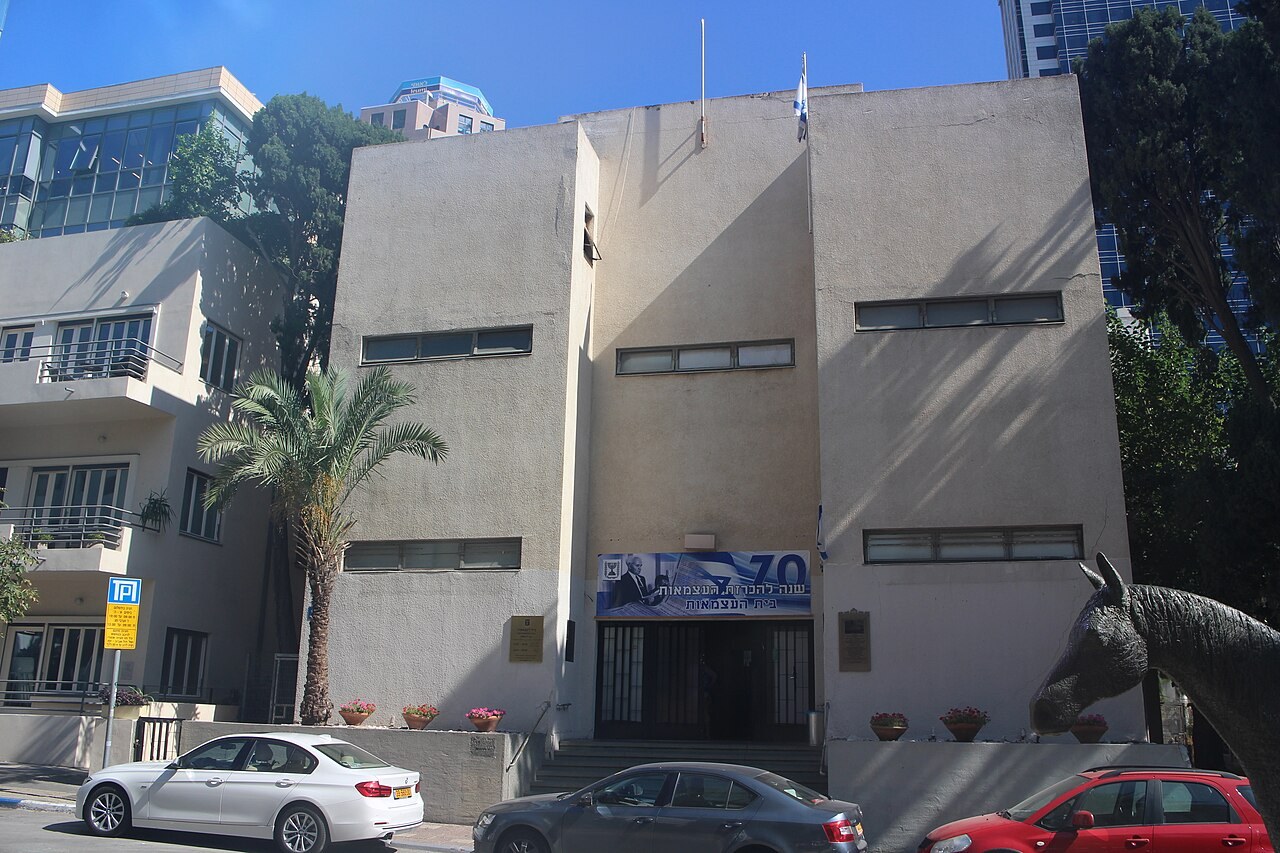
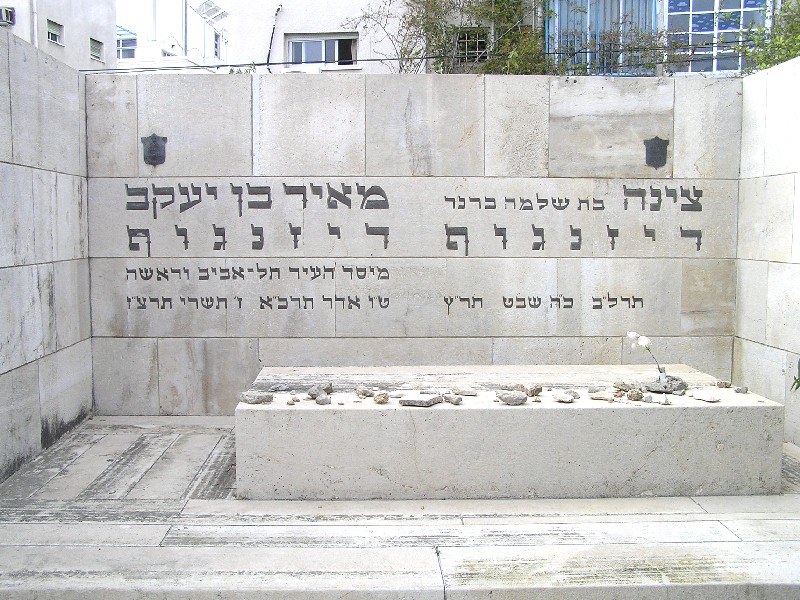
During his lifetime, Meir Dizengoff bequeathed his home to the Tel Aviv Museum of Art. On May 14, 1948, Ben-Gurion declared the establishment of the state in that house. While still alive, Dizengoff had the honor of cutting the ribbon on the street named after him, a street leading to Tel Aviv's first square, named after his wife, Zina Square. Zina died of a serious illness in 1930, and Meir Dizengoff died six years later. The entire community in the country mourned him, and the municipal council declared three days of mourning.
תגובות
עדיין אין תגובות.