
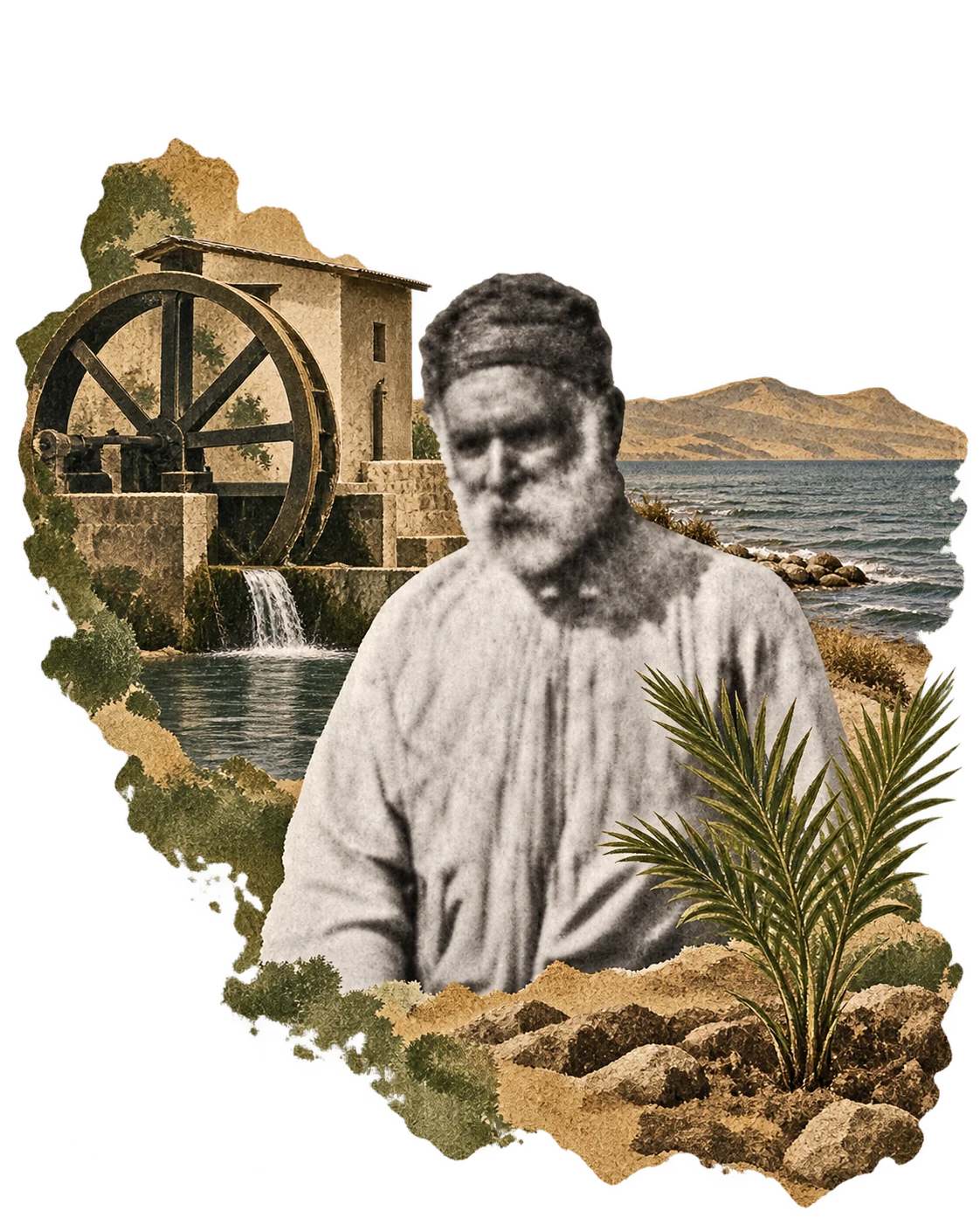
He led a small group of 45 Jews who left their homes in southern Yemen in 1909 and, after a long and exhausting journey, arrived at the Sea of Galilee. Forgotten pioneers who established a settlement that lasted 18 years.
Rabbi David ben Israel Tzairei The sight in the summer of 1930 was heartbreaking. A small group of exhausted, broken, impoverished Yemenites said goodbye to their dead in the cemetery on the shore of the Sea of Galilee. After the Kaddish prayer, they looked at the Motor House and their ramshackle dwellings, teetering on the verge of collapse, then climbed onto the trucks that took them to the village of Marmorek, near Rehovot. Thus came to an end eighteen years of pioneering settlement, later known as the 'Yemenites of Kinneret'.
The Battle over the Memorial Plaque
In the summer of 1994, 64 years after the settlement was abandoned, Supreme Court President Justice Meir Shamgar ruled that the descendants of the 'Yemenites of Kinneret' could not compel members of Kibbutz Kinneret to restore the memorial plaque commemorating the Yemenites' work to its place beside the Motor House. At the same time, Justice Shamgar noted: "At the margins of this matter, we wish to add that this litigation, which in our view is entirely unnecessary, could be avoided if the petitioners' request were granted and the aforementioned memorial plaque were installed on the outer wall of the Motor House... if the first respondent were to show goodwill, taking into account the petitioners' strong desire to commemorate their fathers' pioneering work."
This was not the first case of a settlement being evacuated, nor was it the first time settlers were moved from one place to another. Other groups were also relocated from the area where the 'Yemenites of Kinneret' lived during those same 18 years, but the case of the 'Yemenites of Kinneret' has remained the most painful, both for the Yemenites' descendants and for the descendants of Kibbutz Kinneret, to this day.
At that time, the Shar'ab district in southern Yemen was home to the largest number of Jews, who were spread across more than 130 settlements. The Jews were known for their simple way of life; they devoted much time to the Zohar and Kabbalah and to accounts of miracles, and many of them were Torah scholars. It is well known that yearning and longing for the Land of Israel were part of the lives of Yemenite Jews from the day they were born. Rabbi Shalom Shabazi, Rabbi Shalom Sharabi, Rabbi Mordechai Sharabi, and others also lived, studied, and dreamed in this district.
When Yaakov Sapir (for whom the settlement of Even Sapir near Jerusalem is named) returned from one of his journeys, he told of a miracle that Rabbi Shalom Shabazi experienced regularly: "Every Friday evening, he was miraculously transported to the Land of Israel to spend the Sabbath there, sometimes in Jerusalem, sometimes in Tiberias, sometimes in Acre or Hebron, and after the Sabbath ended he returned to his own land."
From Yemen to the Kinneret Farm
In 1909, under the leadership of Rabbi David Israel Tzairei, known as Al-Sharia (Arabic for 'the judge'), who was then 46, several families from the village of Shu'uba in the Shar'ab district decided to immigrate to the Land of Israel. One of the immigrants described their reasons for making aliyah this way: "It was not because of a king's decree, nor because of a lack of livelihood, nor for any of the reasons that cause people to wander from one country to another, but out of an overwhelming desire and love to go up to the Land of Israel." Before leaving, the immigrants explained their reasons to their Arab neighbors: "My friend, this is your land, yours and your fathers', but it is not mine; my land is the Land of Israel, far away in Palestine, where the land is mine and my fathers'." For three arduous weeks, the families walked to the capital, Aden, sometimes coming under attack from bandits. From the port of Aden they sailed to Jaffa and from there to Haifa, then began working for the farmers of Hadera. In 1912, a representative of the Hashomer association arrived and offered them work at Kinneret Farm.
Before them, the 'Yahad Trio' had lived in the Motor House. That was the name given to Benzion Israeli, Noah Naftolsky, and Meir Rotberg, members of the Second Aliyah and part of the 5,000 young revolutionaries determined to redeem the land through self-labor, equality, brotherhood, and the refusal to employ Arab workers. They arrived as secular individuals who did not spare criticism of the religious immigrants of the First Aliyah, who had families. They worked in the settlements of Judea to realize their vision and preached their principles to everyone. In 1909, Benzion Israeli and Meir Rotberg arrived at Kinneret Farm, which had been established a year earlier. In 1910, the Motor House was built at the outlet of the Sea of Galilee, and the 'Yahad Trio' dispersed after an argument with Berman, the farm manager. Later, Benzion Israeli returned and led the settlement of Kibbutz Kinneret.
In 1912, the Yemenites left Hadera and made their way to Kinneret after being promised that they would find a livelihood and better housing there. Some of the families stopped in Yavne'el, while 14 families continued to Kinneret and settled in the Motor House, which was actually one large room and two small auxiliary rooms. After several years of living in cramped conditions, they built five miserable mud huts. Shmuel Dayan, father of Moshe Dayan, who lived in Degania Alef, wrote of these homes: "The Yemenites' bare wooden houses protest silently. They cry out and, in their silence, demand justice from us all; we are indebted to them!... They are lonely and barren among the creators. They dug the land just as we all did, with toil and sweat, and they surpassed everyone in their sacrifices. Their suffering is greater than that of everyone else, while they enjoy less than all the people living here. The oppressed and downtrodden of this place."
Two years after they settled on the land, World War I broke out, and the Yemenites' situation continued to deteriorate. In 1917, malaria struck them, and many died. Dr. Feigenbaum, one of the first doctors, was worried about their condition and concluded that "the Yemenites now living beside the aforementioned Kinneret swamp must be removed entirely from the Jordan Valley and transferred elsewhere... 94% of them have enlarged spleens." That same year, Berl Katznelson also wrote: "The Yemenite community is dwindling away. There is no way to save those still alive other than to move them to a more favorable climate. At first the Yemenites did not want to listen to such advice, but the deaths of recent weeks changed their minds as well. Now they agree to leave the place. They want to go to Petah Tikva."
While the settlement institutions were slow to find land and funding for their relocation, the Yemenites continued their daily struggle. Every morning they rose for prayers and afterward planted eucalyptus trees, cleared stones from the land, uprooted stubborn jujube trees, paved roads, and worked at the Naharaim power plant.
"Gentlemen, our hearts are like fire. For two years we worked the land at Kinneret with our own hands and endured hardship. We endured reproaches, and some of us died. We have grown attached to the land because we cleared its stones, uprooted the jujube trees, planted eucalyptus trees there, and watered them with water cans on our shoulders. We endured its hardships, and should we not now enjoy its benefits? And why do our Ashkenazi brothers want to move us from there?" This is what Yosef ben Israel Tzairei said in his speech before the Galilee Workers' Council.
The Pleas to Leave Kinneret
By 1923, the situation had become desperate, and Rabbi David ben Israel Tzairei appealed to the Zionist Executive: "Please allow me to describe my situation as it is. It has been eleven years since I left my native Yemen and came to the Land of Israel. Here I live in the water-pumping station beside the settlement of Kinneret, and I suffer greatly here. All my donkeys were stolen by thieves who broke into the house, and I cannot raise poultry either, because the foxes eat them; at night I cannot sleep, because the sound of the machine keeps me awake. I am also periodically afflicted with malaria. This is my miserable situation here in this ruined house. My daughter fell from the ladder in this house and died. For it is a ruin, and no one can live in a ruin. Since the Zionist Executive is always in need of the Yemenites' help, I therefore ask you to come to my aid and redeem me from this ruin, which has brought me to despair, and help me settle in a Jewish settlement, in a house fit to live in. I hope that my request will find an echo in your hearts."
The land was too small to accommodate both Kibbutz Kinneret and the Yemenites. Two years later, the Zionist leader and writer Moshe Smilansky wrote: "There is a dispute between this wretched neighborhood (the Yemenite neighborhood), on the one hand, and Kinneret Hill and the 'Department', on the other. The neighborhood has been settled for 15 years on 80 dunams of land, all of which can be irrigated. The group (Kibbutz Kinneret) wants this land because it needs it like air to breathe. The 'Department' agrees with the group that the neighborhood should be moved elsewhere. And the neighborhood, naturally, does not agree. 'Objectively', the group and the 'Department' are in the right. All of Kinneret's land is too small to accommodate 20 families... Today, everyone is hungry together, not only for land but for bread as well. Even the members of the group lack clothing. The Yemenite neighborhood has no right to exist in this place, economically, hygienically, or socially. The lack of a minyan is crushing the Yemenites into the dust."
Years later, Yosef Margalit, son of Rabbi David ben Israel, wrote: "In fact, we did not want to move. For a long time they wanted us to move, and we did not want to. The only thing that made us move was the lack of a minyan at the synagogue. Father said: 'In Yemen, I was not in exile. Exile is in the Land of Israel. If I cannot pray on the Sabbath, that is exile; I cannot stay here.'"
Professor Yehuda Nini, from a religious Yemenite family in Tirat Shalom, near Ness Ziona, recounted the story of the 'Yemenites of Kinneret' in his moving book 'Were You There, or Did I Dream a Dream'. To prevent these events from being judged by the standards in use today, he wrote at the very beginning: "The subject before us is not 'ethnic' in the sense commonly understood today. None of the people of Kinneret, including Benzion Israeli, was tainted by discriminatory tendencies on the basis of ethnicity or origin... And yet, although I understand these 'difficult' people, difficult with themselves and difficult with others, like all idealists, their truth was beyond reproach. Could one imagine any other possibility in the world of idealists? Benzion Israeli is the hero of this book. The 'impatient' reader may think he was 'to blame' for what happened to the Yemenites of Kinneret, but that is not the case. Benzion should be seen as the representative of the collective that lived and worked at Kinneret Farm, which later became Kibbutz Kinneret." It should be noted here that although Benzion Israeli, on the one hand, pressed for their relocation, he was also the one who removed the mounds of stones from their graves and replaced them with dignified headstones.
Contrary to what one might conclude, relations between the Yemenites and the settlers were good. The poet Rachel dedicated her poem 'Hebrew Woman' to them (although the poem is often mistakenly attributed to the poet Yokheved Bat-Miriam). It was the Yemenite women who cared for the labor movement's leader A. D. Gordon, who appreciated them for observing the Sabbath. There was also a close friendship between the Yemenites and Abraham Herzfeld, one of the pioneers of the Second Aliyah, and some say that it was Yosef Trumpeldor who picked up one of the dreamy Yemenite girls who had been left behind in the field and took her on his horse.
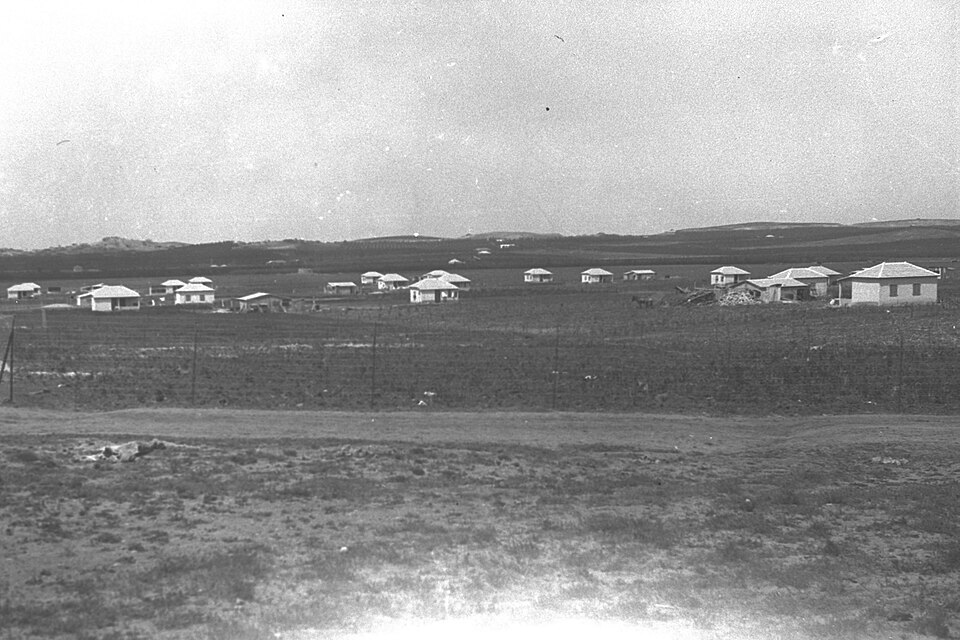
In 1928, the families left Kinneret and moved to Rehovot, where they established the first Yemenite moshav, Marmorek (today a neighborhood within Rehovot), and named its main street 'Kinneret'. The first three girls born in the moshav were named Kinneret. The homes of the 'Kinneret people', as they were called, are easy to recognize: date palms brought from Kinneret were planted in their yards. David Margalit, grandson of Rabbi Tzairei, said: "Before he died, Father asked me and my two brothers to place basalt stones from the Kinneret area on his grave, and that is what we did. He and Mother are buried in Marmorek, but two large basalt stones stand on their graves." And so their descendants continued to carry the Sea of Galilee in their hearts. Once a year, they visit their family members' graves in the Kinneret cemetery. Photograph of the Tzairei girls, with the Motor House in the background




תגובות
עדיין אין תגובות.