
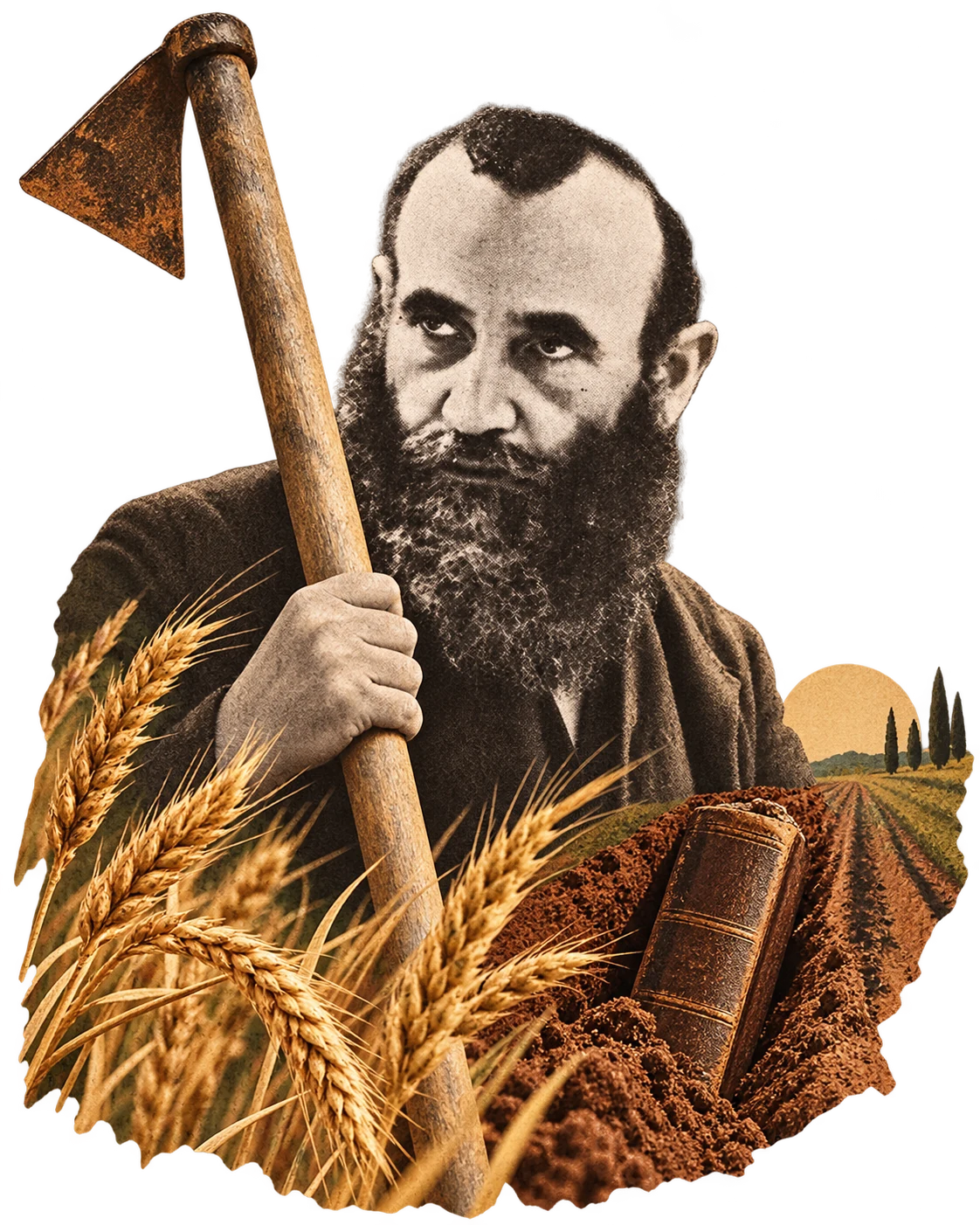
As a Hasid, he was an unusual figure. He brought pioneering ideals into Hasidism, believed in coexistence with the Arabs, helped shape the idea of Torah and labor, and was known as the "Pioneer Rebbe."
Between the Land of Israel and Poland
In March 1914, Rabbi Isaiah Shapira, then 23, felt that his lifelong dream was about to come true. When the shores of the Land of Israel appeared on the horizon, his heart began to pound and he could hardly hold back his tears. After arriving, he became close to Rabbi Kook, then chief rabbi of Jaffa, first as his student and later as a close friend. In time, he put some of Rabbi Kook's teachings and thought into writing. But just as it seemed he had finally reached a place of rest and security, events began to take a new turn.
In June 1914, Franz Ferdinand, heir to the Austro-Hungarian throne, was assassinated, an event that led to the outbreak of World War I. International relations between the countries grew increasingly complicated, and Rabbi Isaiah did not want to take any chances, so he returned to Poland to be with his family.
He made use of the stay in Poland, which had been forced upon him, to establish the Mizrachi movement in his country. He delivered passionate speeches in Hebrew about the need to make settlement in the Land of Israel a central goal, and to prepare for it by readying one's mind and heart for immigration, taking part in building the country, and shaping it in the spirit of Jewish tradition. "We want a life of labor and creativity founded on traditional Judaism. We cannot concern ourselves only with spirituality and confine ourselves to the four cubits of halakha alone... We want a Judaism of Torah and labor... We aspire to return to the ancient Hebrew way of life, to the original biblical Judaism founded on justice, integrity, and morality," he wrote in the founders' call to action.
In 1920, Rabbi Isaiah Shapira immigrated to the Land of Israel, despite his wife's opposition (she joined him only four years later). He lived in Jerusalem, the city he had dreamed of: "As I walk through Jerusalem's busy, bustling streets, filled with the noise of the city, my soul sometimes overflows with longing for that ancient Jerusalem, steeped in the holiness of generations and woven into the texture of my life from the earliest dawn of my childhood." Standing before the Western Wall, he said: "This is the nation's last desperate cry before it is driven from the home of its life, rising up to me from beneath a pile of sighs, accumulated here over thousands of years."
In Jerusalem, he worked in the two fields that mattered most to him: immigration and labor. He was appointed director of the Mizrachi's immigration department and employment office in Jerusalem. He helped young people find agricultural work and a plot of land in the country. He organized 120 religious workers who took part in paving the Rosh Pina-Tabgha road, and, together with a group of 50 workers, cleared Solomon's Pools, removed rubbish, and cleared stones from the land. The first cell of Hapoel Hamizrachi was founded in his home, with an emphasis on the worker. This was how he began traveling around the country, Bible in hand: "When I set out to wander through our land, it seems to me that I have broken through the barriers of time and am sailing through eternal life... The past and the present are interwoven so closely that it is hard to tell them apart... On every stone and every mountain ridge lies a genealogical record stretching back thousands of years."
When he reached Samaria, he wrote: "As we gaze upon the beautiful landscape around us, several verses in the Bible that had until now been unclear become clear to us... It is as if Isaiah's words have come to life before us: 'Woe to the crown of pride of Ephraim's drunkards, and to the fading flower of its glorious beauty, which is on the head of the fertile valley, of those overcome by wine.' Here, these words need no interpretation. They are carved into reality, into nature, into the beauty of the surrounding landscape." Elsewhere he wrote: "As I descended Mount Scopus on my way to Jerusalem, it seemed to me that a living Bible and a living Talmud were spread across the whole world here. Every bush, every plant and thorn I came across at every step seemed to me like living verses from the Bible and the Talmud, and I felt that gates had opened before me to a new world, until now closed and barred: the world of plants." On the way to Bethlehem, he was overcome with sadness: "We are passing through the fields of Bethlehem. The sweet sounds of Ruth... Today everything is foreign. There is no trace of Ephrathite Judah, its elders and its harvesters. The birthplace of King David is entirely Christian..." After visiting the power station at Naharayim, he was moved by the country's future and wrote: "Here will be the center for energy and light for all the Land of Israel."
Family Roots and the Dream of Aliyah
Isaiah Shapira was born in Poland in 1891 to a distinguished family of rabbis and rebbes. Some claim that on his father's side, through his father, Rabbi Elimelech of Grodzisk, the family line reaches back to King David. Isaiah was the youngest child, and his mother was the second woman his father married, after all his sons from his first wife had died. His brother, Rabbi Kalonymus Kalmish, the Piaseczno Rebbe, was born to this wife. When Isaiah was one year old, his father died, and his maternal grandfather took responsibility for his upbringing. He taught him Torah, as well as poetry and violin. He inherited his modesty from his grandfather, who instilled in him a love of the Land of Israel and taught him manual labor as part of his preparation to immigrate there and work the land. From a young age, he was surrounded by admirers who saw him as his father's heir.
As an adult, he married Haya Sara, daughter of Rabbi Nathan ha-Kohen Rabinowitz, the Rebbe of Krimilov, and the newlyweds moved into her parents' home. When he received his rabbinical title, he was offered the position of rabbi of the Mokotow community, near Warsaw. But Isaiah turned down the offer and refused to become a rebbe, since he dreamed of immigrating to the Land of Israel, a dream that came true in 1920.
Settlement, Education and Peace
Rabbi Isaiah Shapira organized the settlement at Kfar Uriah and a group to grow tobacco on Mount Canaan, near Safed. Wherever he went, he inspired a fresh and passionate spirit of action to hasten the coming of the Messiah, accompanying it all with Hasidic songs and melodies. He saw hardships as minor birth pangs of the promising future of the Land of Israel and its builders. From time to time, he traveled to Europe, appearing in Hasidic courts and encouraging immigration to the Land of Israel. Following one of his trips in 1923 to encourage immigration, two groups organized and immigrated a year later. One, led by the Yablona Rebbe, founded Nahalat Yaakov, which purchased land near Sheikh Abreik (today Beit She'arim). The other, led by the grandson of the Kozhnitz Rebbe, established the Hevrat Avodat Yisrael company and settled on the banks of the Kishon. Shapira helped them purchase the land, but when both groups failed, he brought them together into a single group that established Kfar Hasidim. Later, another group immigrated with his encouragement and laid the foundations for the settlement of Kfar Ata. To this day, the village has a synagogue in his memory, and a memorial plaque recognizes him as the founder of Kfar Ata. All these settlements were agricultural, combining Torah and work on the land in accordance with Rabbi Shapira's teachings.
In 1926, his wife Haya Sara died, and he married Tova, daughter of Rabbi Israel Friedman, the Boyan Rebbe.
Rabbi Shapira was deeply concerned about education. He believed that the right approach was "a blending of these two forms of education," as he wrote. He meant religious education in its old form and modern education, in contrast to the way he himself had been educated and to the approach of his brother, Rabbi Kalonymus Kalmish, who had established a large yeshiva in Warsaw.
Shapira believed that "a child does not want to be constantly under the supervision of parents and teachers. He longs for an hour of freedom... to spend with friends..." and proposed a suitable framework: "Only a religious youth movement can succeed in this." He therefore supported the Bnei Akiva movement, which adopted his teachings. He was sharply critical of the Chief Rabbinate, which his teacher and friend Rabbi Kook had helped establish: "The rabbinate in the Land of Israel today is not fulfilling its role... It is detached from life in the Land of Israel; it does not guide that life... There is no doubt that the rabbinate is to blame for this."
He was concerned by the fervor to complete the work of settlement as quickly as possible, and wrote explicitly about it: "It may be that our generation is the generation of the wilderness, but it is not our task to complete the work. We were not contracted to build the national home in our own day. Perhaps all we will do is lay the foundations." In his view, the foundations included the vital work of the Jewish National Fund in redeeming the land. He saw the Arab neighbors as brothers with whom peace had to be achieved: "We will become a majority in the country, and then peace will be established with the Arabs and we will reach an agreement. We will have something to offer them, and concessions to make to them." He was unafraid to be bold and joined the left, believing it was the right path.
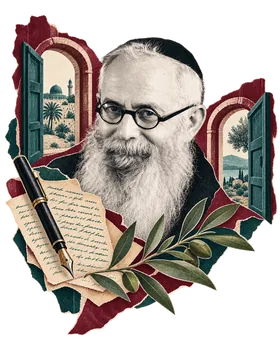
In 1926, the British, who then ruled the country, decided to reorganize the security forces and remove the Jews from them. The disbanding of the Jewish Legion thwarted Ze'ev Jabotinsky's vision of establishing an official Hebrew army, prompting Revisionist Zionists to launch a campaign for the establishment of a fighting Jewish battalion. A year earlier, the Brit Shalom movement had been founded. It comprised a group of Jewish intellectuals who advocated full equal rights for the two peoples living in the country, Arabs and Jews, and condemned the Revisionists' activities. They published a statement drafted by Gershom Scholem, one of the foremost scholars of Kabbalah, and signed by six members of the movement: the Reform Rabbi Judah Leib Magnes, the first president of the Hebrew University of Jerusalem; journalist Yehoshua Radler-Feldman; philosopher Samuel Hugo Bergmann; Hans Kohn, a scholar of nationalism; poet and writer Mordechai Avi-Shaul; and Rabbi Isaiah Shapira. "With deep sorrow, we see governments and peoples continuing to prefer security through weapons over security achieved by creating relations of justice and friendship... We believe that armament and feelings of distrust and fear not only fail to protect us from wars, but bring them about. In keeping with the aspirations of the prophets of Israel, we are convinced that all our aims must be directed toward uprooting from within us the military spirit and the delusions built on ideas of heroism and national honor," they wrote in the statement.
This statement was met with strong opposition among broad circles in the country. One of its opponents was Dr. Eliezer Lubrani (a doctor of philosophy and a member of the Haganah), who responded: "... None of us would doubt for a moment the good intentions of those behind the wonderful 'statement,' but in practice, this statement too is nothing but a grotesque." He concluded: "And you, authors of the 'statement,' go back - in the name of the living God - to your lecture halls, your laboratories, your books, and your songs, where the world is seven times more beautiful and seventy-seven times purer. Why concern yourselves with the questions of the day when the eternal questions lie before you? And please, let the Jewish community in the country make its voice heard, at least once, for an abyss of books and dreams separates our lives from your fantasies."
Rabbi Shapira did not leave this unanswered. He wrote a reasoned statement clarifying his position: "The statement against the campaign to establish a Jewish battalion aroused opposition in various circles..." He went on to note that establishing such a battalion "would not only fail to bring peace, but would disrupt it. It would help stir national feelings in both camps, widen the rifts, and increase the hatred... And finally: do not belittle too much the prophets of Israel's mission of peace. We are returning to our homeland in the name of justice, and it is for its sake that we want to build our home here. We want to purify ourselves of all the filth of exile and all its afflictions, and create here a better way of life, founded on integrity, truth, and peace. Let us not bring a sword down upon the sanctuary of our life as it is being built."
Banking, Agriculture and Legacy
Rabbi Isaiah Shapira understood that economic stability was the foundation for settlement in the country, and therefore studied economics and credit needs in depth, and also wrote articles on the subject. In 1932, he was appointed director of Zarubavel Bank and was very successful, while continuing to study Torah and work toward settlement in the Land of Israel.
Throughout all those years, he never let go of his dream of working the land in the Land of Israel. In the winter of 1942, after completing his role at the bank, he settled in Kfar Pines and, at the age of 50, became a farmer. He did not abandon his Torah studies, and continued to pursue music as well, composing 36 Hasidic and pioneering melodies for festivals and prayer.
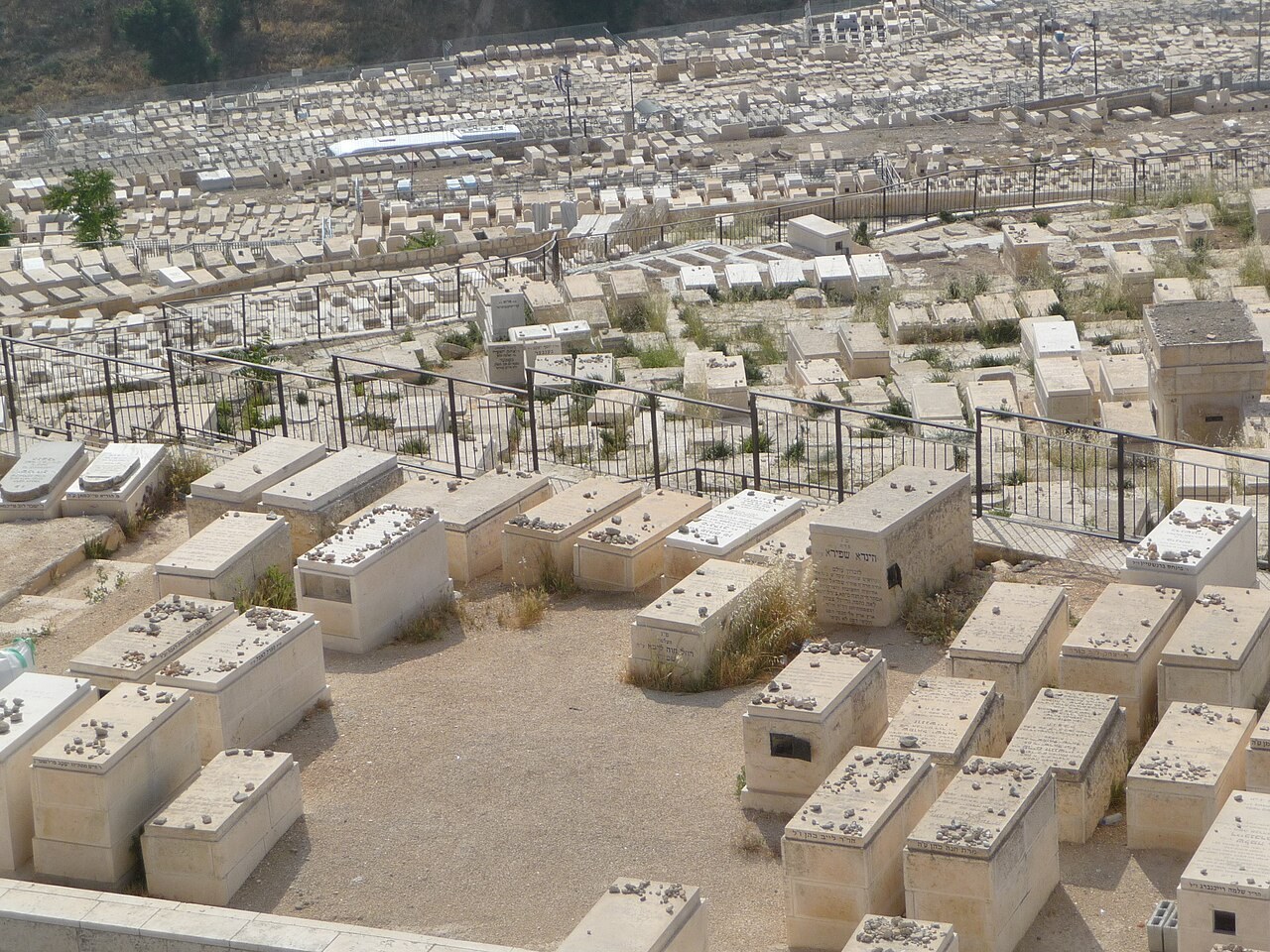
When news of the Nazi killing machine reached the country and he learned that many members of his family and of the communities he had known had been murdered, he collapsed. He returned to Jerusalem to rest at the home of his brother-in-law, Rabbi Hanokh Bornstein, in the Beit Vegan neighborhood. But on the eve of Shavuot in 1945, he died at the age of 54 and was laid to rest on the Mount of Olives.
Quite a few institutions bear his name: the synagogue in Kfar Pines, Beit Isaiah on Chlenov Street in Tel Aviv, the synagogue in Kiryat Ata, and a street in Bnei Brak. Rabbi Isaiah Shapira was a man unafraid of boldness and originality, even when they did not fit the expectations of those around him. After his death, he became known as the "Pioneer Rebbe."

תגובות
עדיין אין תגובות.