
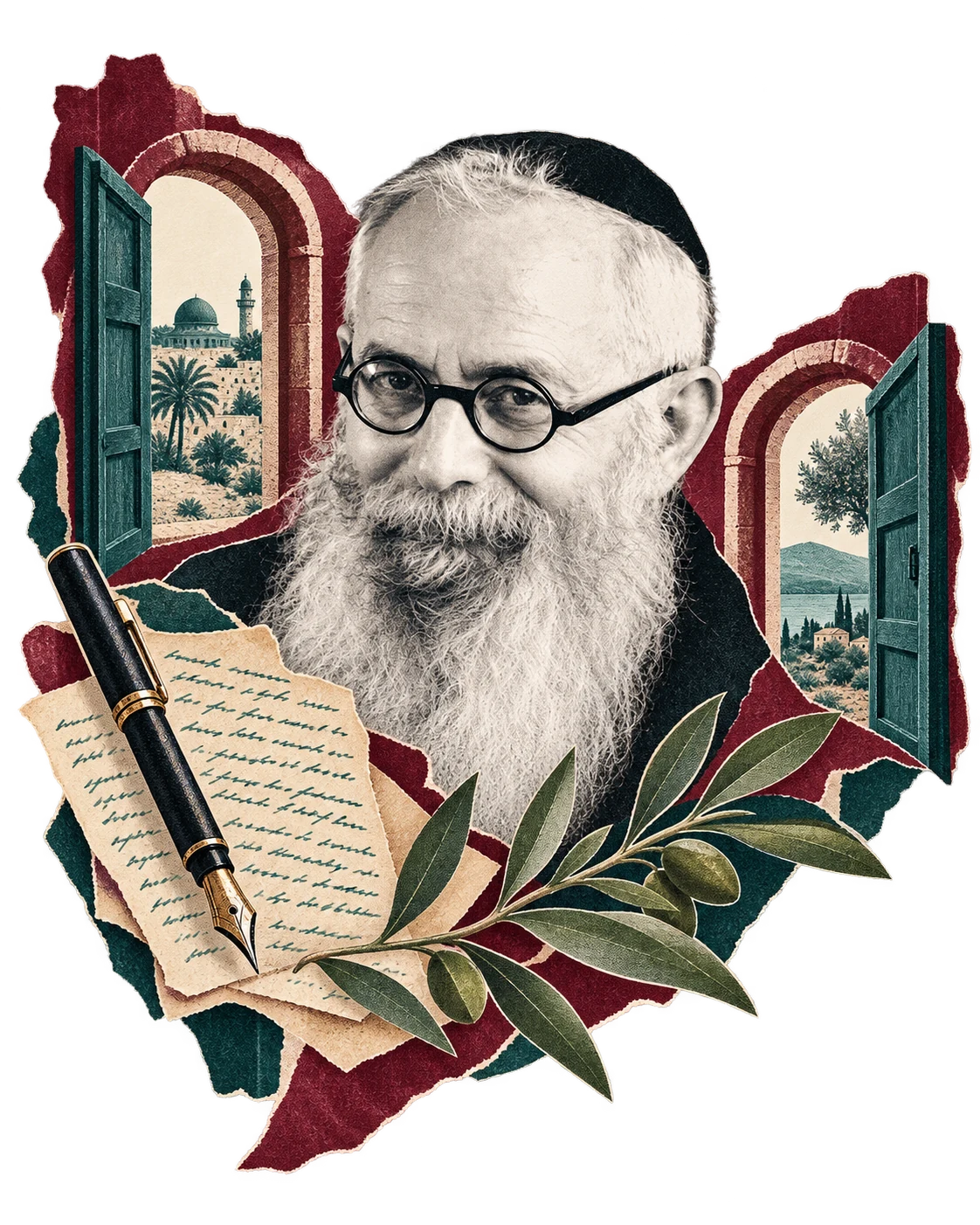
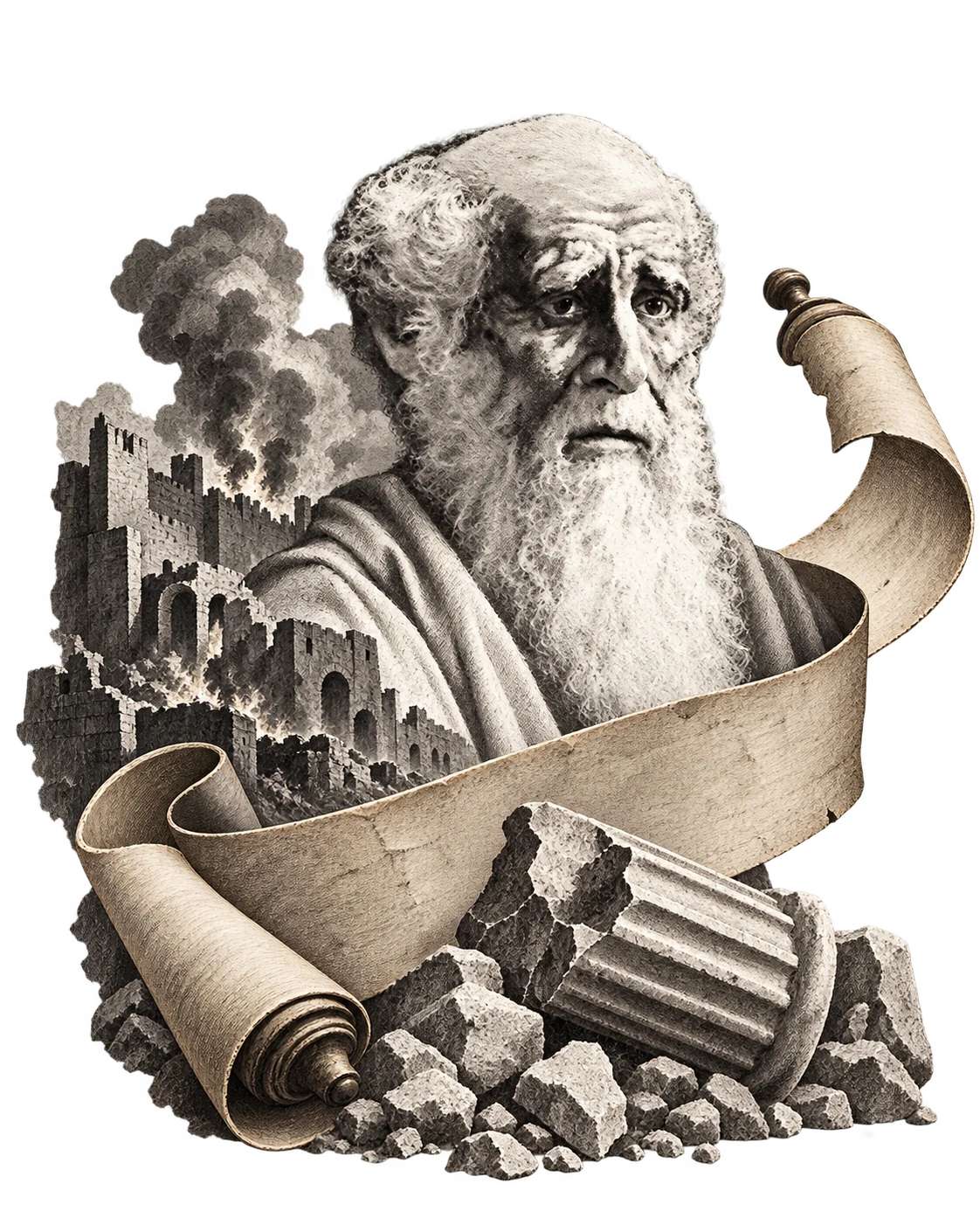
He was a distinctive and complex figure. An observant Jew and one of the founders of HaTzofeh, yet also active in Brit Shalom, which believed in coexistence. A passionate Zionist, yet also a fierce critic of Zionist policy. A feminist, vegetarian, humanist, and pacifist, yet also a patriot and builder of the land.
A Vision of Jewish-Arab Partnership
"Love the inhabitant of the land, for he is your brother, your own flesh and blood; do not turn a blind eye to him. Do not ignore your own flesh... And like finds like, and the two shall become one kind" - so wrote a 27-year-old in 1907, before he had even immigrated to the Land of Israel. He not only called on Jews to welcome the Arabs, but even suggested that Jews and Arabs marry one another. This was Yehoshua Radler-Feldman, known as Rabbi Benjamin, whose life story began with a rare feminist decision: he chose to add his mother's surname, Feldman, to his own surname, Radler. A rare and revolutionary act in the 19th century.
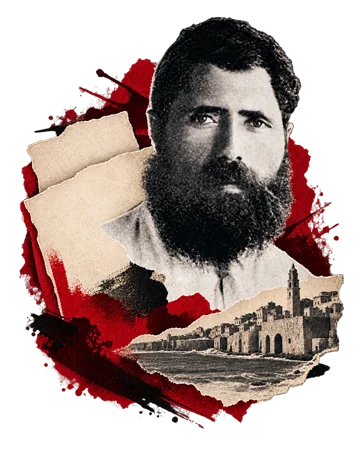
In 1921, during the Jaffa riots, his close friend Y.H. Brenner was murdered, and Rabbi Benjamin carried his coffin. The two had founded the legendary journal HaMe'orer in London and written most of the first issues themselves. To conceal this fact, they adopted pen names: Brenner was called Bar Yochai, while Radler-Feldman chose the name Rabbi Benjamin. The name stuck with him for the rest of his life. This is how he explained his choice: "It recalled the name of my grandfather, Rabbi Bunim, of blessed memory, who was dear to me (a family allusion). It recalled Benjamin the traveling wanderer (an allusion to my circumstances). Above all, it recalled Rabbi Benjamin in Mendele's wonderful story 'Lo Nahat B'Yaakov,' a character I was fond of in those years (a literary allusion)." S.Y. Agnon praised him for it: "It is customary among writers to take pride in their foreign titles: a professor makes much of his professorship, and a doctor makes his articles sound doctorly. But we have never known a writer to call himself by the title used by his fellow Jews for a worthy Jew. Until Rabbi Benjamin came along and called himself Rabbi Benjamin." In 1907, Rabbi Benjamin published the essay 'The Burden of Arabia,' which expressed the pan-Semitic vision he held throughout his life. When he wrote it, he was organizing agricultural training in Romania and had not yet immigrated to the Land of Israel. Rabbi Benjamin was a rabbi, and of course he knew the prohibitions in Deuteronomy: the peoples whom it was forbidden to marry (the Hittites, Girgashites, Amorites, Canaanites, Perizzites, Hivites, and Jebusites), and the severe prohibition against Ammonites and Moabites entering the congregation of the Lord. But he also knew the reality of the Bible itself: the Messiah for whom we hope, descended from the house of David, is the product of intermarriage - and not just any intermarriage, but marriage with three of the peoples whom it was forbidden to marry.
At first, Brenner opposed publishing the essay in the journal, arguing that Rabbi Benjamin did not understand that the Arabs were our enemies. Despite this, Rabbi Benjamin remained faithful to this vision until his dying day.
Zboriv, Berlin and London
Yehoshua Radler-Feldman was born on May 23, 1880, in Zboriv, Galicia, under the rule of the Austro-Hungarian Empire of Emperor Franz Joseph. In his memoir, 'From Zboriv to Kinneret,' he painted a nostalgic picture: "The days of Franz Joseph, Wilhelm, and Nicholas. Days of happiness and prosperity, days of tranquility and security." He described a world where "all is quiet around us. There is no revolt, no revolution, no uprising. The world has a fixed order, and each person has his place, his status, and his surroundings... There is no internal discord and no external conflict." His childhood in the multinational empire shaped his liberal and multicultural outlook.
In 1901, at the age of 21, he went to Berlin to study agriculture at the Agricultural College, alongside figures who would later become leading members of the Yishuv, such as Professor Volcani. At the same time, he joined the city's Zionist group, and in 1902 published his first essay, 'Fragmentary Notes,' about the great debate between Herzl and Ahad Ha'am. Herzl supported the immediate establishment of a Jewish state, anywhere at all, while Ahad Ha'am believed that establishing a political state before building a cultural foundation would leave it rootless. Together with his friends Lin and Gontzer, Rabbi Benjamin founded HaKeshet, the first illustrated monthly in Hebrew.
In 1906, after completing his studies, he moved to London. At a party in the city, he met Y.H. Brenner, who burst into the hall with a group of revolutionaries from Poale Zion. Shortly afterward, the two founded the journal HaMe'orer.
It is difficult to overstate the importance of HaMe'orer. It was a new literary journal in Hebrew, at a time when other Hebrew journals, such as HaShiloah, had been shut down by Russian censorship in the wake of the first revolution. HaMe'orer carried the banner of the Hebrew language in its hour of need. Its influence on readers was remarkable; one could even say that everyone who got hold of the journal became a writer or aspired to be one. Indeed, the journal achieved its goal, stirring people to thought and creativity. For two years, HaMe'orer was the only journal being published, serving as a counterweight to European culture.
Aliyah and Kinneret
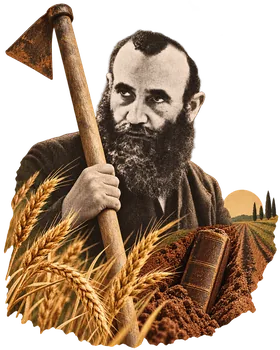
In 1907, Rabbi Benjamin immigrated to the Land of Israel as part of the Second Aliyah and began working as an agricultural laborer in Petah Tikva. He was appointed the first secretary of the Herzliya Hebrew Gymnasium in Tel Aviv. When he resigned, the agronomist Berman came to him and offered him a job as secretary of the new settlement to be established on the shore of the Sea of Galilee: "They are about to establish a training farm at Daleyka, on land belonging to the Jewish National Fund, on the shore of the Sea of Galilee, near Tiberias. This is the Zionist Organization's first settlement initiative in the Galilee." Despite warnings about the difficulties of the place (Bedouins, malaria, its remoteness from any settlement, and so on), Rabbi Benjamin agreed at once.
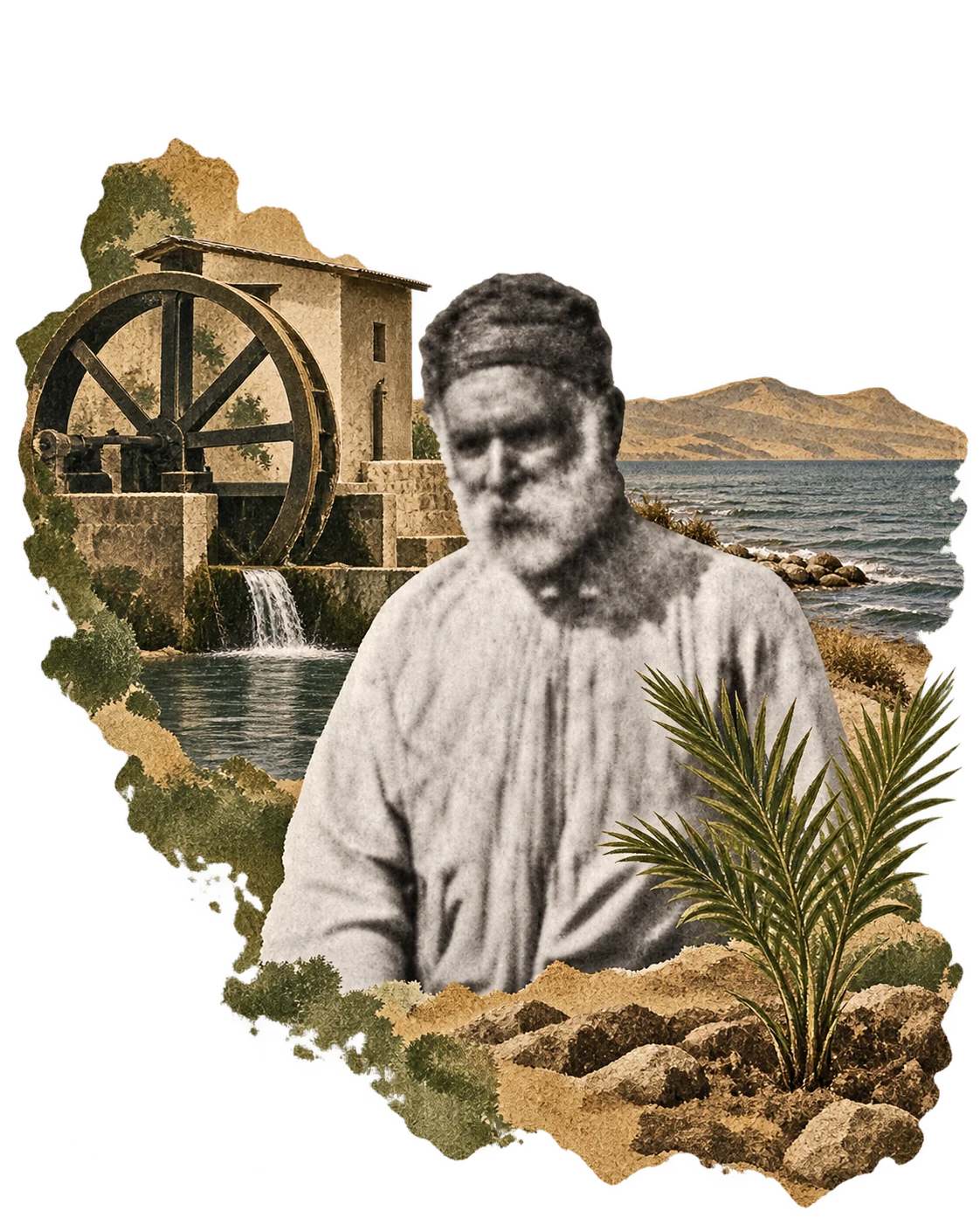
His first contribution was choosing the name: after consulting his housemate and friend S.Y. Agnon, the name Kinneret was chosen. He was enchanted by the landscape. "On the first night in the isolated settlement: I know that we are far from people and city, surrounded by sea and mountains. At such an hour, I feel as though I am in Robinson Crusoe's home - or, more accurately, on the islands of Iceland, among a band of pirates and conquerors of a continent."
A conflict developed at Kinneret between a group of Second Aliyah laborers and the manager, Berman, and Rabbi Benjamin acted as mediator: "And between these two groups he moved as a third. Perhaps the people of the Palestine Office had deliberately sent him there to stand between them, prevent clashes, and bring about compromise and reconciliation."
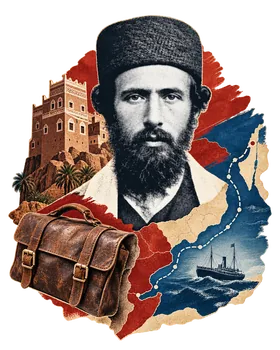
One of the important and controversial projects in which he took part was organizing the immigration of Yemenite Jews. The Palestine Office mistakenly viewed the Yemenites as natural agricultural laborers, able to withstand the harsh conditions of the land and make it fruitful. Arthur Ruppin wrote in his memoirs that Rabbi Benjamin had initiated the idea, but Rabbi Benjamin disclaimed the credit and said it had been a joint initiative. Shmuel Yavne'eli was chosen as the emissary to undertake the long and dangerous journey to Yemenite communities. Rabbi Benjamin handled all the logistics: planning the route, preparing the cover letter, arranging transportation for the immigrants, and building the infrastructure to receive them. When Max Bodenheimer, then chairman of the Jewish National Fund, asked him to write a pamphlet to raise funds, Rabbi Benjamin wrote a poetic work. The pamphlet was widely distributed and an overwhelming success. It was translated into several languages, circulated in tens of thousands of copies, and raised about a quarter of a million francs, an astronomical sum by the Jewish National Fund's standards.
The Yemenite immigration did indeed fulfill expectations in terms of the immigrants' integration as laborers and fighters, but it also exposed the dark side of the Yishuv. The immigrants experienced blatant discrimination and humiliation. Rabbi Benjamin wrote painfully in his memoirs: "The Yemenites did not disappoint. It was the leaders of the Yishuv who disappointed, allowing them to become second-class citizens and laborers. Inferior ones. People who spoke grandly of democracy failed to fulfill this great mitzvah in practice." He described the discrimination explicitly: "Sadly, it did exist. For years and years, the Ashkenazim were the first to travel, and the Yemenites traveled only afterward. This practice continued in the settlements for many years. There was also a difference in wages."
Despite his disappointment, Rabbi Benjamin loved the Yemenite immigrants with all his heart and described their remarkable qualities in his book, and they returned his affection. Without his knowledge, they chose him as their representative to the National Council, a very rare honor for an Ashkenazi at the time.
Between 'HaHed' and Brit Shalom
Rabbi Benjamin was an integral part of religious Zionism. For twenty-seven years, beginning in 1926, he edited the monthly HaHed, a journal intended to bring the Haredi public closer to the Zionist idea and the national funds. The body behind the journal, which also funded it, was the Department for Propaganda among the Haredim, established jointly by the Jewish National Fund and Keren Hayesod. HaHed was founded by Rabbi Hanokh Henich Bornstein. Born in Poland, he was the son of the Rebbe of Sochaczew (author of Shem MiShmuel) and the grandson of the dynasty's founder (author of Avnei Nezer). Hanokh immigrated to the Land of Israel in 1924, gravitated toward Zionist circles, and helped found the Beit VeGan neighborhood. He earned his living as a clerk in the Jewish National Fund offices, and in the evenings edited HaHed with Rabbi Benjamin. He led a modest double life: a public servant by day and a religious editor by night. After the Holocaust, when he learned that his brother had been murdered, he became the Rebbe of Sochaczew, but continued working at the Jewish National Fund and editing the journal until his retirement in 1953. The other key figure was Rabbi Yeshayahu Shapira (the Pioneer Rebbe), Bornstein's brother-in-law. Shapira, a descendant of Hasidic dynasties and one of the founders of Mizrachi in Poland and HaPoel HaMizrachi in the Land of Israel, was a leading figure in religious settlement.
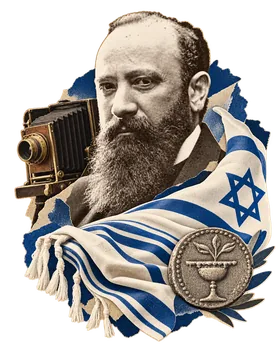
Rabbi Benjamin saw HaHed as a mission: to bring the Haredi public, from which he himself had emerged, closer to the Zionist enterprise. He did so skillfully, using language and content familiar to them. He was also one of the founders of the daily newspaper HaTzofeh.
During the First World War, he was appointed to represent the interests of the Jews in the Land of Israel before the German consul. In this role, he succeeded in saving the Jewish community from various decrees imposed by the Turks, allies of the Germans. He took part in founding Tel Aviv and built a house in Nahalat Binyamin. He helped establish the Neve Sha'anan neighborhood in Haifa, Beit VeGan and Beit HaKerem in Jerusalem, the Ruhama settlement in the south, and Bat Yam. In 1936, he was among the founders of the Aluma institution in Jerusalem, one of the first attempts in the country to combine religious studies with secular studies. He was one of the initiators of the establishment of Bar-Ilan, Haifa, and Tel Aviv universities.
In 1925, Rabbi Benjamin was among the founders of Brit Shalom, an organization that called for the establishment of a binational state in which Jews and Arabs would enjoy full equality of rights. He edited its publication, She'ifatenu, and worked tirelessly for the organization. The movement established its headquarters in his home on Ma'alot Street in Jerusalem. He worked alongside intellectuals such as Martin Buber, Judah Magnes, Gershom Scholem, Hans Kohn, and Ernst Simon. After a few years, Rabbi Benjamin left the organization. As a Herzl-style Zionist, he opposed the concessions his colleagues were prepared to make regarding Jewish immigration to the Land of Israel.
Nevertheless, his work for peace and cooperation between Jews and Arabs continued until his dying day. He was active in Kadima Mizraha, the League for Jewish-Arab Rapprochement, Ihud, and the monthly Ner, which he founded and edited. He learned Arabic and believed that every Jew in the country should learn the language. He even kept notebooks for studying Arabic on his own.
When he heard about the massacre in Kafr Qasim in 1956, at the age of 76, he announced that he would move to the village as a sign of solidarity with its residents. During the truce in the War of Independence, he appealed in the newspapers to the Arabs and their leaders, asking them to allow the families of those killed at Gush Etzion to visit their loved ones' graves: "This is a religious, human, and cultural matter, one that should be held dear by every decent, conscientious person, regardless of religion or people, in wartime and all the more so during a truce." He also proposed a peace plan that included the return of 100,000 Palestinian refugees to Israeli territory and their resettlement there, the absorption of the rest in Arab countries, and the relinquishing of the southern Negev. These views drew fierce criticism.
Humanism, Rescue and Criticism
Rabbi Benjamin was a humanist with a broad outlook. He believed in social justice, equal rights, and human dignity. He was also an avowed feminist. In a 1915 essay about the First World War, he identified the origins of the modern peace movement in the work of Bertha von Suttner and her anti-war book 'Lay Down Your Arms!'
In 1942, when the first reports about the destruction of Polish Jewry began to reach the country, Rabbi Benjamin was one of the few who did not remain indifferent. He organized intellectuals and social activists from across the political spectrum in a group called Al Domi (the name comes from the words "Do not be silent; do not hold your peace or be still, O God" [Psalms 83:2]). The group's aim was to raise awareness in the Yishuv of what was happening in Europe by every means possible, and to influence world public opinion in an effort to save Jews. S.Y. Agnon, Martin Buber, and Dov Sadan were also members of the group.
A year after Berl Katznelson's death, Rabbi Benjamin did something considered improper: he publicly attacked him for not devoting all his efforts to rescue work, preferring instead to invest them in publishing books.
After the establishment of the state, Rabbi Benjamin continued to criticize the leadership's policies. In a 1957 essay titled 'Yes to the State of Israel, No to Ben-Gurion's State,' he wrote: "Ben-Gurion's state is not simple and modest, as we had envisioned it, but idealistic, religious, heavenly, messianic, and militaristic. Prophets foresaw its coming... Generals equipped it with weapons. The ravens bring it, as they did for that ancient seer beside the brook Cherith, bread and meat in the morning and bread and meat in the evening. They also bring it luxury cars, planes, and guns beyond measure." Beyond the anti-militarist critique, it is important to remember that Rabbi Benjamin remained a devoutly religious man throughout his life, and here he sharply criticizes the Israeli leadership's use of religion for political purposes.
His literary work was extensive: he wrote many essays, founded newspapers and journals, translated most of Herzl's writings into Hebrew, helped translate textbooks into Hebrew, and published various books, including 'On the Borders,' 'The Treasure of the Land,' 'Faces' (two volumes), and works about Herzl, David Wolffsohn, the settlement of Yemenite Jews, and other subjects. His work blends scholarship, lyricism, and humor.
In 1947, during the War of Independence, he sheltered many children evacuated from Kfar Etzion in his home near the Ratisbonne Monastery. After his death, a room was established in his memory in the village, a testament to his deep connection with the place and the people who lived there.
Yehoshua Radler-Feldman - Rabbi Benjamin - died in 1957. His life was a rare combination of commitment to Jewish tradition, devotion to Zionism, genuine love, and a pursuit of justice. He was a writer, journalist, translator, organizer, mediator, pioneer, and builder. He took part in almost every significant event in the history of Zionism and left a distinctive mark on everything he did. His legacy reminds us that even within the consensus there is room for other voices, and that sometimes it is precisely the lone voices that point toward a more just path, even if they were not accepted in their own time.

תגובות
עדיין אין תגובות.