
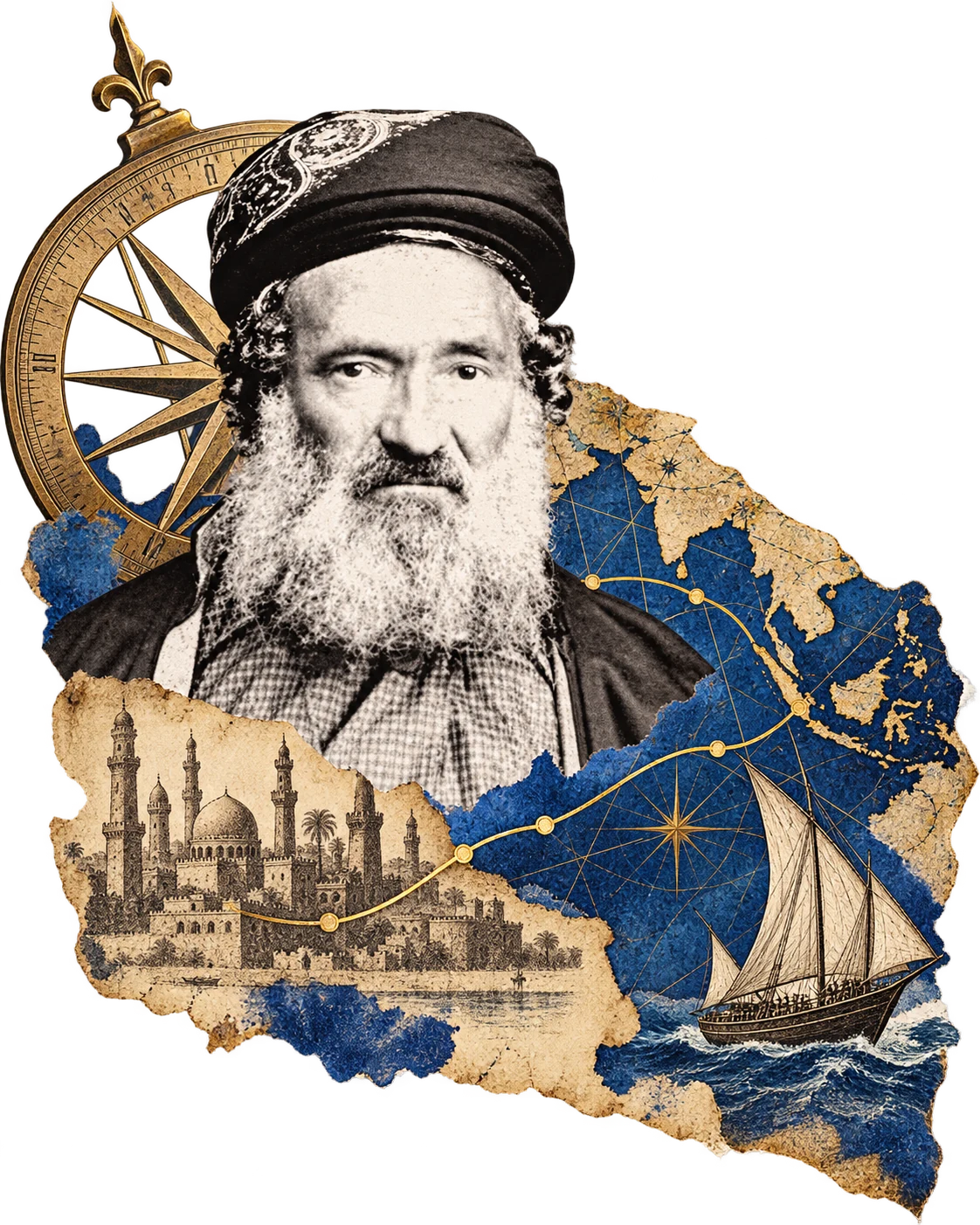
He was among the first scholars to document the customs of Jewish communities in many countries, including Egypt, Indonesia, India, Ethiopia, Yemen, Australia, Germany, and more. A curious man, he uncovered documents from the Cairo Geniza and studied the Aleppo Codex. His discoveries were nothing short of astonishing and left their mark on Israeli history.
A northerly wind blew fiercely, and the ship pitched on the waves. Rabbi Jacob Sapir described the morning after the storm during his journey to India: "At daybreak, the holy travelers (Muslim pilgrims) stood up and quarreled fiercely with the captain, for he had brought misfortune upon them by bringing a defiled Jewish man aboard to desecrate their sacred journey (their pilgrimage to Mecca), which was devoted to holiness and purification. Like cannibals, they became savage and tried to seize me and throw me into the sea. But the captain, to whom I had been entrusted by a respected merchant in the city of Suez, who had instructed him and vouched for me, so that he would keep me safe from harm, also knew that I was a European and carried consular papers, and that he would not escape punishment. He held on to me with all his might and did not let me fall prey to their teeth. But the terror of death seized me, and I feared for my life at every moment."
From Safed to Jerusalem
Jacob Sapir was born in 1822 in a small town near Vilna, Lithuania. When he was ten, his family immigrated to the Land of Israel and settled in Safed. A year later, his father died, and a few months after that, his mother died. In 1834, when he was twelve, riots broke out against the Jews of Safed (the "Peasants' Revolt"). Jacob fled to the village of Zeitoun and wrote: "We stayed there for forty days, in mortal fear in the hands of the robbers, our possessions before our eyes in the hands of strangers. We could not even be sure of our lives. They stripped us naked, for they took even our clothes from us and emptied our home of everything..."
He left Safed after the earthquake of 1837. He went alone to Jerusalem, where he found the love of his life. At the age of fifteen, he married Feiga Leah, daughter of Rabbi Shlomo Zalman Hacohen, one of the leaders of the Perushim community, to which he belonged. The "Perushim community" was the name given to the disciples of the Gra (the Gaon, our teacher Elijah - the Gaon of Vilna), who had immigrated to the Land of Israel as early as 1808. These students settled in the Jewish Quarter, in the courtyard of Rabbi Judah the Hasid. At the time, Jacob worked as a teacher at the Etz Chaim Talmud Torah, traded in etrogim, and, on behalf of the burial society, composed the inscriptions on gravestones. Jacob also wrote poems (he wrote the poem "Kanaf Renanim" in honor of Moses Montefiore).
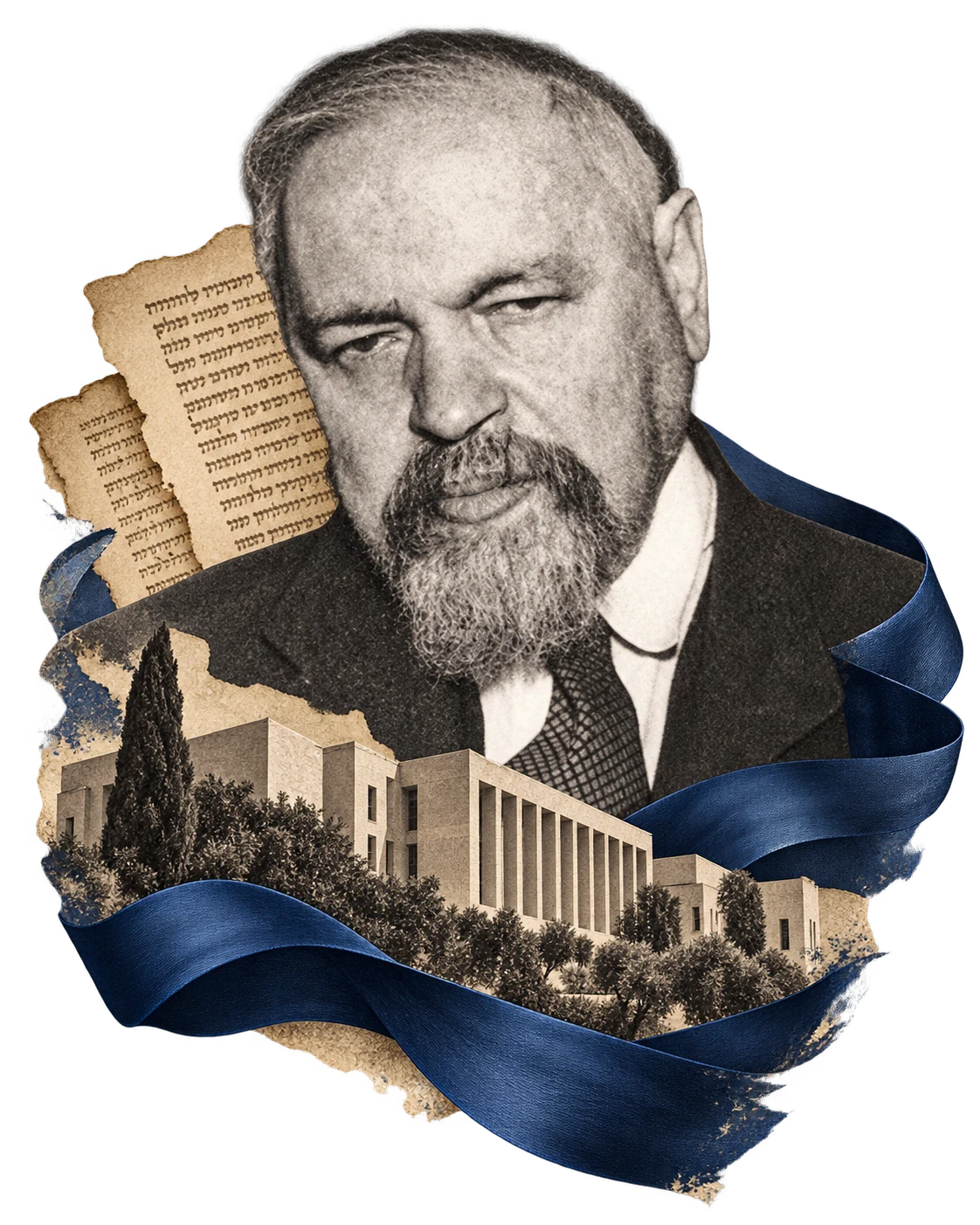
"A short man, his face pale with illness, and reddish rings seemed to circle his eyelids. On either side of his torn, filthy hat, his long sidelocks curled down, strangers to any comb. There was no trace of the silk coat he wore, nor of its former glory from ages past; and the shoes he had slipped off at the threshold seemed to bear on their hollowed heads all the dust of the Valley of Jehoshaphat from time immemorial" - Ludwig August Frankl described Rabbi Jacob Sapir's appearance this way in his book Yerushalayim! His appearance was ugly, and his clothes were dirty.
Missions and Travels in the East
In an age when travel meant embarking on a dangerous adventure that lasted many days, Jacob Sapir served as a shadar (an emissary of the rabbis). These emissaries were sent from the Land of Israel to Jewish communities in the Diaspora to raise donations to sustain the Jewish community in the Land of Israel. They also carried religious and cultural information and current news from one community to another. The fate of about ten percent of the shadarim who left the country is unknown.
In 1858, Rabbi Jacob Sapir was sent to India and Australia to raise money for the construction of the Hurvat Rabbi Yehuda synagogue in Jaffa. He boarded a ship to Alexandria and from there traveled overland into the heart of Egypt. He visited the Jewish communities along the way, documenting them and the hardships of his journey. Once he described how he nearly was murdered, and another time how he almost went blind. From Egypt, Jacob Sapir continued to Ethiopia, where he was among the first to establish that Jews lived there and to describe them in detail. After he was swindled and left without money, he was forced to stop in Yemen: "And God meant it for the best... From Yemen I gathered much valuable information and obtained the treasures my soul had hoped for, as well as a good reward for my labor..."
The Jews of Yemen fascinated him. He prayed in a Yemenite synagogue, celebrated a Passover Seder according to Yemenite Jewish custom, and took part in ceremonies with his hosts. He spent a year in their company. He was the first Jew to bring the Jews of Yemen, who lived in degrading conditions, news of the return to Zion and of Jewish life in other countries, where Jews were protected by law. He was also the first to bring news of Yemen's Jews to the Jewish community in the Land of Israel.
He described the Yemenite community so well: "Here at the Souk al-Rubu I waited for about an hour, and a few Jews came down to the market. When I saw them from afar, carrying their loads, their faces told me they were Jews. The sidelocks at their temples, which they call 'simanim' (for it is a good sign for Israel), reached down to their chests. Their beards were not as long and full as those of most inhabitants of this country, whose complexions were darkened by the sun, and they lacked the dignified appearance of a full beard; but neither razor nor scissors had touched them. Their heads were shaved and covered only by a black turban, without a wrap or ornament, soaked in hair oil; they anoint their heads and whole bodies with boiled butter (called samneh in Arabic). Their clothes, too, were black and dark blue, and never without oil. A thick, black, fringed shawl, like a cloak, was doubled over their shoulders beneath their loads, and its fringes trailed on the ground, for it served as their clothing and cloak. All who saw them would know that they were descendants of Abraham, Isaac, and Jacob. When we recognized one another, joy and gladness rose from the depths of our hearts, like the joy of a bridegroom. Kisses on lips and hearts opened the wellspring of the eye, sending tears of joy from the eyes of those who love the chosen people."
From Yemen he continued to India, Java, Australia, and New Zealand. On his way back, he witnessed the digging of the Suez Canal. When he returned, he wrote down the story of his travels in three volumes, which he called Even Sapir. At the beginning of his book, he wrote: "It will take you around the land of Ham (the journey through Egypt), the Red Sea, the inner regions of Yemen, all of East India, the new land of Australia... the lands I traveled through and explored for four years and nine months, and wrote about in this book as a record: the condition and appearance of our brothers and our people, their religious and civil conduct, and what has happened to them from then until today. Also included are stories and matters of Torah, research and insightful observations, lists of ancient tombstones and notes about them, sacred poems and supplications, and wondrous accounts - something of interest to everyone."
He continued his connection with the Jews of Yemen after returning to the Land of Israel. He corresponded with them, worked to preserve their heritage, and helped print the book Hemdat Hayamim, the work of their rabbi, Rabbi Shalom Shabazi.
The Geniza and Other Discoveries
The story of the Cairo Geniza could be the basis for a fascinating, substantial book. According to tradition, holy books do not lose their sanctity even when they wear out. Therefore, every synagogue has a niche or a room for a geniza, where worn-out books are kept. This was also the case at the ancient synagogue of the Jewish community in Fustat, the old city of Cairo, which was established in 882 and where Maimonides used to pray.
Over the years, in addition to Torah scrolls placed in the geniza room, legal documents, letters, lists of names, and more were stored there. Egypt's characteristic climate preserved this treasure. In 1864, Jacob Sapir was the first to discover this geniza, recognize its immense value, and remove several documents from it. He revealed the geniza's existence in a book he wrote that same year. Today, parts of the geniza can be found at the University of Cambridge, in St. Petersburg, Budapest, Vienna, Strasbourg, Paris, London, Oxford, Manchester, New York, Philadelphia, Washington, and many other places. The geniza has yielded about 350,000 text fragments that teach us about Jewish life in the Middle Ages, when the geniza's reach extended from Spain and Morocco in the west to Aden and India in the east. It contains treasures of manuscripts from the period of the Geonim and the early rabbinic authorities, letters in Maimonides' own handwriting, halakhic responsa by the Geonim, and pages in Greek, Latin, Persian, Arabic, and even Chinese. The materials found there can teach us about events in the Land of Israel in the early Middle Ages, the study of Karaite Judaism, the study of the Babylonian Talmud, and dozens of other fields, such as Jewish magic and mysticism. Scholars continue to study the geniza to this day, using the most advanced technology to further their research.
In 1865, about seven years after his first journey, Jacob set out on another trip, this time to Europe. He visited Russia, France, and Germany, where the community of Posen granted him Prussian citizenship, which gave him German nationality.
His curiosity led not only to the discovery of the geniza documents, but also to the identification of the Cave of the Sons of Hezir, on the slopes of the Mount of Olives. Rabbi Sapir was also involved in the Petah Tikva Society, which planned to buy land near Jericho in 1871 for settlement.
The Aleppo Codex, now displayed in the Shrine of the Book in Jerusalem, is the most accurate manuscript of the Bible. It was written in Tiberias in 930 and passed among the communities of Jerusalem, Cairo, and Aleppo (Syria). In 2016, UNESCO recognized the codex as a cultural treasure of global significance. While the manuscript was in Aleppo, Rabbi Jacob Sapir was among the first scholars to study it.
In 1882, Rabbi Jacob had the privilege of seeing the Yemenite Jews immigrate to the Land of Israel ("E'eleh BeTamar"), whom he had visited twenty years earlier. He was deeply saddened to see how they lived in caves and niches in the village of Silwan, with no one in the Jewish community looking after them, and some even questioning whether they were Jewish.
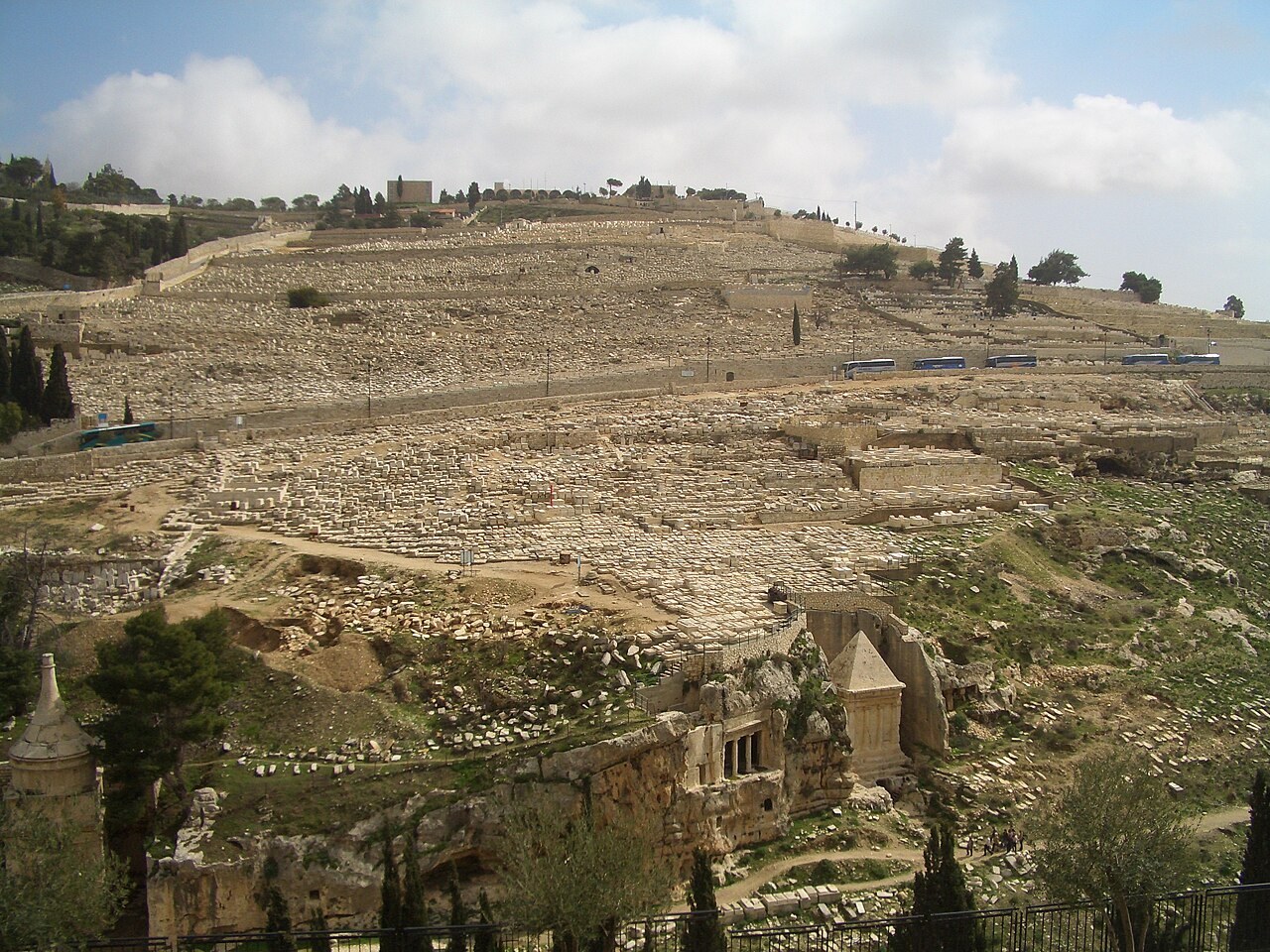
Three years later, Rabbi Jacob Sapir died and was buried in the Perushim section of the cemetery on the Mount of Olives. A modest inscription was engraved on his gravestone. The rabbi's sons-in-law were Shmuel Baruch, son of Rabbi Haim Nissim Baruch, and Yehiel Brill, one of the pioneers of the press in the Land of Israel. His grandson was the Zionist activist Eliyahu Sapir, and his great-grandson was Yosef Sapir, a leader of the General Zionists and a minister in the Israeli governments.
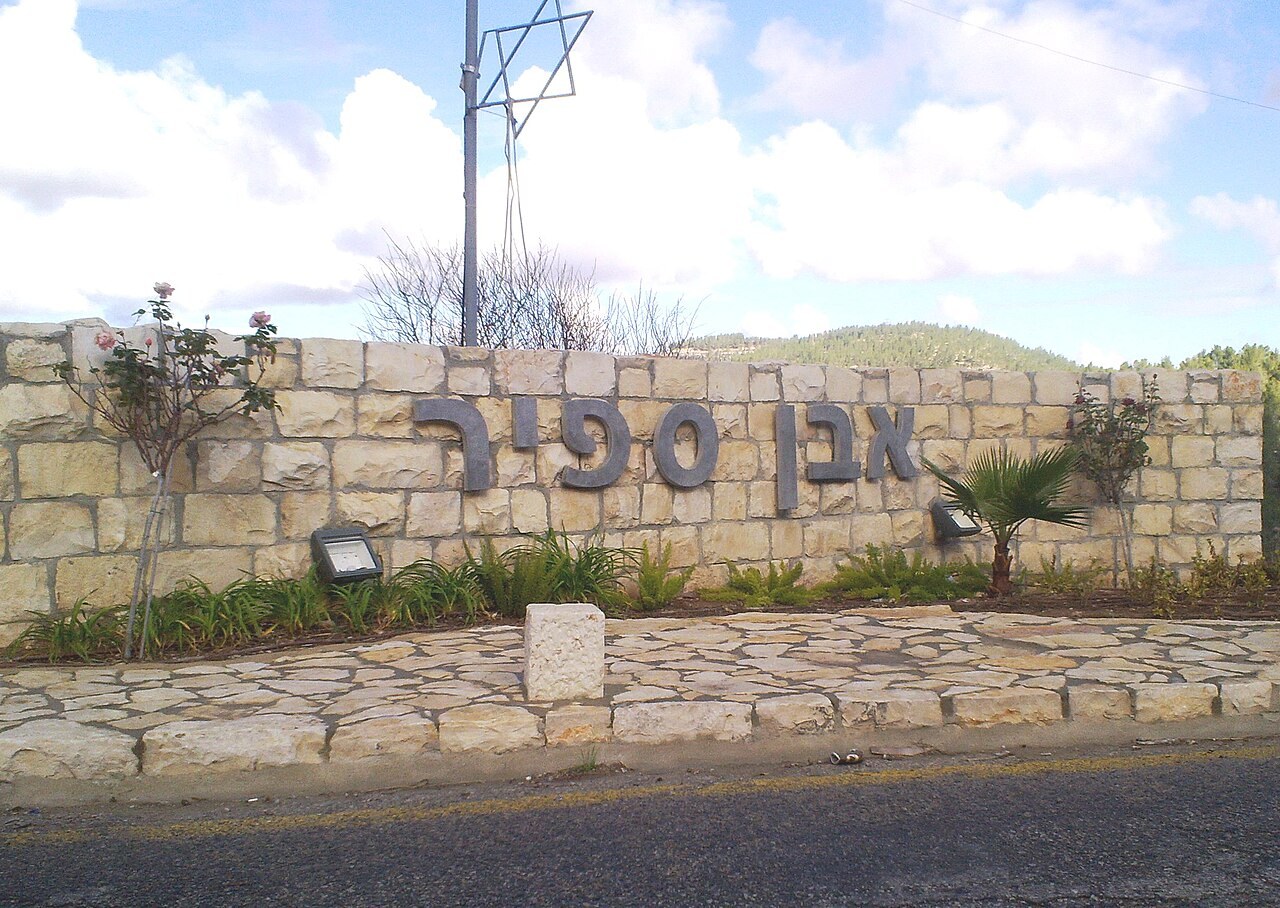
In 1950, immigrants from Yemen founded a moshav near Jerusalem and, in tribute to Rabbi Jacob Sapir, named it Even Sapir.
תגובות
עדיין אין תגובות.