
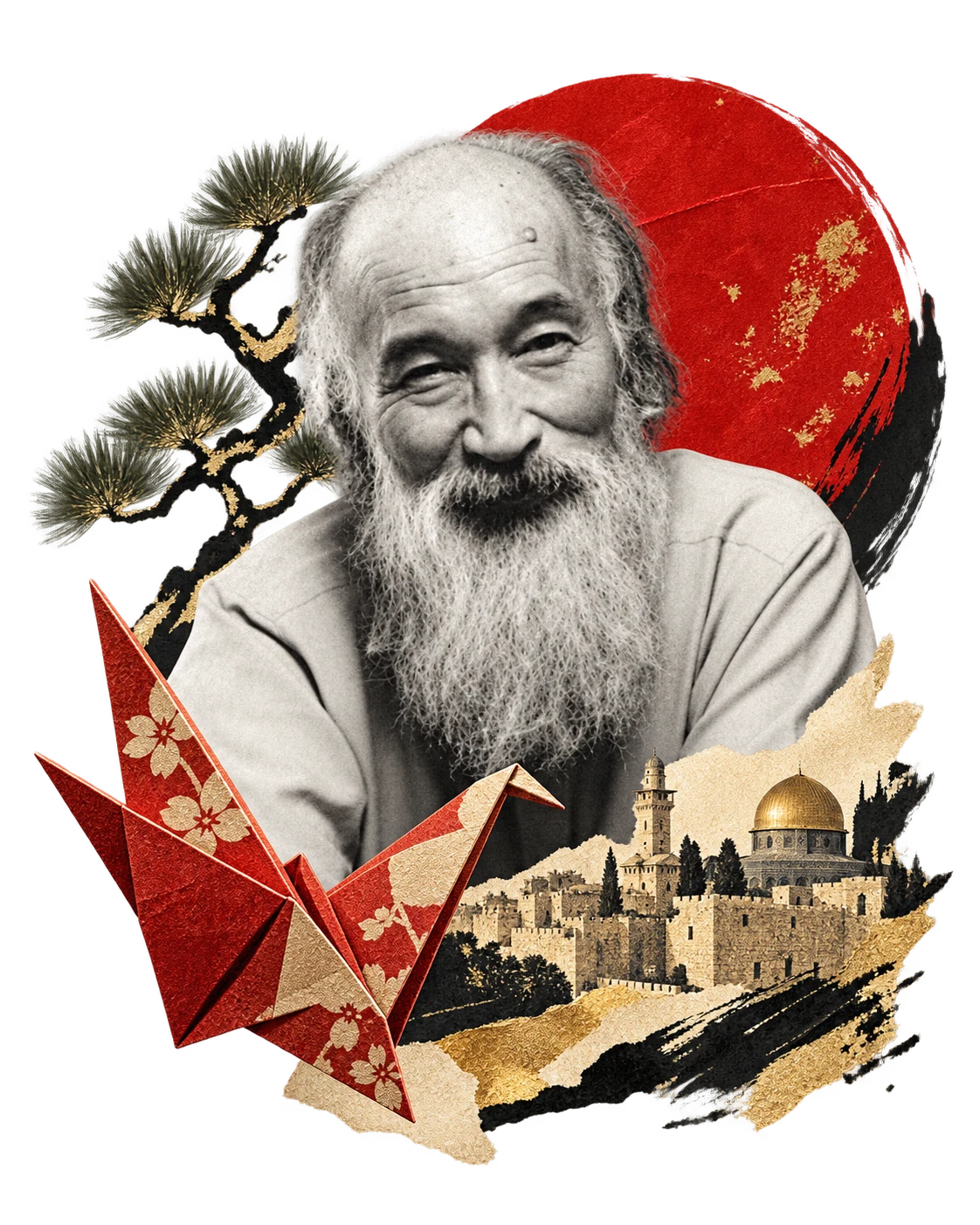
A businessman who founded a non-Jewish Zionist movement. Every year, its members come and give us a taste of Japanese culture.
The Revelation and the Founding of the Makuya
In 1947, about two years after the end of World War II, a 37-year-old man meditated in a secluded spot above Japan's Mount Aso volcano. He closed his eyes, breathed deeply, exhaled slowly, let go of his thoughts, and calmly listened to the nature around him. He said that he experienced a divine revelation. Professor Ikuro Teshima, a devout Christian who until then had been a successful businessman, abandoned everything and set out on a new path. For long days and nights without sleep, he immersed himself in the Bible, and published his insights in a magazine called 'Light of Life.' Gradually, thousands of believers gathered around him, and he founded the Makuya movement, whose name translates into Hebrew as 'Tent of Meeting.'
The movement was founded in May 1948, the month in which the State of Israel was declared. Ikuro Teshima championed a return to early Christianity and saw the founding of the state as divine intervention, just as it had been revealed to him: "The Jews are now returning to their land. Most people in the world think this is an ordinary migration of people, requiring passports, visas, and tickets. But anyone who does not see that the hand of God is doing all this is blind. This is a miracle happening before our eyes, and there is no power in the world that can stop it. The Jewish people need not fear anyone. Israel will grow and prosper." "The Bible is a light for all people," Professor Teshima maintained, "and faith in the Bible completes all religions." He drew his faith from Christianity, the Bible, customs, and various thinkers, among them Rabbi Kook, Martin Buber, Professor Abraham Heschel, and the Japanese Christian theologian Kanzō Uchimura, who aspired to integrate Christianity into Japanese culture. When he founded the movement, Professor Teshima added the name Abraham to his original name.
Abraham Ikuro Teshima was born in 1910 into a family that followed Shinto, a religion centered on belief in gods and spirits. From a young age, he read the Bible and was drawn to monotheism and Christianity. He was baptized at 17, but because he did not identify with some aspects of the religion as it was practiced, he preferred to embrace a non-church-based Japanese form of Christianity.
Meeting Israelis in Japan
In 1954, Professor Israel Slominitzky of the Faculty of Agriculture in Rehovot was due to travel to Japan to learn from the locals about the Japanese method of growing potatoes in plastic tunnels. For Professor Slominitzky, it was a dream come true. The trip, on which his wife Leah accompanied him, was part of his doctoral research, titled 'Two Growing Seasons of Potatoes in Israel.' After visiting Hiroshima, the couple boarded a train to Nagasaki. Israel Slominitzky and his wife Leah were quietly and excitedly talking about their experiences so far when the Japanese man sitting across from them turned to them and asked, "Is that Hebrew you're speaking?" Astonished, they said yes. The Japanese man took a Bible in Japanese from his bag, its chapter headings handwritten in Hebrew. "I wrote this myself," Abraham Ikuro Teshima said proudly. It was the first time since founding the movement that he had met an Israeli from Israel who spoke Hebrew.
A warm bond developed between the Slominitzky couple and Abraham Ikuro Teshima. The two professors found common ground, and their dream of meeting again came true seven years later. In 1961, Teshima came to Israel, and Israel Slominitzky toured the country with him, introduced him to Martin Buber and Professor Hugo Bergmann, and took him on a tour of Kibbutz Beit Alfa, where Slominitzky had grown up. Abraham Ikuro Teshima was enthusiastic about the kibbutz idea and impressed by a country that exceeded all his dreams. What he saw matched the vision of his new movement and the prophecies in the Bible and the New Testament. In his writings, Teshima quoted Psalm 137: "By the rivers of Babylon, there we sat down, and wept, when we remembered Zion..." He explained: "The Bible clearly prophesies that the people of Israel will ultimately return to their land and play a central role in fulfilling divine providence over this land." He made use of his visit to study Hebrew at the ulpan at Kibbutz Hefzibah, next to Beit Alfa. He became an ardent Zionist and saw kibbutz life as an Israeli counterpart to the Japanese way of life, which emphasizes modesty and a shared working life. He believed that the members of his faith were descendants of the ten lost tribes, and together with his followers he created the first Japanese-Hebrew dictionary.
Professor Slominitzky's tour of Japan led to the development of protected cultivation methods in Israel, and later to tunnel and greenhouse farming, considered among the most important achievements of modern Israeli agriculture.
The Makuya in Israel and the Legacy
The members of the Makuya movement left a considerable mark on Israel. In 1974, his followers established a Japanese garden at Kibbutz Hefzibah in memory of Professor Abraham Ikuro Teshima. The garden was inspired by Isaiah 41:18-20: "I will open rivers on the bare heights, and fountains in the midst of the valleys. I will make the wilderness a pool of water, and the dry land springs of water. I will plant in the wilderness the cedar, the acacia, the myrtle, and the olive tree. I will set in the desert the cypress, the plane tree, and the larch together. That they may see, and know, and consider, and understand together, that the hand of the Lord has done this, and the Holy One of Israel has created it." The garden combines trees mentioned in the Bible with Japanese elements such as a stone bridge and lanterns. Every year, a number of Japanese believers come to the kibbutz to work in the garden. Near Mitzpe Netofa in the Lower Galilee, not far from Golani Junction, the Makuya Forest was planted, and the university botanical garden in Jerusalem has a grove of cherry trees brought from Japan. Every year, when the cherry blossoms bloom, believers from Japan come to the garden and celebrate the 'Sakura Festival' (sakura means 'cherry blossom'), just as they do in Japan. Another small forest was planted near Sha'ar Hagai, on the road leading up to Jerusalem.
It is worth noting that relations between Japan and Israel predated the founding of the Makuya movement. As early as 1914, Rabbi Kook saw the Japanese as allies and wrote: "This enlightened and free people, awakening from a long slumber with renewed strength, truly deserves to look upon the Jewish light with clearer eyes than other nations, whose spiritual lives have been poisoned by a combination of delusion and hatred of the Jewish people (Letter 668)." Japan was the first country in Asia to establish diplomatic relations with Israel, in 1952, and Israel was the first country in the Middle East to establish relations with Japan.
Just before the Six-Day War, Professor Teshima established the 'Israel Emergency Committee in Japan.' When the war broke out, he flew to Israel with goods and assistance he had gathered in Japan. When the Western Wall was liberated, he burst into tears and offered a prayer of thanks to God: "This day is the best and greatest day of my life," he said of the moment.
In 1973, shortly after the Yom Kippur War and the death of David Ben-Gurion, Israel's first prime minister, Professor Teshima declared at a large rally that the redemption of the Japanese people was closely bound up with the Jewish people and the Land of Israel: "We must not allow Israel to become an orphan among the nations. We cannot, and indeed must not, abandon Israel in its hour of distress," he said. At the end of the rally, he collapsed and was hospitalized for three weeks. At the end of that time, at the age of 63, he returned his soul to his Creator. At his request, a Jerusalem stone was placed on his grave in Kumamoto.
Abraham Ikuro Teshima did not appoint a successor, and the movement is now led by a committee. His son earned his doctorate in Jewish studies at Harvard University, and his grandson studied Talmud and Bible at the Hebrew University and earned a doctorate in Bible at the Jewish Theological Seminary of America.
תגובות
עדיין אין תגובות.