
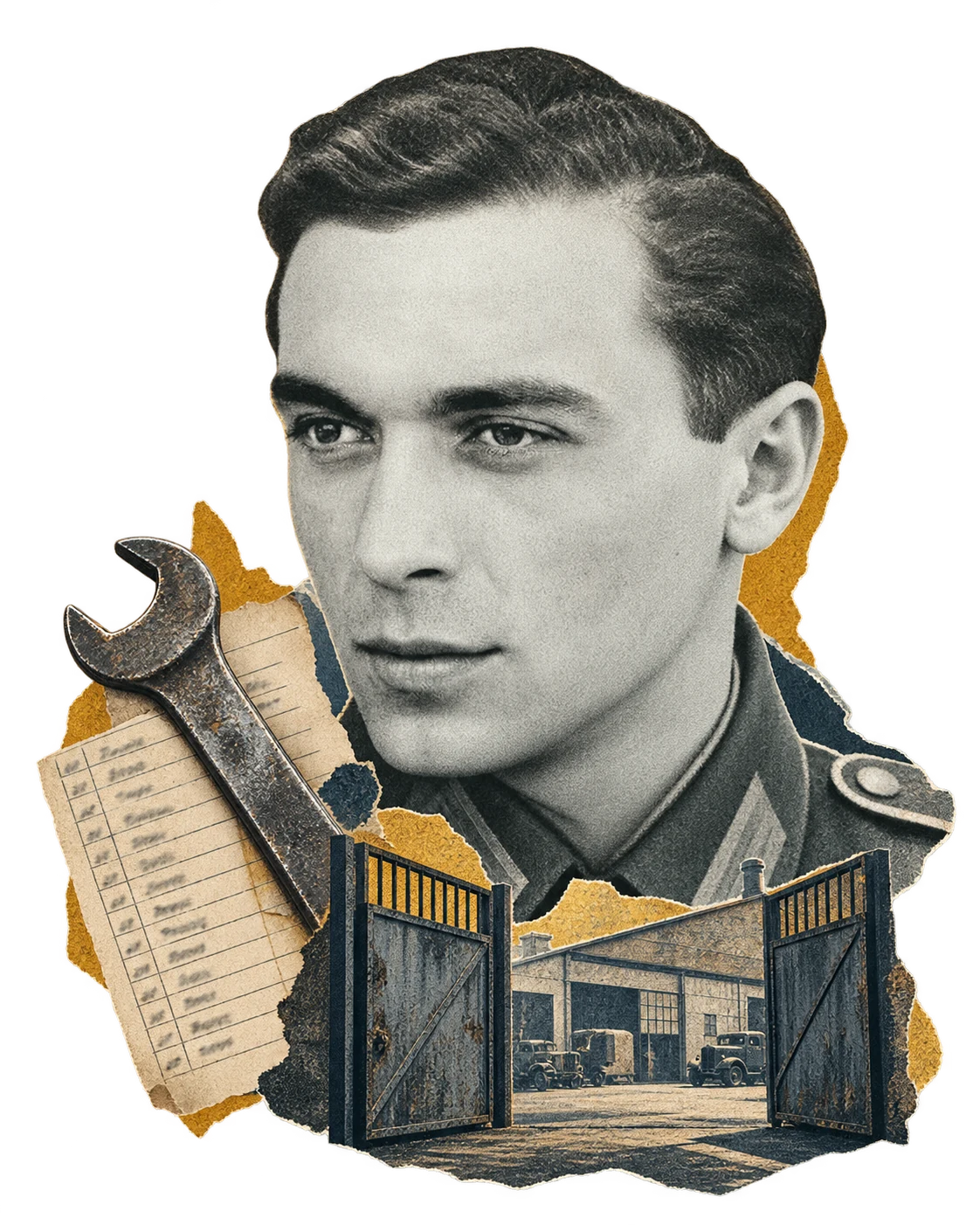
Walking into a home and seeing a picture of a Nazi soldier on the wall is strange. Seeing such a picture hanging on the wall of a home in Haifa is even stranger. But the strangest sight of all is a picture of a Nazi soldier hanging on the wall of a Holocaust survivor's home.
The Rescue of Israel Fromer
Israel Fromer, then a 14-year-old boy, described what he saw one day in August 1942: "Kurzbach drove a military truck into the ghetto and began loading people onto it. He shouted at us. We were terrified of him. Only later did we understand that it was an alibi, so he could pass himself off as someone who didn't 'like Jews.' No one knew then that he was using his uniform to save us... He pretended to look at a list and shouted at me in German, 'What's your name?'... To this day, I don't know whether I climbed onto the truck or was thrown inside. Everyone was crammed together."
Israel Fromer and his family spent the night at Kurzbach's factory. The factory gates were locked, and no Jew could leave. When they returned to the ghetto, it was almost empty, because while they were forbidden to leave the factory, a roundup had taken place in the ghetto, gathering up the Jews and sending them to the Belzec extermination camp. In this way, Kurzbach saved about 200 Jews. And in Israel's home, a picture of Gerhard Kurzbach hangs on the wall.
Little is known about Gerhard Kurzbach. He was born in Poznan in 1915. In 1919, Poznan fell to Poland, and the Kurzbach family, along with other German families, left the city and settled in Bunzlau, in Lower Silesia. Gerhard worked as an auto mechanic in his father's workshop. In August 1939, a month before the German attack on Poland, he was drafted into the Wehrmacht and served in the artillery. In May 1941, he was transferred to Bochnia, where he was put in charge of a workshop for repairing military vehicles. Hundreds of ghetto residents were forced to work at the factory, which enabled him to bring hundreds of Jews out of the ghetto and save them from extermination. Kurzbach disappeared in March 1943, and it later emerged that he had been abruptly transferred to another unit. The last sign of life from him was a letter he sent his family from Romania in 1944. He died in 1945 in a Red Army prisoner-of-war camp. Did the Germans know about his rescue efforts? Was he sent to the front as revenge for saving Jews? These questions remain unanswered...
"Thanks to his courage, we and other Jews were saved from certain death," said Israel Fromer, who was also the last person to see him alive. Kurzbach spent his final moments as a German soldier with a Jewish doctor named Dr. Neufeld. "He arrived in his dress uniform, with a pistol and a long sword. I opened the door for him, he came in, and I immediately closed it," said Fromer, who was then a teenage messenger at the camp. About half an hour later, he noticed five armed German soldiers approaching the room. The senior man in the group came up to Kurzbach, disarmed him, and arrested him. Since then, no one has known what became of him. "There were rumors that the Germans court-martialed him and shot him," he said.
Israel's parents and two of his brothers were murdered in the camps, but he and his sister survived. After Kurzbach saved him from the roundup, he escaped another roundup in the ghetto by finding shelter in a bunker. Later, he also survived the Szebnie camp, despite the abuse inflicted by the sadistic commander, Grzimek. After the Holocaust, Grzimek was tried as a war criminal and imprisoned in Dachau, and Fromer, as he put it, still had time to 'spit in his face' before he was hanged. Israel Fromer also survived the camps at Birkenau, Jawiszowice, Buchenwald, and Theresienstadt. "I ate birds, cooked grass, stole food from dogs in the kennel"... Fromer survived the horrors and immigrated to Israel in 1948. As soon as he arrived, he was already fighting in the War of Independence. He started a family in Israel, and his two daughters, Irit and Ruhama, were named after two of his sisters who were murdered in the Holocaust. When he learned about Gerhard Kurzbach's family, he wrote to them: "Dear Kurzbach family, This coming summer I will turn 85. I have always been grateful to the man who saved me from death. I owe my life to Staff Sergeant Kurzbach in Bochnia, Poland. He saved me, my parents, and my brother, who was three years younger than me, from being deported to the extermination camp. Thanks to his courage, we and other Jews were saved from certain death." He added, "I was the only witness who saw the armed Wehrmacht soldiers enter the ghetto and the building where I worked." He signed the letter: "With gratitude, Israel Fromer."
One fifth of Bochnia's residents were Jewish. In July 1941, when the Germans occupied the city, they established a ghetto for the Jews of the city and its surroundings. The terrible overcrowding brought disease, and disease brought death. Deportations to Belzec began in August 1942. A large proportion of the ghetto's Jews were forced to work for the military vehicle fleet - HKP. Some survivors said that Gerhard Kurzbach took them off the transports, hid them in the workshop, and moved them to safety. Ze'ev Yakubowicz, one of the survivors, testified: "When we learned that a deportation was being planned... we managed to hide. The rest of the family was taken to the train... One of my uncles was in charge of vehicle repairs, and he arrived at the station with the head of the workshop. The German (Kurzbach) took 200 Jews off the train, on the pretext that he needed them for work. My parents were among them... He took us to the army camp... The 200 Jews were taken back to the ghetto... and came to work every day..."
Greta Junkler wrote about her survival in October 1945: "The deportations began in July 1942. We knew about the raids in Krakow and Tarnow and assumed the same thing would happen in Bochnia. My husband set up a hiding place in our apartment building... On Saturday he went to work, but he didn't come back... I stayed in the hiding place for three days with two children, a loaf of bread, a kilo of sugar, and a bucket of water. On Friday, my uncle, the engineer Yakubowicz, got us out, and together with the German sergeant Kurzbach, who was head of the HKP, he saved several hundred Jewish families. A medical truck arrived. My sister was there... There were other people in the ambulance who had been hiding in the brickworks. They took us to the HKP, where several hundred Jewish families were hiding. We stayed there for a week. The people in charge of the HKP hid and fed us, and after a week I returned to the ghetto with my sister and the Yakubowicz family. Six weeks later, I learned that my husband had been taken to the camp at Rakowice Airport. Kurzbach went to the camp and brought my husband back to the ghetto, where we stayed until August 1, 1943, when the ghetto's liquidation began."
Romek Marber's Testimony
The survivor Romek Marber, a successful graphic designer from Britain who illustrated and designed newspaper covers and book jackets, attended a ceremony in Berlin where Gerhard Kurzbach was posthumously recognized as Righteous Among the Nations, with the title presented to his family. "I stand before you today thanks to the man in this picture," Marber said in his speech at the ceremony. "Kurzbach managed to save me and other Jews, but the fact that he tried to save us matters even more than the fact that he succeeded. He did it against the tide and with great personal courage... We learn from this that those who hate and spread an ideology of hatred ultimately lose. Hatred has no future."
Romek Marber was born in 1925 in the Polish city of Turek. He had a twin sister, Roma, and a brother, Kuba. When the war broke out, the family was deported to the Bochnia ghetto. The fateful day of his life was August 23, 1942, when he was sent to work in the vehicle workshop outside the ghetto, which was commanded by Kurzbach. "We were told we had to stay and work there overnight, and the factory gates were closed," he said.
When he returned to the ghetto, Romek discovered that his family had been sent to the Belzec extermination camp. He managed to escape using forged documents, but was caught and deported to the Plaszow camp. From there, he was moved from one camp to another until his liberation in April 1945. At the end of the war, he went to Italy, where he learned that his father and brother had also survived and emigrated to Britain. Romek abandoned his original plan to immigrate to Israel and joined them. In Britain, he made a living working in a clothing factory. A designer who worked there encouraged him to develop his graphic skills, which he had already demonstrated at school in Poland before the war. He first took an evening course at an art school and later received a scholarship as a Polish refugee, earning the opportunity to study at the Royal College of Art.
After graduating, he opened his own studio. He designed city guides for London and a range of other products. In 1960, he was appointed a designer at The Economist. During his career, he designed covers for New Society and The Observer, worked on television and film productions, and designed advertisements. He also taught, serving, among other roles, as head of the graphic design department at Hornsey College of Art in London from 1967 to 1989.
The Recognition of Kurzbach and the Ceremony
Gerhard Kurzbach's case met the criteria for recognition as Righteous Among the Nations (a non-Jew who risked their life to save Jews). After the decision was made to grant him the title, Yad Vashem staff and the Israeli Embassy in Berlin set out to locate his relatives so they could accept it on his behalf.
It soon emerged that the family was divided between the states of Bavaria and Brandenburg and that the two branches had never met. "It's hard to describe how moved they were when I called them. None of them knew Kurzbach, but they started to cry," said Sandra Witte, an employee at the Israeli Embassy in Germany who is responsible for organizing ceremonies for German Righteous Among the Nations. One of them, Kurzbach's nephew, was deeply moved by the official letter he received from Israel and gave Yad Vashem photographs of his uncle, along with a rare document - a letter that Gerhard Kurzbach's wife received in 1943 from Jews her husband had saved, shortly after he left the factory and disappeared: "Two hundred people mourn his departure," they wrote to her. "We have lost not only the man in charge, whom we loved and respected, but also someone who was like a father and a good friend to us, someone to whom each of us is grateful."
Hundreds of German high school students attended the ceremony held in December 2011. They were captivated by the speeches and gave Marber a standing ovation when he finished speaking. Most were 15 or 16 - the age Marber had been when he worked at Kurzbach's factory.
תגובות
עדיין אין תגובות.