
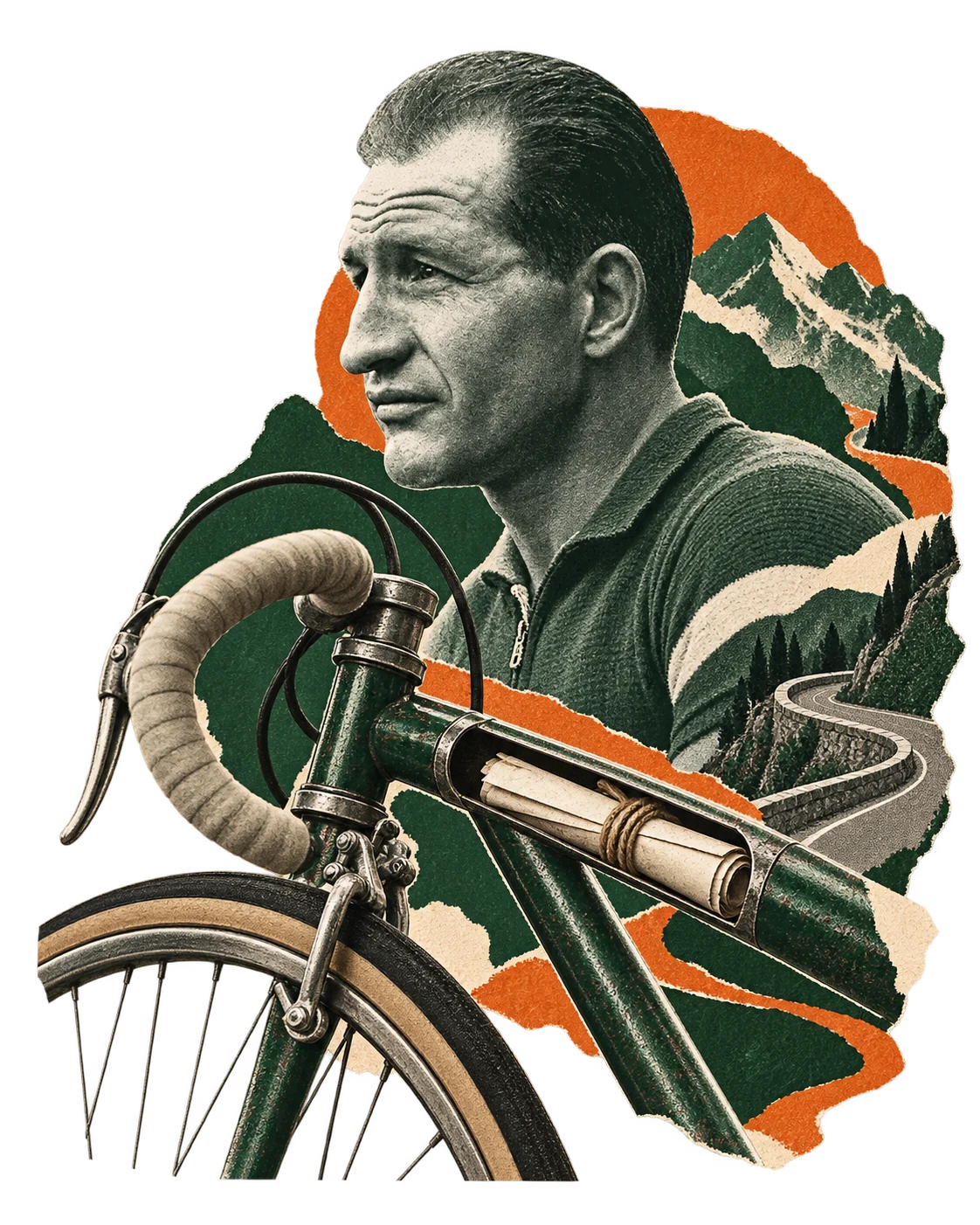
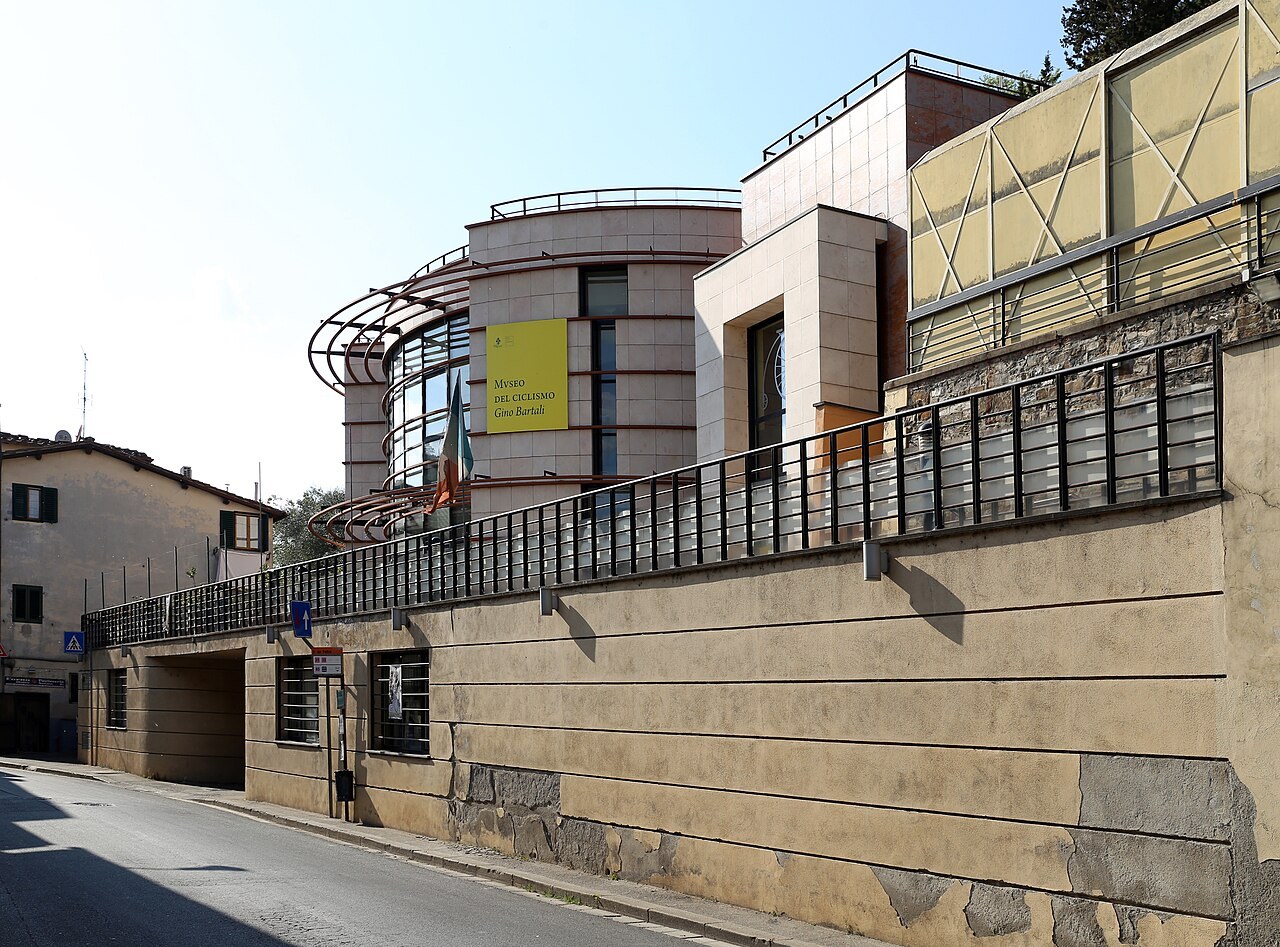
"If you're good at sports, they pin medals to your chest, and later they shine in some museum. What you achieve through good deeds is pinned to your soul, and shines everywhere," Bartali told his son Andrea.
Gino Bartali and the Great Races
Gino Bartali was one of the first cyclists in history to win the two most difficult and prestigious races in the sport. One is the prestigious and famous Tour de France, a cycling race contested by teams - 5,745 km covered over about three weeks, through France's breathtaking scenery. The race includes very challenging climbs and dangerous descents, as well as flat stages. In addition to stages in which all the riders set off together and race to the finish, there are time-trial stages, in which riders set off one after another. The Tour de France winner is considered the best cyclist in the world.
The world's second most important race after the Tour de France is the Giro d'Italia. The Giro takes place in Italy every May: three weeks of riding over 3,500 km in 21 stages. The race consists almost entirely of mountain climbs and near-continuous riding.
Winning both of these races in succession earns a cyclist a place in the pantheon of great athletes. Gino Bartali made his mark not only in the pantheon of cycling, but also among the ranks of good people.
In 1936, Bartali won the Giro d'Italia and the Giro di Lombardia. That same year, his brother Giulio was killed in an accident during a cycling race, and Bartali came close to retiring from the sport. He was persuaded to stay, and the following year he won a stage of the Giro d'Italia again. He wore the yellow jersey as the race leader, but withdrew from the race the next day. The official reason was an injury, but the real reason came to light years later: he had been forced to withdraw because he had not dedicated his stage win to the fascist regime. In 1938, he competed in the Tour de France for the first time. So that he could focus on the Tour, the Italian Cycling Federation barred him from also competing in the Giro d'Italia that year. He fell behind in the Tour de France after one of his wheels collapsed, but managed to make up the gap on his way to his first victory in the prestigious race. The following year, in protest against the fascist regime, the French prevented the Italians from competing in the Tour de France.
Gino Bartali was born in July 1914, just as Europe was plunging into the chaos of the First World War, in a small town near Florence, to a poor working-class family. Bartali would become not only one of the greatest athletes in history, but also a model of humanity and courage. As a boy, he worked hard for months to save up for his first bicycle. What began as a means of getting to school soon became a passionate obsession. Bartali trained with extraordinary determination, and by the age of 21 he was a professional athlete. His achievements were astonishing: he won the two most difficult and prestigious races in the sport - the Tour de France and the Giro d'Italia. His victories made him a national hero, but Bartali would prove that his true greatness lay far beyond the race routes.
Italian Jewry in the Shadow of Fascism
On the tip of Italy's boot, in the Salento Peninsula, a fascinating chapter in the story of European Jewry was written. This place, the closest to the shores of the Land of Israel, silently witnessed two defining moments in Jewish history - the beginning of the exile and its near end. About two thousand years ago, the tearful eyes of thousands of Jewish captives fell upon the shores of Salento. They arrived on the ships of Titus after the destruction of the Temple, forming the nucleus of one of the oldest Jewish communities in Italy. This community, one of the oldest in Europe, survived and grew over two thousand years, despite a continual struggle for equal rights.
It was only in 1848, in Sardinia, that Jews began to taste the fruits of equality. The process reached its peak 22 years later, when all Italian Jews finally gained full equal rights. This openness led to a historic breakthrough: Italy became the first country in Europe to have a Jewish Minister of War (Giuseppe Ottolenghi, 1902-1903) and a Jewish Prime Minister (Luigi Luzzatti, 1910-1911). But the joy was short-lived. Benito Mussolini's rise to power brought a wave of severe antisemitism. From 1937 to 1943, Italian Jewry endured years of persecution and discrimination, culminating in deportations and mass murder.
In 1943, after the Axis powers (Germany, Italy, and Japan) were headed for defeat in the war, Italy decided to depose Mussolini, surrender, and join the Allies. In response to what Hitler saw as Italy's "betrayal" of Germany, he decided to invade Italy and occupied the north, while southern Italy was controlled by the Allies.
From September 1943 to January 1944, at least 3,110 Jews from Italy were sent to Auschwitz. It is known that 2,224 of them perished in the Holocaust. Another 4,056 were deported east between February and December 1944, and it is known that 2,425 of them perished. About 2,700 Italian Jews were deported, and most of them perished.
Amid this darkness, the Jewish partisans shone brightly. About 2,000 Jewish fighters joined the resistance, a proportion nine times higher than their share of the population. Exemplary figures such as Dante Almansi, Leo Valiani, Mario Jacchia, and Emilio Sereni became symbols of courage and sacrifice.
The Underground in Assisi
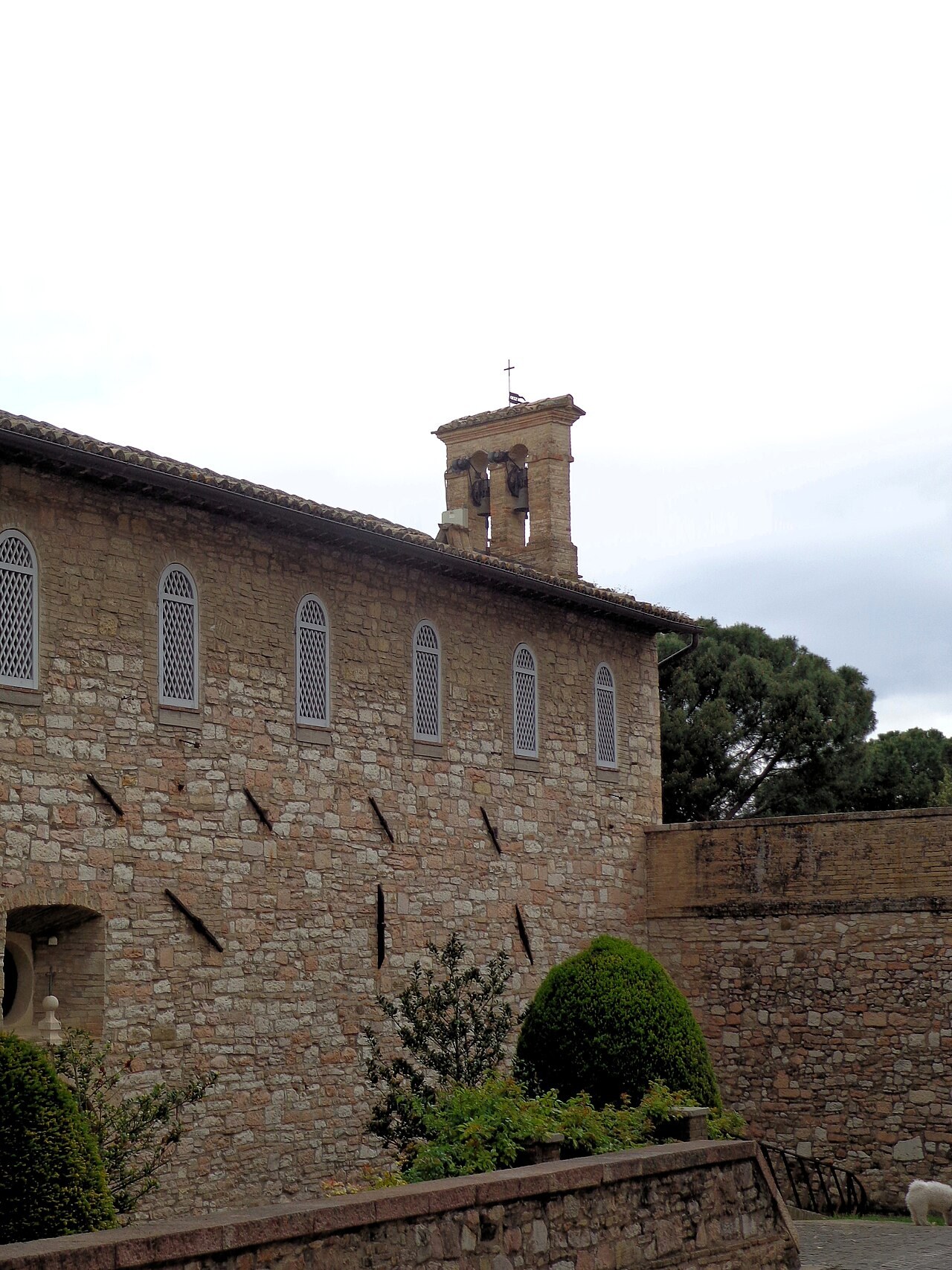
Against this backdrop, Gino Bartali's actions stand out. He joined the Assisi underground, which worked to save Jews from the Nazis. This underground group was established shortly after the German occupation by the Bishop of Assisi, Monsignor Giuseppe Placido Nicolini. It is worth noting that Assisi is the hometown of Francesco di Bernardone - Saint Francis of Assisi - founder of the Catholic Franciscan order. There are more than 30 Franciscan churches in Israel. Among the best known are the Church of the Transfiguration on Mount Tabor, the Church of All Nations, Dominus Flevit Church, San Simon Monastery, the Church of the Visitation in Ein Karem, St. John in the Mountains Monastery in Ein Karem, the Church of the Nativity in Bethlehem, and St. Peter's Church in Jaffa. Naturally, Assisi became a major and important center for the Catholic Church. Monsignor Giuseppe Placido Nicolini led the operation to save Jews and arranged hiding places in the city's 26 monasteries. The bishop went so far as to authorize the hiding of Jews in monasteries that admitted no outsiders. Thanks to the relief committee he established, Assisi became a refuge for many Jews and others who passed through the city and received forged papers that enabled them to survive elsewhere.
Without such documents, it was impossible to stay in guesthouses, pass through street checkpoints, or obtain food ration cards from the authorities. Jews in Florence, Bartali's hometown, who went to collect their ration cards under their real identities were arrested on the spot. The forged documents gave them a chance to live. Without them, that chance was close to zero.
To prepare the documents, the relief committee joined forces with a network founded by Rabbi Nathan Cassuto, the son of Moshe David Cassuto. The Hebrew University of Jerusalem had invited Moshe David to serve as a professor of biblical studies. Nathan, an ophthalmologist, established a network to produce these documents. The forged documents were prepared in stages. The first stage was obtaining blank documents. In the next stage, the details of the intended holder were filled in and stamps were added. In the third stage, the future document holder was photographed, and their picture was attached to the documents. In the final stage, the documents were delivered to the people in hiding. Each stage required the documents to be transported from place to place, putting both the courier and the other members of the underground at risk.
This is where Bartali came in. As part of his athletic training, Bartali rode with extraordinary courage and daring, risking his life as he cycled hundreds of kilometers across Italy and reached every destination without arousing suspicion. He took advantage of his reputation, trusting that the local police would not dare stop him. When he learned that refugees were staying in a particular monastery, Bartali would set out for it as part of his training, wearing a shirt bearing his name so that people would recognize him as the famous cyclist. He collected photographs of the refugees from the monasteries and brought them to the laboratory in Assisi to be incorporated into forged identity cards. In the same way, he delivered the completed documents to refugees in the monasteries - all under the watchful eyes of the fascist police, both uniformed and undercover, and the German army. The documents were hidden in the bicycle frame, in the saddle, and in the prayer book he carried.
In those days, athletes in Italy were regarded as warriors and greatly admired. No one would have thought to suspect an idol like Gino Bartali. Another person who joined the underground was Elia Dalla Costa, the Archbishop of Florence, who ordered that help be given to save Jews. In addition to his high position in the church hierarchy, Dalla Costa had officiated at Bartali's wedding, and it is clear that his request carried great weight with Bartali.
In addition to the considerable risks Gino Bartali took on his journeys from monastery to monastery, he is credited with other rescue efforts: he hid the Goldenberg family - two parents and their two children, who had come to Italy from Eastern Europe - in the cellar of his home. On another occasion, when groups of Jews were trying to escape, Bartali went to the railway stations, where he distracted the Nazi guards, who were thrilled by the famous athlete. Once, he was summoned for questioning at the fascist police headquarters, where people were tortured and executed, and warned not to maintain contact with the underground. After this interrogation, Bartali sent his family into hiding and continued his underground activities. He also provided information about German patrols along the only remaining escape route to the south, but eventually the smugglers who used it were caught, and the route was closed. Following his reports, the underground decided to stop trying to send refugees to the south of the country.
It is estimated that Gino Bartali saved about 800 Jews during the war.
After the War and Recognition
After the war, Bartali returned to competition. After winning several Italian races, he astonished everyone by winning the prestigious Tour de France again, a decade after his first victory. One evening, he received a fateful phone call. He was told that there had been an assassination attempt on Palmiro Togliatti, secretary of the Italian Communist Party, who had been seriously injured, and that Italy was on the brink of chaos. Bartali promised to do everything he could to win and help calm the country. In the end, Bartali kept his promise with a heroic victory. Tensions in Italy subsided, and many credit Bartali's victory with helping to calm the country. In 1950, he had a chance to win the Tour de France, but a dispute between the Italians and the French led the Italian federation to force its riders to withdraw.
Bartali died in May 2000, and his actions were not made public until three years after his death. When asked about them during his lifetime, he refused to discuss them and would only say: "Good deeds should be done, not talked about."
In 2008, several Italian cyclists, including Paolo Bettini and Maurizio Fondriest, as well as former footballer Fabrizio Ravanelli, made a bicycle journey from Florence to Assisi - the route Bartali had taken on his bicycle during the war - to commemorate his courageous efforts to save refugees. At the end of 2010, the testimony of an Israeli Holocaust survivor was published, stating that his family had been hidden in the cellar of Villa Bandino - Bartali's home in Florence - until the city was liberated by the Allies.
Thirteen years after his death, following testimonies from many Jews he had saved, Yad Vashem awarded Gino Bartali the title of Righteous Among the Nations.
In 2018, a bicycle ride called "Ride To Remember" was held in the Judean Lowlands in memory of Gino Bartali. The organizers of the 2018 Giro d'Italia, whose first stage was held in Jerusalem, named the stage "Bartali Stage" (Tappa Bartali). It was dedicated to his work and his memory, and at its conclusion Bartali's granddaughter presented a commemorative plaque to the stage winner, Tom Dumoulin.
In recognition of his actions, in 2006 Carlo Azeglio Ciampi, the President of Italy, awarded him the Gold Medal for Civil Valor. At the medal ceremony, he said: "This is a noble example of the greatness of a spirit of sacrifice and human solidarity."
In recent years, the organization "Bartali - Youth in Motion" has been active in Israel. It is a youth movement on bicycles that, inspired by Bartali's story, uses mountain biking as a tool for bringing about social change. Since the outbreak of the Iron Swords War, the organization has stepped up its work on behalf of children evacuated from the Gaza border communities and the north, aiming to support them in difficult times.
Gino Bartali was one of those heroes who showed extraordinary courage in difficult times, going against the tide without reward or publicity, risking their lives and acting with humility.
"My father rode 700,000 miles in his life. What were a few more miles if it meant saving Jews?" his son Andrea said when he came to Israel to receive the title of Righteous Among the Nations awarded to his father. He added: "I remember when I was 20, my father decided to tell me about it... All those years he never told anyone about what he had done, not even my mother. He was a modest man. Even when he told me, he made me swear I wouldn't tell. I suppose after all those years he no longer wanted to keep it all to himself."
Gino Bartali was more than a champion athlete. He was a model of humanity, courage, and humility. Bartali's good deeds continue to touch many souls to this day.
Once, when asked about his sporting success, he said: "Sports medals are pinned to your chest; good deeds cling to your soul."
תגובות
עדיין אין תגובות.