
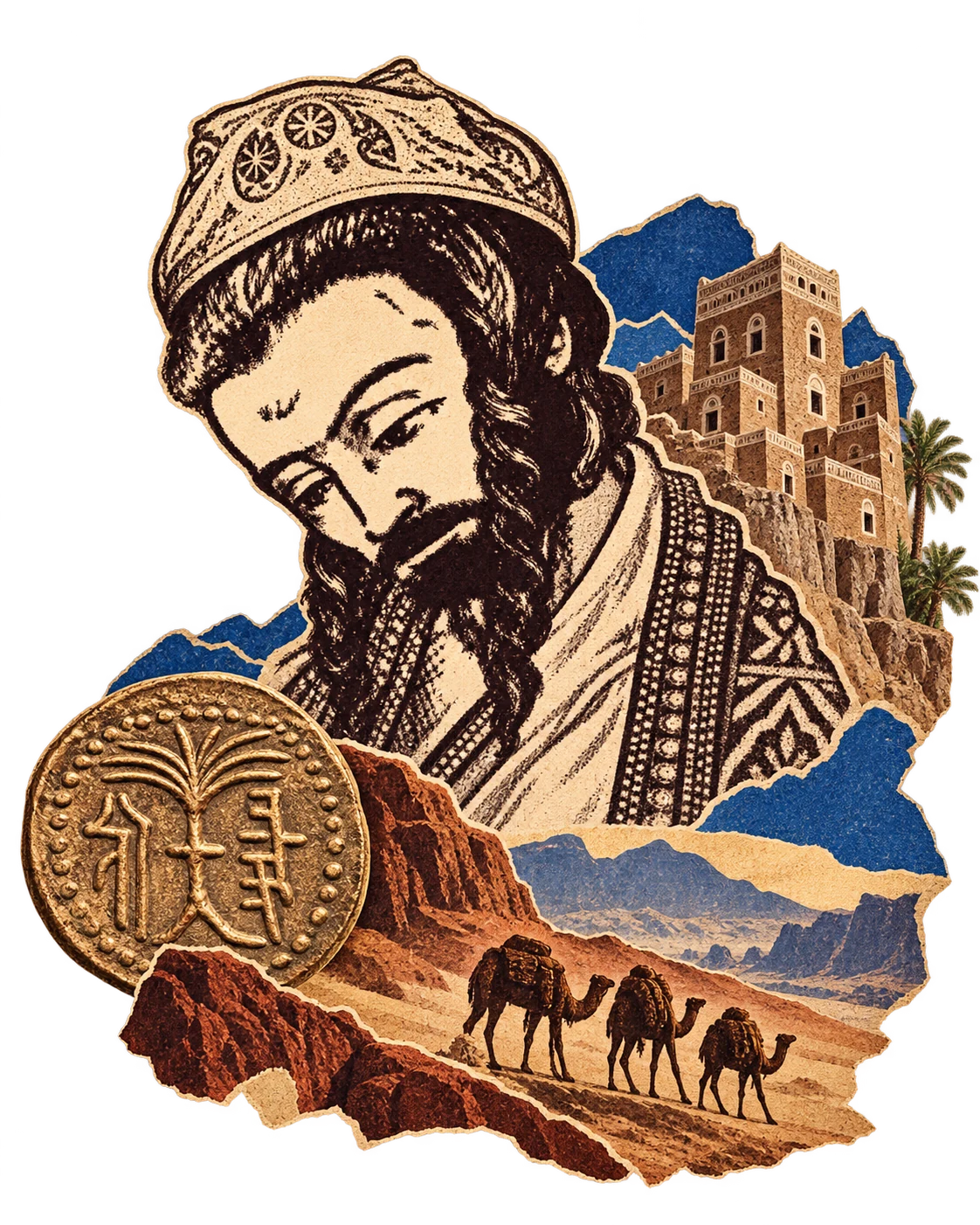
This is an astonishing story of a warrior king, courageous and wise, who subdued a mighty kingdom: a Jewish Yemeni king with sidelocks on his cheeks, a king who ruled where Yemen would later rise. He was the last Jewish king of the Himyarite Kingdom. Joseph Dhu Nuwas
Aksum and Himyar on the Incense Route
The Aksumite Empire was established in the first century CE and ruled northeastern Africa. Aksum was located in the area of present-day Ethiopia and Eritrea, and controlled the rich trade between the Indian Ocean and the Mediterranean Sea along the busy Incense Route. At its height, Aksum ruled northern Ethiopia, Eritrea, northern Sudan, southern Egypt, Djibouti, Yemen, and southern Saudi Arabia. The Aksumite Empire was the Kingdom of Sheba known to us from the Bible. It was from this kingdom that the Queen of Sheba came to King Solomon to test his wisdom. Isaiah said of this kingdom: "A multitude of camels shall cover you, the young camels of Midian and Ephah; they all shall come from Sheba; they shall bring gold and frankincense" (Isaiah 60:6). Many centuries after Isaiah, the Romans called it "Arabia Felix."
Along the Incense Route, in the area of Yemen, lay another kingdom - the Himyarite Kingdom - founded in the first century BCE. Its kings bore the title Tubba' (like "Pharaoh" in Egypt). Muslim historians relate that one of the rulers bearing that title, Abu Karib As'ad, who ruled from 420 to 385 CE, set out to conquer Medina. During the siege of the city, Jewish sages persuaded him to convert to Judaism. After conquering Medina, Abu Karib As'ad returned to his country, converted, and converted the rest of his kingdom's people; from then on, its kings were Jews.
At the Beit She'arim cemetery (second century BCE), a burial hall was uncovered containing a Greek inscription reading "of the people of Himyar" and a sarcophagus bearing the inscription "Prince of Himyar." Most scholars agree that the elite of the Himyarite Kingdom converted to Judaism around 380 CE. The kingdom's rulers may have seen Judaism as a potential unifying force for their new empire, which was home to many different cultures, and as a unifying identity against the incursion of Byzantine and Ethiopian Christians on the one hand, and the Zoroastrian Persian Empire on the other. The Himyarites went further and began persecuting those who converted to Christianity in their country in order to curb the spread of Christianity and, in doing so, reduce Roman influence in the kingdom. Abu Karib As'ad's son, the Tubba' Karakhba'il, left us inscriptions carved on dams from his reign, in which he glorifies the name of "the Merciful"; "God of heaven and earth"; "God of Israel"; and "God of the Jews." The prayers ask for his blessing for "the people of Israel" and often end with "shalom" and "amen"; some are even in Hebrew.
The last Jewish Tubba' was Joseph Dhu Nuwas, also known as Joseph As'ar. He was called "Dhu Nuwas" - "Lord of the Sidelocks" - because of the sidelocks that adorned his cheeks. Joseph was born a Jew, and his sidelocks were like those of a Yemeni Jew. The enemies of the Himyarite Kingdom were the Byzantines, whom Joseph hated with a burning hatred. In 522, the Byzantines conquered Zafar, the capital of Himyar, and even killed several Jews (in Zafar, a city that still exists today about 300 km north of Aden, a stone ring dating from 200 CE was found bearing the name "Isaac bar Hanina"). Joseph Dhu Nuwas set out on a campaign of revenge and conquered the city of Najran (now in Saudi Arabia, on the border with Yemen). He killed its Christian king, Harith ibn Qillah, massacred Christians, and set their churches on fire. Some claim that he dug a trench of fire and threw into it Christians who refused to believe in the God of the Jews. In 2014, the French-Saudi expedition discovered an inscription at Bi'r Himma recording Joseph's passage through the area after the massacre at Najran, as he marched north with 12,000 soldiers into the Saudi desert to demand the return of the rest of his kingdom.
Joseph Dhu Nuwas maintained ties with the sages of Tiberias and the head of the Sanhedrin, Mar Zutra bar Mar Zutra. Through Mar Zutra, he sought to establish a coalition between the Himyarite Kingdom and the Persian kingdom, an alliance against the Byzantine Empire. Joseph also attacked the caravans of Byzantine merchants traveling through Himyar along the Incense Route on their way to India. In his time, Judaism reached its height, and he is described as "a man of fearless courage, exceptional wisdom, and extraordinary energy."
Joseph Dhu Nuwas and the Fall of Himyar
The Christian community targeted by Dhu Nuwas's massacres appealed to Kaleb, king of Aksum, for help. The first time Kaleb attempted to invade the Himyarite Kingdom, he failed. But on his second attempt, aided by Christians and tribal chiefs in Himyar who had betrayed Joseph, Kaleb succeeded in winning the campaign. In 525, seeing that all hope was lost, Joseph Dhu Nuwas died a king's and hero's death, throwing himself, together with his horse, from a high cliff into the sea. His death meant that Judaism and the Jewish community lost their privileged status in Yemen. Stories of Dhu Nuwas's deeds were passed down from generation to generation, and in time various beliefs spread that the Ten Lost Tribes of Israel lived in the south of the Arabian Peninsula, and that one day they would be discovered and restore the Kingdom of Israel to its former glory.
A thousand years later, the false messiah David Reuveni invoked the king of the Jews in Arabia to support his ill-fated mission, claiming that he was the brother of King Joseph Dhu Nuwas.
A street in Jerusalem is named after Joseph Dhu Nuwas (the street runs north from Jaffa Road, opposite Nahalat Shiv'a). Prof. Shlomo Sand (whose theory is controversial) described in his book The Invention of the Jewish People the conversion to Judaism of the kings of Himyar and the inhabitants of the kingdom in Yemen, and concluded that Yemenite Jews are not Jews whose origins lie in the Land of Israel, but descendants of converts from the Himyarite Kingdom. On the other hand, there is a school of thought that holds that Jews arrived in Yemen at several points throughout history. In biblical times, there were five waves of migration to Yemen. The first wave of Jewish settlers in Yemen was associated with the development of trade relations between the kingdom of Solomon and the Queen of Sheba in the 10th century BCE, as mentioned earlier. Josephus Flavius wrote that King Herod (37-4 BCE) sent a Jewish unit of 500 soldiers in 25 BCE to assist the Roman army under the command of Aelius Gallus. The Roman army was sent to take control of Yemen because of its strategic importance along the Incense Route. The soldiers of the unit got lost in the desert, but some believe they settled in Yemen. The Greek writer Epiphanius wrote that Jewish refugees arrived in Yemen after the suppression of the Bar Kokhba revolt (135 CE). Shmuel Leib Gordon was deeply moved by this Dhu Nuwas and wrote a poem about him (read it at this link http://bit.ly/2OU51Zu)



תגובות
עדיין אין תגובות.