
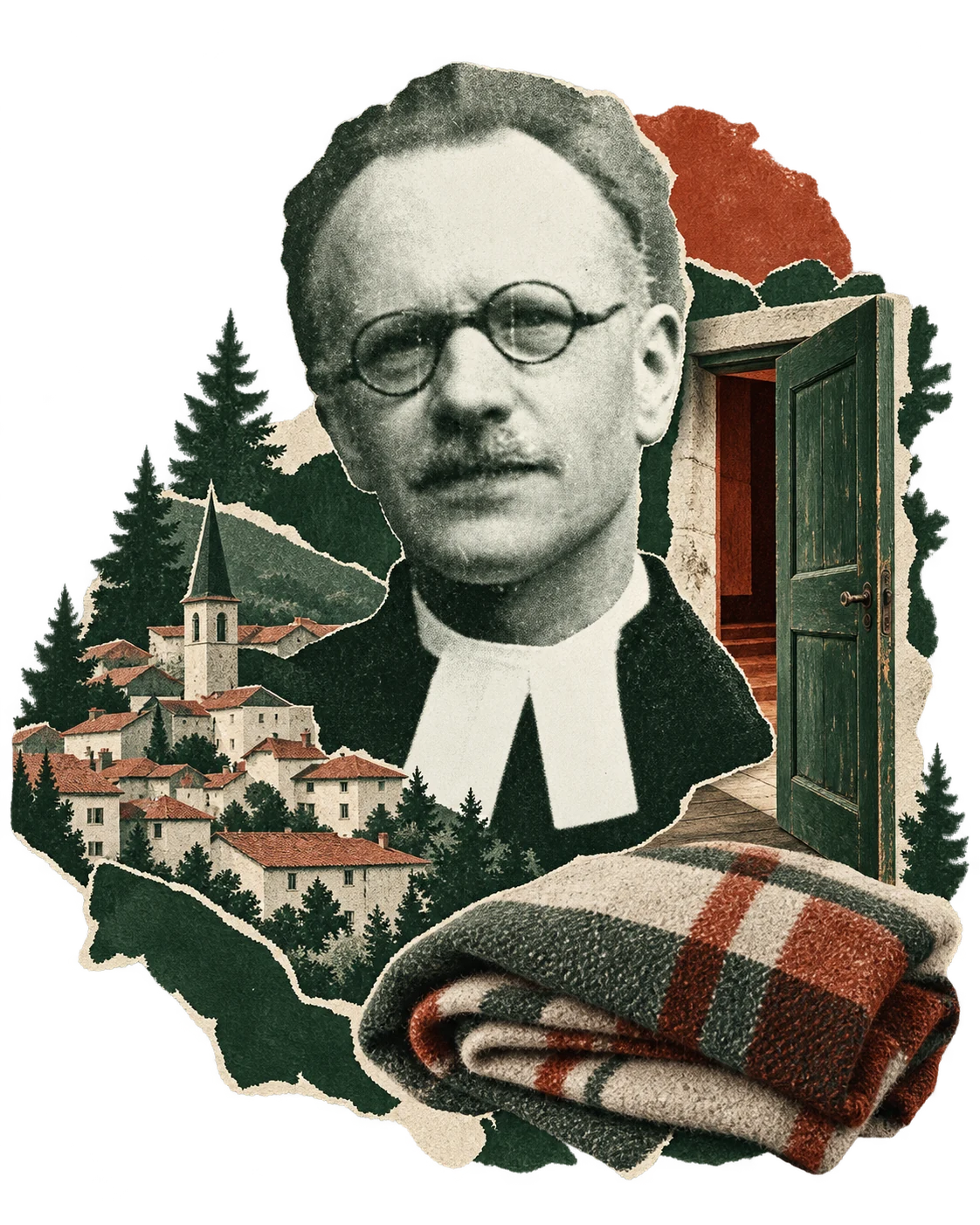
In the darkest period in human history, as the brutal machinery of murder operated at full force, the courage of the people of a small town who rallied to save thousands of Jews was a ray of light in the darkness.
Le Chambon-sur-Lignon and the Rescue
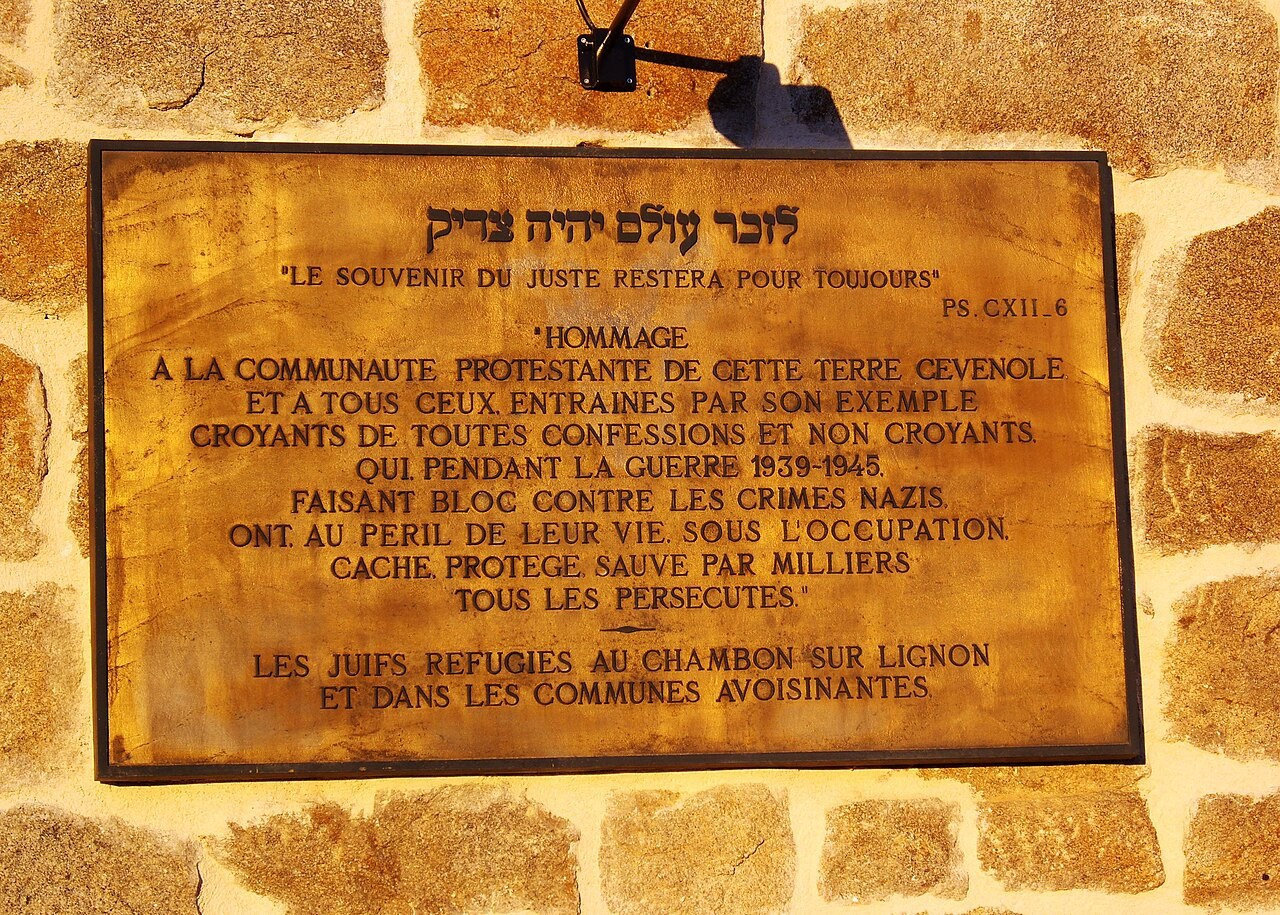
“And all your people are righteous” is written on the monument at Yad Vashem commemorating the courage of the residents of a town in southern France. Le Chambon-sur-Lignon was, and remains, a small Protestant town amid a Catholic French population. A plaque describing the courage of its people stands in a small garden in the heart of the town. They saved about 5,000 Jews from certain death at the hands of the Nazis, putting their own lives at risk. “It had to be done, and fate had it that we were there to do it. Helping those people was the most natural thing in the world,” the townspeople said of the rescue efforts led by the town’s pastor and his wife, Andre and Magda Trocme.
The Ways of Andre and Magda
Andre Trocme was born in April 1901 to a prosperous family in Saint-Quentin, Aisne in northern France. His father, Paul, was a Protestant industrialist, and his mother, Paula Schwerdtmann, was born in Germany. From a young age, he had a strong sense of justice and great sensitivity, and knew how to express his opinions. At 13, when World War I broke out and the scale of the disaster to come was not yet clear, he declared that he was a pacifist, a position his family did not understand. Despite his beliefs, he did not refuse military service. After the war, he began studying theology in Paris, and at 24 continued his studies in New York, where he met Magda Grilli di Cortona. They married the following year and had four children.
Magda Elisa Larissa Grilli di Cortona was born in Florence at the end of 1901. Her father, Oscar, an Italian Florentine nobleman, was an engineer and a colonel in Italy’s Corps of Engineers, and her mother, Nelly, was Russian. Shortly after Magda was born, her mother died, and her father remarried an Italian Catholic woman. The couple had three children. Magda drew inspiration from her maternal grandmother, Voria Poggio Wisocki, a strong, tough, and independent woman who was born in Siberia, where her father had been exiled by the tsar. She was an Orthodox Christian who left her husband and moved to Florence. From the age of 10 to 18, Magda studied at a Catholic convent, where her stepmother had sent her. After graduating, she went on to study at a higher education institution in Florence. In 1925, she moved to New York and studied social work. There she met the “pacifist” Andre Trocme.
Andre’s first job was in the town of Sin-le-Noble in northern France, where he served as the religious leader of the struggling metalworkers and miners. In 1934, Andre was appointed pastor in the town of Le Chambon-sur-Lignon. The settlement was founded in the 16th century by Huguenots (French Protestants) persecuted by the Catholic Church. From then until today, the townspeople have belonged to a Protestant religious minority in Catholic France, a minority persecuted for its faith. Four years after arriving, Andre Trocme and his friend, Pastor Edouard Theis, founded the College Cevenol International (Lycée International Cevenol), intended to provide an education for local farmers. The college taught love for every human being, regardless of religion, but the idyll did not last long: everything changed with Hitler’s rise to power in Germany. In mid-1940, the Nazi army invaded France and established the Vichy government.
Weapons of the Spirit
The day after the surrender, Andre Trocme and his colleague Edouard Theis delivered the sermon that became known as “Weapons of the Spirit”: “We must not become slaves or bow cowardly before new ideologies. Let us have no illusions: the doctrine of totalitarian violence has gained enormous prestige in the eyes of the world in recent days... Let us begin to trust one another again and greet one another, remembering at every encounter, as the first Christians did... Let us resolutely gather around Jesus Christ... It is the duty of Christians to resist the violence imposed on their consciences with the weapons of the spirit. We call on all our brothers in Christ not to agree to cooperate with this violence... To love, to forgive, to do good to our adversaries, that is our duty... We will resist when our adversaries seek to demand our submission in violation of the Gospel’s commandments. We will do so without fear, but also without pride and without hatred.” The sermon shook the townspeople, who maintained an approach of nonviolent resistance and solidarity throughout the war.
In October 1940, Marshal Petain issued an order requiring people to give the Nazi salute at various ceremonies. Trocme and his two partners in running the college, Edouard Theis and Roger Darcissac, said the order went against their consciences and chose disobedience and nonviolent resistance.
A month after the invasion of France, in July 1940, the citizenship of about 16,000 Jews was revoked. They were later barred from working in the public sector, and by August they were already required to wear a yellow star. Toward the end of the year, Jews were sent to internment camps in southern France - and that was when rescue efforts began.
The rescue effort began with a single refugee whom Magda found shelter for with friends. It was clear that the number of refugees would grow, so Andre Trocme appealed to his congregation and asked them to save the Jews, or, as he called them, “people of the Bible.” The townspeople, who were also persecuted for being Protestant, saw the Jews as sharing their fate, the fate of the persecuted, and joined the effort. Both the Huguenots and the Quakers (Christians who advocate peace and nonviolence) helped raise the resources needed to ensure the survival of the Jews they rescued. In this way, the town and its surroundings became an extraordinary island of safety in the heart of hell in France.
When transports from the internment camps to the extermination camps began, the rescue effort intensified. The rescue operations were conducted like a carefully planned military campaign. Magda played a significant role in the rescue effort and was responsible for finding families willing to take risks and help the Jews. Some of the volunteers waited at the railway station and took in the refugees as soon as they arrived. Pastor Edouard Theis and his wife, Mildred, took it upon themselves to smuggle Jews into neighboring Switzerland. They arranged forged identity papers and food ration cards for them, then led them along secret routes to the border with neutral Switzerland, where they handed the Jewish refugees over to Protestant activists on the other side, who took them to safety. It is estimated that these efforts saved about 5,000 Jews.
The Nazis began to suspect that rescue operations were taking place, and warned Andre Trocme. His reply was unequivocal: “These people came here to receive help and shelter. I am their shepherd. A shepherd does not abandon his flock... I do not know what a Jew is. I know only human beings.” The Nazis later began entering the town and searching for Jews. One resident recalled: “When the soldiers left, we would go into the forest and sing a song. When they heard the song, the Jews knew they could come out safely.”
In August 1945, Georges Lamirand, who had served as a minister in the Vichy government, visited the town and warned Andre to stop what he was doing. The situation was volatile and dangerous, but Andre Trocme continued to urge his congregation to “do the will of God, not the will of men.” He also read aloud the passage about cities of refuge: “You shall set apart three cities for yourself within your land, which the Lord your God gives you to possess... so that every murderer may flee there... He shall flee to one of these cities and live... Therefore I command you: Set apart three cities for yourself. And if the Lord your God enlarges your territory, as he swore to your fathers, and gives you all the land that he promised to give your fathers... so that innocent blood may not be shed in your land, which the Lord your God is giving you as an inheritance” (Deuteronomy 19). If cities of refuge must be set aside for a murderer, all the more so for those who are innocent.
On February 13, 1943, Andre Trocme, Edouard Theis, and Roger Darcissac were arrested. After four tense weeks, however, they were miraculously released and resumed their work with even greater caution.
Memory, Honor and Legacy
The 5,000 survivors represent thousands of stories, each one a world unto itself. Among them were Alexander Grothendieck, one of the greatest mathematicians of the 20th century, and his mother, as well as Denise Sikirsky, who lit one of the six torches at the 2003 state opening ceremony at Yad Vashem. The story most closely associated with the town is that of Eric Schwamm, an Austrian Jewish boy. At the age of 13, Eric fled with his parents and grandmother from the notorious French internment camp at Rivesaltes, from which the family was due to be sent to Auschwitz. In the summer of 1943, the family managed to reach Andre’s town and was hidden there for about two years.
At the end of the war, Eric Schwamm’s parents returned to Vienna, but Eric himself stayed in the town. In 1950, he moved to Lyon to study pharmacy, where he met his future wife. Eric prospered in business but never forgot the town and its residents, who had saved him and his family. Eric Schwamm died at the end of 2020 at the age of 90. A few weeks after his death, the executor of Schwamm’s estate contacted the town council and informed them that Eric Schwamm had left his fortune to the town, an amount estimated at more than 2 million euros. “For a town of our size, this is certainly a substantial sum,” said the mayor. At Schwamm’s request, the municipality planned to invest the money in educational programs and activities for children and young people.
After the war, Andre Trocme continued his work for peace and was appointed secretary of the International Fellowship of Reconciliation (MIR) in Europe. He was among the first to demonstrate against the nuclear arms race in France in 1958, and from 1960 until his retirement in 1970, he headed the French Federation Against Nuclear Armament.
Andre was not the only member of his family to work to save Jews. His nephew Daniel Trocme was a teacher and ran a boarding school in a village where Jewish children were also hidden. In June 1943, the Gestapo raided the school, and Daniel was arrested along with 18 of his students. He was accused of protecting a 16-year-old Jewish boy, and in early 1944 was sent to the Majdanek extermination camp, where he was murdered at just 34 years old.
At the beginning of 1971, Yad Vashem recognized Andre and Magda Trocme as Righteous Among the Nations, along with 32 other residents of the town. Five years later, Daniel Trocme was also awarded the title. In 1990, the entire town was honored for its actions.
The courageous story of the townspeople and the Trocme couple has been commemorated in films and books. The film “Weapons of the Spirit” was released in 1987. “The Hill of a Thousand Children” (La colline aux mille enfants) was also inspired by the rescue story.
Nobel Prize-winning author Albert Camus came to the town in 1942 to recover from tuberculosis and spent months recording his experiences from that period in his diary.
In 1979, Philip Paul Hallie wrote the book “Lest Innocent Blood Be Shed,” and in 1998, Carol Matas wrote “Greater Than Angels.” Both tell the story of the townspeople. The town and the work of Magda and Andre Trocme are also mentioned in the novel “The Kites” by the Jewish author Romain Gary. The book ends with the sentence: “And to conclude this story of mine, I shall return to the names Andre Trocme and Le Chambon-sur-Lignon, for there are none like them.”
Andre Trocme died in Geneva on June 5, 1971, at the age of 70. Magda Trocme lived longer and died on October 10, 1996, at the age of 95.
תגובות
עדיין אין תגובות.