
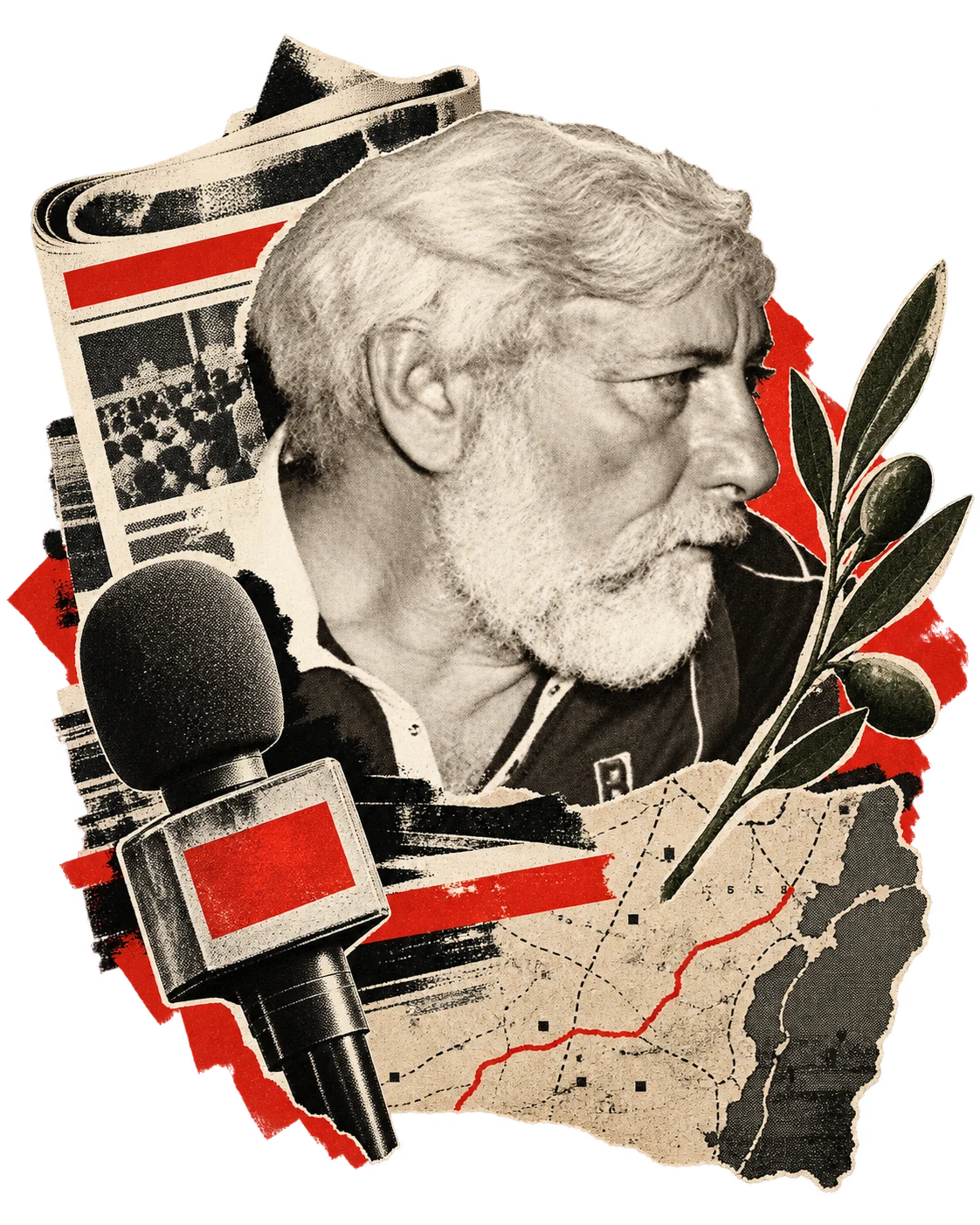
At 15, he joined the Irgun; during the War of Independence, he enlisted in Samson's Foxes, wrote their famous song, and proposed turning the song "Jerusalem of Gold" into the national anthem. Isser Harel called him "the regime's number-one enemy."
Uri Avnery
The Road to Beirut
The car screeched to a halt in front of the checkpoint. Among its passengers were three Israelis, one man and two women, and a German television crew. IDF soldiers checked the passengers and let the car continue on its way. From there, it proceeded toward a Lebanese Army checkpoint controlled by the Christian Phalange, whose soldiers had no idea that some of the passengers were Israelis. The car then continued toward a steep sand hill, where the passengers met up with PLO fighters and met with the deputy of Issam Sartawi, Yasser Arafat's envoy in Paris. The group got into Arafat's armored Mercedes and drove to West Beirut, trying to evade Mossad agents and the Christian Phalange. Years later, Uri Avnery, the bearded man among the passengers, wrote: "The meeting did not take place at an official PLO site, but in a private apartment belonging to the Shakur family, in an ordinary apartment building. It lasted about two hours and focused entirely on the possibility of peace between Israel and the Palestinian people. It was the first time Arafat met with an Israeli, and in that sense, one could say it was a 'historic meeting.' The date was 03.07.1982. I recorded every word, and the German crew was invited to film the last ten minutes."
After the meeting, the Israelis took advantage of the good atmosphere that had developed and asked Arafat to meet with Aharon Ahiaz, an Air Force pilot whose plane had been shot down on June 6, 1982, and who was being held captive by them. "No problem," was Arafat's response. The meeting with Ahiaz brought his family word that he was alive, along with a letter from him. Aharon Ahiaz was released about two and a half months later, without anything in return. Journalist Ronen Bergman said that when the Mossad learned of the meeting, they followed Uri Avnery in an effort to reach Arafat and kill him.
Uri Avnery's meeting with Yasser Arafat crossed both enemy lines and the lines of consensus in Israeli society. Many regarded it as an act of treason. Uri Dan, a journalist at HaOlam HaZeh, a newspaper then owned by Avnery, wrote a critical article about him in which he reported, among other things, that Uri Avnery's mother disinherited him because he chose to travel to Beirut instead of visiting her at the institution where she was hospitalized.
Uri Avnery and HaOlam HaZeh
Uri Avnery began his journalism career while on convalescent leave after being wounded in the battles of 1948. He was invited by Gershom Schocken, then editor of the newspaper Haaretz, who offered him a position on the editorial staff as the paper's lead columnist. Avnery left the newspaper shortly afterward because he felt he had not been given the freedom of expression he deserved.
In April 1950, he and Shalom Cohen bought the weekly HaOlam HaZeh, which had until then been an entertainment magazine. He recalled: "From the very beginning, my friends and I at HaOlam HaZeh had it in mind to create a newspaper that didn't exist in Israel, and in fact didn't exist anywhere in the world. The paper's distinctive format was an Israeli innovation, a total revolution in its writing style, headlines, pictures, mix, everything. It was something entirely new... Of course, this went hand in hand with a political revolution, because we were a newspaper that completely rejected the model of the state Ben-Gurion had founded, in every area." Uri Avnery was the newspaper's editor for 40 years, until 1990. The paper was successful by any measure, and in the mid-1960s it reached its peak. It was the second-most widely circulated weekly, with first place going to the weekly Davar Acher, distributed by the Mapai establishment.
Uri Avnery made the newspaper free, critical, and biting, unlike other newspapers, which were merely conduits for information and praised Zionist actions.
As a fighter, Avnery greatly admired members of the military and scorned those who had not fought (Shimon Peres). He was enthusiastic about Operation Kadesh and called for the unification of the two parts of Jerusalem. He proposed turning the song "Jerusalem of Gold" into a national anthem and was among the first to call for the establishment of a Palestinian state.
Alongside his admiration for military personnel, he exposed Moshe Dayan's looting of antiquities and published a list of his mistresses. The combination of revelations of corruption and an unconventional political agenda was among the factors behind the newspaper's financial success. The newspaper and Uri Avnery were anathema to Isser Harel, then head of the security services, who called Avnery "the regime's number-one enemy." Harel feared the paper would become a platform for incitement, and in 1956 he founded a competing newspaper called Rimon, anonymously and with state funds. It was printed in a sensational, colorful format in the hope of driving HaOlam HaZeh's readers away. The effort failed, and Rimon closed soon afterward.
Many of the country's leading journalists worked under Uri Avnery as editor, including Anat Saragusti and Sarit Yishai-Levi (his partners at the meeting with Yasser Arafat), Uri Dan, Natan Zahavi, Yigal Laviv, Raphael Bashan, Baruch Nadel, Silvi Keshet, Aharon Bachar, Dan Omer, Rafi Ginat, Hanoch Marmari, Ephraim Sidon, Kobi Niv, and Nurit Bat-Yaar. Despite the newspaper's clear political line, it was able to employ and accommodate a wide range of differing and opposing views. One of the reporters who worked for the paper was Gideon Sa'ar, the right-wing figure in Likud who left and now leads the New Hope party. Sa'ar had a political column in the paper called "Drip Feed."
Avnery was hailed as the father of Israeli tabloid journalism. He taught the craft of journalism and argued that every article should begin with a dramatic element. One of his crime reporters would begin almost every article with the sentence: "The car screeched to a halt..."
From Childhood in Germany to a Life of Struggle
Uri Avnery was born in 1923 as Helmut Ostermann in the town of Beckum, Germany, to Hilda and Alfred, a prosperous banker. He was the youngest of the family's four children, and spent his childhood in a wealthy home, surrounded by comfort. He attended his first years of school with Rudolf Augstein, later the owner of the successful weekly Der Spiegel.
When the Nazis rose to power, his father saw what was coming, and toward the end of 1933 the family immigrated to Palestine with a modest sum of money. Within a year, following a series of poor decisions, the money was gone, and his father opened a laundry in Tel Aviv where his mother also worked. The family spent the following years in poverty. At 14, Helmut left school to help support the family. Among other jobs, he worked as a radio technician and as a clerk for a lawyer. Later, he worked as a detective and became one of the first investigators in the country.
His brother Werner enlisted in the British Army, in Commando Unit 51. It was a mixed unit of Jews and Arabs known as the "Death Battalion." Werner was killed during the campaign to liberate Ethiopia, and the family name was changed to Avnery in his memory. Helmut later changed his first name to Uri as well, completing the transition from Helmut Ostermann to Uri Avnery.
As a young man, Avnery admired Jabotinsky, and in 1938, at the age of 15, he joined the Irgun to fight the British for the establishment of a Hebrew state. He was active in the organization for three years. During the War of Independence, he became a fighter in the Givati Brigade's Samson's Foxes unit and took part in many battles. The most notable were Operation Nachshon, to open the road to Jerusalem; Operation Maccabi; Operation Peleshet; and Operation Yoav, to liberate the Negev. Toward the end of 1948, he was promoted to squad commander in the brigade's 54th Battalion. The squad he commanded was made up of volunteers, most of whom had immigrated from Arab countries, particularly Morocco. That December, he was wounded, and he said his life was saved thanks to four soldiers who had immigrated from Morocco and pulled him to safety under fire. He wrote "The Foxes' Song," better known by its title "Samson's Foxes," which is particularly associated with singer Shoshana Damari's performance.
Every day, the newspaper Haaretz published reports Avnery sent them about the course of the battles. After the war, Uri Avnery collected all his dispatches into a single book, In the Fields of Pleshet 1948, which became a bestseller. Those were wonderful days for Uri Avnery, and he had money in his pocket. At the same time, he was not at peace with the book's message, and he moved from the far right of the political spectrum to its far left. He published a second book, The Other Side of the Coin, in which he described the dark sides of the war. In doing so, he shattered the heroic image of the war, and, as expected, the book caused a great deal of controversy.
"I am a man of struggle. I feel at home in a struggle. I don't think I sacrificed anything for it. I have lived a very full life, and I still live a very full life within the political struggle. Nothing is as important as what is called politics. Politics will determine whether the State of Israel will exist 50 years from now, what kind of state it will be, whether it will be a state we want to live in or not, and everything else seems trivial to me," said Uri Avnery. There were two attempts on his life. The first was in March 1974, when a man attacked him with his fists. The second took place toward the end of 1975, when Eliyahu Galili stabbed him in the stomach, leg, and chest. The first person to visit him in the hospital was Rehavam Ze'evi (Gandhi), who persuaded him to carry a weapon. Avnery did so, carrying a pistol for 15 years.
Avnery was married to Rachel, who stood by his side throughout. They were married for 58 years and chose not to have children. His mother died at the age of 95, and he promised to beat her record and live longer than she had. But in August 2018, Avnery suffered a stroke and died at the age of 94. At his request, his body was cremated.
תגובות
עדיין אין תגובות.