
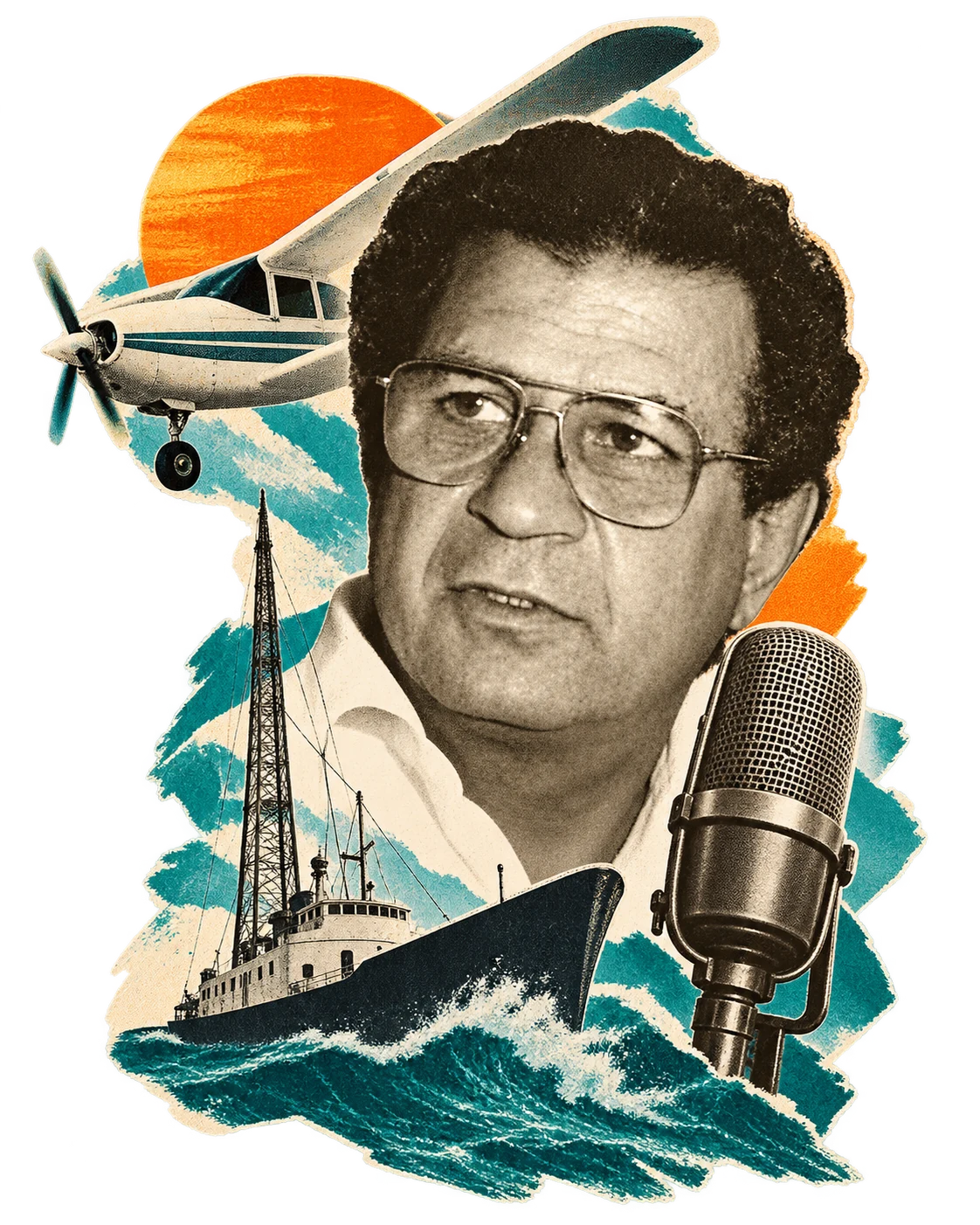
He was born in Iran to a Yemenite father, studied in India, and served in the Israeli Air Force. A Don Quixote who gave all his money to help others.
The First Flights for Peace
On the morning of February 28, 1966, the light aircraft took off from Herzliya Airport, headed out over the sea, then turned south and flew toward Egypt. Air Force planes that were scrambled spotted the words "Peace 1" written in Hebrew and Arabic on the aircraft's engine cowling. The pilots, who knew the pilot of the light aircraft, tried to contact him but to no avail. At a certain point, they decided to break off contact and returned to base. Several hours later, Israel Radio reported on the news that Abie Nathan's plane had crashed near the city of Port Said, and many of his fellow pilots began gathering to mourn his death.
Moments before his "death," Abie Nathan noticed that the fuel tank was running low and decided at the last moment to land at Port Said Airport. The astonished Egyptian air traffic controllers realized after several long minutes that the plane had come from Tel Aviv, but were even more surprised by the pilot's strange request to "meet Nasser." The city's governor was summoned to the airport, while back home Abie had already been reported dead.
The governor began a series of phone calls with senior officials in Cairo, then returned with instructions to refuel the plane and allow it to return to Israel. "If anyone asks about you, we'll deny that you were here, and you won't be prosecuted in Israel," he promised. Abie Nathan explained that he could not return because night was falling and he could not fly in the dark. So he spent the night in the Egyptian control tower playing cards with the controllers, and the next morning Nathan set off aboard "Peace 1" on his way back to Tel Aviv.
"Abie is alive!" people cried at the California restaurant, where the pilots used to meet. The crowd ran to Herzliya Airport, and about 1,000 people welcomed him. Abie was carried around the airport on people's shoulders amid loud singing and champagne. Police officers waiting there in a patrol car questioned him and released him immediately. About a year later, the Six-Day War broke out.
This was Abie Nathan's first flight in an effort to bring about peace, or at least dialogue between the sides, but it was not his last. On July 28, 1967, Abie Nathan took off from Nicosia in the same plane and landed once again at Port Said Airport. This time too, he was expelled and returned to Israel, but he was fined and given a one-year suspended sentence. Abie refused to pay the fine and spent 40 days in prison.
His third attempt was on June 4, 1969, when he boarded a commercial flight in Rome as a passenger and landed in Cairo. He was arrested immediately upon landing at Cairo International Airport and deported on a flight to Athens.
From Abadan to El Al
Abie Nathan was born in 1927 in Abadan, Iran, to Matilda and Yaakov. His father, a Yemenite Jew born in Sana'a, had come to Iran through his work for the Anglo-Iranian Oil Company. When Abie was born, his parents noticed that he had a strange birthmark, and brought in a specialist who told them that it was a sign he would achieve great things. Abie was born into a wealthy family, and when he was 12 the family moved to Mumbai, where he studied at the Sir Jacob Sassoon Jewish Zionist School. By the age of 14, he had already developed an interest in politics and a desire to lead. At that age, he also won first place in a political speech competition.
At the age of 17, Abie Nathan lied about his age and joined the British Royal Air Force. While working for Air India, he learned that the State of Israel had been established and was looking for volunteers for its fledgling air force. The very next day, he reported to the Jewish Agency offices and offered his services. He left a secure job and flew to London with all his savings - about 250 pounds. As he recalled: "I thought I'd come to Israel, do my part, the war would be over in three months, and I'd go back to my job at Air India." From London, he was sent to Paris and instructed to fly a plane to Czechoslovakia and from there to Israel.
Abie Nathan felt a sense of mission and pride in belonging to a group of volunteers and helping establish the state. Soon afterward, he transferred to serve as a fighter pilot in Squadron 103 at Ramat David. "There were no anti-aircraft guns in Sasa. We bombed the village from an altitude of 3,000 feet, feeling completely safe... I walked among the ruins and charred bodies scattered everywhere. I witnessed the destruction, devastation, and death caused from the air by a bomber pilot. Now I saw with my own eyes what I had done. I fell into a deep depression," he later said. The next mission was to stop the Egyptian column. Abie failed to locate the target and was afraid to drop the bombs on civilians, so he directed them into the sea. The war ended that day, and a ceasefire came into effect. Abie continued to serve in the Air Force, flying paratroopers and instructing at flight school. Later, he was sent to England to train on the Israeli Air Force's first Mosquito aircraft. He aspired to become a squadron commander, but believed that being a new immigrant had hindered his advancement, so he chose to leave and join El Al.
His years at El Al were good ones for Abie Nathan. He felt fulfilled flying Jewish immigrants from his native Iran to Israel, and also worked the Tel Aviv-London-New York route. During this period, he rented an apartment in London and often spent time in Paris and Rome. He was very strict about safety, which sometimes led to some flights being delayed. On one occasion, he even flew without passengers because the crew was tired and might otherwise have put passengers at risk. This led to tensions with management, and at the end of 1958 he resigned from El Al with the rank of captain.
The Restaurant, Nivas and the Wanderings
With the severance pay he received, he and several fellow pilots opened the California restaurant. The restaurant was next to the Kassit Cafe, where Tel Aviv's old guard, including Nathan Alterman and his circle, used to spend time, while the young people of the day - Arik Lavie, Shaike Ophir, Gila Almagor, and others - would go to the California. The restaurant was a success, and Abie bought out his friends' shares. Before long, he had moved into other businesses in Tel Aviv and become a wealthy and well-known man.
At the California, he met Nivas, a Spanish waitress. As he said, she was the love of his life and made him more sensitive to people and more socially active. She introduced him to literature and painting, but after about two years the relationship ended and Nivas left the country. Abie followed her in an attempt to win her back, but when he discovered that she was already engaged to someone else, he set off on a two-year trip through the Scandinavian countries.
From Humanitarian Aid to Protest and Peace
Abie Nathan devoted many years of his life and much of his wealth to helping and saving others: He awarded scholarships to students at Tel Aviv University in memory of his fellow pilots who fell in the War of Independence. He supported actors in need and gave financial assistance to families in distress. In 1966, he helped drought refugees in India's Bihar region, distributing 10 tons of corn to 35 villages. In 1968, he founded the Biafra Children's Fund, which held a campaign to raise money for food in the wake of the humanitarian disaster. In 1976, he helped survivors of the earthquake in Guatemala. In 1979, he organized a food distribution operation in Cambodia following the country's genocide, and in 1985 he set up tent camps in Ethiopia in response to the severe drought. That same year, after the earthquake in Colombia, he established a brick factory to help rebuild homes. In the mid-1990s, he helped establish refugee camps in Zaire and Rwanda. In Israel, he organized humanitarian operations, including providing stoves for the elderly and planning a drug rehabilitation village. At the beginning of 1980, he founded Abie's Angels, a volunteer organization for mutual aid, and in August he established the Good Old Age Fund, which distributed clothing and household goods to needy elderly people. At the end of that year, he established a social lobby on behalf of the elderly and received an award from the Knesset for his work. In March 1981, he donated money to establish a maternity ward and funded renovations to homes for the elderly in Tel Aviv. In January 1991, he bought food and 50,000 bottles of mineral water for the Kurds in northern Iraq, who had fled to the mountains to escape Saddam Hussein. In 1992, he flew to Somalia and set up a camp for 35,000 refugees. And this is only a partial list...
"I give wherever someone is in need, and I don't care where," he said. "Before I give my daughter a slice of cake, if there's a boy or girl somewhere in the world beside her, even an Eskimo with no bread, then before I give her the cake, I'll make sure the child gets the bread."
He was also involved and active in politics. In January 1975, he began a hunger strike aboard his ship in Marseille, protesting the superpowers' violence and arms shipments to the Middle East. In 1978, he went on a hunger strike for 45 days, demanding that settlement construction be halted during the peace negotiations. In the 1980s, he began meeting with PLO members, prompting the passage of a law against such meetings. Despite the law, he continued to hold meetings, and in 1989 he was sentenced to six months in prison. In 1991, he went on a hunger strike for 40 days to protest Amendment No. 2 to the Prevention of Terrorism Ordinance (the "Meetings Law"), which prohibited meetings with the PLO. He continued his contacts with Yasser Arafat and his associates, and in September 1991 was convicted of violating the Prevention of Terrorism Ordinance and sentenced to 15 months in prison. Abie chose not to appeal the sentence and was imprisoned.
Although he was involved in many different activities, most people remember Abie Nathan mainly for the Peace Ship. In 1967, he began establishing a radio station to promote peace in the Middle East, called the Voice of Peace. The ship was stationed about 25 km off the coast of Israel and, from 1973 until October 1993, broadcast messages of love and peace from the Mediterranean Sea. The revenue from its advertisements helped fund a large part of his rescue and relief operations. In 1975, as an act of peace, he tried to take the ship through the Suez Canal, which had reopened, but the Egyptians would not allow him to.
In 1997, while beginning to write his memoirs in Washington, he suffered a stroke, with his daughter Sharona at his side. Abie had another daughter, Yasmin Feingold, a former Israeli rowing champion who made headlines when she nearly drowned in the Yarkon River in 2009. Abie met her mother when she worked on the Peace Ship.
Although an Indian fortune-teller told him he would live to the age of 67, Abie Nathan died on August 27, 2008, at the age of 81. The man who had cared for so many people died penniless, his dream of brotherhood and peace still a distant one. The last ten years of his life, during which he was paralyzed, very ill, poor, and lonely, were a tragic end to the life of a man who fought for peace and for society. Before he died, he was asked what he wanted written on his gravestone, and he answered, "I tried." And so it was.
His friend Yonatan Geffen wrote the song "Don Quixote" about him, which was sung by Arik Einstein. He is also mentioned in the songs "There Will Be More" and "We Had It Good, Things Will Get Bad," performed by Einstein:
Here is Abie Nathan, aboard the ship / Sailing into the darkness / Ya habibi Abie, good luck to you / Deep in our hearts, there's one great prayer / There will be more, there will be more / Peace will come to us someday / There will be more! There will be more...
The plane he flew to Egypt was retired and put on display at the Ramat Gan National Park. In 1972, it was set on fire by hooligan teenagers and burned to the ground. The ship was sunk on Abie's orders, and for years its location was unknown. In 2016, it was found about 16 km west of Palmachim Beach.

תגובות
עדיין אין תגובות.