
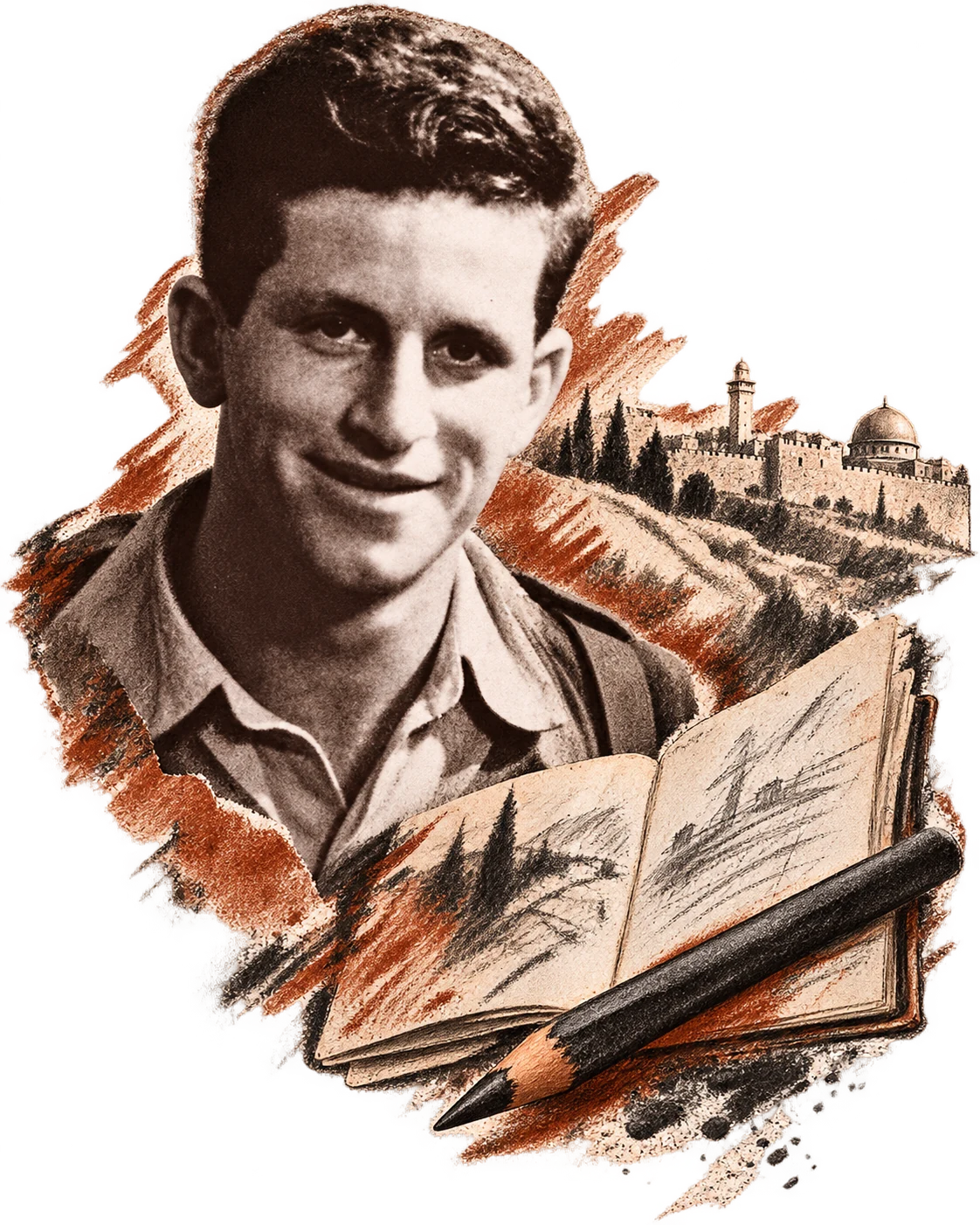
Jimmy was killed by a stray bullet in the War of Independence. "What a cruel twist of fate! To come through all the battles for Jerusalem and on the way there without being hit or wounded... only to fall to a stray bullet... to be the only one killed in such a brilliant battle..."
The Shared Outpost in 'There Were Days'
One of the songs most closely associated with the War of Independence is undoubtedly Haim Hefer's "There Were Days":
The day will come when you'll sit by the hearth And your back, too, will be bent like a hump Then you'll remember your days in the Palmach And tell the story while smoking a pipe
There were days, When we sat at the outpost, There were days, We fought and loved, Now nothing is recognizable - A city sits on the outpost, Perhaps thanks to those days...
The outpost mentioned in the song is the "Shared Outpost." During the War of Independence, Harel Brigade soldiers held its northern section, while an Egyptian force occupied its southern section, with no more than 60 meters between the two forces. On the night of October 19, 1948, Harel Brigade soldiers captured the "Shared Outpost," and the operations officer and company commander, Aharon (Jimmy) Shemi, was killed by a stray bullet. His death stunned everyone and left them deeply shaken. Jimmy had seen many hours of combat in numerous operations in the sector, and it seemed that death always passed him by.
Our forces captured the outpost, and the Arabs, in their retreat, left behind rifles and cannons, which were extremely valuable at the time and came to be known as "Jimmy's cannons" and "Jimmy's rifles." The end of the battle is described in the book Friends Tell of Jimmy: "Amid the great clatter of machine guns, shouts and cheers could be heard in at least half a dozen languages: 'Victory, we won!' People caught in the moonlight raced in a frenzy across the outpost, between the trenches and the olive trees. Before setting out, Jimmy ordered the Davidka crew to shell the enemy's last positions... Jimmy leaned against a sandbag emplacement, standing calm and taut, craning his neck and straining to see by moonlight where the Davidka shells had struck the enemy positions. Suddenly he collapsed and rolled into the trench. A bullet from Beit Shemesh, from the Arab village at the foot of the hill, hit his side and pierced his heart. 'I've been wounded,' he said. 'Give my regards to the family.' Eliezer opened his shirt - there was no sign of blood. The bleeding was internal. They began calling, 'Jimmy, Jimmy,' but there was no answer. They rushed a medic over with a stretcher, and on the stretcher, his head slumped to one side." Jimmy was 22 when he died.
Two years after the battle for the outpost, the Hartuv transit camp was established. In time, as the song puts it, it became the city of Beit Shemesh, and HaMishlat Street commemorated the site.
From Haifa to the Palmach
Aharon (Jimmy) Shemi was born in May 1926 in Haifa. He studied agriculture and, alongside his studies, drew caricatures, wrote poems, and played the violin - a rugged Sabra with a sensitive soul.
In 1945, he joined a Palmach training group and took part in several operations, one of which ended with his capture and imprisonment. He was wounded twice, completed a commanders' course, and qualified as a Palmach platoon commander. During the War of Independence, Jimmy was appointed commander of a company in the Harel Brigade's Fifth Battalion (the Sha'ar HaGai Battalion). He and his company fought in the fierce battles along the road to Jerusalem, at Ramat Rachel, and on the Jerusalem-Jericho road. He took part in the battles for Augusta Victoria Hospital and Sheikh Jarrah, and in the fierce battle for Radar Hill. Jimmy was loved by everyone, and when he fell, it felt as if everything was collapsing: "No, this is too much. Too much. Someone has crossed the line..." his fellow battalion members said.
The task of delivering the sad news to Jimmy's parents fell to the battalion welfare officer, Aliza Becker (later Aliza Guri, wife of Haim Guri). Aliza went to Safed and picked up Jimmy's father, the painter Menachem Shemi, and his mother, Rebecca, in a taxi to Abu Ghosh, where Jimmy lay covered by a military blanket. Aliza recalled sitting beside the driver as they made the journey from Safed to Abu Ghosh in complete silence. Every so often, his parents would place a hand on her shoulder and ask, "Are you all right, young lady?"
Jimmy was posthumously promoted to the rank of major and was buried in the military cemetery at Kiryat Anavim, where the Harel Brigade's fallen from the War of Independence are buried. A fifth of the brigade's soldiers were killed during the War of Independence, and half of them are buried in this cemetery.
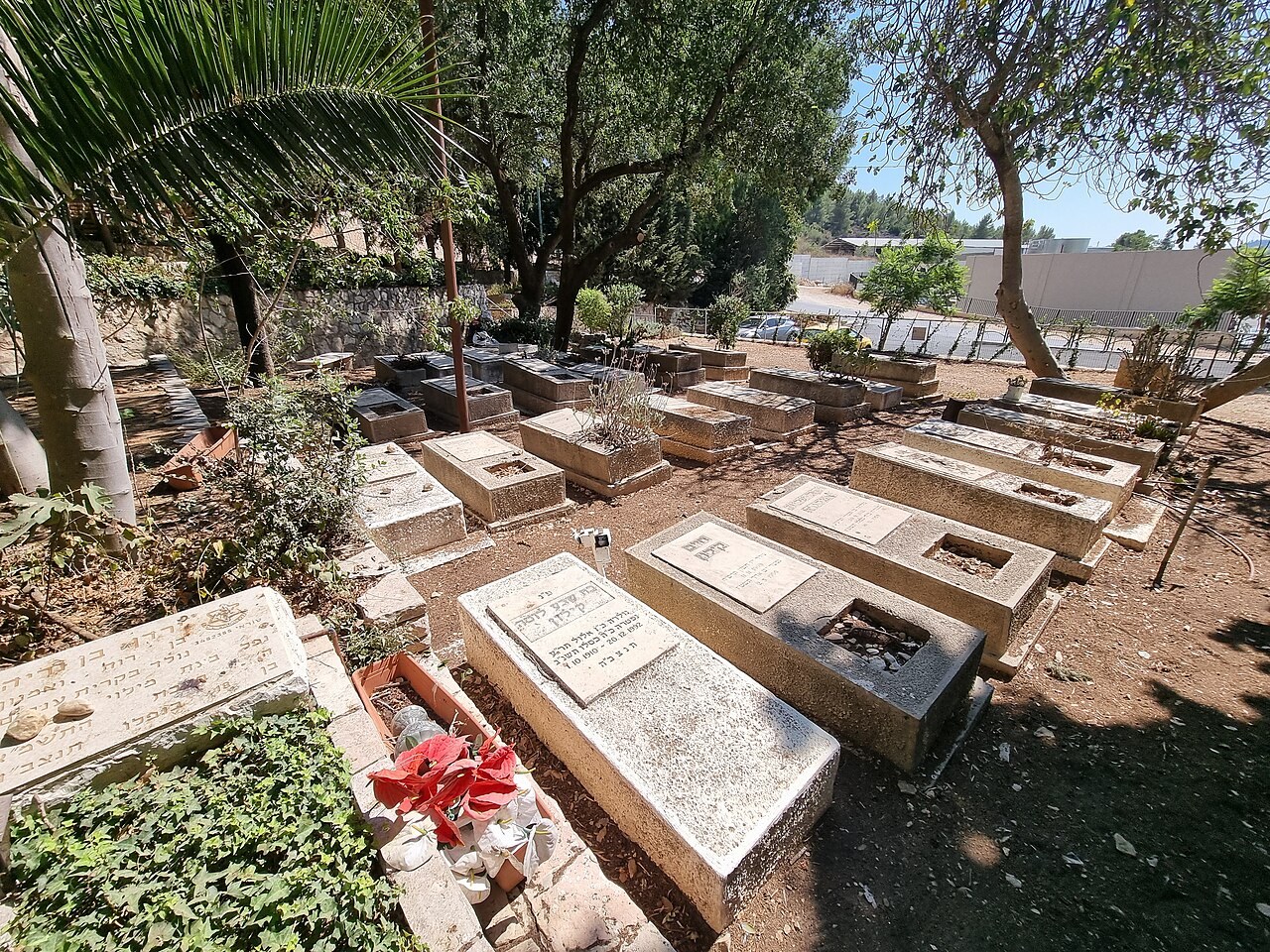
At the time, it was dangerous to go out and dig graves during the day, so members of Kiryat Anavim would go out to dig at night. The cemetery was several hundred meters from the path the fighters took from the settlement on their way to battle. As they headed out to fight, the soldiers could hear the shovels digging, knowing that some of them would be laid to rest there forever... Friends Tell of Jimmy recounts that one night Jimmy and his soldiers passed by the cemetery and, up the hill, saw members of the kibbutz at work digging. "They're preparing this for us!" the thought struck each and every one of them. "Hey, you there! Work faster! Be ready! We've already set out..." Jimmy shouted down toward the cemetery. It became a joke. The first impression faded somewhat, and the unit continued on toward Radar Hill.
Meir Shalev, too, writes about the digging of graves in his book A Pigeon and a Boy: "...There wasn't a single night when we didn't go on an operation, and the work was divided up: whoever didn't go out dug a grave for the one who wouldn't come back. And that sound of pickaxes in the wadi, iron striking rock, I can still hear it now, more than the gunfire. Digging and digging, not daring to guess exactly who it was for this time."
The echoing blows of the pickaxes that accompanied those heading into battle can be heard in the background of Bobby Gibson's song "Harel Battle," with lyrics translated by Haim Hefer:
Boom-ba, ba-boom, boom, boom The whole universe grows dark The mountain is dim, the street is black The city is dying under siege No bread, nothing, nothing. Boom-ba, ba-boom, boom, boom...
The Monument and the Book in His Memory
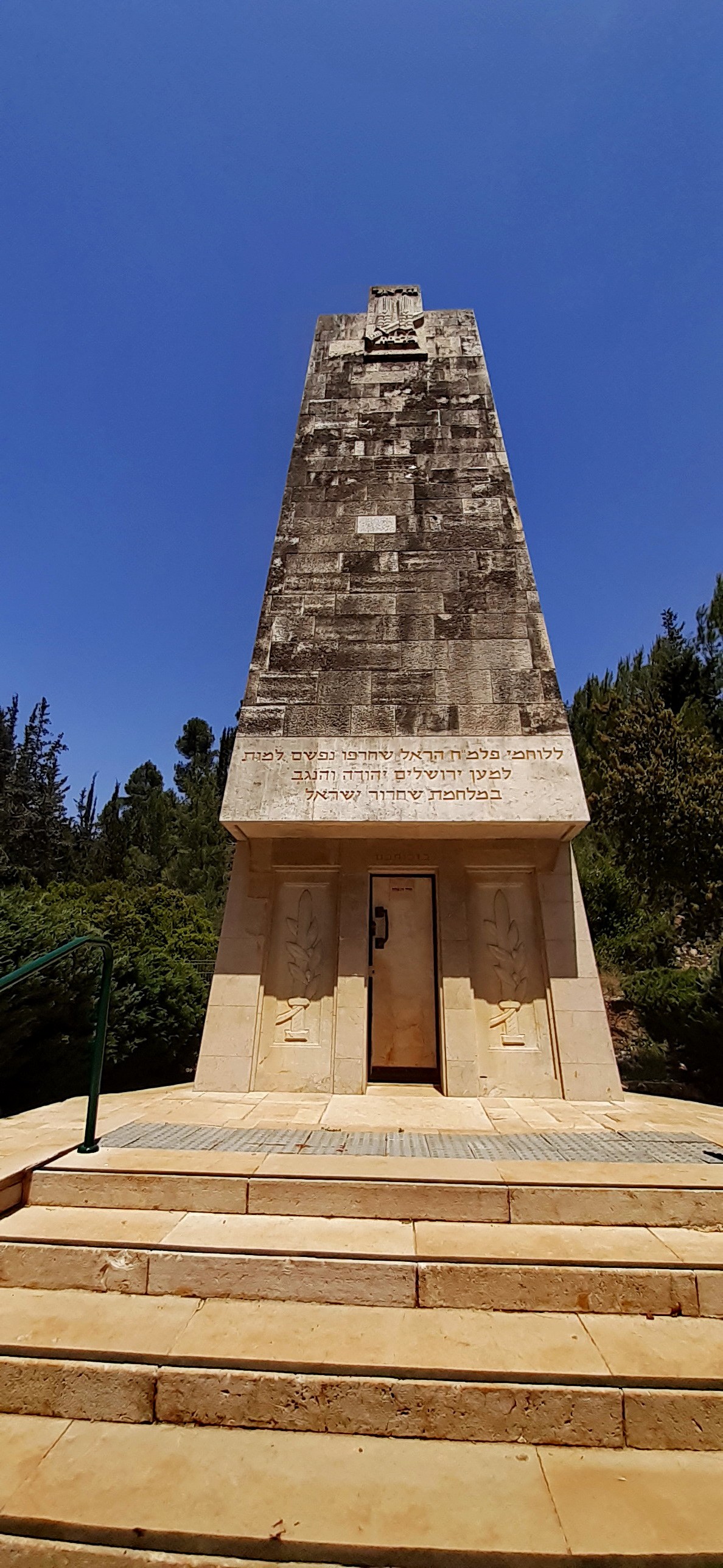
The memorial to the fallen of the Harel Brigade in the cemetery at Kiryat Anavim, overlooking Jimmy's grave, was built by his father, the painter Menachem Shemi, who himself fought in both world wars. Menachem came to the Land of Israel at a young age and studied at Bezalel. The decision to build the memorial was made in 1950, and funding came from the fallen soldiers' parents and the kibbutzim where they had grown up. At the same time, Menachem and Rebecca worked on another memorial to their son - the book Friends Tell of Jimmy. Menachem Shemi worked on the memorial for a year, and when he finished building it and put down his tools, he died. He did not even live to see the book come off the presses. Menachem and Rebecca were also buried at Kiryat Anavim, not far from their son Jimmy. They are the only parents of a fallen brigade member buried there.
The Fifth Battalion, commanded by Jimmy, was initially made up of Palmach reservists: young soldiers who had been discharged and gone on to study or work. Later, youth training groups from the kibbutzim joined them, along with Gahal soldiers (overseas recruits) who had just disembarked from the ship. The latter were not fluent in Hebrew. They did not know how to shoot, and their welcome was on the battlefield. Even so, there were funny moments in this situation, too. It is said that before setting out for battle, commander Zivi Tzafriri, a member of Kibbutz Givat Hashlosha, pointed to the village and said in broken Yiddish, "Das Tzuba - menemt" (That's Tzuba - we'll take it). The soldiers charged the village, shouting, "Za rodzinu, za Stalina, za Ben-Guriona," which means in Russian: "For the motherland, for Stalin, for Ben-Gurion." Later, a commander in the Jordanian Legion said that during the Fifth Battalion's attack, shouts in Russian could be heard across the area, causing them to fear that "the Russian brigade has come to help the Jews."
The book Friends Tell of Jimmy brings together stories from the fighters who served alongside him and poems he wrote from the age of 11 until he fell. It is considered the first memorial book published in the State of Israel, and excerpts from it are read at memorial evenings. The late journalist Amnon Dankner even called it "a book that shaped a generation." In 1968, the book was adapted for the stage, and the production opened at the Habima Theatre in 1970. Yohanan Zarai composed the music, and Hanna Rovina appeared in it.
Jimmy's loss was not the last sorrow to befall the Shemi family. After his parents died, his sister Naomi passed away, and his brother Ze'ev was killed in a car accident. Naomi's son, Avner, was killed in the Yom Kippur War, about three months after his wedding.
תגובות
עדיין אין תגובות.