
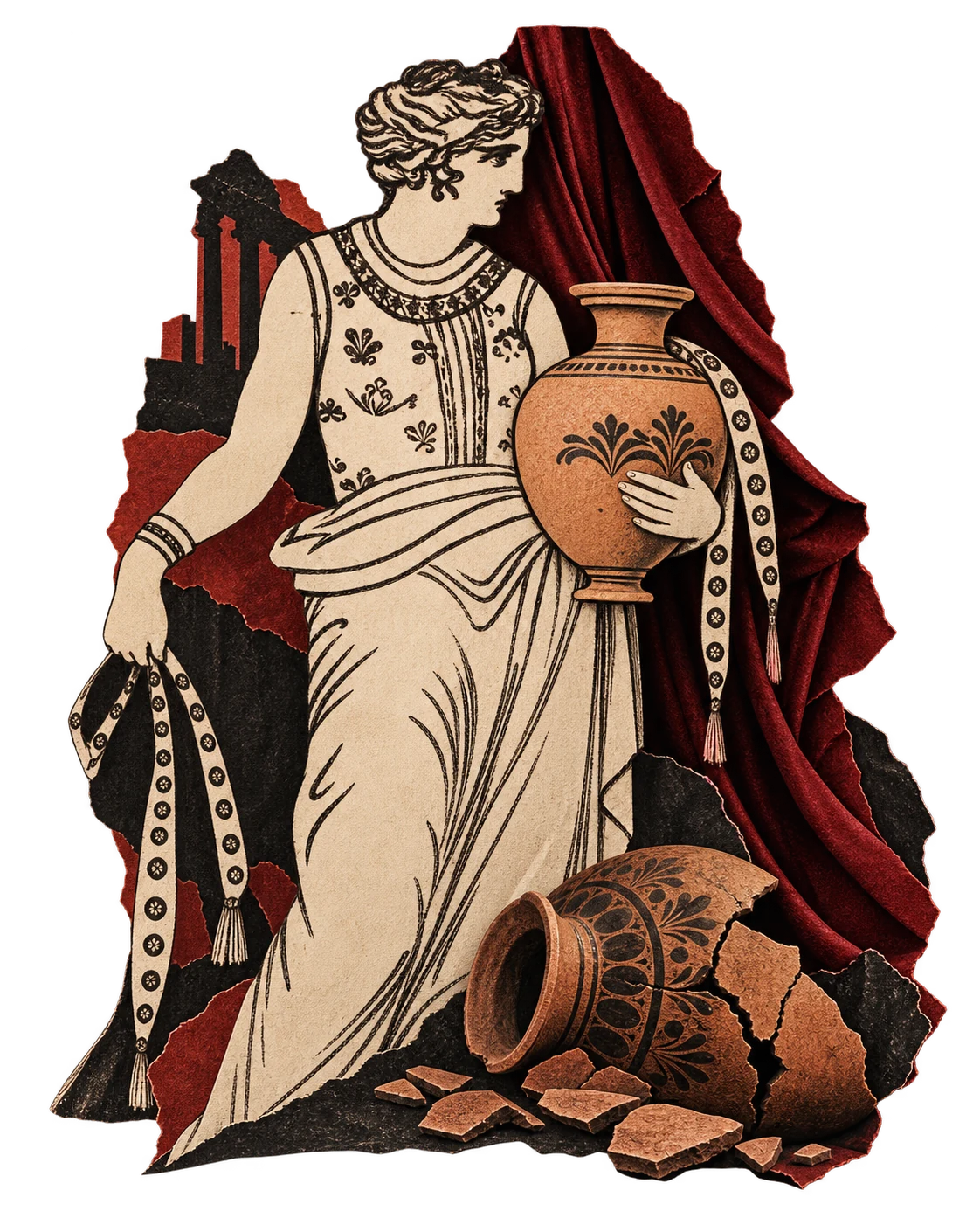
The story of Electra
Freud and the Electra Complex
In 1905, the Austrian-Jewish psychologist and neurologist Sigmund Freud published the book "Three Essays on the Theory of Sexuality," in which he set out his ideas about childhood sexuality and described concepts such as the 'Oedipus complex,' 'penis envy,' and 'castration anxiety.' The books shocked the world. Until then, no one had thought about these things, let alone dared to put them in writing - they sounded pathological.
That same year, Sigmund Freud was a professor at the University of Vienna. He later became known as the father of psychoanalysis. He is considered one of the most important thinkers in the field of personality theory, and one of the most prominent and influential scientists and intellectuals of the twentieth century.
Freud's psychosexual theory is a stage theory. Each stage is defined by an erogenous zone, an area of the body where sexual physical pleasure is focused. Freud's theory describes five stages of development, beginning at birth and ending at the close of adolescence.
The third stage, the phallic stage, is very significant in Freud's psychosexual theory. It occurs at around ages 4 to 6. At this stage, children notice the differences between boys' and girls' genitals. They become interested in related topics and ask many questions, such as: Where do babies come from? Why do I have a penis, but my sister doesn't? And so on.
Another feature of the phallic stage is the emergence of sexual attraction to the parent of the opposite sex: boys are attracted to their mothers, and girls to their fathers. Sexual attraction to the parent of the opposite sex arouses anxiety. In boys, it creates 'castration anxiety,' and in girls, 'penis envy.'
When the child's environment is too harsh or closed off, there is a risk that an Oedipal personality will develop. It is named after King Oedipus from the Greek tragedy, who killed his father and married his mother. The female counterpart of the Oedipus complex is called the 'Electra complex.' The name comes from a story in Greek mythology about Electra, daughter of Agamemnon, who murdered her mother.
Did Oedipus really experience sexual feelings for his mother? Was Electra really in love with her father, and did she experience sexual feelings for him? The
answers will be explored in this chapter and the next.
The Story of Electra
The story of Electra
The Greek tragedy of Electra was written by the Greek playwright Euripides, one of the three great tragic playwrights of ancient Athens. The tragedy was written in 413 BCE.
We begin the story with Agamemnon, the young man who was forced to flee after Aegisthus murdered his father. Agamemnon and his younger brother Menelaus fled to Sparta, where they lived for several years. In Sparta, Agamemnon fell in love with Clytemnestra, who was then married to Tantalus and was the daughter of Tyndareus, king of Sparta. Agamemnon murders Tantalus, smashes the head of their little son, and forces Clytemnestra to marry him. From his marriage to Clytemnestra, Agamemnon has two daughters, Electra and Iphigenia, and a son, Orestes. With the help of his brother Menelaus and his father-in-law Tyndareus, Agamemnon seizes power and becomes king of Mycenae. Menelaus becomes king of Sparta and marries Helen, who was considered the most beautiful woman of her time.
Another man who desired the beautiful Helen was Paris, prince of Troy. He came to Sparta, where he was received as befitted a prince, but one day he abducted Helen and fled with her to Troy. The abduction deeply wounded Menelaus's pride and heart. He enlisted several kings to support him, and together they set out to fight Troy in the famous Trojan War.
The Greeks Included:
The Greeks included:
Agamemnon, king of Mycenae, who led the entire Greek campaign; Menelaus, king of Sparta and husband of the abducted Helen, Agamemnon's brother; Odysseus, king of Ithaca; Achilles, king of the Myrmidons and the greatest Greek warrior; Ajax the Lesser, king of Locris.
The Trojans Included:
The Trojans included:
Priam, king of Troy, who led the Trojan side in the war; Hector, Priam's heir and a warrior in the Trojan army; Paris, Priam's son and Helen's abductor; Aeneas, a Trojan noble who, according to myth, founded Rome; Penthesilea, queen of the Amazons; Memnon, king of Ethiopia.
No fewer than 8 kings took part in that battle, along with many nobles, prophets, and priests. The battle ended in a Greek victory.
At the End of the Battle, the Journey Home Begins:
At the end of the battle, the journey home begins:
The journey of Odysseus, king of Ithaca, is told in the "Odyssey," one of the two great Greek epic poems attributed to Homer. The first to be written was the "Iliad."
Agamemnon's return home was not easy either. The wind stopped blowing, making it difficult for the ships carrying him and his soldiers to reach their homeward destination. In his distress, he appealed to Artemis, goddess of the hunt, for help. In return for her help, Artemis asked Agamemnon to offer his daughter Iphigenia as a sacrifice to the gods. Agamemnon agreed to the bargain, and Artemis granted his request. She restored the winds that carried him home, and took Iphigenia to Tauris, the Crimean Peninsula, saving her from being sacrificed to the gods.
Let's go back a little: remember Clytemnestra, Agamemnon's wife, whose first husband he murdered and whose son's skull he crushed? Now Agamemnon has also sacrificed their daughter Iphigenia to the gods. This was the last straw, and Clytemnestra decided to act.
While Agamemnon was fighting in Troy, Clytemnestra was having a passionate affair with Aegisthus, of all people, the man who had murdered Agamemnon's father. Together they plotted Agamemnon's murder, and when he returned from the war, they put their plan into action.
Electra and her brother Orestes now had to avenge their father, whom their mother Clytemnestra had murdered.
For anyone who's lost track of the plot, here's a recap of the murders:
Aegisthus murders Agamemnon's father. Agamemnon murders Clytemnestra's husband and son, marries her, and they have three children: Electra, Iphigenia, and their son Orestes. He sacrifices Iphigenia, which, in his view, brings her life to an end, though he does not know that Artemis has kept her alive. His wife Clytemnestra and Aegisthus, the murderer of his father, together murder Agamemnon...
The Revenge of Electra and Orestes
After Agamemnon's murder, Electra, the daughter of Clytemnestra and Agamemnon, was married to a simple farmer. She feared that if she married a nobleman, her children would learn of the family’s bloody history and try to avenge their grandfather Agamemnon's death by murdering their grandmother. But at Electra's request, the farmer did not consummate the marriage...
Orestes, Electra's brother, was placed in the care of King Strophius of Phocis, in what is now central Greece, where he grew up as a true prince. There he became friends with Pylades, the handsome and gifted son of King Strophius.
Phocis's historical importance lay in the fact that Delphi was within its borders. Delphi was the home of the Oracle of Delphi, the high priestess who was the most important oracle in classical Greece. The Oracle of Delphi tells Orestes that when he reaches the age of 20, he must return home and avenge his father's death.
Electra, the proud king's daughter, humiliated by her mother Clytemnestra and her father's murderer Aegisthus, meets her brother at the foot of their father Agamemnon's tomb and urges Orestes to take revenge. Orestes brings his friend Pylades into the plot.
Carrying out the murder is not easy for Orestes, and he hesitates for a long time. Killing his mother is the most tragic and difficult moment of his life. As he spills his mother's blood, his heart is torn between compassion and love on the one hand, and a sense of duty to avenge his father on the other. Orestes covers his eyes with his cloak so that he will not see or hear his mother's pleas for her life. His hand trembles, and he is horrified by the atrocity he has committed with his own hands. He is utterly broken during and after the deed. Electra encourages him and reminds him that it is his duty, even as she too feels the full horror of what has happened. After murdering his mother, he also murders Aegisthus, his father's murderer. In the aftermath, Orestes goes mad and is pursued by the Erinyes, goddesses of rage and vengeance whose role is to hunt down those who murder their relatives. The Erinyes lead Orestes and Pylades to Tauris on the shores of the Black Sea, where his sister Iphigenia is being held, unbeknownst to them. After the siblings reunite, the Erinyes stop pursuing Orestes.
According to mythological literature, Clytemnestra does not deserve to be called 'mother' by the two siblings. They have no moral obligation toward this promiscuous and corrupt woman, and so she is murdered first, before Aegisthus.
And, as in every good fairy tale, Electra and Pylades, her brother Orestes's best friend, fall in love and marry.
Hugo von Hofmannsthal had a Jewish grandfather. From an early age, he was something of a child prodigy. In 1901, he met the composer Richard Strauss and wrote the librettos (literally 'little book' in Italian, meaning the text of a musical work) for several of his operas, including "Electra." Throughout the opera, Clytemnestra's appearance on stage is accompanied by three consecutive notes with a fanfare-like, harsh, and sharp character. They serve as a motif identifying the character, making her even more terrible and two-dimensional, both flesh and blood and demonic. Since she showed no mercy, she inspires no pity whatsoever.
Now all that remains is to wonder whether Electra's actions really prove that she was attracted to her father Agamemnon, as psychoanalysts define it. Did he really arouse her sexually...?

תגובות
עדיין אין תגובות.