
Another complex, another story.
Not long ago, I posted the story of Electra here http://bit.ly/2z42BRc, and even then I promised to tell the story of King Oedipus as well.
As you may recall, Freud's psychosexual theory is built around five stages of development, beginning at birth and ending at the close of adolescence. One feature of the third, phallic stage is the emergence of sexual attraction to the parent of the opposite sex: in boys, toward their mother, and in girls, toward their father. Sexual attraction to the parent of the opposite sex provokes anxiety. In boys, it gives rise to 'castration anxiety,' and in girls, to 'penis envy.' When a child's environment is too harsh or unaccepting, there is a risk that the Oedipal type will develop. It is named after King Oedipus from the Greek tragedy, who killed his father and married his mother. Did Oedipus really develop a sexual attraction to his mother?
King Oedipus
King Oedipus.
Our story begins with Laius, Oedipus's father, who in his youth stayed at the court of King Pelops. Pelops was a grandson of Zeus, king of the Greek gods, and a lover of Poseidon. Pelops conquered half of the Peloponnese, which was named after him, and there Laius fell in love with Chrysippus, Pelops's son. Laius abducted Chrysippus and fled with him to the mountains. Chrysippus tried to escape his abductor, but during his flight he fell into an abyss and died. This enraged Apollo, who laid a curse on Laius: his son would kill him and marry his mother. With the help of Apollo and Artemis (Diana, goddess of the hunt), who killed the former ruler and his children with their arrows, Laius seized power in Thebes from Amphion. He married Jocasta.
Oedipus's Birth and Abandonment
Laius, aware of Apollo's great power and the force of his curse, tried to avoid sleeping with his wife Jocasta so she would not become pregnant. One day, Laius came home drunk and slept with his wife. Jocasta became pregnant, and they had a son - Oedipus, the hero of our story.
After Oedipus was born, Laius realized he was in great danger and again tried to avert the prophecy. He drove a stake through the child's foot and sent him to Mount Cithaeron, where he tied him to a rock so that wild animals would devour him, or he would starve to death. A shepherd found the child and brought him to the palace of King Polybus in Corinth. The king's wife adopted the child as her own and gave him the name Oedipus (swollen-foot); the boy grew up as a prince in every respect. Oedipus lived believing that his adoptive parents were his biological father and mother.
The Murder, the Riddle and the Kingship
One day, Oedipus rode out of the city toward Thebes. When he reached the crossroads, six riders appeared before him, including an old man. As befitting a prince, Oedipus asked them to make way for him, and when they refused, he killed five of them, including the old man. The only rider to survive fled back to the city of Thebes and told what had happened. Among those killed was Laius, king of Thebes. Several years after the incident, someone told Oedipus that he was adopted. Oedipus was furious and went to Apollo's temple to find out who he was. The question Oedipus asked Apollo was, "Who am I?" Apollo did not give Oedipus a direct answer, but told him that he was destined to kill his father and marry his mother. Oedipus, who did not understand the prophecy, feared it referred to his adoptive parents, so he fled north from Corinth toward the kingdom of Thebes. To Thebes,
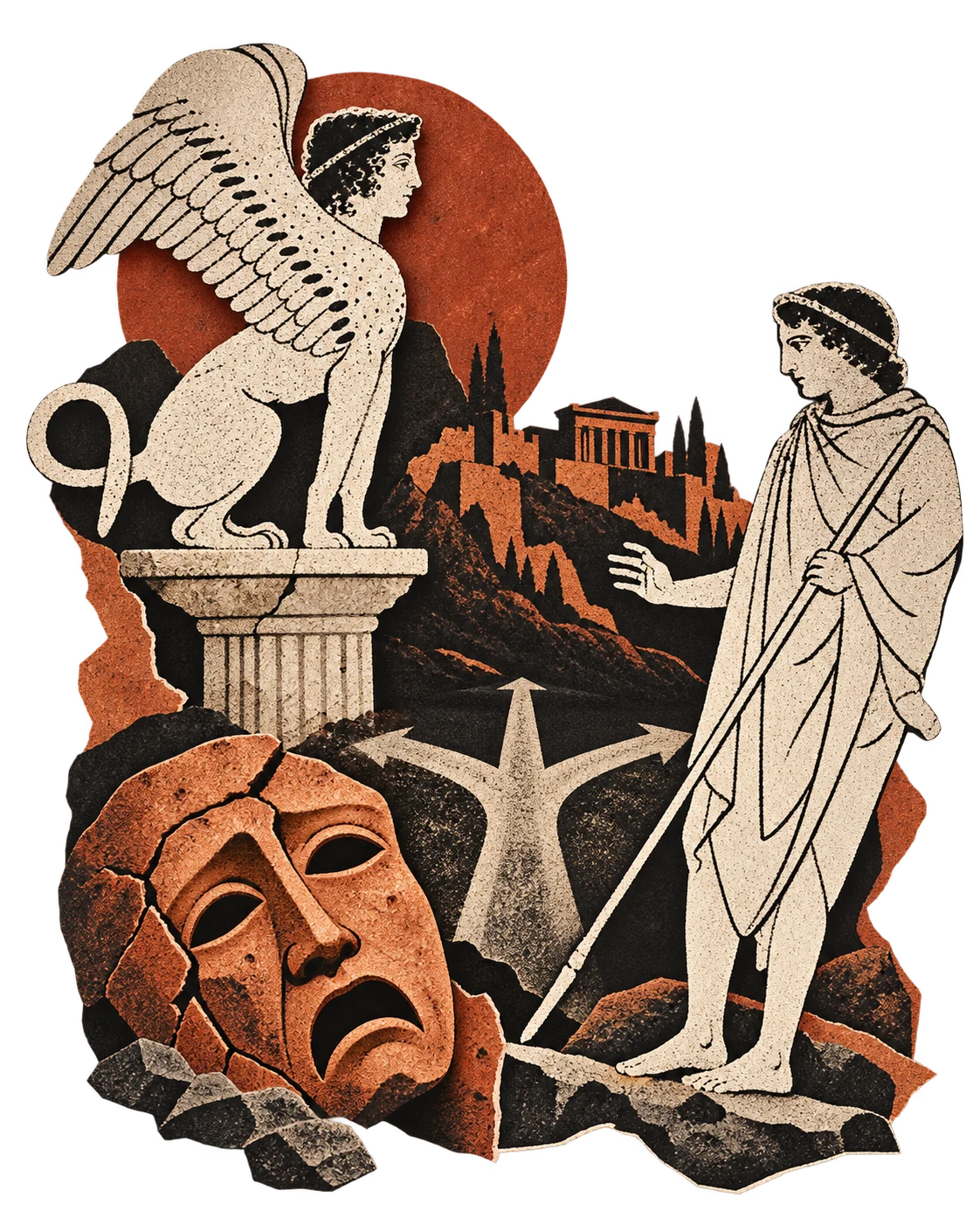
Even before Oedipus fled there, the monster Sphinx arrived, with the body of a dog, the wings of a bird, and the head of a woman. The Sphinx declared that if no one solved her riddle within a certain time, she would devour the city's virgins and young boys. At the entrance to the city, Oedipus encountered the monster, who agreed to let him pass on the condition that he answer her riddle correctly: "What walks on four legs in the morning, on two at noon, and on three in the evening?" (Stop here and try to answer...)
Oedipus answered that it was a human being: "At the dawn of life, one crawls on all fours; in the prime of life, one moves on two; and in life's twilight, one leans on a cane." Since he solved the riddle, the monster that had threatened the city vanished. Oedipus, who had freed the city from the monster's menace, was received with great honor by its people, who gave him the royal scepter in gratitude. They told him that their king Laius had been murdered a short time earlier, and Oedipus married the widowed queen, Jocasta. They had two sons and two daughters.
The name Oedipus has two meanings: the first is 'knower of the foot,' referring to the riddle he solved, and the second is 'swollen-foot,' referring to the stake his father drove through his foot and to the way he tied his feet to a rock so he could not escape.
The Plague of Thebes and the Uncovering of the Truth
After twelve years of rule, a plague began to ravage the city of Thebes, claiming many lives each day. The markets and streets fell silent, and the people turned to their king for help in escaping the terrible calamity. When a messenger arrived at Oedipus's palace and announced that one of the city's residents was the one who had murdered the king, cries of anger rang out from every side: "The murderer of King Laius lives in Thebes! Woe to us. The plague is the gods' vengeance! The story that the king was murdered by passing bandits is a lie! Call Tiresias, the seer, and let him tell us who the murderer is!"
"We must cleanse the city of the criminal's presence!" King Oedipus, too, was shaken by the news. He had never heard of the heinous murder of the king of Thebes. He asked his people to disperse and swore that he would do everything to find the murderer, punish him, and appease the angry gods. The townspeople obeyed their beloved king. One by one, they went home, with a cloud of grief and anxiety on their faces.
The tragedy "Oedipus the King" was written in Athens around 425 BCE by the playwright Sophocles. It is the first tragedy in a trilogy of three tragedies: "Oedipus the King," "Oedipus at Colonus," and "Antigone." The tragedy was performed at the theater in Athens as part of the competitions held during the festival honoring Dionysus, god of wine and theater. Sophocles was 28 when he won first prize in the playwriting competition for the tragedy he presented. He wrote 123 plays, of which texts of only seven survive. The play is based on a myth about Prince Oedipus mentioned by Homer.
And now, back to the play. The wise Oedipus seeks a way to discover the heinous murderer, and to that end he decides to summon the seer and oracle Tiresias, so that he will come and reveal who the murderer is. But the oracle refuses to answer the king's questions. "For the good of us both," the elderly oracle tells him, "do not press me to reveal the truth."
But the welfare of the city of Thebes is foremost in Oedipus's mind, and he orders the oracle to tell him the truth. "By the gods, I adjure you. Reveal what is in your heart, whatever it may be, for the concerns of the individual are nothing when the common good is at stake. I command you to say who the murderer is... Please, I beg you."
The oracle stubbornly refuses to reveal the truth to his beloved king, prompting the king to accuse him of complicity in the murder and of treason, since he stands by and sees the victims who perish each day in the plague. Then, at the climax of the play, the oracle says these words to the king: "I have been silent, O king, but if you seek to save the city from the plague, then leave the city, for you yourself are the murderer." The words strike King Oedipus like a thunderclap, and he curses Tiresias, the prophet. But now that Tiresias has begun to speak, he does not stop; he reveals the whole truth to the terrified king, who cannot believe his ears: "You insisted that I reveal what is in my heart, O king, so I shall do so completely: the murderer you are seeking is you yourself, and the murdered king was your father. And know that the widow you took as your wife is your mother."
King Oedipus was shaken by what he had heard. The queen hurried to her husband, hoping to calm him. She told him that many years before she gave birth to her son with her late husband, the seer had prophesied that the boy would kill his father and marry his mother. Her husband took his son and cast him onto a high mountain in order to thwart this cruel fate. In the end, Jocasta said, her husband had been murdered ten years earlier by a passing bandit at the crossroads, not by his son, as the oracle had foretold. Oedipus asked the queen to describe her murdered husband, and then it dawned on him that the two of them looked alike. At this point, Oedipus began to believe the words of the seer Tiresias: that he was indeed the murderer who had later married his mother. Oedipus remembered the encounter ten years earlier, when he had come upon a wagon on the road whose passengers demanded, in the most humiliating manner, that he get out of their way. He lost his temper and killed the old man, who had an air of majesty.
Madness and delirium seize Oedipus, and he lets out a great and terrible cry: "It is all true! I am cursed. Now my light shall turn to darkness."
After it became clear to Oedipus that he had killed his father and married his mother, he discovered that his wife Jocasta had hanged herself when she learned the bitter truth. Great grief then took hold of him, and he gouged out both his eyes with the pins from the dress of his mother-wife, seeking refuge in the dark world of blindness. It is better to be in that world than to look straight at the world that had once been so bright. At last, his beautiful daughter Antigone led her blind father out of the city. The terrible plague that had claimed ten thousand lives in the city indeed disappeared.
In the play, sight and blindness are used to characterize Oedipus and Tiresias, and each has a different interpretation of these concepts. The prophet Tiresias begins and ends physically blind, but throughout the story he "sees with the eyes of his mind." For Tiresias, sight means understanding the gods' messages and knowing fate and what is to come.
In contrast, Oedipus begins the play able to see both physically and intellectually. In the middle of the play, he loses his reason and thus becomes metaphorically blind, because he cannot see the truth. At the end of the play, he blinds himself physically because he no longer wants to see the truth and his fate.
And once again, all we can do is wonder whether the name 'Oedipus complex' really fits the definition. Did Oedipus really develop a sexual attraction to his mother in the way psychoanalysts describe? After all, he had no idea she was his mother. To him, Jocasta was an attractive king's widow, befitting his status as a prince...

תגובות
עדיין אין תגובות.