
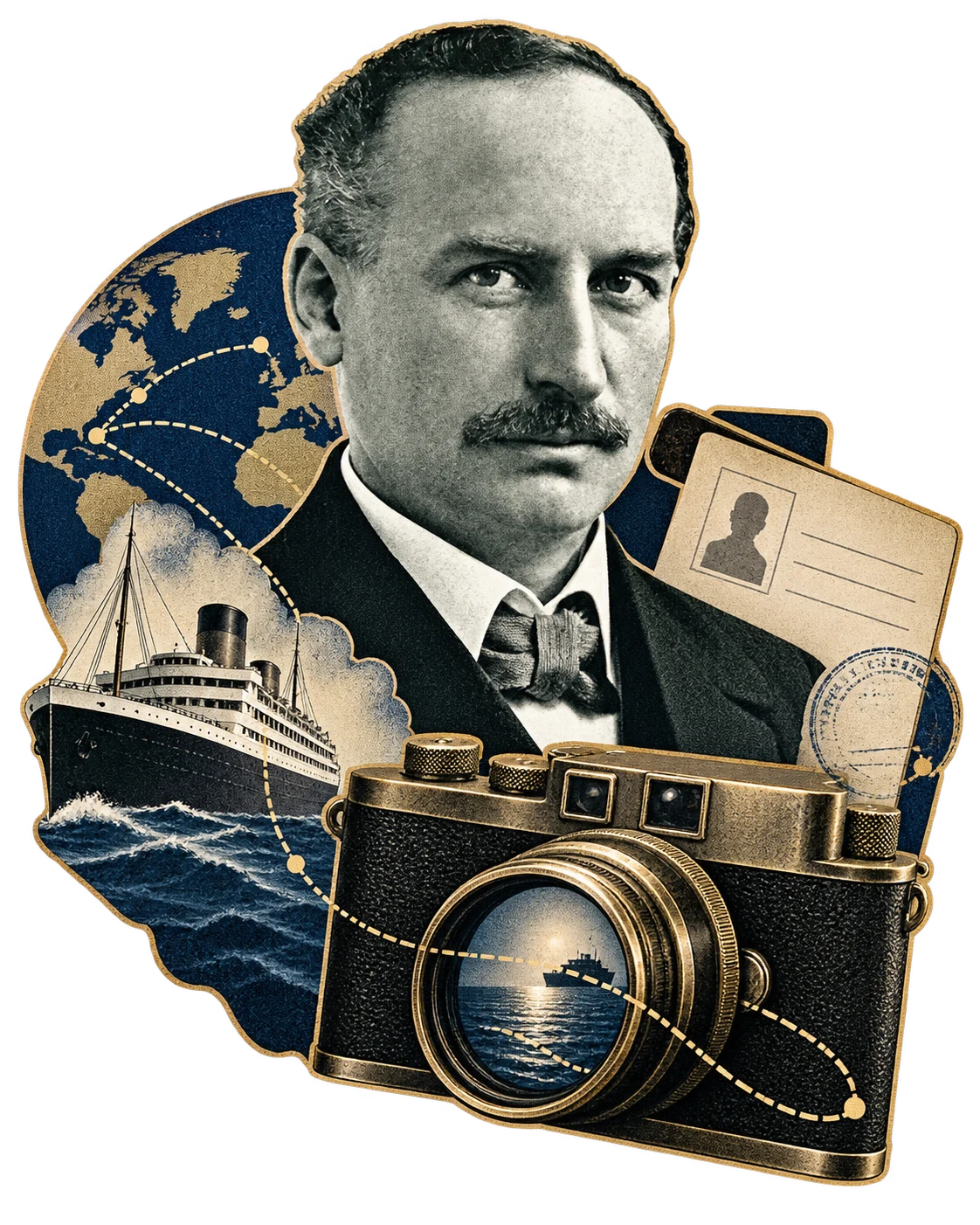
The German company Leica invented the small camera we know today, with the help of a talented and compassionate manager who led a team of talented, dedicated, and loyal employees, most of them Jewish.
Ernst Leitz II
The Road to the Leica Camera
Ernst Leitz II was born in Wetzlar, Germany, to a hardworking and wealthy German Protestant family. His father, Ernst Leitz I, founded the Ernst Leitz company, which manufactured optical instruments. Ernst Jr. specialized in business administration and precision mechanics, and joined the family company in 1906. When his father died, Ernst Leitz II became the company's CEO and was responsible for developing the binocular microscope, with its two eyepieces. This development became a commercial success, and over 23 years the company sold about 200,000 microscopes.
At the end of World War I, Germany was in deep economic crisis and was forced to pay enormous reparations to the victors. Development of the lightweight camera had begun before the war, but despite the economic hardship, Ernst Leitz decided to continue: "I've made my decision. We'll take the risk," even as quite a few people tried to dissuade him from embarking on this dangerous venture. At his side was a brilliant engineer named Oskar Barnack, who believed he could overcome every obstacle and bring the development to a successful conclusion.
Oskar Barnack was a photography enthusiast who suffered from severe asthma, a condition that made it difficult for him to carry a large camera. As a photography enthusiast, he wanted to develop a small camera that would be easier to use. For Barnack, Leitz's invitation to join the development team was a dream come true. Barnack used the photographic film employed by the movie industry and loaded it horizontally, as in a movie camera. The third member of the successful team was Professor Max Berek, a physicist specializing in lenses.
As early as 1914, on the eve of World War I, Ernst Leitz II took the first prototype to New York and registered it as a patent, although further development was still needed before it could become a marketable product.
The risk paid off, and in 1924 Ernst Leitz II proudly unveiled the world's first compact camera, named the Leica. By 1933, about 100,000 cameras had been sold, and by 1950, about 500,000. Over the years, about 1.5 million Leica cameras were produced. To this day, the company sets the optical standard and is one of the world's leading camera makers.
The invention made Ernst Leitz II wealthy and well known. Politicians and celebrities visited his home. Among his guests were Theodor Heuss, Germany's first president; the physician and Nobel Peace Prize laureate Albert Schweitzer; and pioneering photographers Alfred Eisenstaedt and Henri Cartier-Bresson.
Ernst Leitz II was not only a visionary manager, able to assess risks and make difficult decisions, but also a manager who cared deeply about his employees. At a time when workers had few rights, his employees enjoyed pensions, sick leave, and health insurance - benefits introduced during his father's time. The company valued its human capital and chose outstanding, talented employees, who in turn chose to stay on until retirement. The company fostered a sense of one big family with a shared purpose, and sometimes the employees' children joined the company too. Most of the company's employees were Jewish, which was certainly uncommon at the time.
Saving Jews Under the Nazis
When Hitler came to power in 1933, Ernst Leitz saw what was coming and decided to risk his life to save Jews. He established what would later become known as the "Leica Freedom Train." He employed many Jews as "overseas sales representatives." Jewish company employees, retailers who sold the camera, their family members, and their Jewish friends were all sent by Leitz on "sales and marketing" assignments to company offices in France, Britain, Hong Kong, and the United States.
In November 1938, after Kristallnacht, Leitz increased the number of employees he sent to the company's New York office. Everyone who arrived wore the new emblem of freedom around their neck - a Leica camera. He also provided each person with living expenses equal to three months' salary, followed by half pay for the next three months, until they found work in the American photography industry. Among these refugees were many designers, technicians, sales representatives, and writers who found work in the press and photography industry. The operation reached its peak in 1938-1939, when every few weeks Leitz sent a group of Jews to the United States. This flow stopped on September 1, 1939, when World War II broke out and Germany closed its borders. By then, Ernst Leitz II had managed to smuggle hundreds of Jews out of Germany, most of them to the United States.
Surprisingly, Ernst Leitz II joined the Nazi Party but continued to voice his liberal-democratic views. He later explained that he had been forced to do so in order to protect his employees and to "prevent proceedings from being brought against him."
Not far from the factory, which had been converted to serve the Nazi military, was an abandoned iron mine that had operated from 1842 to 1928. When the bombing of Germany began, hundreds of Ukrainian women were brought into the mine's tunnels to manufacture cameras and optical equipment for the German army.
Ernst's daughter, Elsie Kuehn-Leitz, found it difficult to watch the miserable forced laborers and did what she could to improve their situation. During the war, Elsie helped Jewish women escape to Switzerland. On one occasion, she was caught and interrogated under torture, but was eventually released. When Alfred Turk, one of Leica's senior employees, was arrested and imprisoned for helping many Jews, the company secured his release with a large bribe.
The Gestapo knew about Ernst Leitz II's activities but preferred to turn a blind eye, since the factory was vital to the war effort and, moreover, brought in enormous sums that greatly benefited Nazi Germany.
This story might never have come to light were it not for the dedicated research of Rabbi Frank Dabba Smith, a California native who lived in England. In 2002, Rabbi Smith wrote the book Leica Freedom Train, published by the American Society of Photography. The Leitz family did not want any publicity about its actions during the war, and only after Ernst Leitz II's death did they agree to let the story be published.
After the war, Elsie Kuehn-Leitz received an honorary degree from the French Academy of Humanities (1965) and a medal from the European Academy in the 1970s. In 2007, she received the Anti-Defamation League's Courage to Care Award. At the award ceremony, the League's director, Abraham Foxman, said: "At considerable risk, and in defiance of Nazi policy, Ernst Leitz took bold steps to lead his Jewish employees and others out of harm's way. If only there had been more Oskar Schindlers, more Ernst Leitzes, fewer Jews would have died."
The comparison with Oskar Schindler, who saved 1,200 Jews in Poland, is apt. Both Schindler and Leitz saved Jews by employing them, at great personal risk. Many years later, Leitz's son Gunther broke his father's silence and said: "He did what he did because he felt responsible for his employees, their families, and his neighbors in Wetzlar."
תגובות
עדיין אין תגובות.