
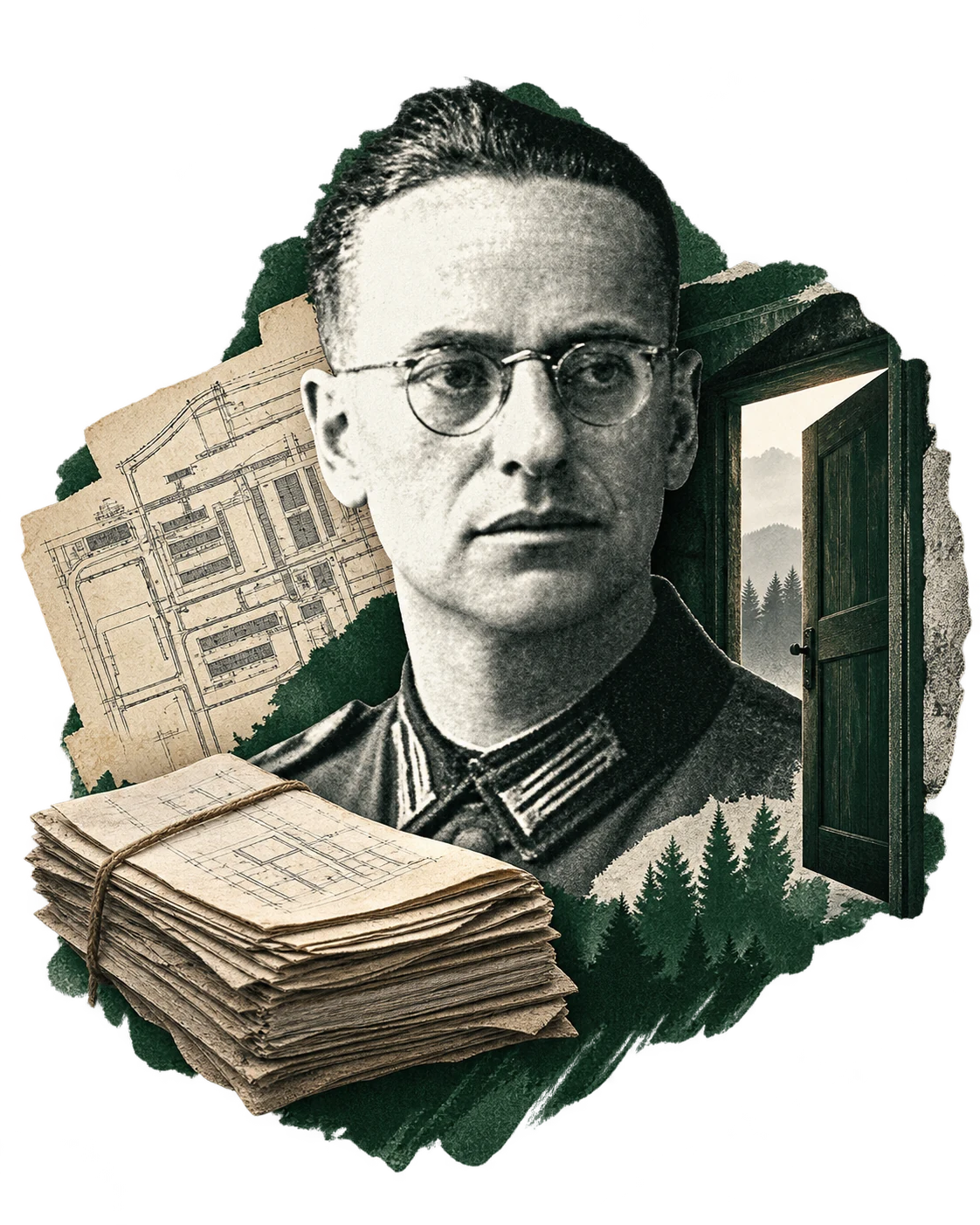
The remarkable story of an SS officer at the heart of the killing machine, and one of only two members of the Nazi Party to receive the title of Righteous Among the Nations.
The Road to Auschwitz
Helmut Kleinicke was born in Germany in 1907 into a nature-loving family of foresters who worked very hard to make a living. His family invested in his education and emphasized the values of hard work, integrity, and fairness. To his parents' delight, as they hoped he would not have to work as hard as they had, Helmut chose to study civil engineering. In 1933, he joined the Nazi Party, and when World War II broke out, he was drafted into the SS. Because he was an engineer, he was immediately given an officer's rank, and over time he rose to the rank of Oberstleutnant (lieutenant colonel). In 1940, when construction began on the Auschwitz extermination camp, Kleinicke was part of the team of engineers responsible for planning and building its structures. At the time, he lived in the town of Chrzanów, about 20 km from the extermination camp.
Unlike his fellow officers, Helmut Kleinicke had a different plan for the extermination of the Jews. To build the structures, he recruited many young Jews from his hometown of Chrzanów, far more than he needed. They were known as "Helmut Kleinicke's workers." He treated them well and protected them, and they 'enjoyed' complete immunity from death. More than once, he removed his workers from transports to extermination camps. The workers soon realized that Helmut Kleinicke was actually saving their lives. "Everyone who worked for Kleinicke was a VIP. We had a document saying we worked there, and it was our insurance," said Yosef Wiesler, a Holocaust survivor who worked for him.
At times, Kleinicke put his own life at risk by hiding some of his workers in his home's cellar. He also sometimes helped forced laborers escape, driving them in his car to the distant Tatra Mountains, about 200 km away.
Saving the Jews of Chrzanów
Helmut Kleinicke spent more time saving Jews than employing them. In 1943, he was dismissed from his position after the Gestapo noticed that his workers were beginning to disappear. After his dismissal, Kleinicke was trained as an artilleryman and sent to the front in the hope that he would not return. But apart from a minor injury to his hearing, he survived the war. At the end of the war, he was captured by the British and released in 1945. He returned to Germany and resumed his life with his wife. In 1949, he was cleared of war-crime charges.
Some of the survivors from Chrzanów immigrated to Israel and tried to rebuild their lives and start families, hoping for a saner future. Shortly after the war, the Kleinickes had a daughter named Jutta. The war left deep scars on Helmut, and, as his daughter recalled, he never smiled. He lived with the feeling that he could have saved more Jews because he knew the German killing machine. Helmut kept silent and did not tell his story. He knew no one would believe that an SS officer had helped Jews and saved their lives.
The Jews who survived thanks to him also kept silent, but they did not forget the SS officer who had saved their lives, and some of them even wrote to him. "Dear Mr. Kleinicke, I worked for you in Bobrek in 1942. Thanks to you, I was spared a great deal of suffering." So began Yosef Wiesler's letter. Helmut Kleinicke read it and put it in a drawer without replying to Wiesler.
In January 1979, he watched the series 'Holocaust: The Story of the Weiss Family,' which took him back to those days, which he had never forgotten. Three days later, he suffered a stroke, and several months later he died at the age of 72.
After his death, his daughter Jutta Spatzek said that her father knew the Jews were being sent to their deaths. "I felt this guilt too," she said. But along with that sense of guilt, her father left her a pile of letters, including one from Yosef Wiesler. She contacted him and expressed her wish to meet him. She said, "I just feel I was born to bring my father's story full circle and say: 'He was not guilty.'"
From Silence to Belated Recognition
In 2017, dozens of survivors from Chrzanów living in Israel, from the first and second generations, gathered at the general memorial ceremony for the city's victims, held at the Ghetto Fighters' House, where Helmut Kleinicke was also remembered.
Jutta came to Israel with her son Sebastian and met with a small number of the survivors her father had saved at Beit Zionei America. When she saw Yosef Wiesler, whose letters she had read, they both burst into tears. At that meeting, another survivor named Chaim said that he thanked God he was still alive and had had the chance to meet Helmut's daughter and tell her what a hero and guardian angel her father had been. Another survivor told her how her father had smuggled him to the train station in his car and saved his life that way. "You should be proud. Your father was a human being in the great darkness that had descended on the world then," one of the survivors told her. Helmut Kleinicke was known as 'the Schindler of Chrzanów.' In 1948, Zygmunt Englender testified that in February 1943, he had hidden in the local nursery with 20 other Jews to avoid an impending deportation, with Helmut Kleinicke's knowledge. Yosef Wiesler, Lola Berman, Gershon Meller, and other former residents of Chrzanów testified that they owed their lives to Kleinicke.
Shortly after the meeting, Jutta received a letter from Yad Vashem that read: "We are pleased to inform you that it has been decided to award Helmut Kleinicke the title of 'Righteous Among the Nations' for the help he gave Jews during the Holocaust, at risk to his own life. The medal and certificate of honor will be sent to the Israeli Embassy in Berlin and presented to his family at a special ceremony." Kleinicke's name was later inscribed on the wall in the Garden of the Righteous Among the Nations at the Yad Vashem Museum.
In early 2020, Helmut Kleinicke was posthumously awarded the title of Righteous Among the Nations at the Israeli Embassy in Berlin. Yosef Konigsberg, a 95-year-old Holocaust survivor and the last person in Germany able to tell of Helmut Kleinicke's heroism, was at the ceremony. Kleinicke had pulled him off a transport to Auschwitz when he was 16. "This is one of the happiest days of my life... I owe him my life... My mother came to him and begged him to save me. Kleinicke grabbed me and said I was his best worker," Konigsberg said, looking directly at Jutta Spatzek, who was sitting not far from him. "Thank you, thank you." Konigsberg's mother and sister were sent to Auschwitz shortly afterward. Neither survived. At the time, Yosef Konigsberg entrusted Kleinicke with his stamp collection, and Kleinicke promised that if they both survived the war, he would return the stamps. Three years ago, Konigsberg received the collection back from Jutta Spatzek.
Helmut Kleinicke is the 628th German and one of only two members of the Nazi Party to receive this honor.
At the ceremony, Jutta said that from the moment she learned her father's story, and after her visit to Israel, her life had changed significantly: "It confirmed what my father had told me in just a few words - and I had never known whether he was telling the truth." Kleinicke left no records of how many Jews he saved, but the survivors estimate that the number was at least several hundred.
"I feel that this brings a chapter to a close... It was a very long and emotional search to discover the truth about my father, and I hope people in America, Britain, and Israel will hear about it," Jutta said after the ceremony.
A small correction:
The rank of Oberstleutnant is a Wehrmacht rank, not an SS rank. A small correction:
The equivalent SS rank is Obersturmbannführer.
תגובות
עדיין אין תגובות.