
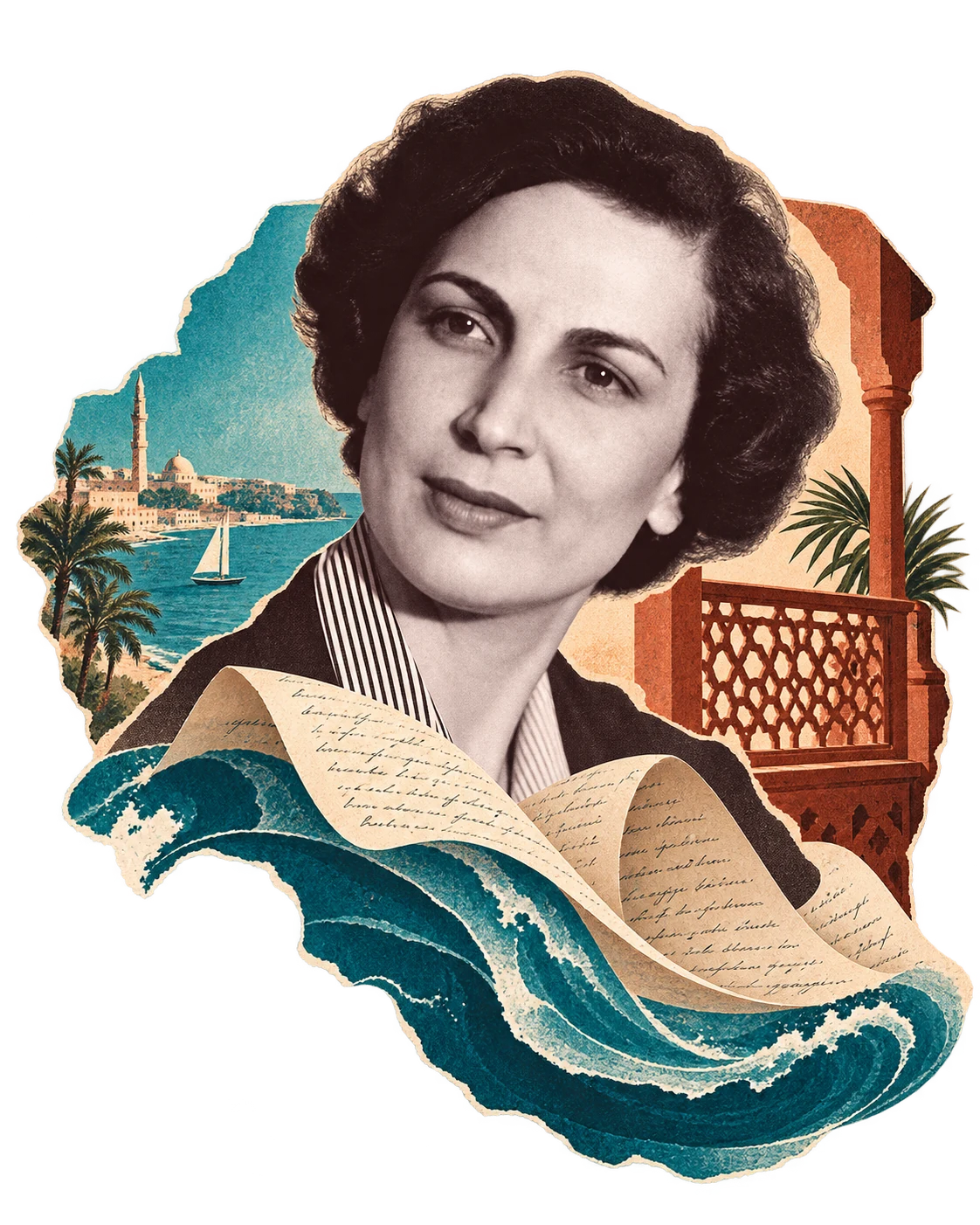
She was intelligent, beautiful, talented, and bold. A woman with a keen sense of justice, she set out to fight inequality and injustice and became known as 'the First Lady of Mediterraneanism.'
Racism and Loneliness in the Moshav
"At a new moshav in the Galilee hills, I visited a family from Marrakesh: a man and a woman, both not yet thirty, and their four children. I asked how they felt in Israel. 'We are so lonely here. There is no one to exchange a word with.' They spoke of loneliness again and again, much to my surprise, since I had noticed that the moshav was home to many families of Yemenite origin. I asked my hosts whether they understood the Arabic spoken by the Yemenites and whether they had tried talking to them. They were offended by the question itself and replied, 'No, they are black and very backward. They didn't know what electricity was before they came to Israel. We speak French, and if we mix with the Yemenites, people will consider us black like them too.'" She goes on to criticize them: "They had been in Israel for barely two months, and already they had seized on distinctions and divisions based on color. If the European immigrants had treated them as equal citizens, the people I spoke with would not have needed their illusions of white superiority over the Yemenites." In a short, moving passage, Jacqueline Kahanoff described different kinds of racism: racism based on color; racism between Moroccans and Yemenites; racism between Europeans and Mizrahim.
Iraqi and Tunisian Roots in Cairo
Jacqueline Shohat was born in Cairo in 1917. Her father belonged to a family that had come from Iraq and was proud of its origins, as her father used to say: "The most important diaspora, thanks to the Babylonian Talmud and to Rabbi Saadia Gaon." Her grandfather, Jacob Shohat, was a merchant who financed caravans carrying goods between East and West. When the Suez Canal opened and trade routes dwindled, the family moved to modern Egypt, then under British control. Her mother, Yvonne Shmala, came from Tunisia and belonged to a family whose origins were in Monastir, Spain. Her grandfather and his elder brother had emigrated to Tunisia at the beginning of French colonial rule.
Jacqueline was fluent in French and English and studied at the same school where her parents, Joseph and Yvonne, had met. They made their home in an upscale neighborhood in the heart of Cairo. Her father was a businessman, well versed in the Bible, who showered his daughters with love. Her mother, though petite, was strong-willed, blessed with great emotional intelligence, and ran the household with a firm hand. She created a home that valued knowledge and openness, and her daughters inherited from her an admiration for French culture. At the same time, there was tension in the household between their father, who leaned toward tradition because he feared that progress would strip his daughters of their Jewishness, and their mother, who was drawn to European culture and the arts. From a young age, Jacqueline could quote passages from Marcel Proust's In Search of Lost Time and poems by Victor Hugo, and knew the Bible and Jewish traditions.
In August 1927, when she was ten, Jacqueline watched a procession made up of people of different religions and nationalities: "Everyone was here together, all the Egyptians." She could not have guessed how quickly that unity would give way to radical Islam - "hostile toward everyone present and toward the minorities."
She loved literature from an early age, and by adulthood already knew that her future lay in journalism. At sixteen, Jacqueline became friends with Denise Mosseri, an heiress to one of Egypt's great fortunes who proved to be the brightest student at their high school. The two friends were on the left of the political spectrum. They were both interested in psychology, philosophy, and politics, and argued about Mein Kampf, the occupation of the Rhineland, the Anschluss of Austria, the Spanish Civil War, and more. Jacqueline enjoyed being open to all religions. Her father believed that God was everywhere and allowed her to visit the cathedral. Her religion was the Hebrew language and the blessings of her grandfather and father: "My religion was my father." She had a wonderful childhood and adolescence, and supportive parents, as she described them so well: "The pillars on which I hung the rickety bridge that connected me to my past, without which no future was possible."
Her Levantinism Takes Shape
Even then, she had witnessed injustice and expressed views that were uncommon at the time. She saw Levantine culture as an advantage over the British and French in Egypt: "We, the Greeks, Jews, Syrians, and Copts, the industrious minorities, the truly cultured people, can take their place if we learn the secret of their power, yet do not let it poison us. We will give tomorrow its character and its color, and it will not be stained with blood, if only we remember the commandment 'Thou shalt not murder,' taught to us by our religions." Jacqueline refused to fit into the role assigned to women in Egypt. She wanted "to do things as women do in Europe" - to be a doctor or "to be a writer who will find the words, our words, to tell of our lost time, and find it again through progress, but not only within its bounds, beyond them as well."
Alongside her writing, she volunteered at the Muhammad Ali clinic in the Muslim quarter. The patients there were in terrible condition, and years later she recalled: "Years afterward, when I saw in the United States pictures of the living corpses in Auschwitz, I remembered the tiny skeletons, still barely breathing, on the clinic's tables." Later, she volunteered in the Jewish quarter, where a clinic had been established in the school.
At twenty, she first came to the Land of Israel with her friend Sylvie. They traveled around the country, and Jacqueline saw women wearing shorts and working alongside men. This freedom, so unlike what she had known in Cairo, excited her, though her feelings were mixed: "We admired their determination to labor for their redemption, and perhaps for our own as well, yet we also took exception to what seemed to us prejudices they shared with all the other white settlers, wherever they might be... We were surprised that the Jews of Palestine felt no kinship with the Arabs. It seemed that everyone outside their camp was a gentile or an Ishmaelite in their eyes, and that we Sephardic Jews were also somehow tainted because of our ties to this stepbrother." Jacqueline did not hesitate to criticize them: "The arrogance of our guides and of most of the people who showed us their kibbutzim, their inability to let their achievements speak for themselves, and their tone of superiority when comparing themselves with other peoples. All this invited a measure of ridicule." Although she understood that the founding of the state put Jews in Arab countries and in Egypt in a difficult position, she decided, "One day I, too, will come to the Land of Israel."
"No man wants a woman who is that smart. No man will agree to marry you," her mother predicted, but Jacqueline continued her studies. She married Izzy Margolis, a Jewish doctor of Russian-Egyptian origin who was born in the United States. In 1941, they traveled to the United States and settled in Chicago: "I felt I had fallen into a world completely different from anything I had known before. Different not only in its scale but also in its ways of living and doing things, which, though hard to define, I noticed immediately. To my eyes then, the eyes of a very young woman, they seemed strange and a little mad, amusing and frightening." This is how she described her experience in the United States. She saw the move as a chance denied her in Egypt - to be "a normal woman, and at the same time a writer." The United States did not impress her: "How vast America was, monotonous and ugly!... The people, too, seemed unfinished, like lumps of clay." She spoke out against the poultry industry. In her view, its industrial 'efficiency' was inhuman. To speak about such things in those years was itself something new. She was ahead of her time in raising questions about vegetarianism, veganism, and the treatment of animals.
Jacqueline studied literature and journalism at Columbia University. When she graduated, her dreams came true: "The dearest of my dreams was to become a writer," and she was indeed hired by The Atlantic Monthly. In the United States, she wrote Jacob's Ladder, her first novel, and Rachel as She Is, which won her a literary prize in 1946, as well as several short stories. In these stories, she criticized Mizrahi Jewry, which, she argued, spoke in slogans on the one hand, while on the other reducing women's role to bearing children and keeping house. Jacqueline fell in love with the anthropologist and intellectual Claude Lévi-Strauss, who had fled his native France for the United States to escape the Nazi occupation. She described their romance as the most meaningful relationship of her life. After five years in the United States, she divorced her husband and returned to Egypt.
She returned to Egypt as a successful, well-known writer, but it was no longer the same Egypt she had left. Antisemitism had now taken hold in Egypt. After a short stay in Cairo, she joined her sister in Paris and became part of a circle of intellectuals with whom she traveled around Europe. Jacqueline wrote about them and about herself. In Paris, she met Alexander Kahanoff, whom she had known in Cairo when they were young. They fell in love and married, and in 1954 they arrived in Israel: "Jews from the East expected a completely different kind of welcome from their brothers. They had to adapt to a society they had not helped shape, where they were often considered raw material in need of processing, in need of education for 'Zionist training.'" That was how she felt, and how she wrote. For two years they lived in an absorption center in Beersheba, then moved to Bat Yam. The living room in Jacqueline and Alexander's home became a gathering place for intellectuals. She wrote essays and translated from English, and contributed to the newspapers La'Isha, At, and Haaretz, bringing a new voice to the country that excited readers.
Writing, Struggle and Legacy
The person who 'discovered' her and brought her to the forefront was Aharon Amir, who gave her a place in the literary journal Keshet, which he edited. She published several essays, including 'The Golden Age of Women Writers' and 'Levantinism.' She told the stories of the disadvantaged - women, Moroccans, and others: "As for myself, I am a typical Levantine, in the sense that I value equally what I inherited from my Eastern origins and what I have now inherited from Western culture. What in Israel is called Levantinization, I see as enrichment, not impoverishment." The journal Keshet brought together an elite group of writers, including A. B. Yehoshua, Amos Oz, Haim Be'er, and Dahlia Ravikovitch. They all admired her and wrote about her and her work. Her essays blended personal stories with philosophical discussions of the issues that troubled her. She was the one who gave the word 'Levantinism' its positive association with openness and inclusion. The writer Haim Be'er described her beautifully: "She served up a new, surprising dish at the narrow Israeli table. She did not preach, but let you understand that Ashkenazi condescension was based on a mistake, and that the Levantine alternative was immeasurably better than what we had to offer. She represented a world whose beauty lay in its complexity: French, English, Middle Eastern, Jewish, Eastern aristocratic. Through her personality and her writing, she offered connections we had never known, a possible model for living in this region, neither in self-effacement and servility nor in arrogance."
Jacqueline Kahanoff rightly earned titles such as 'a harbinger of the Mediterranean spirit,' 'the First Lady of Mediterraneanism,' and 'a harbinger of the Mediterranean idea.' She was ahead of her time in identifying the tension between Ashkenazim and Mizrahim, and tried to address it through her writing.
Few in the literary community know about one of the important High Court of Justice rulings connected to Jacqueline, and few law students know that it involved the same well-known Jacqueline Kahanoff. In August 1972, her husband Alexander filed for divorce in the rabbinical court in Tel Aviv. From his perspective, it was a brilliant move: Jewish law regards a woman who refuses to live with her husband, as Jacqueline had done, as a 'rebellious wife,' and therefore she forfeits all her rights. On the other hand, if the rabbinical court did not recognize their marriage, since they had married in a civil ceremony, he would owe her nothing then either. In the worst-case scenario, if he lost, under Jewish law she would depend on his goodwill to grant her a get, and he could refuse to do so unless she made concessions. Moreover, in the eyes of the rabbinical court, she was still married to her previous husband, since that marriage too had been a civil one. But even if she had obtained a divorce in accordance with Jewish law, she would have been forbidden to marry him because he was a kohen...
Jacqueline understood that the rabbinical court would deprive her of her rights and that her husband's decision to take this route had not been made in good faith. True to her principles, Jacqueline petitioned the High Court of Justice. This was an enormous sacrifice on her part, since she had to expose her private and intimate life before a panel of unfamiliar male judges. Her arguments represented not only herself but all women, as the petition stated: "They are so cruel and so contrary to the progressive spirit of the legislature in its enactment of laws to protect women's rights that it is inconceivable that the legislature intended, in the Rabbinical Courts Jurisdiction Law, to assign matters such as these to the exclusive jurisdiction of the rabbinical courts." She pressed the High Court to decide whether divorce fell exclusively within the jurisdiction of the rabbinical court. The High Court rejected her petition challenging the rabbinical court's right to hear her case. Worse, the ruling she received from the High Court affirmed the rabbinical court's authority to continue discriminating against women under Jewish law and depriving them of their rights, something she considered worse than her personal defeat.
At the beginning of 1976, she wrote: "I woke up drenched in sweat, trembling, leaning against the wall. I dragged myself to the bathroom. I looked at my face in the mirror, green beyond recognition, and then I knew I was very ill." She had uterine cancer, and during this difficult time she wrote: "It was precisely impersonal medical technology that allowed me not only to live a few more years (we hope), but also to experience something like a revelation, an almost mystical celebration of life. I feel an intense joy as I look at the world of trees, sky, flowers, the rustle of the wind - at it and all its smells, shapes, and colors." Later she wrote: "I didn't know that dying was so boring."
In 1979, Jacqueline Kahanoff died at the age of sixty-two and was buried in the cemetery in Bat Yam. A street in Beersheba is named after her.

תגובות
עדיין אין תגובות.