
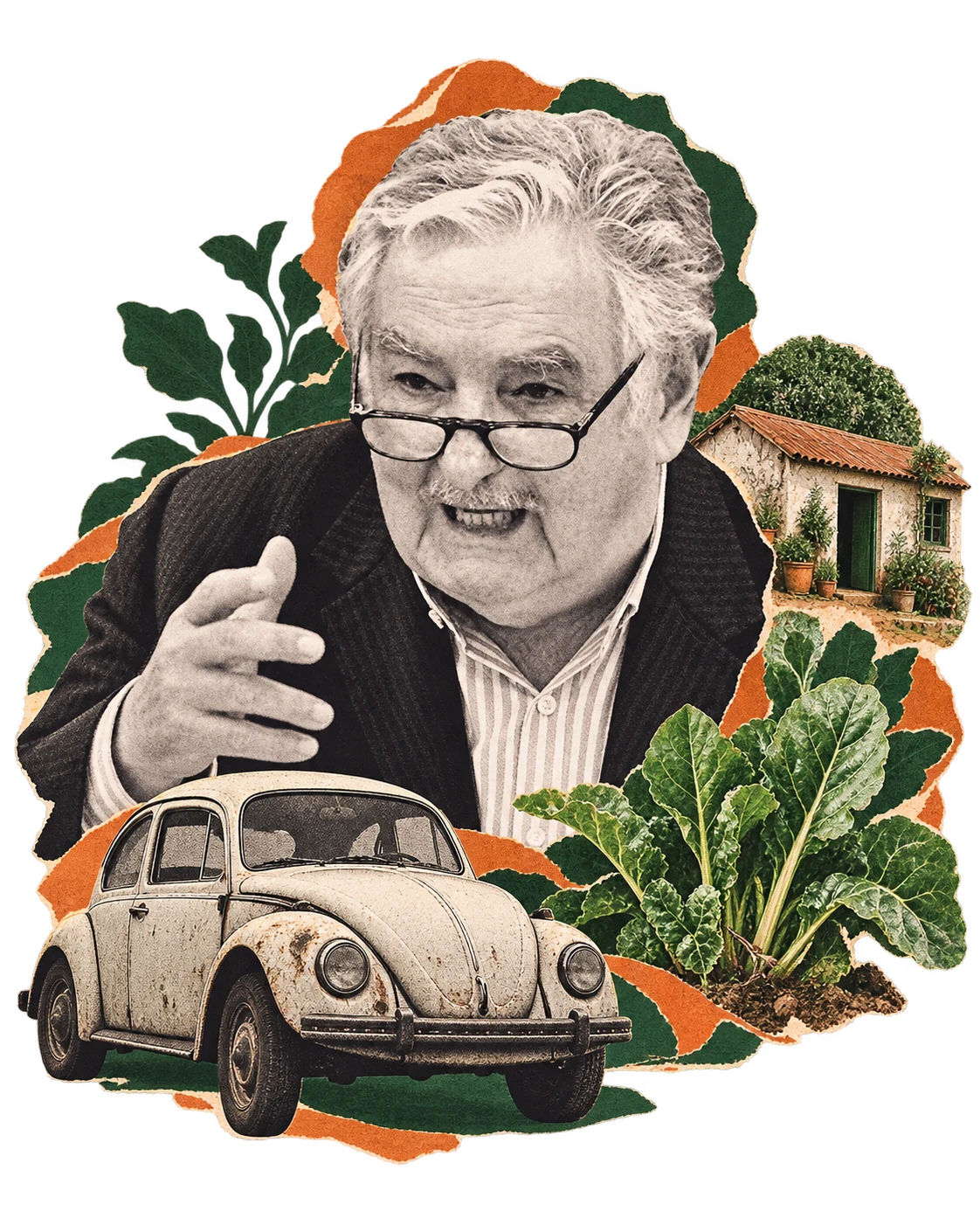
"The poor are not those who have little, but those who need a lot" - said the man known as "the world's poorest president." A revolutionary who spent time in prison, a guerrilla fighter who was nevertheless considered one of the most inspiring leaders.
The Escape from Punta Carretas Prison
Punta Carretas Prison in Montevideo, the capital of Uruguay, was known as the most secure prison in the country. It was a massive, fortified building considered almost impossible to breach. José Pepe Mujica was imprisoned there along with dozens of members of the Tupamaros movement. It was the second time Mujica had been imprisoned. He was already known as an expert escape artist, so he was kept under extremely tight guard. Mujica did not give up. He began organizing an elaborate escape plan involving not only Tupamaros members, but also common criminals.
Mujica carefully assigned the prisoners different tasks: the diggers were divided among the various shifts, the lookouts monitored the guards' movements, and one team made noise to cover the sounds of digging. Using spoons, forks, and improvised tools they had obtained or secretly made, the prisoners managed to dig a 100-meter-long tunnel. They hid the earth in hollow walls, and spread some of it around the prison yard to avoid arousing suspicion.
Lucía Topolansky was one of the key figures in the operation. She identified the exact spot where the tunnel would emerge outside the prison walls. Working from the outside, she coordinated messages and instructions to the prisoners inside, using concealed notes, codes, and planned visits by lawyers and relatives who carried messages. She identified the exact spot where the tunnel would emerge outside the prison walls and was responsible for arranging vehicles and forged documents that would allow the escapees to disappear as soon as they emerged from the tunnel.
September 6, 1971, was the big night. There were celebrations for Uruguay's Independence Day and a commemoration of Túpac Amaru, the figure who inspired the movement. That night, the digging was completed, and 106 prisoners began crawling through the hot, airless tunnel. The excitement was immense. Outside, Lucía and friends were waiting for them in getaway cars. The crawl took several hours in complete silence. As soon as they emerged, the prisoners were dispersed among the cars. Not one person was killed or injured. As they drove, they changed clothes, received forged documents, and made their way to safe houses prepared in advance. The escape was not discovered until the following morning. It caused national embarrassment for the Uruguayan government, but also inspired widespread admiration among the movement's supporters.
The escape from Punta Carretas is considered one of the most successful and impressive mass escapes in history. It even made the Guinness Book of World Records as the largest mass prison escape. Today, the prison has been turned into an upscale shopping center.
José Pepe Mujica enjoyed his freedom only briefly. Just a month later, he was captured and returned to Punta Carretas. As soon as he entered the prison, he began planning his next escape. This time it would be a less heroic escape, involving only about ten fugitives. In light of the failure of the first escape attempt, this time the tunnel was dug from the outside in. They made their way out on boards fitted with wheels to speed up movement through the tunnels. And so, in April 1972, José and his comrades escaped from prison, once again causing the authorities considerable embarrassment.
The Tupamaros and the Crisis in Uruguay
José Pepe Mujica was one of the leaders of the Tupamaros movement (MLN-Tupamaros), a socialist guerrilla movement deeply influenced by the Cuban Revolution led by Che Guevara. The movement took its name from José Gabriel Túpac Amaru, an Indigenous man who led a major revolt against the Spanish Empire and is considered a national hero. The rapper Tupac Shakur was also named after him, incidentally.
"The Switzerland of South America" was what Uruguay was called during the First and Second World Wars. It sold agricultural products to the American army, and the small country, wedged between the giants Brazil and Argentina, made a fortune. But when the war ended, demand declined, and living standards fell with it. Wages were cut, unemployment soared, and social unrest began.
The Tupamaros organization was founded by Raúl Sendic. Its first members were farmers affected by poverty in rural areas, alongside radical left-wing cells within the Uruguayan Socialist Party. The organization attracted members of trade unions, the rural poor, and idealistic young students. From their earliest operations, they were portrayed as romantic revolutionaries, a kind of modern-day Robin Hood. In the summer of 1969, after Lucía Topolansky and Mujica had gathered intelligence, the Tupamaros rented a house near the Financiera Monty financial institution in the capital, Montevideo. From there, they began digging a tunnel beneath the city streets toward the bank's vault. After several months, they reached the room where securities, cash, and confidential documents belonging to wealthy and influential clients were kept. These clients had laundered and hidden money and evaded taxes. The amount stolen was enormous by the standards of the time, but, astonishingly, nobody complained. No one wanted to reveal the size of their ill-gotten fortunes. The Tupamaros went directly to the public, publishing excerpts from the documents to expose the hidden wealth of the ruling class. This won them considerable public sympathy and even led to the conviction of several wealthy people in the country.
They made it unequivocally clear that they were not criminals driven by greed, but ideologues who took the money to fund the revolution. They used it to build a network of safe houses, establish an underground printing press, and finance "people's prisons" used to hold prominent figures who had been kidnapped for negotiations.
During their operations, they took great care not to harm civilians, but later this rule began to erode, partly as a result of the aggressive pressure on them. During the raid on Pando, a small town about 32 kilometers west of Montevideo, in October 1969, one police officer and three guerrilla fighters were killed in an exchange of fire. On April 18, 1972, four soldiers guarding the home of Army Chief of Staff Florencio Gravina were also shot dead. The organization also routinely robbed banks. Years later, in a documentary about him, El Pepe, a Supreme Life (available on Netflix), Mujica said that he greatly enjoyed walking into banks with a .45-caliber pistol. To him, it was the only time people treated him with respect.
The operations intended to change the government ultimately brought about the opposite result. In 1972, responsibility for dealing with the Tupamaros was handed to the army, which succeeded in putting a stop to the organization's activities. A year later, a military dictatorship was established.
Imprisonment, Isolation and Memories
When the underground movement was crushed, in August 1972, Mujica was captured while sleeping outdoors, armed with an Uzi submachine gun and a hand grenade. His capture marked the end of the effective guerrilla period. He was transferred to a military prison, where the leaders were declared hostages, and the government threatened that if the Tupamaros tried to resume their activities, the leaders, including Mujica, would be executed. The military government set out not only to imprison him, but also to break him psychologically and physically. He was thrown into a horse trough, where he spent two years, and over the next 13 years was moved between different facilities to prevent escape attempts. Throughout this period, he was kept in complete isolation. During those years, he endured severe torture. He suffered hunger, filth, beatings, and humiliation. All of this can be seen in the film A Twelve-Year Night (available on Netflix), which depicts, among other things, the unbearable conditions: he was allowed to use the toilet only once a day, and Mujica and other prisoners were forced to drink their own urine. Over time, he developed a urinary tract infection and eventually lost a kidney. José Pepe Mujica later admitted that the extreme isolation nearly drove him mad and left him paranoid. In the face of the regime's attempts to break his spirit, Mujica developed a unique inner survival strategy. To stay sane, he had to recall things he had read in his youth ("I start remembering and remembering and remembering") and hold an inner conversation with "the person I carry inside me." He did not see himself as a victim and refused to dwell on his suffering: "We won: we didn't go mad." In prison, he came to a fundamental understanding: a person's inner freedom is built on the realization that what is truly necessary is one's inner spiritual and intellectual resources, not material possessions. During that period, he was allowed to read only two books by Plato and a novel about the Second World War. Amid brutal imprisonment and stifling loneliness, Mujica continued his struggle, both small and great. One of the best-known examples was his fight to get a chamber pot. After several years, he was given one, and he planted a flower in it.
Mujica's birth certificate says he was born in 1935, but he claimed that there had been a mistake in the record and that he was born in 1934. He was born José Alberto Mujica Cordano and got the nickname "Pepe" when he joined the Tupamaros. He grew up in a middle-class family. His father, Demetrio Mujica, was of Spanish Basque descent and worked in transportation infrastructure. José Pepe was only seven when his father died from excessive smoking, and the family fell into poverty. His mother, Lucía Cordano, took on the role of breadwinner, running a small flower business, where José worked with her. Even then, he realized that he would sell more flowers among the poor than in wealthy neighborhoods, because mortality was higher among the poor and most flower purchases were for the many funerals. They lived on a small, shabby farm where they grew flowers and raised a few chickens and cows. He himself described his childhood as "poverty with dignity." José did not complete high school and worked as a farmer. His connection to the land stayed with him throughout his life. As a teenager, he developed a deep interest in politics and was influenced by left-wing thought and the Cuban Revolution. He was a member of the Uruguayan Socialist Party's youth movement.
Return to Political Life
In the early 1980s, the winds of democracy began blowing again in Uruguay and Latin America more broadly, and civilian political life became increasingly dominant. In 1984, major strikes broke out across the country, directed against the military regime and demanding the release of political prisoners, including Mujica. In January of that year, the first general strike since the 1973 military coup was organized. It lasted 24 hours. The weakness of the military apparatus was exposed, and talks began between the military leadership and civilian politicians in an attempt to agree on a transition to civilian rule. After reaching an agreement, general elections were held. In November 1984, democratic elections marked the end of the military regime. Julio María Sanguinetti was elected civilian president. He took office in March 1985, completing Uruguay's formal transition to democratic life after 12 years of dictatorship. Sanguinetti decided to release all political prisoners, but also not to prosecute military personnel involved in human rights violations during the dictatorship. José Pepe Mujica was released.
Upon leaving prison, Mujica took the chamber pot and buried it beside his mother, who had died while he was imprisoned. For him, it was a personal ritual of liberation, a victory over oppression, and a tribute to his mother, who had supported him and waited for him, though he had not been able to attend her funeral.
Several years after democracy was restored, Mujica and the Tupamaros joined other left-wing organizations to establish the Movement of Popular Participation, a political party that joined the Broad Front coalition, which José Pepe himself had organized. He ran in elections with the Broad Front, and in 1994 José Pepe Mujica was elected to the House of Representatives. It was an emotional day for him and for his fellow farmers, workers, and the left-wing bloc. In the 1999 elections, he was elected to the Senate. The Movement of Popular Participation gradually grew in strength, partly thanks to Mujica's personal charisma, and in 2004 it became the largest faction in the Broad Front. That year, Mujica was reelected to the Senate, and the movement he led won 300,000 votes, consolidating its position as the coalition's leading political force and playing an important role in Tabaré Vázquez's victory in the presidential election. On May 1, 2005, President Tabaré Vázquez appointed Mujica minister of agriculture, livestock, and fisheries. Following his appointment, Mujica resigned from his Senate seat. The day after being appointed minister, he arrived at the Ministry of Agriculture on his bicycle. The guard, who did not recognize him, asked how long he planned to leave the bicycle there, since the new minister would be arriving soon. José Pepe Mujica smiled and replied: "I think three years - that's how long my appointment lasts..."
Mujica was close to farmers. He was one of them and knew what troubled them. He worked energetically to improve conditions for farmers, promote modern agricultural development, and strengthen agricultural exports. Mujica became known for his direct, down-to-earth approach. He advocated sustainable agriculture and implemented reforms that supported the renewal of rural communities and made resources more accessible to disadvantaged groups. At the end of his term, following a cabinet reshuffle, he returned to the political arena as a senator.
In 2008, José Pepe Mujica announced that he would run in the presidential election scheduled for the following year. The sitting president at the time, Tabaré Vázquez, favored his finance minister, Danilo Astori, as the presidential candidate. Conservative candidates competing against Mujica tried to portray him as someone who would impose a reign of terror on the country, in the style of Hugo Chávez of Venezuela and Evo Morales of Bolivia, leading Uruguay to break with the Western world. Mujica strongly denied the allegations against him and insisted that a government led by him would pursue centrist policies.
The Road to the Presidency
In November 2009, the poor orphaned boy, the former terrorist, the revolutionary, defeated his conservative rival Luis Alberto Lacalle and won the election with more than 52% of the vote. In March 2010, Lucía Topolansky presented him with the presidential sash at his inauguration, as is customary for the senator who received the most votes.
His presidency first became an intriguing curiosity and later inspired admiration around the world. He arrived at the presidential palace in an old blue Volkswagen Beetle, model year 1987. He donated 90% of his monthly salary of $12,000 to charity, and in 2010 declared personal assets of $1,800, equal to the value of his Beetle. He gave the presidential palace to the homeless and continued living on his shabby farm, in a tin-roofed shack, with Lucía Topolansky, whom he had married in 2005. His trademark was his directness and simplicity. He walked around with his three-legged dog, Manuela, whom he loved and took everywhere. Lucía also donated a significant portion of her salary to the poor. This way of life earned him the title "the world's poorest president." José Pepe Mujica hated that title. "I'm not poor, I'm austere," he explained in a newspaper interview, adding: "Living simply is what makes me free." Quite a few people wondered whether it was all an act or a genuine way of life. After living this way for forty years, it can be said with certainty that he was genuine and sincere.
During his presidency, Mujica passed a series of social welfare and liberal laws that made Uruguay one of the most progressive countries in the world in these respects. They included a law allowing a woman to have an abortion at the state's expense during the first 12 weeks of pregnancy, and the right of same-sex couples to marry. Uruguay became the first country in the world where it was legal to possess, grow, and trade marijuana. He significantly promoted green energy. Most of the country's electricity now comes from renewable energy. He increased social spending from 60.9% to 75.5%. He lowered the unemployment rate from 13% to 7%, reduced the poverty rate from 40% to 11%, and raised the minimum wage by 250%. Every policy he promoted was guided by one question: what is good for the poor? He knew that illegal abortions were not a problem for a wealthy lady who could pay huge sums to good doctors willing to break the law, but a major problem for her maid, who could not afford a good doctor for an abortion and had to go to a bad one. The mortality rate among women as a result of botched abortions was very high. He knew that most people arrested for cannabis use were poor. His simple style and profound humanist insights earned him the affection of many Uruguayan citizens. "The problem is that the world is run by old people who have forgotten what they were like when they were young," he once said. Mujica was a strict vegetarian in a country where eating meat is an essential and important part of the culture.
In September 2013, Mujica was invited to address the United Nations General Assembly. The speech entered the canon of great speeches thanks to its sharp criticism of capitalism and overconsumption, and its call to return to simpler human values: "We are the only species capable of acting against its own kind. The weakness of modern politics is that it is bound by the economy and the market that we ought to govern. This is not about returning to the days of primitive man, but about our survival. Modern life seems to operate according to an inverted set of values, governed by those who claim 'that we are happier when we are richer, no matter what means are used.' We are spreading this global brand of consumption, which in some of our societies has become an end in itself."
On happiness, he said: "We have sacrificed the old immaterial gods, and now we sit in the temple of the 'gods of the market.' The market organizes our economy, our politics, our habits... We destroyed the real jungles and planted anonymous jungles of concrete. We responded to a sedentary lifestyle by walking on treadmills, to insomnia with pills, and to loneliness with electronics. Is it possible for us to be happy when we are so far removed from our human nature? We must ask ourselves this question. Development cannot work against happiness. It must work for human happiness, for love on earth, for human relationships, caring for children, having friends, and meeting our basic needs. Because this is the most precious treasure we have: happiness." He did not only criticize; he also offered a real alternative: "The world cries out for global rules that respect the achievements of science... We must reach a broad planetary agreement to unleash solidarity among the most oppressed and punish and tax waste and speculation by mobilizing the great economies, not to produce disposable goods, but useful ones, without planned obsolescence or surplus, that will help the world's poorest peoples."
The End of the Term and the Legacy
After completing his presidency in 2015, Mujica continued to serve as a senator for the Broad Front coalition. At a time when politics is often seen as a means of serving private interests, Mujica showed that it is possible to hold power without losing one's human dignity. He did not feather his own nest, accumulate personal wealth, or seek global influence, and remained true to his basic principles. He showed that politics can be humane, that government can serve citizens without enslaving them to the state, and that leadership without true integrity is hollow and empty.
In October 2020, at the age of 85, Mujica formally retired from the Senate. He returned to working on his farm with his old tractor and promoted a project to build an agricultural school for poor youth in an empty barn near his home, a project he funded out of his own pocket. In April 2024, he revealed that he had advanced cancer and decided to forgo further treatment. Mujica died on May 13, 2025, at the age of 89, and was buried beside his mother, near the chamber pot in which he had grown the flower in prison, and beside his dog Manuela.
At the time of writing this post, Uruguay, unlike its larger neighbors, is managing itself exceptionally well. It has managed to avoid the economic and political problems that characterize the region, and even to rely entirely on green energy. It is considered the only liberal democracy in Latin America, and a considerable part of this success can be attributed to one of the wisest and most impressive presidents this region, and perhaps the whole world, has known - José Pepe Mujica.
תגובות
עדיין אין תגובות.