
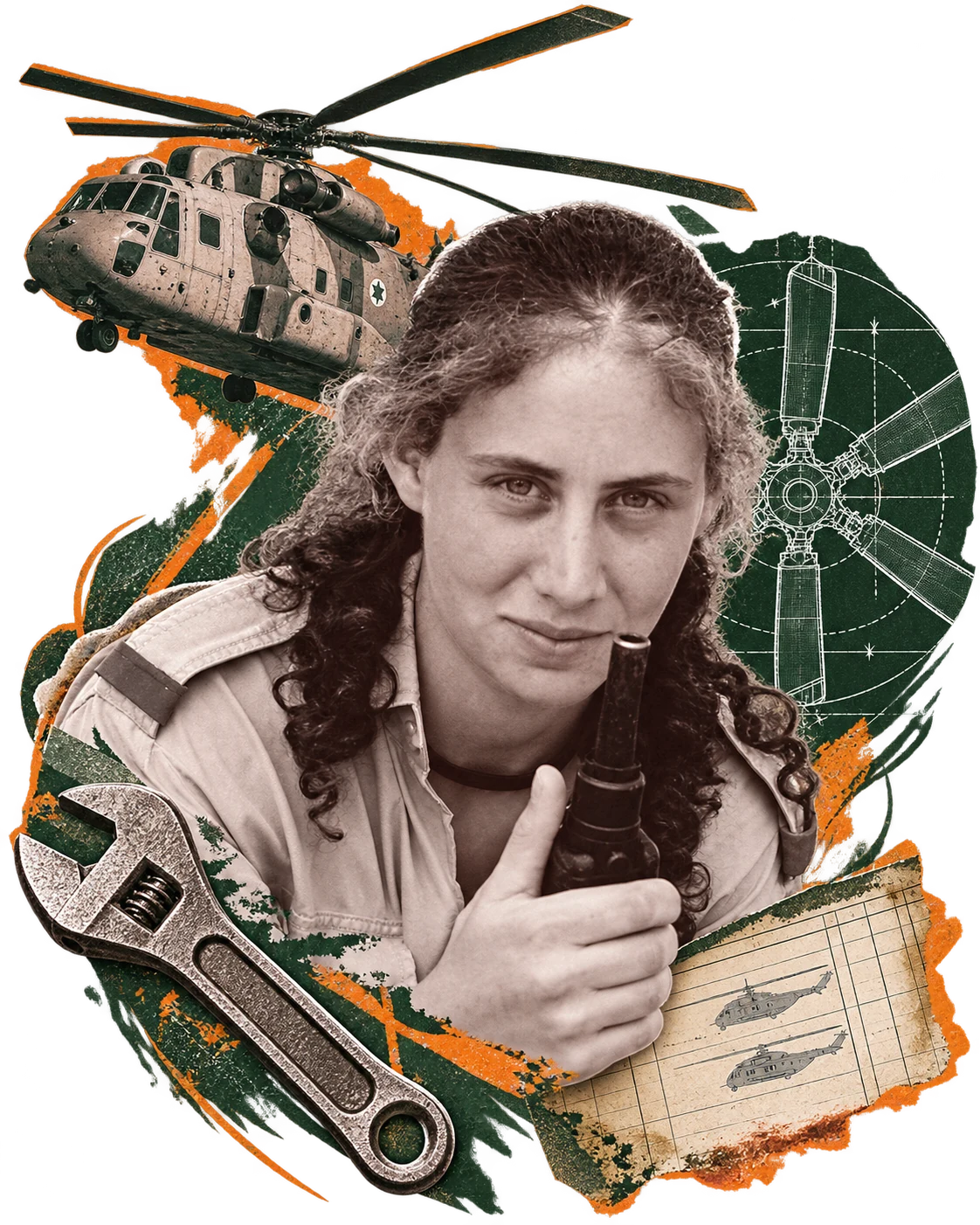
On August 12, 2006, at around 2:30 in the morning, representatives of the IDF's City Officer arrived at the Tendler family home in Rehovot. They brought terrible news. Their daughter Keren was missing on Lebanese soil. Keren was the only female airborne mechanic in the Air Force's Yasur squadron.
Keren Tendler The morning of July 12, 2006, in Brigade 5 looked like just another grueling day on the northern border. Preparations for a patrol along the security fence were routine. The soldiers climbed into two Hummers, started them up, and set off. At 9:05 a.m., Hezbollah began shelling northern communities. The barrage was a diversion for another operation the organization had planned. At that very moment, the Hummer patrol reached the area of Zar'it, where a Hezbollah squad attacked them with anti-tank missiles. Three soldiers were killed in one vehicle. The squad reached the second vehicle, captured two reserve soldiers, Sergeant First Class Ehud Goldwasser and Staff Sergeant Eldad Regev, and withdrew back into Lebanon. This marked the start of the Second Lebanon War. On July 16, 2006, four days after the abduction, Israel went to war.
Family, Studies and the Road to War
Keren Tendler was born in Rehovot in September 1979, the eldest daughter of Riwana and Dan Tendler, who had immigrated to Israel from Romania just three years earlier. Keren stood out among the girls. She had a strong technical aptitude, and in tenth grade she was accepted into the CAD/CAM (computer-aided design and manufacturing) program at ORT Rehovot College. She was one of three girls in a class of 40 boys.
Keren also proved talented as a fashion illustrator, a medal-winning competitive swimmer, and an enthusiast of artistic photography. Her mother, Riwana, said of her: "She was always full of energy, always busy. She started swimming at five and a half. Her father taught her to ice-skate. She was a very active child who barely slept. She wanted to devour life. To swim, run, and spend time with friends. As she got a little older, she was surrounded by boys. She wanted to do things. She had the ability, and she felt she could make the most of it."
The aim of the war was to subdue or destroy Hezbollah. "There are moments in a nation's life when it must look reality squarely in the eye and say: Enough! This is a moment of national truth, and I say: Enough! Israel will not be held hostage. We will win!" Prime Minister Ehud Olmert said in the Knesset on the fifth day of the war. As the days passed, it became clear that there was a wide gap between the objectives and what was being achieved, and public disappointment was deep and bitter.
The situation on the enemy's side was not much different. "We did not think, not even by one percent, that the abduction operation would lead to a war on this scale... Had we known that the abduction operation would lead to this result, we would never have undertaken it," said Hezbollah leader Hassan Nasrallah. After the war, Lebanese government officials called for Hezbollah to be disarmed, and the organization was accused of being a "state within a state" and serving foreign Iranian and Syrian interests.
The Road to the Air Force
In early July 1997, after completing her matriculation exams, Keren began basic training, then returned to complete her studies in grades 13 and 14. Shosh Levy, a teacher at ORT Rehovot, recalled Keren: "She was a very beautiful young woman, blonde, with striking eyes. She was special even then... She stood out for her exceptional skill with her hands, which also made her one of the top students in the program. From there, she went on to military service... She was exactly what her name means: a ray of light in the class. Always full of life and joy."
After finishing her studies, Keren returned to the army and was assigned to the Air Force. She was sent to the Technical School in Haifa to study aircraft mechanics, and at the end of the course was posted to the Yasur helicopter squadron at Tel Nof Air Force Base. She was overjoyed. In 2000, she was selected for a firefighting mission in Greece, where she received media coverage in the Greek press and was even interviewed by Army Radio. Even then, she was already pursuing her next challenge and was accepted to the airborne mechanics course, the profession she had dreamed of. To qualify for the course, she had to complete the men's basic training, Rifleman 7, similar to that for pilot training. She passed it successfully, and in January 2001, when she began her career service, she was sent to the course, becoming the first and only woman in the airborne mechanics course. Keren graduated with higher marks than the men, and at the end of the course she received a parachuting course as a reward.
She also achieved the highest marks in the squadron where she completed her qualification. She was assigned to the Yasur squadron, "The Night Movers," and it became the love of her life. Keren was the only female airborne mechanic ever to serve in the Yasur squadron. The squadron's heavy transport and rescue helicopters can carry 38 combat soldiers with their equipment, and their rear ramps allow two jeep-sized vehicles to be loaded. Keren took part in many operations in Israel and abroad, some of which remain classified.
Her mother, Riwana, told of one operation Keren took part in: "They landed in Bucharest. As soon as she landed, she picked up a phone and called to let me know she was safe and sound. I felt so proud, because we were born in Bucharest. We left there, and she returned in uniform, as a representative of the IDF and the people of Israel... It's very hard to describe the feeling: my daughter, a representative of the IDF, arriving in the very city where I was born."
In early 2005, after four years of career service, Keren left the regular army and began studying law. She was still called up for reserve duty, however, and devoted many days to the squadron.
The Last Flight over Lebanon
In 2006, when the Second Lebanon War broke out, Keren asked to take part in the squadron's sorties, which involved considerable risk. Keren belonged to a generation of women soldiers who had access to most combat roles, but going into battle was something else, as Second Lieutenant Keren Kaufman said a year before the war broke out: "I try to imagine a situation in which a female soldier is killed in an operational activity... What would happen if a female soldier were captured by Hezbollah? I think that on that day they would close every military role open to women." Perhaps her commander had heard her words, which led him to oppose including Keren on flights in Lebanon. But Keren was not the kind of woman to accept such a refusal. She insisted on her right to fight like everyone else, and took her demand all the way to the squadron commander. In the end, he agreed to take her along on the operational flight in Lebanon, which set out on August 11, 2006.
The government and the IDF wanted to end the war differently and achieve a decisive outcome, so a change of course was needed. On August 12, 2006, after the UN had already adopted Resolution 1701 calling for a ceasefire, the decision was made to launch Operation Change of Direction 11, described as "the largest helicopter-borne landing operation since the Yom Kippur War." It was supposed to be the final stage of the war. The aim was to reach the Litani River and clear southern Lebanon of Hezbollah fighters. Approval for the operation came on August 11, 2006, at 6:00 p.m. It began with the airlift of paratroopers deep into Lebanon and along the Litani River. One Yasur helicopter had just dropped off its troops and taken off again. About 30 seconds after takeoff, a Hezbollah missile struck the helicopter, and Keren was killed. Her crewmates also fell: Major Sami Ben-Naim, Major Nisan Shalev, Captain Daniel Gomez, and Sergeant Major Ron Mashiach. The bodies of the other crew members were found that same night, but Keren's body was not. The helicopter's downing led Brigadier General Eyal Eisenberg, who commanded the operation, and Northern Command chief Major General Udi Adam to decide to halt it. The fighting continued until the ceasefire came into effect.
"Air Force Commander Shkedi sat here with us and said that they wouldn't come back without Keren," her mother, Riwana, said. "He said, 'I'll send my best soldiers there.'"
Two weeks before she fell, Keren wrote in her diary: "My heart aches; our country has been fighting for two weeks already. The situation is just sad. God, I know I keep bothering you with my nonsense about love. Please grant this next request: look after our country, bring peace to our skies, look after all the soldiers, their health and safety, and let them all return home safely - including those who have been taken hostage, those fighting on the ground, and those in the air. Bless our entire land."
Operation Veshavu Banim ('And the Children Shall Return'), to find Keren's body and bring it to Israel, set out the following day. Fighters from the Shaldag Unit and Unit 669 were sent on the mission. The search team was under immense pressure to find her body. Reaching Keren before Hezbollah did was strategically important. The timetable added further pressure: the fighters entered the area on Sunday evening, and the ceasefire was due to take effect on Monday morning. After that, it would no longer be possible to leave soldiers in Lebanese territory. Both sides used the final hours to establish facts on the ground, and the closer the ceasefire deadline came, the more intense the fire became.
The tension and pressure were immense. The fighters landed near the crash site and joined the paratrooper battalion that had been dropped there the previous day. One of the fighters recounted: "We had great difficulty finding the body, mainly because of the darkness. Before first light, we moved into concealed positions and stayed there for several hours. At first, we weren't given permission to go out and search again in daylight because of the threat in the area. Only after a few hours did they realize the threat was relatively low and let us go out. After about an hour of searching, we found Keren's body. We recovered her body, returned to our concealed positions, and waited until dark. We were supposed to return to Israeli territory by helicopter, but they weren't authorized to enter Lebanese territory, so we had to walk back. We joined the Paratroopers Brigade, which was also evacuating the area that morning after the ceasefire, and began walking toward Israel."
Hundreds of paratroopers at the head of the column, with Shaldag and Unit 669 fighters bringing up the rear, carried Keren's body on a stretcher and walked toward Israeli territory for many hours. Captain Yiftach, who took part in the operation, said: "I have never encountered a mission like that since. It was a great privilege to take part in it. Keren is not with us today, but I saw how the army uses its strength for moral purposes, too. The principle 'We don't abandon the wounded in the field' was put into practice, and did not remain just words on paper."
Uri Levy of Ruhama described the funeral procession: "A thousand paratroopers, all combat soldiers, accompanied Keren on her final journey. A thousand paratroopers brought Keren home to her parents. It was a heroic funeral procession, and no one could hide the lump in their throat or the tears in their eyes... A thousand exhausted, weary paratroopers stood and saluted Keren."
Keren was 27 when she died. The words engraved on her grave read: "Our Keren, smiling, ambitious, loving toward others, a fighter. Forever in our hearts."

תגובות
עדיין אין תגובות.