
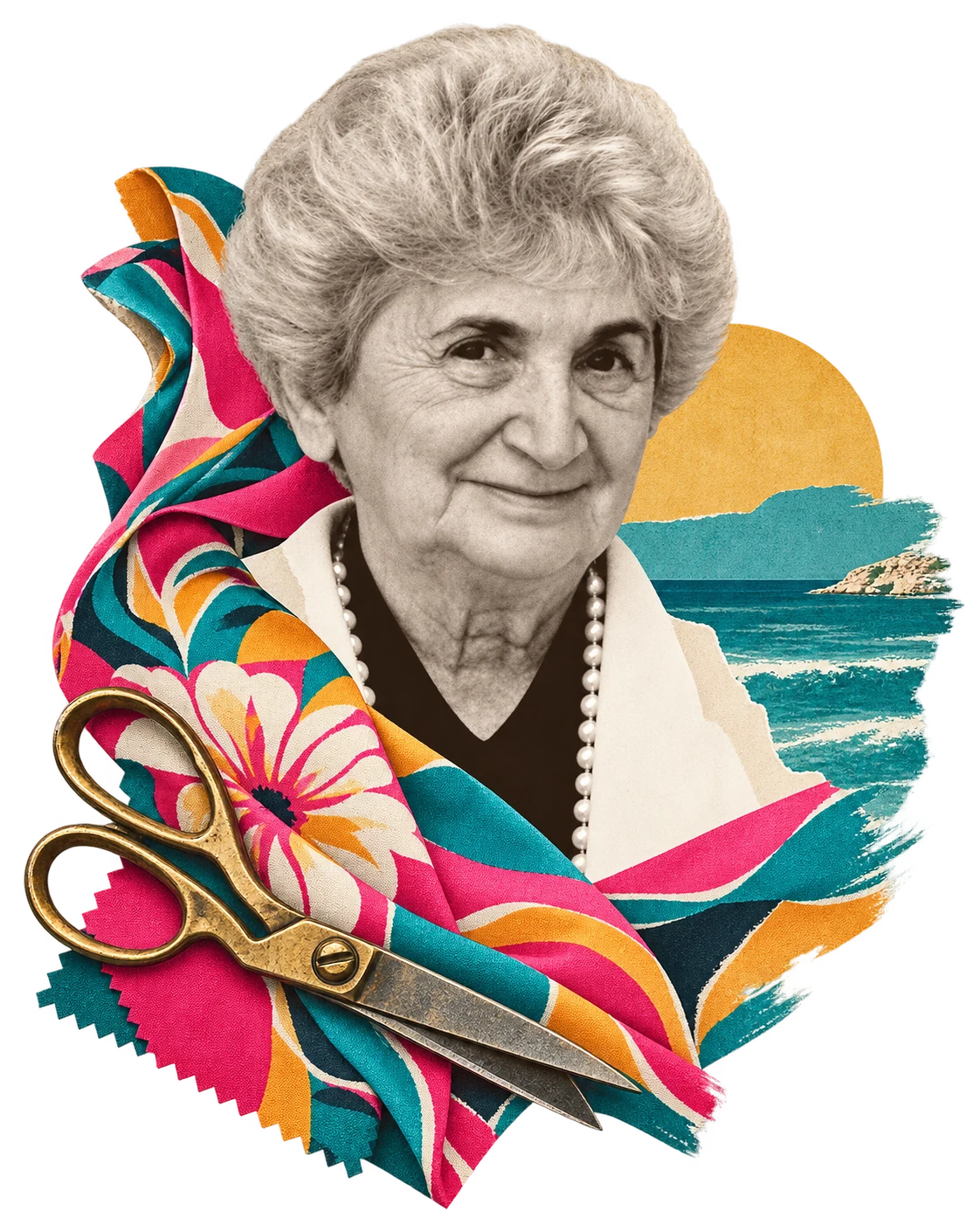
She was one of the most prolific creators in her field anywhere in the world. A traditionally observant woman, she built a vast swimwear industry that became the international brand Gottex.
The Journey That Led to Gottex
She knew that if she were caught, she might meet the same fate as the other Jews who had been captured: they were shot by the Nazis and thrown into the Danube. She knew that one glance at her face would be enough to tell that she was Jewish. "I was dark-haired," she explained. That day, she stood on the platform at the train station, on her way to the capital, Budapest. In one hand she held her daughter Yehudit, and in the other, the baby Miriam and a huge bouquet of chrysanthemums that hid her face. She survived the journey alone. The Nazis had taken her husband, Armin, for forced labor. Two weeks earlier, she had placed Yehudit with a Christian family to save her, but she broke down and took her back. Now they were on the train...
From that train journey on, the scent of chrysanthemums was associated with rescue. Years later, German supermodel Claudia Schiffer wore a swimsuit patterned with chrysanthemums. Within days, every one of the styles had sold out at the American department store chain Bloomingdale's. This time, everyone knew her name and face, and knew that she was Jewish and from Israel. Her creations became the international brand Gottex, identified with her: Lea Gottlieb.
Lea Gottlieb had never studied design, textiles, or anything related to fashion, but she had talent, creativity, and an instinct for fashion and elegance. She projected authority and tremendous charisma, and everyone addressed her as "Mrs. Gottlieb" or, for short, "Mrs. G." What seemed to others an unusual choice at the time turned out to be a success. Lea was a trailblazer in more than just swimwear. The model Tammy Ben Ami, of blessed memory, also did not represent the beauty ideal of the time: she was dark-skinned and tall, with broad shoulders. Lea was taken with Tammy and made her the face of Gottex.
Her husband Armin and her two daughters worked alongside her in the enterprise that was her life's work. Yehudit was the designer, Armin was the financial manager, and Miriam, the younger daughter, ran the New York branch. Americans fell in love with the colorful collections, and there was no fashion house in the world that did not know the brand. Every self-respecting department store carried Gottex styles. The company succeeded on the playing field of the giants: France and Italy. Gottex created a new fashion and lifestyle. For the first time, women could buy a matching set of swimsuit and kaftan, and even accessories.
To her critics, who claimed that working in swimwear was completely at odds with her values as a traditionally observant woman, she would reply: "I don't like women who are too exposed. In my opinion, the swimsuits I design aren't too sexy. I like to wrap a woman in a cover-up dress, a kaftan, or a jacket."
Anyone entering the factory could see who called the shots. Lea, a petite woman, would walk in with quiet confidence, sit in an armchair, and eat exotic fruits accompanied by papaya juice. Around her, like a busy hive, models came and went, seamstresses made alterations, and a personal assistant kept her updated on the day's schedule. Every so often she would utter a remark in Hungarian, the only language she spoke fluently. Communication with her took place in a mixture of broken Hebrew, English, French, Italian, and Hungarian. On the fourth floor was a showroom for the major buyers, who came and showed Mrs. Gottlieb great respect. Anyone who entered the showroom felt they were in Paris or Milan, the fashion capitals of the time. In the 1980s, the company's annual turnover was about $40 million. Its collections were sold in 63 countries, and buyers from Saks Fifth Avenue, Bloomingdale's, and Harrods would visit Israel every year to order swimsuits for the following season.
Founding Gottex and the Breakthrough
Lea Gottlieb was born in Sajószentpéter, Hungary, the only child of a religious Jewish family. She grew up with her grandmother and later moved into her aunt's home. Despite the difficult conditions, she was a diligent student and a quick learner. At a young age, she began supporting herself by tutoring. As an adult, she worked as a bookkeeper at a raincoat factory, where she met Armin, the son of the factory owners. They married, and their love lasted their whole lives. "He is my best friend. Thanks to his constant encouragement and the harmony in our married life, I got to where I am," she said at the height of her success.
When World War II broke out, Armin was taken for forced labor, and Lea, left with their daughters, began fleeing from place to place. From time to time, she visited Armin at the labor camp. After Armin was released, the couple began moving between hiding places across Europe. At the end of the war, they debated where to settle, and in 1949, with only eight dollars in their pockets, they arrived in Israel and were housed in a transit camp in Be'er Ya'akov. "We managed well and were very happy," Lea said. From Be'er Ya'akov, they moved to an abandoned apartment in Jaffa, which filled with Holocaust survivors like themselves. Armin, who had a keen business sense, began going from customer to customer and taking orders for coats. At the same time, he organized women who sewed and brought their sewing machines with them. Lea designed the coats, and he arranged their production. The business began to grow, and after a year the family moved to northern Tel Aviv, where workers' housing was being built. After saving money for five years, Lea and Armin decided to take a risk and design a swimwear collection. Years later, she said in her heavy Hungarian accent that she had noticed that in Israel, "winter has only four months, and summer eight months." Success came quickly. Women loved the colorful swimsuits, and they flew off the shelves. The business moved from their small home in northern Tel Aviv to Hagdud HaIvri Street. In 1956, they founded a successful swimwear factory. At first, it was named after her husband, A. Gottlieb, but later they rebranded under the name Gottex, a combination of "Got" from Gottlieb and "tex" from textile.
From the very beginning, Lea Gottlieb set her sights high, especially on the overseas market. By the time she had finished designing her first five styles, she was already showing alongside the major fashion houses. At the Matlon store on Herzl Street in Tel Aviv, a long line of women stretched outside, and the stock sold out within a few days. Lea was the first to make swimsuits from Lycra in a range of fluorescent colors, with a wet-look finish that caught the eye. That was exactly what customers loved. The fabrics were bought in Italy, from the same places used by leading designers such as Yves Saint Laurent and Dior.
Each collection included about 500 pieces and took about nine months to produce. Producing Gottex's lavish catalogs cost a fortune. When Lea Gottlieb was asked whether the topless trend, which had begun at the time, would hurt her business, she replied: "Those aren't our customers. Our customers are more elegant." She always used the best the industry had to offer: the finest fabrics, the best designers, and the world's leading models. They included Brooke Shields, Claudia Schiffer, Tyra Banks, Stephanie Seymour, Naomi Campbell, Elle Macpherson, Tammy Ben Ami, of blessed memory, Galit Gutman, and Sapir Kaufman, of blessed memory.
Gottex could boast customers from both the local and international elite, including Sophia Loren, Barbara Walters, Kim Novak, Princess Noor, Elizabeth Taylor, Nadine de Rothschild, Jihan Sadat, Queen Elizabeth II, Hillary Clinton, and Nancy Kissinger. A few weeks before her death, Princess Diana met Lea at the luxury department store Harrods and bought ten pieces from one of the collections. There is a famous photograph of her wearing a leopard-print Gottex swimsuit. Lea arranged a private fashion show for Nancy Kissinger at the King David Hotel in Jerusalem and even made her a special swimsuit. She refused to deposit the check Henry Kissinger gave her and preferred to have it framed.
The collections were usually designed around themes, such as a tropical collection, and some were created for historical occasions. For the peace treaty with Egypt, for example, Lea designed swimsuits inspired by the wall paintings in ancient Egyptian temples, in turquoise colors and prints featuring gold chains that echoed the necklaces worn by ancient Egyptian women in the wall paintings.
Lea Gottlieb also designed the swimsuits featured in the popular series The Love Boat. In an interview with People magazine, she described how she discovered the extent of her success while watching the show by chance: "That's when I realized that everyone on board was wearing styles I had designed."
Her creations won many awards. In 1972, she won first prize at the International Swimwear and Beachwear Fair in Cannes, where she competed against 186 fashion houses from around the world. When asked about the high point of her career, she gave a clear answer: "1992. That was Jerusalem." That year saw the most colorful collection Gottex had ever produced. It was first presented at a fashion show in Düsseldorf, Germany. At the finale, twenty models walked out in white swimsuits printed with gold ornaments, as the song "Jerusalem of Gold" played in the background. The audience rose to its feet and applauded enthusiastically. At that moment, tears began to stream from Lea's eyes. The Israeli Holocaust survivor had presented her creations, featuring Jewish motifs, on German soil and received applause from a German audience.
The Golden Age and the Fall
It was Gottex's golden age, but then the ground began to shake...
Lea Gottlieb lived a life of luxury. She had two penthouse apartments joined into one large apartment on Uri Street, not far from Rabin Square, then known as Kings of Israel Square, and an apartment in Milan. She flew on Concorde jets and stayed in the world's finest hotels. She was always elegantly dressed, wearing a pearl necklace and a Chanel jacket. A combination of reckless spending, expensive inventory, inflated costs, the end of subsidies, and, above all, the shift away from expensive swimsuits as cheap ones from China began to flood the market, brought Gottex to the brink of bankruptcy. Her life's work was at risk of receivership, with debts to the banks approaching $30 million. Lea began making cuts. The Milan offices closed, the collections were reduced, and employees were laid off. The layoffs were the most painful step she ever took. She had to part with people who had been with her from the beginning. In 1995, her husband Armin died, and that summer Tammy Ben Ami, the face of Gottex, also died. The small consolation she found during that period came when she was chosen to light a torch at the opening ceremony of the 1996 Independence Day celebrations.
In 1997, Gottex was sold to Lev Leviev's Africa Israel company. "It is hard for me to part with the workplace I founded, to which I gave my talents and the fruits of my labor for more than a generation," she wrote in her resignation letter to Africa Israel in 2001.
Two years later, her eldest daughter, Yehudit Gottfried, died of cancer at the age of 59. Yehudit had worked as a swimwear designer and had also designed Smash, a swimwear line for young women. It was a great success in Israel and around the world, and was an independent brand, although some saw it as a competitor to Gottex.
The Return to Design
It took Lea four years to recover from the loss of her life's work. Just when it seemed she would disappear into the pages of history, she celebrated her 87th birthday and rolled up her sleeves once again. At home, she began designing and cutting new patterns, this time under a brand bearing her own name: Lea.
"A few days before she died, Yehudit told me I had to go back to work, and it was like a last will and testament to me," she explained, speaking about her return to the field. She competed against the company she had founded and proved that she had the talent and strength to do it all again. This time, too, she attended international trade shows, and at her first shows in Spain she was already receiving substantial orders.
Lea Gottlieb died in 2012 at the age of 94. About a year after her death, an exhibition in her memory, titled The Lady with the Chrysanthemums - A Tribute to Lea Gottlieb, was presented at the Design Museum Holon. At its center was the pinnacle of her creativity, the collection closest to her heart, kept in her private wardrobe in the bedroom: Jerusalem of Gold (1992).



תגובות
עדיין אין תגובות.