
A story of survival in inhuman conditions in the hell of Poland's ghettos, and of the bravery of a convicted criminal who became a Righteous Among the Nations.
Lviv Until the Establishment of the Ghetto
In the 19th century, Lviv in Poland was a Jewish cultural center. It had all the hallmarks of a typical Jewish town: a ritual slaughterer, six synagogues, ritual baths, sports clubs, and even a famous Yiddish theater. On the eve of World War II, Lviv was Poland's third-largest city, after Warsaw and Lodz, and home to around 100,000 Jews, most of them merchants, industrialists, and craftsmen. Most of the city's Jews were educated, and spoke Polish or German. In September 1939, the Soviet Red Army occupied the city, and thousands of refugees poured in, bringing the Jewish population to around 230,000. The Jews' situation worsened with the arrival of the Soviets. Private ownership of property and businesses was abolished, and most industry was nationalized. Jewish community institutions were shut down. In early July 1940, the Soviets began deporting thousands of Jews from Lviv to the Soviet Union, suspecting them of disloyalty to the regime. A year later, in June 1941, the Germans invaded Poland. As the Soviet forces retreated, some of Lviv's Jews fled east, leaving around 160,000 Jews in the city. In November 1941, a ghetto was established in two poor neighborhoods far from the city center, and all the city's Jews were forced to move there. By the end of that year, around 110,000 Jews remained in the ghetto. The Janowska labor camp was established nearby. It later became a concentration camp, from which trains departed for the extermination camps. In time, it too became an extermination camp.
In May 1943, the Nazis set the ghetto ablaze, and only 8,000 Jews survived. A group of Jewish policemen administered the ghetto on the Germans' behalf. "They're killing the Jewish police! This is the end!" came a cry from the ghetto. Entire blocks went up in flames. Jews ran in every direction, fleeing the fire that engulfed them while also trying to escape German bullets. The Nazis' German shepherds had been trained to tear their victims to pieces, and their barking chilled the blood. Children were gathered up and tossed like sacks of potatoes into the trucks waiting for them. Mothers watched helplessly as their children wept bitterly, and some women could not bear the pain and threw themselves from the windows.
Six-year-old Kristina Chirovsky watched the horrifying scenes in terror. A small group of Jews had prepared for precisely this moment. Yaakov Barshitsky understood that the fate of Lviv's Jews was already sealed. Some time earlier, using a spoon and a fork, he had begun digging through his concrete floor toward the city's sewer system. The passage was dug from Mr. Weiss's apartment, the one closest to the drainage shaft. The small group was led by Jerzy Chirovsky, Kristina's father.
It wasn't long before three Polish sanitation workers discovered them. The tension was immense, because the Poles had every reason to hand the terrified group of Jews over to the Germans. The penalty for helping Jews was clear and absolute: death. Turning in Jews earned informers money and food, both of which were scarce among the Poles as well. The three men's supervisor, a Pole named Leopold Socha, climbed into the passage that had been discovered. He saw Paulina, Kristina's mother, and her two children. Kristina held her mother's hand with one hand, while her brother Pavel held her other hand. The sight of the frightened children stirred his compassion, and he smiled and told them, "I won't turn you in."
The Hiding Place in the Sewers
Leopold Socha was the chief inspector of Lviv's entire sewer system. Built by the Italians, the sewers formed a vast labyrinth beneath the city, but he knew exactly where he could hide the Jews and where to lead the German inspectors so they would not find them. For Kristina, Pavel, and the others like them, escaping and living in the sewers was a nightmare. They had to crawl through pipes just 40 centimeters in diameter, in a dark, cold, stinking world crawling with rats. Kristina could not see where she was going, and worse, she could not make a sound. No cries of panic, no weeping, no wailing. The rush of water where the sewer emptied into the river was deafening, and a single moment's inattention could sweep anyone into the river. That was the fate of Kuba, Kristina's beloved uncle.
Six-year-old Kristina had been born into a prosperous merchant family. She was a spoiled child with loving parents. In the dead of night, on the day the Germans arrived in Lviv, everything she had was taken from her: her grandparents, cousins, friends, and even the magnificent dollhouse her grandmother had brought her from Vienna. Among the "sewer dwellers" were Mondik Margolis and his beloved Klara, whom he had met in the ghetto. Mondik had escaped deportation lists several times. He persuaded Klara to come with him, and she left her sister Mania behind.
At first, Leopold Socha demanded money for protecting the twenty-one Jews, and Kristina's parents provided most of it. In return, Socha made sure to bring them food and newspapers every day, took their clothes to be cleaned, brought them potatoes for Passover, and on some Fridays brought candles for them to light.
Some of those in hiding died from the extreme conditions, while others, driven mad, left. Halina Weinberg was in her ninth month of pregnancy when she went into hiding, and gave birth in the sewers. On one occasion, her attempts to silence her baby's cries, which put everyone in danger, led to the baby's death. Her elderly grandmother died later as well. Removing the bodies and burying them was a complicated and dangerous task for Leopold Socha and his assistant Wroblewski. For days, the "sewer dwellers" struggled to hold on to their humanity and preserve some semblance of the routines they had once known. Rabbi Yaakov Barshitsky did so by making a point of putting on tefillin every morning and finding a relatively clean place to pray.
Socha grew very fond of the children, who gave him the nickname "Cabbage Head." He tried to lift their spirits and played with them. Sometimes he carried Kristina on his shoulders to a spot where light entered the sewer system, so she could enjoy a little light and a few rays of sunshine.
From time to time, Mondik Margolis climbed from the hell below to the hell above to bring food or a chair from the ghetto and make life in the sewers a little more bearable. Of the concentration camps, Janowska, on the outskirts of Lviv, was one of the worst. The Nazis at the camp used to push people into water tanks and watch them freeze to death. Every morning, ropes were prepared in the main square, and the Jews were "invited to volunteer" for hanging. Sadly, there was no shortage of volunteers. One day, Mondik sneaked into the ghetto to save Mania, the sister of his beloved Klara. After searching for an entire day, he found her, but she told him she could not bear to live in the sewers. She sent a letter to Klara with him, asking her not to blame herself and expressing the hope that she would survive. Mondik met other Jews and urged them to leave, but they were weak and frightened and did not heed his pleas. He returned to the sewers alone.
The Struggle for Survival
The camp earned the name "Death Tango" because music played in the background during torture, forced labor, and executions. The orchestra was made up of camp prisoners who were famous musicians. When the Russians began approaching the camp, the Nazis formed the forty musicians into a circle and ordered them to play. Each time the order was given, one of the musicians stepped into the center of the circle, placed his instrument on the ground, stripped completely, and was then shot in the head.
After several months, Jerzy Chirovsky, Kristina's father, ran out of money. He told Socha about the situation, but Socha again explained that the two Poles helping him hide the Jews would not agree to risk their lives without compensation. Socha wished Chirovsky and the other Jews good luck and said goodbye. The Jews returned to the sewers, this time without any help, knowing that from then on they were living on borrowed time.
The next morning, they heard footsteps approaching the sewer entrance. When the cover was removed, Socha's head appeared. He felt responsible for the people and saw no choice but to use his own money to bribe the two Poles who worked with him. He asked Jerzy Chirovsky to keep the source of the money secret and say that he had found some more money, which had been given to Wroblewski and Kowalo, Socha's associates.
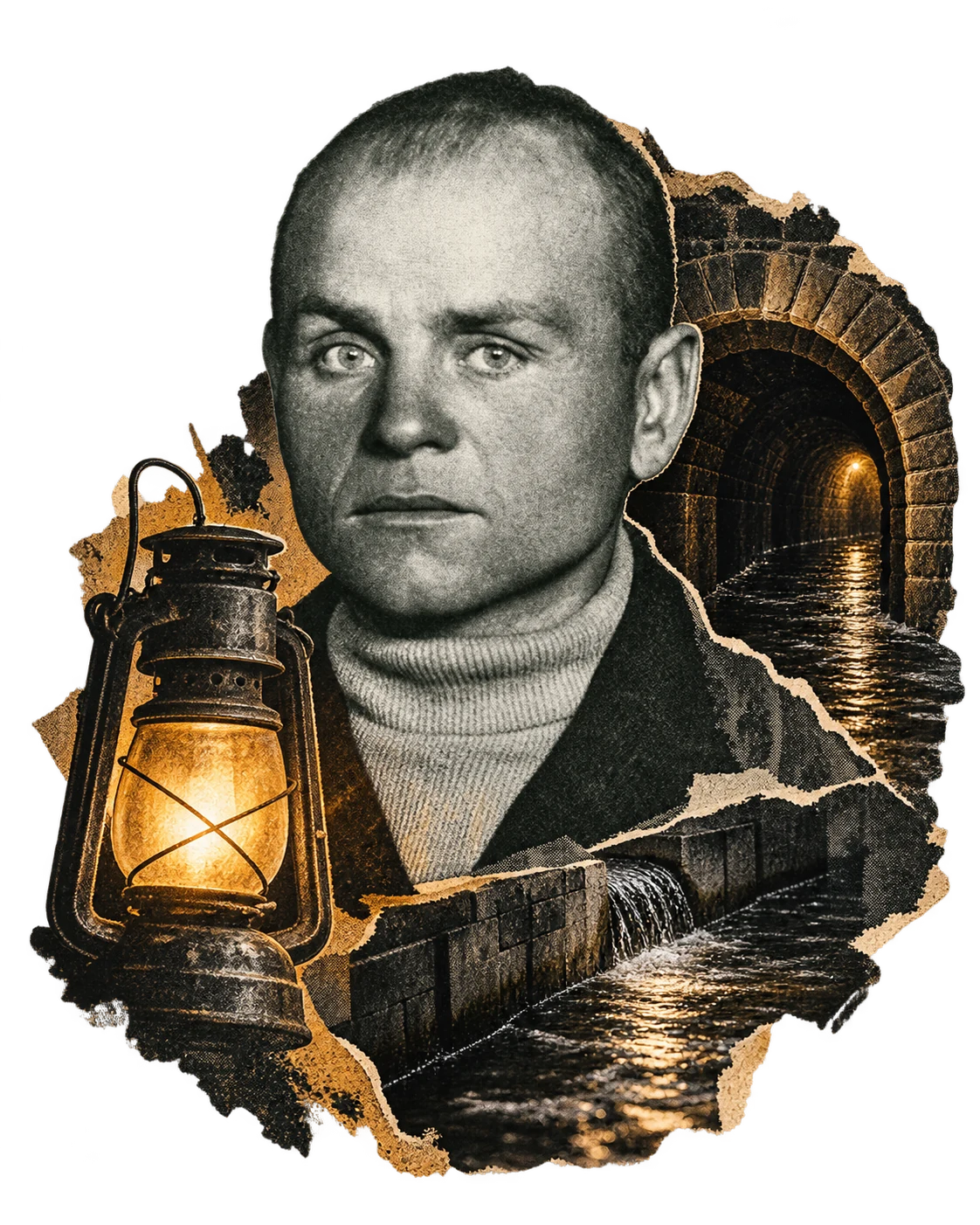
Once, as Leopold Socha sat in the sewer with his Jewish friends, he told them what motivated him to save them. Socha had been born in one of Lviv's poor neighborhoods and, like many of his friends, had drifted into crime and spent several years in prison. When he saw the wretched Jews and realized that he could save them, he saw an opportunity, as a Catholic Christian, to save his own soul. This was his way of proving to himself that under different circumstances he could have been a different man, a good man, and that by saving them he could atone for his dark past and earn God's compassion.
In the ghetto's final days, the Nazis decided to mine the ghetto and capture the Jews hiding in the sewers. They opened the sewer covers and shouted down that the war was over, but Socha had already moved the unfortunate Jews to another hiding place. The team that arrived to lay the mines encountered Socha and Kowalo dressed in the official uniforms of sewer workers. Socha and Kowalo lied to the Nazis, telling them that gas pipes lay underground where they were digging to plant the mines, and that a single mine could blow up the entire street and kill them as well. This lie stopped the mining and the street's destruction, and saved quite a few Jews.
The small group of "sewer dwellers" also survived the spring thaw and the heavy rains of 1944. Water began filling their hiding places. When it reached their necks, Kristina screamed to Rabbi Yaakov Barshitsky, "Pray, Yaakov! Pray to God to save us!" Yaakov prayed, and the water receded. Sixty years later, she said, "It was a miracle."
In July 1944, fourteen months after they had entered the sewers, Leopold Socha lifted the sewer cover and told the Jews they were free. Little Kristina asked, "Are we allowed to cry?"
Of the twenty-one Jews in the group, only ten survived. Ragged, gaunt, and filthy, they climbed out of the sewer one by one as astonished Poles gathered around them. "Jews really lived in the sewers!" After months in the dark, their eyes were blinded by the sunlight. Everything looked red, "washed in the color of blood." Leopold Socha led them to a nearby building and put them in dark rooms until their eyes gradually adjusted to the light. By the end of the war, only 823 Jews who had managed to survive remained in the ghetto.
Life After Liberation
Jerzy and Paulina Chirovsky and their children, Kristina and Pavel, moved to Krakow. Kristina studied dentistry, and Pavel studied dental technology. Kristina later moved to the United States, where she raised a family and worked as a dentist. "Yes, I remember clearly. An experience like that stays with you for your whole life. You live with it," she answered when asked how vivid her childhood memories were. "Even today, when most of the people I remember are no longer alive, I feel that what happened many years ago actually happened only yesterday."
In time, Kristina recounted her story and the group's in her book The Girl in the Green Sweater. The book was the basis for the 2011 film In Darkness. That same year, the film was nominated for an Academy Award for Best Foreign Language Film.
Her brother Pavel was five years old when the ghetto was liberated. In 1957, he immigrated to Israel, married Yolanda, and they had two children, Yaron and Anat. The family lived in Kiryat Motzkin, and Pavel worked as a dental technician. In 1960, Pavel was drafted into the army and assigned to the Medical Corps. He took part in the Six-Day War and the Yom Kippur War. In April 1978, during reserve duty, a military truck carrying medical equipment rolled downhill and struck Pavel as he walked nearby. He was critically injured and died a short time later. He was 39. Pavel Chirovsky was laid to rest in the cemetery at Tzur Shalom.
Jerzy Chirovsky, the father of Kristina and Pavel, died in 1975. Rabbi Yaakov Barshitsky moved to Paris and started a family there. Halina Weinberg emigrated to the United States and married George Preston, a survivor of the Auschwitz-Birkenau and Buchenwald camps. Mondik and Klara married shortly after the war. They moved to London and established a successful kosher catering business. Mondik would dance at every celebration they catered.
In 1946, as Socha and his daughter were riding bicycles, a Soviet truck rolled toward them. Leopold pushed his daughter onto the nearby sidewalk and saved her life, but was crushed to death beneath the truck's wheels. He was 37. The Jews he had saved during the war came to his funeral to pay their last respects to the man who had risked his life to save them.
On May 23, 1978, Yad Vashem recognized Leopold Socha and his wife, Magdalena, as Righteous Among the Nations. In 1981, Socha's assistant, Stefan Wroblewski, and his wife also received the title.
תגובות
עדיין אין תגובות.